Ready, steady… save!
You don’t need a chart to join in. Here are 2 ways to record your savings:
1. Cross it off
Pop a chart into your first post. Saved an amount? Cross it out! Read more »
£0.01 £0.02 £0.03
2. Write it down
Skip the chart and add updates to your first post. Read more »
“Another +£3 saved today. Go me!”
Use +£ before each new saving so it counts towards your total.
📨 Have you signed up to the Forum's new Email Digest yet? Get a selection of trending threads sent straight to your inbox daily, weekly or monthly!
Cloud Cuckoo Land
Comments
-
Interesting. Note that in reference to the Minimum, Moderate and Comfortable, they are referencing last years numbers. I expect there is a shift to the left based on this years definitions.GenX0212 said:Some interesting statistics here (apologies if already posted): https://www.gov.uk/government/statistics/analysis-of-future-pension-incomes/analysis-of-future-pension-incomes
Here is a particularly telling summary: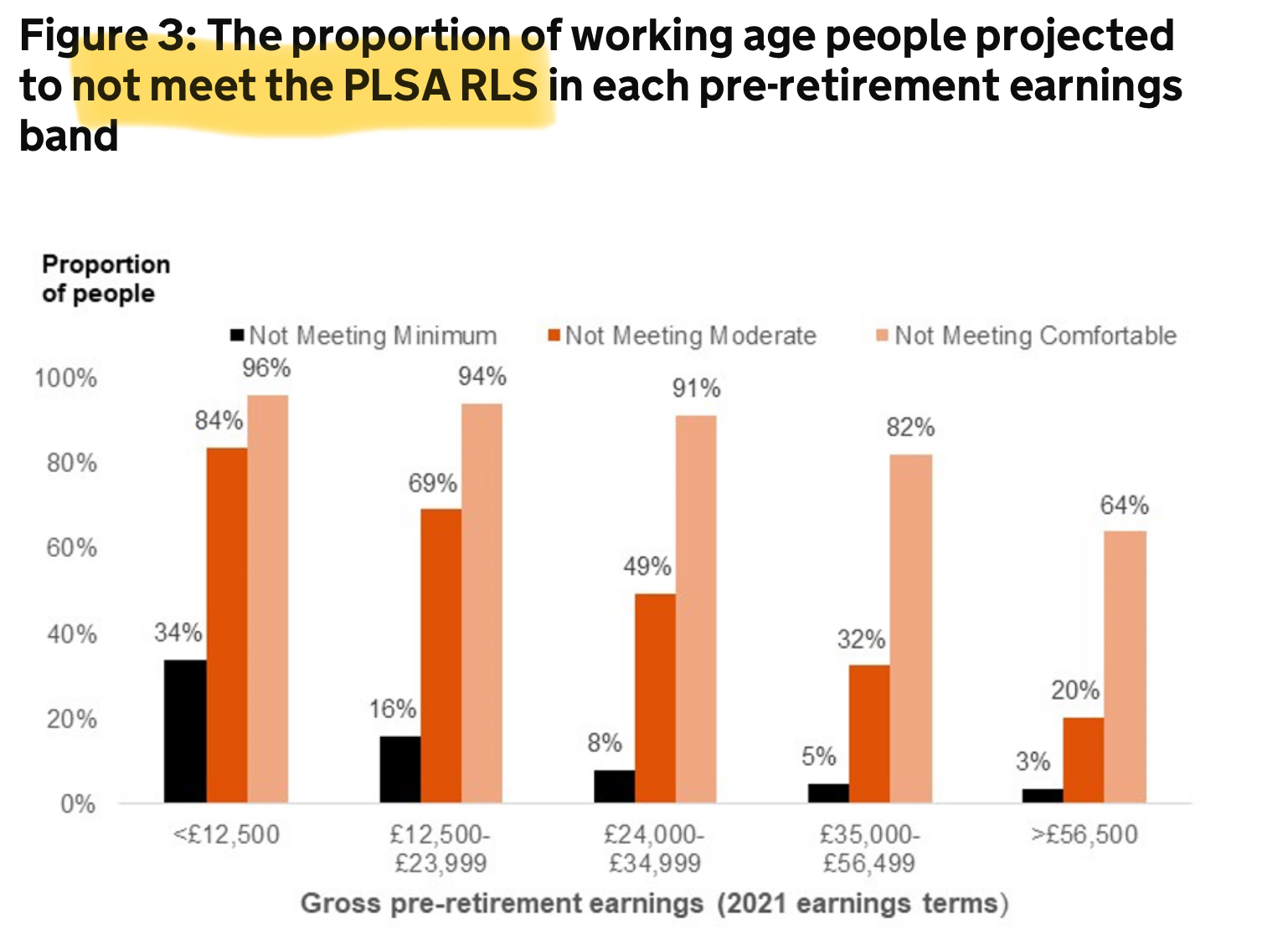 20% of high earners (>£56500) are not expected to achieve a moderate living standard. 64% are not expected to achieve comfortable. Therefore only 36% are.
For average earners (£24000 - £34999) 49% are not expected to achieve moderate1 -
Although most contributors to this thread would say last years figures were more realistic, so maybe the above graph remains a more accurate picture.Phossy said:
Interesting. Note that in reference to the Minimum, Moderate and Comfortable, they are referencing last years numbers. I expect there is a shift to the left based on this years definitions.GenX0212 said:Some interesting statistics here (apologies if already posted): https://www.gov.uk/government/statistics/analysis-of-future-pension-incomes/analysis-of-future-pension-incomes
Here is a particularly telling summary:20% of high earners (>£56500) are not expected to achieve a moderate living standard. 64% are not expected to achieve comfortable. Therefore only 36% are.
For average earners (£24000 - £34999) 49% are not expected to achieve moderate0 -
Not sure if this is for households or individuals but it seems to suggest that a fair number of people will have more income in retirement than they had whilst employed?GenX0212 said:Some interesting statistics here (apologies if already posted): https://www.gov.uk/government/statistics/analysis-of-future-pension-incomes/analysis-of-future-pension-incomes
Here is a particularly telling summary:20% of high earners (>£56500) are not expected to achieve a moderate living standard. 64% are not expected to achieve comfortable. Therefore only 36% are.
For average earners (£24000 - £34999) 49% are not expected to achieve moderateI think....0 -
Just published by the ONS 'Economic insights latest on Household Cost Indices' ...
https://www.ons.gov.uk/economy/inflationandpriceindices/bulletins/householdcostsindicesforukhouseholdgroups/october2023todecember2023.
My take away is that the percentages for household costs inflation for different income deciles and categories are a lot closer than I would have expected.0 -
Slightly ironic that the retired have the joint-lowest percentage for Dec 2023 (and generally lower for the past year), but benefit from the average rise via the pension triple-lock.dealyboy said:Just published by the ONS 'Economic insights latest on Household Cost Indices' ...
https://www.ons.gov.uk/economy/inflationandpriceindices/bulletins/householdcostsindicesforukhouseholdgroups/october2023todecember2023.
My take away is that the percentages for household costs inflation for different income deciles and categories are a lot closer than I would have expected.
(I know retired does not necessarily mean receiving state pension)1 -
I guess the main takeaway is how much lower retired household inflation is (4%) compared to the 20%+ increases that the survey found were needed for each lifestyle category - Cloud cuckoo land indeed.MeteredOut said:
Slightly ironic that the retired have the joint-lowest percentage for Dec 2023 (and generally lower for the past year), but benefit from the average rise via the pension triple-lock.dealyboy said:Just published by the ONS 'Economic insights latest on Household Cost Indices' ...
https://www.ons.gov.uk/economy/inflationandpriceindices/bulletins/householdcostsindicesforukhouseholdgroups/october2023todecember2023.
My take away is that the percentages for household costs inflation for different income deciles and categories are a lot closer than I would have expected.
(I know retired does not necessarily mean receiving state pension)I think....4 -
Would you say that the headlined fiqures that got a lot of airspace at the time hindered the economy by discouraging spending in sectors that have had a hard time recently.michaels said:
I guess the main takeaway is how much lower retired household inflation is (4%) compared to the 20%+ increases that the survey found were needed for each lifestyle category - Cloud cuckoo land indeed.MeteredOut said:
Slightly ironic that the retired have the joint-lowest percentage for Dec 2023 (and generally lower for the past year), but benefit from the average rise via the pension triple-lock.dealyboy said:Just published by the ONS 'Economic insights latest on Household Cost Indices' ...
https://www.ons.gov.uk/economy/inflationandpriceindices/bulletins/householdcostsindicesforukhouseholdgroups/october2023todecember2023.
My take away is that the percentages for household costs inflation for different income deciles and categories are a lot closer than I would have expected.
(I know retired does not necessarily mean receiving state pension)Play with the expectation of winning not the fear of failure. S.Clarke0













Confirm your email address to Create Threads and Reply

Categories
- All Categories
- 355.9K Banking & Borrowing
- 255K Reduce Debt & Boost Income
- 456.2K Spending & Discounts
- 248.4K Work, Benefits & Business
- 606.1K Mortgages, Homes & Bills
- 179.1K Life & Family
- 263.9K Travel & Transport
- 1.5M Hobbies & Leisure
- 16.2K Discuss & Feedback
- 37.7K Read-Only Boards