We’d like to remind Forumites to please avoid political debate on the Forum.
This is to keep it a safe and useful space for MoneySaving discussions. Threads that are – or become – political in nature may be removed in line with the Forum’s rules. Thank you for your understanding.
📨 Have you signed up to the Forum's new Email Digest yet? Get a selection of trending threads sent straight to your inbox daily, weekly or monthly!
The Forum now has a brand new text editor, adding a bunch of handy features to use when creating posts. Read more in our how-to guide
Abolish standing charges
Comments
-
Generally these kind of people want "someone else" to pay, they do not care who, as long as it is not them.Hoenir said:
Consumers are in the main also the country's taxpayers. Who else is there left to pick up the bill?snowqueen555 said:
From what I can see, the bailouts were consumer funded, a google on the subject shows this is clearly the case.4 -
Taxpayers have to fund things, unfortunately most people are not net taxpayers and that is why there is not enough money. 55% of households receive more in cash benefits than they pay in tax, only 15% of people make a net contribution in any one year, the lifetime figure is somewhere around 3%, that means 97% of the population take out rather than pay in, on a net basis. Taxpayers also theoretically elect the government, although that system is far from perfect.snowqueen555 said:MikeJXE said:
It is much like any other market, politicians and big business cause the problems and it is always the taxpayer that gets the bill or suffers.
So where is the money they were paid by their customers ?Netexporter said:Ofgem pays the money into the new SoLR accounts and then gets it back, over time, through the SC.
The failed suppliers haven't got any money, that's why they are in administration.
Gone to the share holders ?
Why do we all have to pay for that ?
There are loads of suppliers gone bust so Why hasn't that been stopped ? Or has it ?
The banks were not bailed out in the way many people think that they were. They were not handed large sums of money for nothing, they were either given short term loans to help with liquidity or the government guaranteed their debt on a short term basis to allow them to continue to borrow on the markets. The exceptions were Lloyd's and HBOS, which we as tax payers should hopefully make a slight profit on when finally all unwound. Also the banking sector was secured for the safety of the public, if a banking system collapses so does society, and that is not good for taxpayers.snowqueen555 said:The bailed out banks,
The housing market has not been bailed out, nearly every intervention by the government over the last four decades has made it worse.
Public services have declined and are continuing to decline because they are not adequately funded. They are not adequately funded because there is not enough tax revenue to fund them properly. There is not enough tax revenue to fund them because taxes are too low. 55% of households receive more in cash benefits than they pay in tax, the bottom two thirds of earners pay the lowest effective rate of income taxation in the EU (the top third pay the fifth highest), VAT in the UK is lower in application because most other counties charge it on food. The UK is a low tax nation, so we get low quality public services.snowqueen555 said:
the decline of our public services.
The "social contract" is still functioning, the problem is the public changed the deal. They wanted low taxes, most want "someone else" to pay for everything. If you want things to improve then everyone will need to pay more tax, significantly more tax, that everyone include you. Are you willing to pay more tax?snowqueen555 said:The social contract of this country failed a few decades ago.5 -
Rather than abolish standing charges, why not just make energy free for anyone who wants it? That way the whole argument about who pays goes away entirely.....0
-
[Deleted User] said:Rather than abolish standing charges, why not just make energy free for anyone who wants it? That way the whole argument about who pays goes away entirely.....
What about my Solar Panels and batteries I paid to have installed...............
0 -
powerful_Rogue said:[Deleted User] said:Rather than abolish standing charges, why not just make energy free for anyone who wants it? That way the whole argument about who pays goes away entirely.....
What about my Solar Panels and batteries I paid to have installed...............
Winners and losers in all scenarios : 0
: 0 -
[Deleted User] said:Rather than abolish standing charges, why not just make energy free for anyone who wants it? That way the whole argument about who pays goes away entirely.....
Why stop there free food and booze and petrol and diesel. Is this straight from Kier?0 -
You have that wrong. Putting the cost covered by the standing charge onto units would be regressive.Baldeagle095 said:Gas and electric standing charges are regressive. They penalise the poor at the expense of the profligate. Taxes aren't levied with a standard charge per household so why should energy charges? Increase usage charges to cover the shortfall but abolish standing charges.
Basically the poor are currently subsidising the rich. Abolish standing charges.
a) those that can afford to install self generation would have lower usage. Poorer people cannot do that.
b) those that have installed self generation have actually increased costs to the grid but you are now suggesting others subsidise them
c) A high proportion of poorer people are on economy 7 heating or electric heating installed by their landlord. You are suggesting added further costs to them.
d) richer people can afford to buy higher cost goods with lower energy use but poor people cannot. They tend to buy the budget goods with higher energy use.
Basically you are proposing that the poor subsidise the rich.
Higher users already pay more because of the price multiplied by unit count.
if you have five houses in a street all being supplied from the same electricity pole (ie. the same infrastructure) why should they all pay different amounts (excluding supply)?Taxes aren't levied with a standard charge per household so why should energy charges?Standing charge is not a tax.
You seem to be very selective in your taxes.
You appear to be another poster hoping to shove your cost onto other people. i.e. personal greed.
I am an Independent Financial Adviser (IFA). The comments I make are just my opinion and are for discussion purposes only. They are not financial advice and you should not treat them as such. If you feel an area discussed may be relevant to you, then please seek advice from an Independent Financial Adviser local to you.9 -
I'm not sure that's correct, that reads to imply the standing charge goes directly to the Ofgem "pot" mentioned.Netexporter said:Ofgem pays the money into the new SoLR accounts and then gets it back, over time, through the SC.
The failed suppliers haven't got any money, that's why they are in administration.
Reading the Ofgem Discussion Paper on the subject:
https://www.ofgem.gov.uk/sites/default/files/2023-11/Standing Charges - Call for Input.pdf
It says there is no Ofgem standing charge and suppliers are free to charge what they like (within the cap).
What appears to be the case is that the suppliers have costs imposed upon them as laid out in the chart below, including SoLR, and choose to factor that cost into supply bills by way of having a standing charge.
Most (all?) of the things the SC covers are fixed so when supplying a product consumed at a variable rate having a fixed element presumably balances the costs to customers.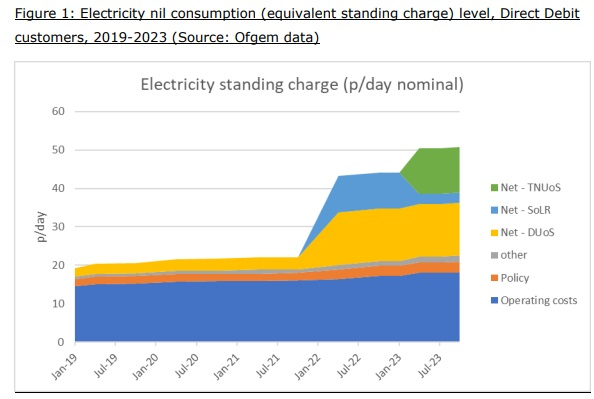
The discussion around standard charges is a difficult one, should we have a better government that doesn't waste so much money and instead spends it on vital infrastructure? Should National Grid generate 3 billion profit a year when such activity could be under public ownership? Even with the supply companies, are they needed? A single government supply company would cut out their (very small) profit element.
The problem if the government ran any of it is it would become bloated and inefficient, in private hands obviously the main drive is profit above anything else. Sadly something in the middle that is well run in the interest of the people with "profit" being invested back into the people doesn't seem to exist.
There really isn't an easy answer to this issue and just focusing on the SC would shift cost from here to there a bit with all customers together ultimately paying the same, looking at the bigger picture and, well, it's just depressing.In the game of chess you can never let your adversary see your pieces1 -
Not according to the post I quoted.PennineAcute said:powerful_Rogue said:[Deleted User] said:Rather than abolish standing charges, why not just make energy free for anyone who wants it? That way the whole argument about who pays goes away entirely.....
What about my Solar Panels and batteries I paid to have installed...............
Winners and losers in all scenarios:
0 -
Bang on. If benefits and/or the minimum wage aren't enough to live on then that should be addressed, rather than campaigning to subsidise random commodities.QrizB said:Baldeagle095 said:Abolish standing charges.Alternatively, leave standing charges alone.Increase benefits to adequately cover the cost of living.
4








Confirm your email address to Create Threads and Reply

Categories
- All Categories
- 353.6K Banking & Borrowing
- 254.2K Reduce Debt & Boost Income
- 455.1K Spending & Discounts
- 246.6K Work, Benefits & Business
- 603K Mortgages, Homes & Bills
- 178.1K Life & Family
- 260.6K Travel & Transport
- 1.5M Hobbies & Leisure
- 16K Discuss & Feedback
- 37.7K Read-Only Boards