We’d like to remind Forumites to please avoid political debate on the Forum.
This is to keep it a safe and useful space for MoneySaving discussions. Threads that are – or become – political in nature may be removed in line with the Forum’s rules. Thank you for your understanding.
📨 Have you signed up to the Forum's new Email Digest yet? Get a selection of trending threads sent straight to your inbox daily, weekly or monthly!
The Forum now has a brand new text editor, adding a bunch of handy features to use when creating posts. Read more in our how-to guide
Abolish standing charges
Comments
-
You are Neil Parish MP, and I claim my fiver ! 😈MultiFuelBurner said:They should be planning many more nuclear tractors imo but that's not a vote winner0 -
Former MP if we are being pedanticGerry1 said:
You are Neil Parish MP, and I claim my fiver ! 😈MultiFuelBurner said:They should be planning many more nuclear tractors imo but that's not a vote winner 0
0 -
Nothing wrong with Nuclear Tractors in Nahfolk land.Gerry1 said:
You are Neil Parish MP, and I claim my fiver ! 😈MultiFuelBurner said:They should be planning many more nuclear tractors imo but that's not a vote winner
0 -
The flaw is the government who make a pigs ear of everything that needs a plan of actionMultiFuelBurner said:
The flaw in your thinking is the light switch approach to calculation. 23 million won't instantly stop using gas it will be gradual and that's why there is loads of planning for pylons on and off shore connections going through now. They should be planning many more nuclear tractors imo but that's not a vote winner so will have to be after the election for whoever takes control.Qyburn said:
What's that going look like after 23 million houses have switched from gas to ASHP, and 30 million cars replaced with electric. I did a rough calculation suggesting the cars would add 18% to UK total consumption. ASHP? I don't know what they use annually but 6,000kWh each adds another 43%Scot_39 said:
Last year - according to gridiamkate - c55% of all electricity generated in UK was from non fossil fuels
Domestic gas hearing's carbon impact is not much different to mains electricity. A couple of years ago it was higher, now it maybe above or below depending on the generation mix. That's before adding the extra 60% that will mostly be gas fired.Scot_39 said:
Are you ready to apply the same to domestic gas - and it's 100% carbon emitting energy.
Its really not as simple as saying "use electricity for everything and don't worry about energy saving"
Think gradual until 2050.
ICE cars have already been put back, nuclear power stations is anybodies guess
If we all wanted to switch in the next 10 years it wouldn't be impossible
Even when all this achieved at huge cost it doesn't mean we have a clean bubble of air over our island1 -
Correct it wouldn't be impossible as you say as electric cars can charge overnight when demand is low and can also feed that power back into the grid when demand is high. (Perfect free battery storage and those with EV's paid for this benefit)MikeJXE said:
The flaw is the government who make a pigs ear of everything that needs a plan of actionMultiFuelBurner said:
The flaw in your thinking is the light switch approach to calculation. 23 million won't instantly stop using gas it will be gradual and that's why there is loads of planning for pylons on and off shore connections going through now. They should be planning many more nuclear tractors imo but that's not a vote winner so will have to be after the election for whoever takes control.Qyburn said:
What's that going look like after 23 million houses have switched from gas to ASHP, and 30 million cars replaced with electric. I did a rough calculation suggesting the cars would add 18% to UK total consumption. ASHP? I don't know what they use annually but 6,000kWh each adds another 43%Scot_39 said:
Last year - according to gridiamkate - c55% of all electricity generated in UK was from non fossil fuels
Domestic gas hearing's carbon impact is not much different to mains electricity. A couple of years ago it was higher, now it maybe above or below depending on the generation mix. That's before adding the extra 60% that will mostly be gas fired.Scot_39 said:
Are you ready to apply the same to domestic gas - and it's 100% carbon emitting energy.
Its really not as simple as saying "use electricity for everything and don't worry about energy saving"
Think gradual until 2050.
ICE cars have already been put back, nuclear power stations is anybodies guess
If we all wanted to switch in the next 10 years it wouldn't be impossible
Even when all this achieved at huge cost it doesn't mean we have a clean bubble of air over our island
Cleaner bubble would be a good statement. It's all small steps to being cleaner.
Let's see what the next Government does whoever they shall be.
Resistance will come but hopefully they will tax gas usage so it becomes the more expensive of energies. A pollution tax (the ulez of energy taxes)0 -
Gas (and diesel) tractors are exempt from ULEZ !MultiFuelBurner saidResistance will come but hopefully they will tax gas usage so it becomes the more expensive of energies. A pollution tax (the ulez of energy taxes)0 -
I can only get my tracker to go 55mph and that's by stripping it down to just a seat and engine.Gerry1 said:
Gas (and diesel) tractors are exempt from ULEZ !MultiFuelBurner saidResistance will come but hopefully they will tax gas usage so it becomes the more expensive of energies. A pollution tax (the ulez of energy taxes)0 -
That would be onerous and bureaucratic to administer, just apply the carbon tax direct to the product or service if you want a carbon tax.sevenhills said:matelodave said:This has become the same pointless discussion that goes round and round without any sort of resolution.
Those that understand, will accept that there really isn't a better system to proved 24/7 services to every household in the land.I agree, it's not practical to have zero standing charges.What should happen is that everyone has their own personal carbon allowance that is low or zero tax, with the more they use the more they pay.Just like with earnings, £1275 tax free, then after the tax free part you pay 20% tax and then a higher rate at a certain level.This would initially only work with low taxes on domestic gas and electricity, but other energy could be regulated and included.0 -
This Graph sums up the problem with standing charges neatly - they are no longer just the infrastructure costs as they used to be, they now include extra bits that are effectively other Surcharges from the Regulator/Government. Personally I think these should be shown separately on bills. That way people can see what they are and should see over time which elements are changing and if that's fair. For example SoLR seems to be dropping away as the market stabilises , be interesting to see what happens to the others when the problems they cover dissipate. Although I do suspect as one "problem" clears a new one will be found and added to the standing charge rather than making the supplier raise costs or the Government cover from general taxes.ArbitraryRandom said:Apologies if this has been addressed in the 10 previous pages (I did try to read through but admit I got a little bored...).
I tried to review the Ofgem consultation (as recommended on the first page) and wonder if someone can explain this graph?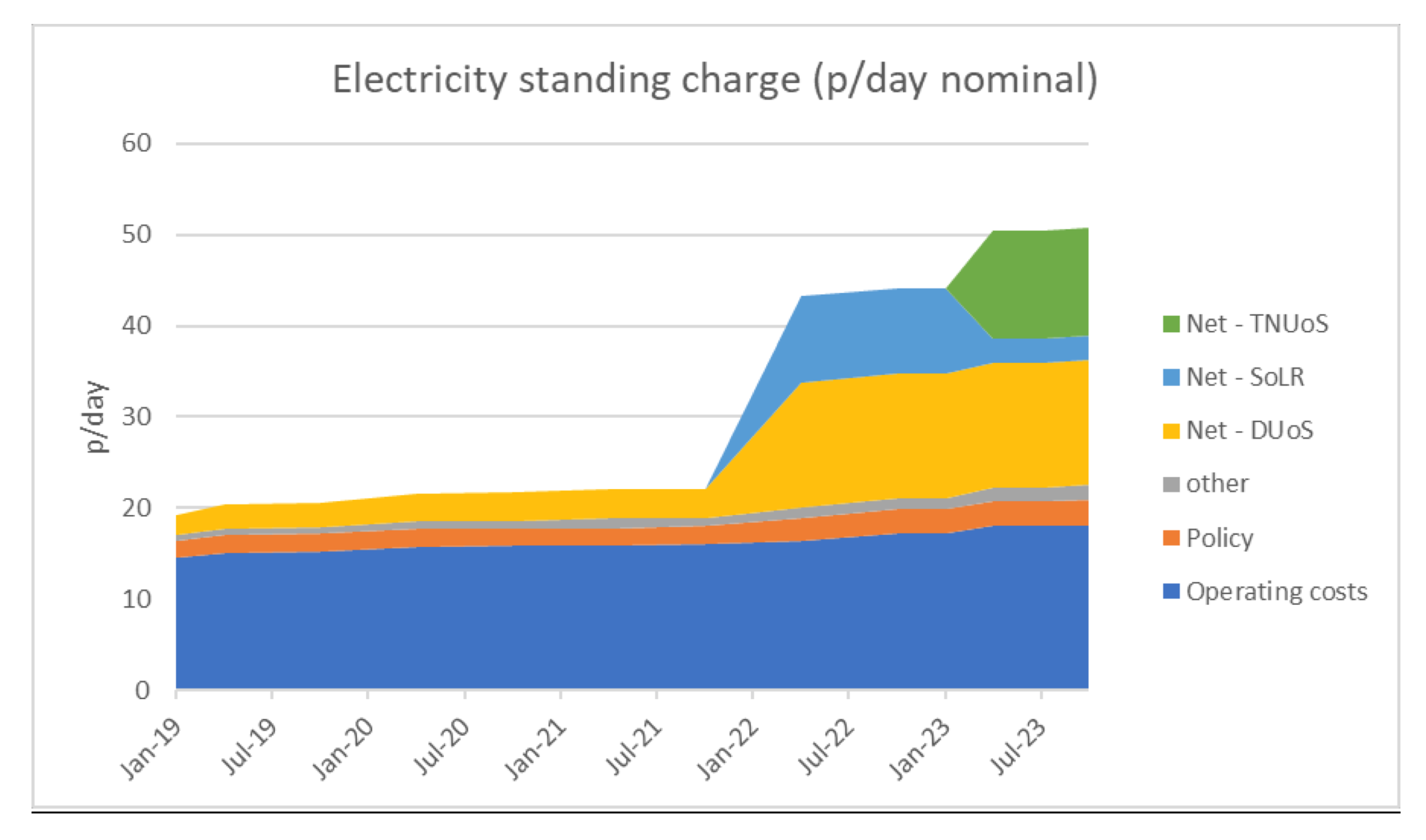
I understand the supplier of last resort costs increasing as a result of the many number of companies which crashed - but I'm not sure I understand why there was a corresponding increase in the TNUoS or DuoS?
If I'm understanding correctly, these costs have increased not because of 'world pressures', but because of UK political decisions re the future energy infrastructure? Therefore, if part of the standing charge were to be reduced or removed, the most sensible argument (to me) its that these should be paid for from (the already progressive) general taxation pot rather than the standing charge - thus allowing the charge to be halved?6 -
MattMattMattUK said:That would be onerous and bureaucratic to administer, just apply the carbon tax direct to the product or service if you want a carbon tax.As I see it, we need to tax carbon, because higher prices dissuade its use. As can be seen from taxing smoking.So how do we make sure the poor are not disadvantaged?As can be seen from council tax, taxing houses is more straightforward than taxing people. We would then need to bring in allowances for how many people per house, but not overcomplicate it.0








Confirm your email address to Create Threads and Reply

Categories
- All Categories
- 353.6K Banking & Borrowing
- 254.2K Reduce Debt & Boost Income
- 455.1K Spending & Discounts
- 246.7K Work, Benefits & Business
- 603.1K Mortgages, Homes & Bills
- 178.1K Life & Family
- 260.7K Travel & Transport
- 1.5M Hobbies & Leisure
- 16K Discuss & Feedback
- 37.7K Read-Only Boards