We’d like to remind Forumites to please avoid political debate on the Forum.
This is to keep it a safe and useful space for MoneySaving discussions. Threads that are – or become – political in nature may be removed in line with the Forum’s rules. Thank you for your understanding.
📨 Have you signed up to the Forum's new Email Digest yet? Get a selection of trending threads sent straight to your inbox daily, weekly or monthly!
The Forum now has a brand new text editor, adding a bunch of handy features to use when creating posts. Read more in our how-to guide
Economy 7 help
Comments
-
pensionpawn said:However I'm not going to change to single tariff as there are signs that the evening rate could actually fall on 1st Oct (to encourage off peak use / reduce the potential for power shortages) and I am waiting for a Powerwall which in addition to soaking up free energy from my panels will time shift E7 into the day through the period of greatest electrical import.If the night rate falls the day rate inevitably has to rise as all the tariffs will cost the same at a 58/42% split, so do keep an eye on how the break-even point moves for you, but with the Powerwall you should have no problems hitting a higher night rate target.Between solar and a Powerwall our day-rate use is typically under 100W a day.
0 -
Sorry, that doesn't make much sense.MWT said:Different suppliers will set their rates to either reward customer more for higher night rate use, but punish them more for lower night rate use or the other way around, so it is always worth looking at the individual numbers to figure out if one supplier is better than another for your particular mix of use, but it never requires 60% night use for it to be advantageous.
Suppliers can set their own day rates and off peak rates, may make one higher, or one lower, but a 58% spilt will always give 10% compared to the standard variable rate. How does that work??0 -
See the second part of my Ofgem cap explainer:sebtomato said:
Sorry, that doesn't make much sense.MWT said:Different suppliers will set their rates to either reward customer more for higher night rate use, but punish them more for lower night rate use or the other way around, so it is always worth looking at the individual numbers to figure out if one supplier is better than another for your particular mix of use, but it never requires 60% night use for it to be advantageous.
... How does that work??The capped E7 unit rate is often lower than the equivalent capped standard unit rate. For example, in the North West region the Ofgem caps are:- Standard rate electricity: 43.3p/day SC and 51.32p/kWh
- E7 electricity: 43.4p/day SC and 48.55p/kWh
The capped E7 rate is a weighted average made up of 58% of the day rate plus 42% of the night rate. Exactly how a supplier achieves that is up to them; they could have a narrow day/night spread or a wide one, but the weighted average can't be higher than the cap.The net result is that a consumer using 42% of their electricity on the night rate will achieve an average price that matches the E7 cap, which is lower than the standard-rate cap.N. Hampshire, he/him. Octopus Intelligent Go elec & Tracker gas / Vodafone BB / iD mobile. Kirk Hill Co-op member.Ofgem cap table, Ofgem cap explainer. Economy 7 cap explainer. Gas vs E7 vs peak elec heating costs, Best kettle!
2.72kWp PV facing SSW installed Jan 2012. 11 x 247w panels, 3.6kw inverter. 35 MWh generated, long-term average 2.6 Os.1 -
sebtomato said:
Sorry, that doesn't make much sense.MWT said:Different suppliers will set their rates to either reward customer more for higher night rate use, but punish them more for lower night rate use or the other way around, so it is always worth looking at the individual numbers to figure out if one supplier is better than another for your particular mix of use, but it never requires 60% night use for it to be advantageous.
Suppliers can set their own day rates and off peak rates, may make one higher, or one lower, but a 58% spilt will always give 10% compared to the standard variable rate. How does that work??The cap for the multi-rate tariff is different to the cap for the single-rate tariff.Single rate is calculated by Ofgem based on 3100kWh use. Mutli-rate is calculated based on 4200kWh split 58/42% day/night.The Mutli-rate tariff will be a little cheaper than the single-rate tariff for anyone who has their use split 58/42%, typically around 9-10%.The suppliers can set their own day/night rates as long as they are below the cap at 58/42% use.So the closer to that split your use is, the less it matters which supplier you are with, the further you are away the more important it becomes.For example, based on the numbers I've seen so far on the new rates being communicated to customers, if you use much more than 42% at night you will want to be with EDF rather than Octopus, but if you use a bit less than 42% then Octopus is a better choice for you. The further you are away from 42% in either direction the greater the importance becomes.Because even at 42% the Muti-rate tariff is a little cheaper than single-rate you can be below 42% and still find it is cheaper than going to single rate, but obviously at some point that changes and you'd be better advised to change to a single-rate tariff, that point will be lower for Octopus than EDF.3 -
MWT said:For example, based on the numbers I've seen so far on the new rates being communicated to customers, if you use much more than 42% at night you will want to be with EDF rather than Octopus, but if you use a bit less than 42% then Octopus is a better choice for you. The further you are away from 42% in either direction the greater the importance becomes.Because even at 42% the Muti-rate tariff is a little cheaper than single-rate you can be below 42% and still find it is cheaper than going to single rate, but obviously at some point that changes and you'd be better advised to change to a single-rate tariff, that point will be lower for Octopus than EDF.Using the South East as an example and calculating 58:42 weighted averages:
- Octopus: standing charge 41.127p/day, day rate 43.397p/kWh, night rate 16.686p/kWh - average 32.178p/kWh
- EDF: standing charge 42.77p/day, day rate 49.80p/kWh, night rate 7.85p/kWh - average 32.181p/kWh
Octopus's lower standing charge works out as £6 a year.The weighted average is close enough to make no practical difference if you use exactly 42% at night rate. If you use more than this, EDF will be cheaper; less, Octopus is cheaper.N. Hampshire, he/him. Octopus Intelligent Go elec & Tracker gas / Vodafone BB / iD mobile. Kirk Hill Co-op member.Ofgem cap table, Ofgem cap explainer. Economy 7 cap explainer. Gas vs E7 vs peak elec heating costs, Best kettle!
2.72kWp PV facing SSW installed Jan 2012. 11 x 247w panels, 3.6kw inverter. 35 MWh generated, long-term average 2.6 Os.1 - Octopus: standing charge 41.127p/day, day rate 43.397p/kWh, night rate 16.686p/kWh - average 32.178p/kWh
-
Yes, that matches my numbers, can't wait to get full details for all the regions though, as I think it is only EDF that has published them all so far...Using the EDF numbers though it would look like on EDF a customer using less than 35% at night should change to single-rate, where as customer on Octopus would be good down to around 30%.0
-
This is a pretty rubbish chart (sorry!) but it illustrates what's going on using those same South East regional numbers.Along the bottom you've got the % of electricity used on the night rate, from 0 to 100Up the left-hand side is the average price in pence per kWh.
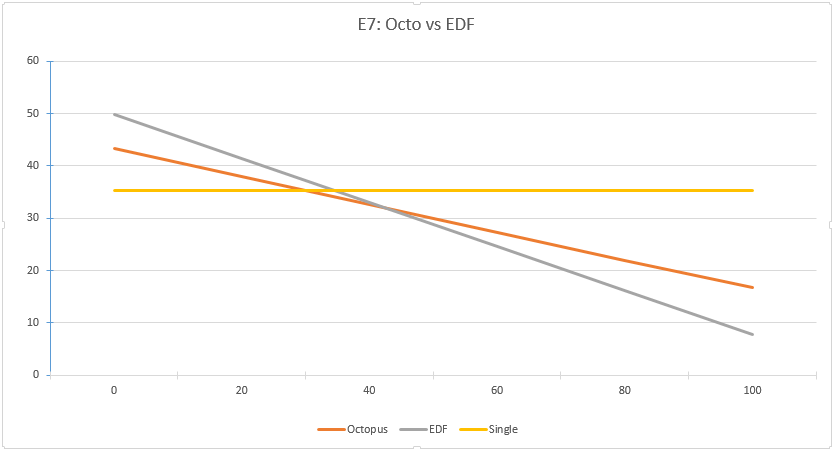 Octopus and EDF cross over around 42%, as expected.Octopus is more expensive than than single-rate until you get to around 30%.Despite falling faster, EDF's higher day rate means it only becomes cheaper than single-rate at around 35%.
N. Hampshire, he/him. Octopus Intelligent Go elec & Tracker gas / Vodafone BB / iD mobile. Kirk Hill Co-op member.Ofgem cap table, Ofgem cap explainer. Economy 7 cap explainer. Gas vs E7 vs peak elec heating costs, Best kettle!
2.72kWp PV facing SSW installed Jan 2012. 11 x 247w panels, 3.6kw inverter. 35 MWh generated, long-term average 2.6 Os.2 -
Agreed, we have the same conclusions.
0 -
Thanks, the graph is helpful too.Before April we were using about 8% night rate… currently have increased that to about 20% but when clocks change that means day rate kicks in at 7.30 not 8.30 am and living in a flat I’m not sure quite how early we can do washing without annoying neighbours.Really not sure how else to increase the cheap rate use, other than buying smart plugs and timers for all the phone charges etc.
we are currently paying £5 more than we would on a single rate but looking at edf October prices for south east, that might mean we would be paying £14 or so per month more than if we were on a single rate.Newlywed at the point I joined the forum... now newly separated1









Confirm your email address to Create Threads and Reply

Categories
- All Categories
- 354.8K Banking & Borrowing
- 254.5K Reduce Debt & Boost Income
- 455.6K Spending & Discounts
- 247.6K Work, Benefits & Business
- 604.5K Mortgages, Homes & Bills
- 178.6K Life & Family
- 262.1K Travel & Transport
- 1.5M Hobbies & Leisure
- 16.1K Discuss & Feedback
- 37.7K Read-Only Boards