We’d like to remind Forumites to please avoid political debate on the Forum.
This is to keep it a safe and useful space for MoneySaving discussions. Threads that are – or become – political in nature may be removed in line with the Forum’s rules. Thank you for your understanding.
📨 Have you signed up to the Forum's new Email Digest yet? Get a selection of trending threads sent straight to your inbox daily, weekly or monthly!
The Forum now has a brand new text editor, adding a bunch of handy features to use when creating posts. Read more in our how-to guide
Automatic gearbox and regular use of neutral
Comments
-
Please explain.ontheroad1970 said:
Yet idling is one of the most inefficient things you can do with an engine, no matter what your vehicle's in car computer tells you.Advocado said:
Of course, but considerably less fuel than having to keep the engine engaged to keep momentum.neilmcl said:
And therefore burning fuel.Advocado said:
No (I'd lose power steering etc?), just literally coast with the engine idling.itsmeagain said:
Van - yes - aerodynamics of a bus!Advocado said:
Interesting post - thanks for the info. It's a diesel van.itsmeagain said:
It should not cause any damage to your gearbox but will wear your brakes out quicker (should you need them), and arguably dangerously delay your emergency use of accelerator (if required).
I only put it into N when I know I won't need the brakes. So I coast for a while if there's a long downward gradient and then into D again once the speed has dropped lower than I want.
Good to know it's not damaging anything.
That makes sense - you will get an improvement, I don't believe the size of the improvement that you claim though, don't believe you wouldn't increase speed in N on steep hills (would agree on gentle to moderate), some models (such as 2.0 DSG Superb) do this automatically for you.
So are you going to go the whole hog, switch the ign off and back on again whilst coasting?
I am a class 1 advanced and ROSPA gold driver and have never had an accident whilst practicing this - seen loads though!
I don't see how keeping momentum by eliminating lost energy from friction of the gearbox and engine is inefficient.
Idling when stationary however is, of course, infinitely inefficient.0 -
DSG can be more interactive, in that you can choose manual mode and go up or down the gears using the stick in the middle or paddles on the steering column.Grumpy_chap said:Maybe I missed something, but the idea seems odd.
Either you buy a manual, in which case you need to keep fiddling with your stick while driving.
Or you buy an automatic, in which case you simply slide the stick to D and then forget about it until you park.
The OP reports have an automatic and fiddling with their stick.
Even though I've had two, I'm really not a fan and find it a pretty recalcitrant pile of poo.
You may ask why I went for a second one, I naively figured VW would have ironed out the problems since I had my last DSG car (2005).
Nope, same uncooperative pile of poo and it resulted in me getting rid of the Polo after only 9 months.
Some people love it though, so what the hey.
0 -
This thread reminds me of the time a friend of mine drove a Ford excavator ( think JCB ) back to Durham ,came to a long steep hill and in top gear would take some time to drive down ,so he knocked it out of gear and let it coast down the road , 5 mins later the excavator was going at about twice its designed speed ,the wet brakes in the back axle were almost non extinct ,the outcome was going to be the digger going off the road so he had a brainwave /panic moment ,reached behind and powered down the jack legs , did not do the road surface or the jack leg feet any good be he survived ( probably needed clean underpants ) BUT he never did it again ,lesson learnt NEVER knock a vehicle out of gear.1
-
No, allowing the engine to brake with foot off the accelerator uses no, or very little, fuel.Advocado said:
Of course, but considerably less fuel than having to keep the engine engaged to keep momentum.neilmcl said:
And therefore burning fuel.Advocado said:
No (I'd lose power steering etc?), just literally coast with the engine idling.itsmeagain said:
Van - yes - aerodynamics of a bus!Advocado said:
Interesting post - thanks for the info. It's a diesel van.itsmeagain said:
It should not cause any damage to your gearbox but will wear your brakes out quicker (should you need them), and arguably dangerously delay your emergency use of accelerator (if required).
I only put it into N when I know I won't need the brakes. So I coast for a while if there's a long downward gradient and then into D again once the speed has dropped lower than I want.
Good to know it's not damaging anything.
That makes sense - you will get an improvement, I don't believe the size of the improvement that you claim though, don't believe you wouldn't increase speed in N on steep hills (would agree on gentle to moderate), some models (such as 2.0 DSG Superb) do this automatically for you.
So are you going to go the whole hog, switch the ign off and back on again whilst coasting?
I am a class 1 advanced and ROSPA gold driver and have never had an accident whilst practicing this - seen loads though!0 -
Here's an easy to understand 'pre-selected' shift schedule map for a 4 speed auto.
Later control functions would more likely be a function of torque request, sometimes using modelled characteristic lines etc. They may also have offset/compensation maps for other noise factors to 'skew' the shift points for things like altitude, various temperatures etc, and In the case of VW, if it detects that it's performing an emissions test - just kidding (not)!
Note that with no throttle, a high gear is auto selected if you were to select N to D at any appreciable speed.
From 50-140Kph, if you open the throttle, the gear shifts down for a lower gear, increases engine speed and therefore more power.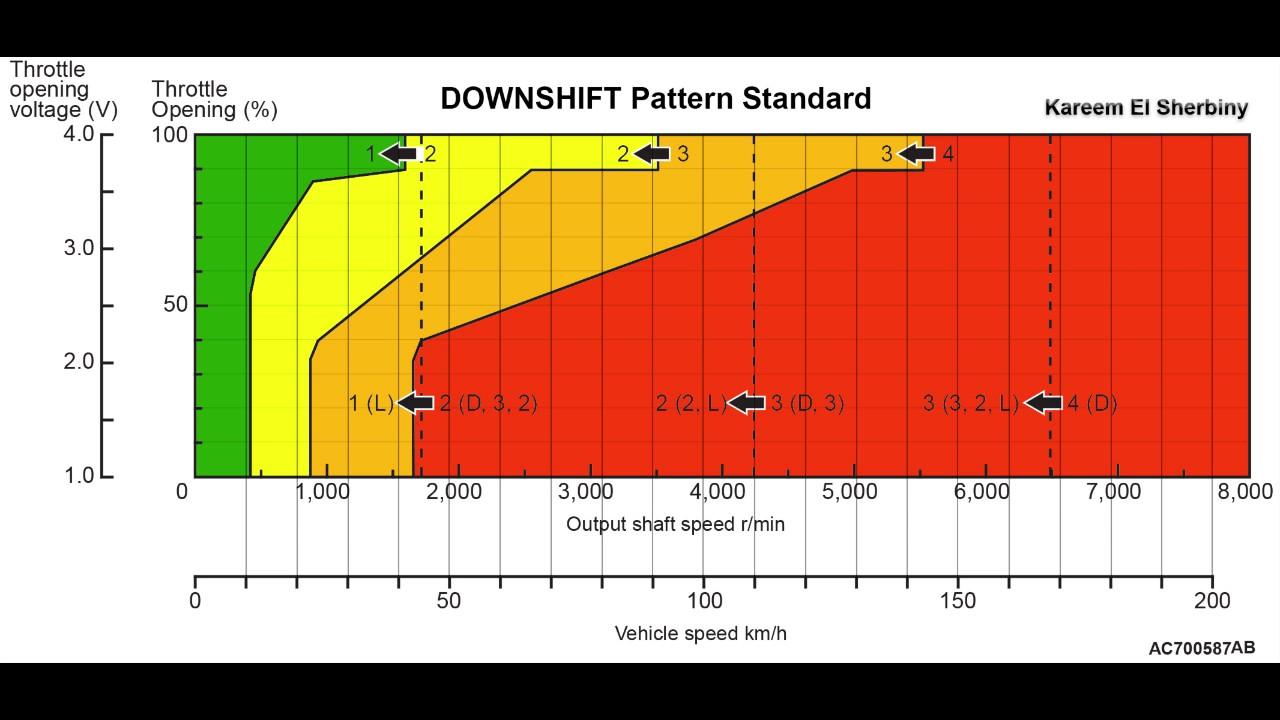
0 -
This is standard practice for some companies these days, and the engines will also 'stop on the move' soon.basill said:Does it have eco mode? My skoda DSG would automatically coast in this mode on a closed throttle, reengaging drive instantly if brakes or accelerator touched.
The OP is only doing manually, what is automated best practice.0 -
Yes - you are missing the manual override function of an Auto Gearbox.Grumpy_chap said:Maybe I missed something, but the idea seems odd.
Either you buy a manual, in which case you need to keep fiddling with your stick while driving.
Or you buy an automatic, in which case you simply slide the stick to D and then forget about it until you park.
The OP reports have an automatic and fiddling with their stick.
The principle that the OP describes (dropping into N) can be done on both auto & manual transmissions.0 -
Only when the car is stationary. The computer should say 0 mpg under this condition. Of course it's even more efficient to switch the engine off whilst coasting.ontheroad1970 said:
Yet idling is one of the most inefficient things you can do with an engine, no matter what your vehicle's in car computer tells you.Advocado said:
Of course, but considerably less fuel than having to keep the engine engaged to keep momentum.neilmcl said:
And therefore burning fuel.Advocado said:
No (I'd lose power steering etc?), just literally coast with the engine idling.itsmeagain said:
Van - yes - aerodynamics of a bus!Advocado said:
Interesting post - thanks for the info. It's a diesel van.itsmeagain said:
It should not cause any damage to your gearbox but will wear your brakes out quicker (should you need them), and arguably dangerously delay your emergency use of accelerator (if required).
I only put it into N when I know I won't need the brakes. So I coast for a while if there's a long downward gradient and then into D again once the speed has dropped lower than I want.
Good to know it's not damaging anything.
That makes sense - you will get an improvement, I don't believe the size of the improvement that you claim though, don't believe you wouldn't increase speed in N on steep hills (would agree on gentle to moderate), some models (such as 2.0 DSG Superb) do this automatically for you.
So are you going to go the whole hog, switch the ign off and back on again whilst coasting?
I am a class 1 advanced and ROSPA gold driver and have never had an accident whilst practicing this - seen loads though!0 -
But I don't want to allow engine braking. I don't want to slow down.neilmcl said:
No, allowing the engine to brake with foot off the accelerator uses no, or very little, fuel.Advocado said:
Of course, but considerably less fuel than having to keep the engine engaged to keep momentum.neilmcl said:
And therefore burning fuel.Advocado said:
No (I'd lose power steering etc?), just literally coast with the engine idling.itsmeagain said:
Van - yes - aerodynamics of a bus!Advocado said:
Interesting post - thanks for the info. It's a diesel van.itsmeagain said:
It should not cause any damage to your gearbox but will wear your brakes out quicker (should you need them), and arguably dangerously delay your emergency use of accelerator (if required).
I only put it into N when I know I won't need the brakes. So I coast for a while if there's a long downward gradient and then into D again once the speed has dropped lower than I want.
Good to know it's not damaging anything.
That makes sense - you will get an improvement, I don't believe the size of the improvement that you claim though, don't believe you wouldn't increase speed in N on steep hills (would agree on gentle to moderate), some models (such as 2.0 DSG Superb) do this automatically for you.
So are you going to go the whole hog, switch the ign off and back on again whilst coasting?
I am a class 1 advanced and ROSPA gold driver and have never had an accident whilst practicing this - seen loads though!
0 -
It's good to see somebody who seems to have some real knowledge rather than the usual 'expert' opinions seen here.itsmeagain said:Here's an easy to understand 'pre-selected' shift schedule map for a 4 speed auto.
Later control functions would more likely be a function of torque request, sometimes using modelled characteristic lines etc. They may also have offset/compensation maps for other noise factors to 'skew' the shift points for things like altitude, various temperatures etc, and In the case of VW, if it detects that it's performing an emissions test - just kidding (not)!
Note that with no throttle, a high gear is auto selected if you were to select N to D at any appreciable speed.
From 50-140Kph, if you open the throttle, the gear shifts down for a lower gear, increases engine speed and therefore more power. 2
2









Confirm your email address to Create Threads and Reply

Categories
- All Categories
- 354.3K Banking & Borrowing
- 254.4K Reduce Debt & Boost Income
- 455.3K Spending & Discounts
- 247.2K Work, Benefits & Business
- 603.9K Mortgages, Homes & Bills
- 178.4K Life & Family
- 261.4K Travel & Transport
- 1.5M Hobbies & Leisure
- 16.1K Discuss & Feedback
- 37.7K Read-Only Boards