We’d like to remind Forumites to please avoid political debate on the Forum.
This is to keep it a safe and useful space for MoneySaving discussions. Threads that are – or become – political in nature may be removed in line with the Forum’s rules. Thank you for your understanding.
Energy news in general
Comments
-
As I am sure you are aware gas generation bought by NESO to resolve an immediate system constraint is much higher than the price that would have been paid if that gas generation had been scheduled. NESO have no alternative but to accept the best price they can get from power plants that are ready and able to ramp up immediately. That is not the most efficient way to operate a gas plant and that inefficiency has to be paid for and the cost goes on our bills.
Edit: for the record the emergency gas generation purchased works out at £143/MWh. For comparison the average price paid for batteries discharging under the balancing mechanism is £105/MWh.
Northern Lincolnshire. 7.8 kWp system, (4.2 kWwest facing panels , 3.6 kWeast facing), Solis inverters installed 2018, 5kW SSE facing system (shaded in afternoon) added in 2025 with Tesla PW3 battery, Mitsubishi SRK35ZS-S and SRK20ZS-S Wall Mounted A2A Heat Pumps, ex Nissan Leaf owner.1 -
4
-
Yeah what we need while the uk is in yet another heat wave is more people pushing for burning fossil fuels
Get used to 4 simple facts
1 - that it is global warming
2 - UK per capita emissions officially at least (ignoring as they do flight emissions - so I presume others do too) are already less than the global average.
3- the world population is growing by roughly the same as the UK popn every year.
4 - wind and grid solar - is not the only way to generate without emissions.
0 -
Its not the first time we have come close to partial collapse in recent years - when wind failed.
Time the green lobby was removed from making decisions about our generation mix.
Let them concentrate on some of the far bigger emissions sources in UK - like domestic and office / shop gas heating emissions - or cutting flights (just the MTCO2e from UK fuel bunkers for commercial flights matches total from UK electricity generation)
We face £100s on essential electricity costs - whilst in WM they plan 2 new airport runways.
And cost and grid stability prioritized.
And it was left to grid engineers to properly balance demand and generation capacity.
0 -
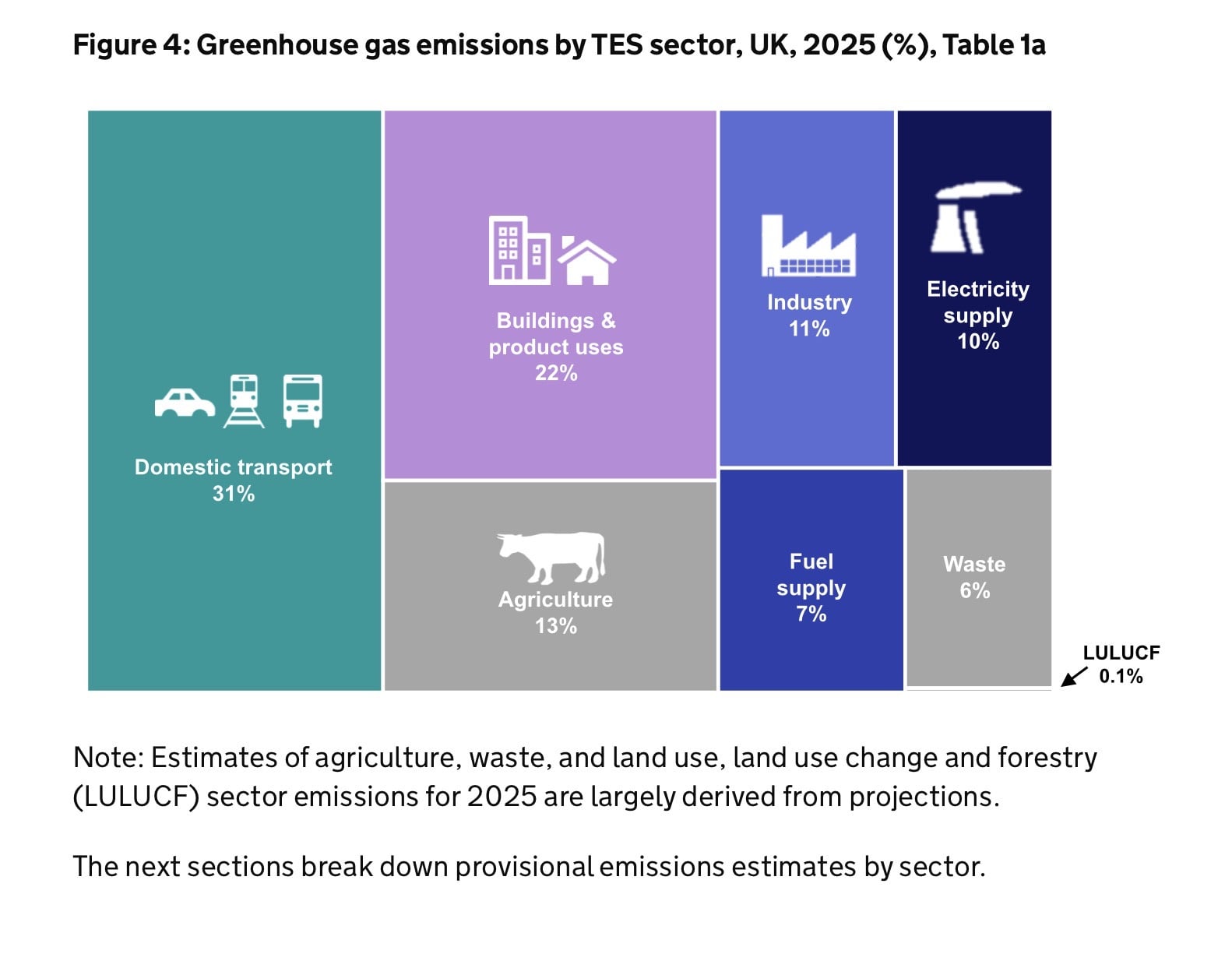
Naivety sound bites at its best …this is how much emissions generated in 2025 Electicity is 100/80/60/40/20 %
Nope 10%
 4.8kWp 12x400W Longhi 9.6 kWh battery Giv-hy 5.0 Inverter, WSW facing Essex . Aint no sunshine ☀️ Octopus gas fixed 5.07 + Octopus Intelligent Flux leccy
CEC Email energyclub@moneysavingexpert.com2 -
And then you have to have those expensive batteries - available at real scale.
Most battery farms will last 1-2 hrs at rated output.
There meant to take care of say a supper time or breakfast rush - not a longer term wind failure.
Atmospheric blocks across UK and Europe - are not uncommon short term - but can and do last 7-10 days.
Last Aug iirc - we lost about 8GW of wind generation (against average capacity factor) for a fortnight - 8*24*7*2 = 2.7TWh of battery would be needed - we have around 13 GWh - 0.5% of that - hence we have to go to gas.
And yes the gas generators know that - and can game their prices accordingly.
The real problem is people all too often ignore the lows of renewables - the effectively 0 GW from solar for 17 hrs a day in deep winter, for the now c15GW that creates a glut on sunny summer afternoons - and the days - sorry weeks - of low output from wind - and fail to maintain the background generation capacity to replace it.
The longer the green lobby is allowed to believes it's own hype - to focus only on the averages or the highs - the closer one day we will be to having a serious grid failure.
We have prematurely shut our coal - despite having had grid near misses in the past - we have not been maintaining our nuclear and gas generation plant - at the scale required - so all too often become reliant on interconnects.
From other nations who are potentially in the same problem - facing the same solar and wind generation problems - a fall back in planned core generation - hence another summer price spike of £9742 - that one in 2022 - to keep the grid in SE England / London up.
Not helped by NE Europe wide shortages at time in large part due French core nuclear dipping - with extended post covid EDF maintenance and delays on new plant like Flamanville 3 (the first build of EDF EPR design at Hinkley/Sizewell).
0 -
And what is missing from that breakdown is international transport.
With UK fuel depot airline supplies roughly equal with electricity generation in terms of MTCO2e.
Suspect if add ferries - probably over.
And If I was a betting man - I'd say you could near double that for the emissions from return flights.
It's certainly up there with domestic gas use and its 16% vs electricity generation 10%.
0 -
Also missing off is Marine , not very clean machines.
4.8kWp 12x400W Longhi 9.6 kWh battery Giv-hy 5.0 Inverter, WSW facing Essex . Aint no sunshine ☀️ Octopus gas fixed 5.07 + Octopus Intelligent Flux leccy
CEC Email energyclub@moneysavingexpert.com0 -
Climate change end point (in the relatively short term) is unknown - they can't even forecast the weather a few days ahead with any accuracy - and we may end up with Siberian or warmish winters, thus the only thing you can do with energy production is to diversify it as much as possible and persuade people to use as little as possible. As many people as possible having their own power plants on the roof, combined with ever cheaper batteries (sodium is coming), does make good sense.
1 -
That's really great news. Shows what can be achieved with a bit of effort. At the start of the last decade leccy was ~70% FF's, hopefully this year it'll be ~25% and still falling fast. So step one nearly achieved.
Then step two, already in progress, is to electrify everything. That's a huge task, but now, it's no longer a huge problem as the economic solutions are now available, such as EV's and heat pumps.
We see transport and buildings now accounting ~50% of emissions, so those can be, dare I say easily, addressed. And that task isn't nearly as bad as it looks, due to the 'primary energy fallacy'. That's where we look at replacing the energy currently being consumed, when in reality we only need to replace the useful energy.
For transport, vehicles are only about 20% to 25% efficient, rising to ~40% for heavy freight, trains etc. To electrify the UK's road fleet will require about 20% to 25% more leccy. And that will be spread across 20-25yrs (approx 10yrs to reach 100% electric, then approx 15yrs to transition the fleet). As we are transitioning around 4% of the leccy fleet pa, then just maintaining RE growth will manage this. A huge success is the UK's city bus fleet, where about one third of new sales are now BEV, and rising fast.
The same applies to buildings, they are getting cleaner as we improve leccy, but more importantly, the main energy consumption is gas (cooking, DHW and space heating). Heatpumps are about 3.5x more efficient than a modern high efficiency gas boiler (~90% efficient). So again, we don't need to replace all of the primary gas energy, only a fraction of it.
Industry needs to electrify as much as possible. Agriculture is a problem, but the electrification of transport helps here as tractors and other heavy plant are now available in BEV form, and this sector is expanding fast. But, the elephant in the room, so to speak, will remain emissions from cattle and sheep, again easily solved by reducing consumption, but I suspect a huge task to convince everyone.
Ironically, fuel supply kinda resolves itself, as we use less and less FF's, which consume a lot of energy in their production, refining and distribution. This also leans into the marine sector, where ferries, near shore transport etc is already electrifying fast. And ~40% of the transportation (by mass) of ocean going ships is actually FF's.
I think long haul flights will remain a problem (short haul will electrify, very short haul already is, such as the Canadian puddle jumpers), and it may be that SAF (sustainable aviation fuel) is the best solution, though not a great solution.
The UK may be behind in terms of heat pump deployment, but we are holding our own in Europe regarding decarbonization of leccy, and BEV rollout (now ~6% of the car fleet, with new sales ~25%).
I think the big bonus we are now seeing is the rapidly falling cost of battery storage. Prices are starting to get a little silly, and the development/deployment of sodium batts is now scaling fast, with the potential of halving battery cell costs. The learning curve (Wright's Law) for batteries is an incredible 20-25%. That's the reduction in costs for every subsequent doubling in production.
Mart. Cardiff. 8.72 kWp PV systems (2.12 SSW 4.6 ESE & 2.0 WNW). 28kWh battery storage. Two A2A units for cleaner heating. Two BEV's for cleaner driving.
For general PV advice please see the PV FAQ thread on the Green & Ethical Board.1








Confirm your email address to Create Threads and Reply

Categories
- All Categories
- 355.7K Banking & Borrowing
- 254.9K Reduce Debt & Boost Income
- 456.1K Spending & Discounts
- 248.3K Work, Benefits & Business
- 605.8K Mortgages, Homes & Bills
- 179K Life & Family
- 263.6K Travel & Transport
- 1.5M Hobbies & Leisure
- 16.2K Discuss & Feedback
- 37.7K Read-Only Boards