We’d like to remind Forumites to please avoid political debate on the Forum.
This is to keep it a safe and useful space for MoneySaving discussions. Threads that are – or become – political in nature may be removed in line with the Forum’s rules. Thank you for your understanding.
📨 Have you signed up to the Forum's new Email Digest yet? Get a selection of trending threads sent straight to your inbox daily, weekly or monthly!
Energy news in general
Comments
-
I suspect many retailers feel the same about shoplifting, and customers have to pay for it, until the business becomes non viable.Scot_39 said:MattMattMattUK said:
Then you will face the consequences of your actions, which can only be regarded as a good thing.wrf12345 said:Already defaulted on the water due to crazy rise in s/c, looks like I will be doing same with gas and electric if prices go any higher... had enough!
How many other suppliers are essentially told to provide their goods for free without realistic measures to prevent people taking with no ability or worse potentially in some cases simply no intention to pay.Play with the expectation of winning not the fear of failure. S.Clarke1 -
I do sometimes wonder though about the priority levels between Sky, Netflix, Disney+ and utility bills.The_Green_Hornet said:
I think we will all face the consequences if more and more people are unable to pay their utility bills.MattMattMattUK said:
Then you will face the consequences of your actions, which can only be regarded as a good thing.wrf12345 said:Already defaulted on the water due to crazy rise in s/c, looks like I will be doing same with gas and electric if prices go any higher... had enough!2 -
"if you are just failing to pay because you have literally “had enough” even though you can afford it, and are doing this as some form of protest, then you’re playing a dangerous game, and should probably reconsider. "
Worry not, I have worked out a way to (temporarily) beat the system, will be back to paying after a six month "payment holiday" for the water and same for gas/electric next year if there are any increase in s/c's, no details as the loophole would be rapidly plugged (nothing to do with benefits etc) and no effect on my financial standing (not that I care).0 -
wrf12345 said:"if you are just failing to pay because you have literally “had enough” even though you can afford it, and are doing this as some form of protest, then you’re playing a dangerous game, and should probably reconsider. "
Worry not, I have worked out a way to (temporarily) beat the system, will be back to paying after a six month "payment holiday" for the water and same for gas/electric next year if there are any increase in s/c's, no details as the loophole would be rapidly plugged (nothing to do with benefits etc) and no effect on my financial standing (not that I care).
Do please enlighten us as to how you are temporarily beating the system. It is presumably Money Saving!I’m a Forum Ambassador and I support the Forum Team on the In My Home MoneySaving, Energy and Techie Stuff boards. If you need any help on these boards, do let me know. Please note that Ambassadors are not moderators. Any posts you spot in breach of the Forum Rules should be reported via the report button, or by emailing forumteam@moneysavingexpert.com.
All views are my own and not the official line of MoneySavingExpert.
1 -
They are not "out of control", they are entirely in control of government, via the regulator.Scot_39 said:
Exactly what I have been attacked for pointing out in many posts.The_Green_Hornet said:Energy bills likely to rise by 20% in next four years, says Britain’s biggest supplier
Britain’s biggest energy supplier has told MPs that bills are on track to climb by a fifth in the next four years, even if wholesale markets plummet, because of the rising cost of government policies.
An executive at Octopus Energy said household energy bills were likely to rise by 20% unless the government took radical action to address the burden of increasing “non-commodity costs”, even in a scenario where wholesale electricity prices fell by half.
Policy and net zero costs are out of control in the UK.
Balancing costs are a daft thing, they exist largely because of a national scale plan for generation, generation contracts around the UK should not give equal pricing, it should have always reflected transmissibility, transmission losses to the relevant market and have been designed to encourage/force generation capacity be built in useful locations.Scot_39 said:
£8bn in balancing costs - over £250 if wax ever to be split equally over c31m donestic and business suppliedby grid - is not some fanciful scare story - its an official now govt quango NESO estimate.
That being said cutting back on upgrade expenditure would be a retrograde step. We are in a mess now due to half a century of chronic underinvestment in our utilities. We have poor energy security, narrow margins for resilience and a dire need to move away from fossil fuels, slashing investment rather than increasing it is not the way to go. Even if one chooses not to understand the scientific consensus that means we need to implement net zero, from a national security viewpoint moving away from fossil fuels is essential.
0 -
Net zero is seen as the govts and its regulators priority - not our energy prices.
We are in the mess we are in because we have chosen to encourage private investors with favourable terms - including once again above market rste CfDs - and curtailment payments - to invest £100s bn in unreliable power sources like wind and now solar. And worse still- built much of tge capacity literally 100s of miles from demand / major population and industrial sites.
With govt quangos in charge of licensing and auctions focussed on wholesale and not total system - i.e. delivered to our door - pricing.
You want to control pricing - stop curtailment now - at least for for all future including ar7 capacity.
Better still retrospectively - if N Sea can have windfall taxes retrospectively - helping to destroy its jobs - renewables can have curtailment payments reclaimed.
Ngeso forecast £3bn - and thats just grid thermal constraint - not total constraint payment - by 2030 saved immediately.1 -
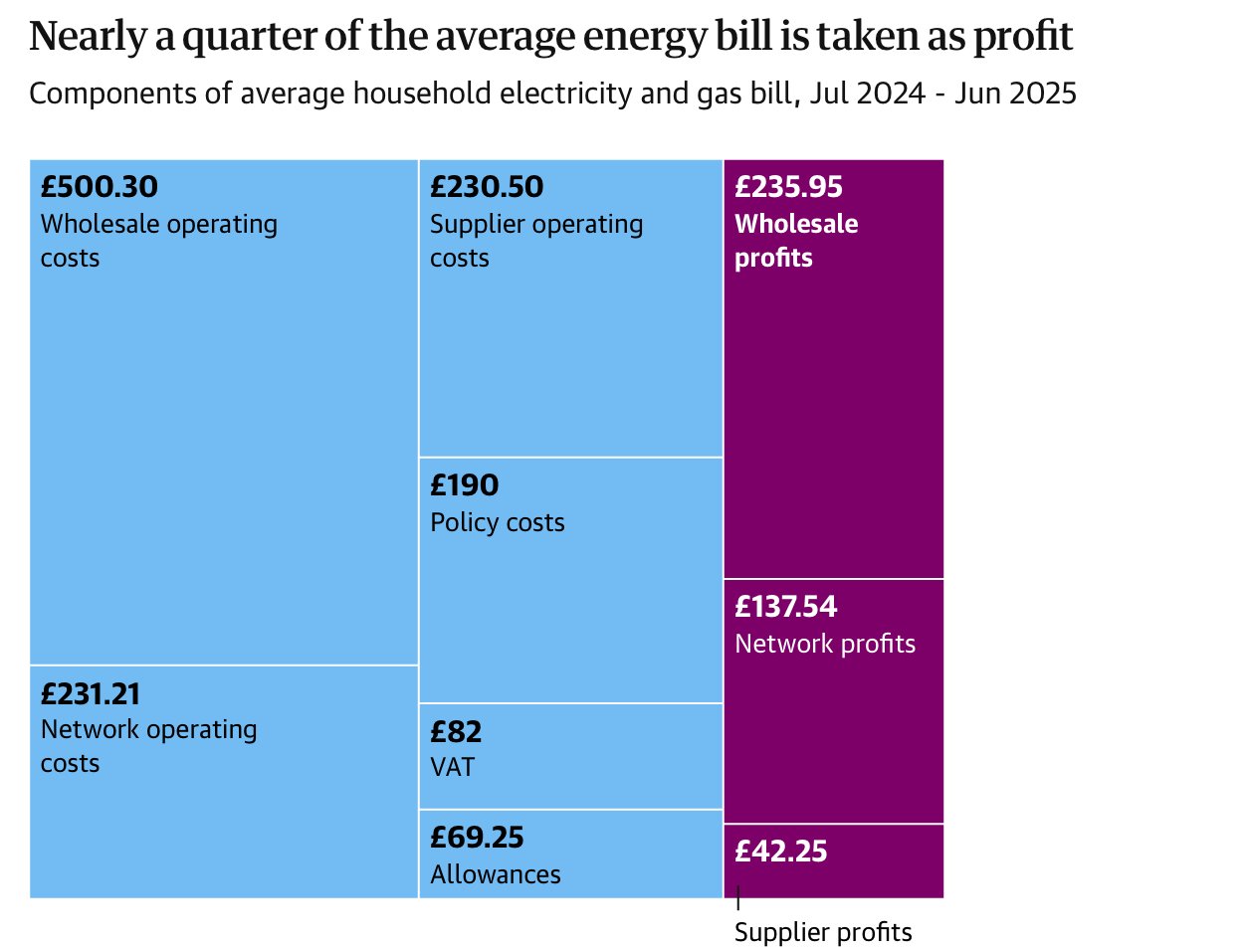
Have a little graphic [ Ofgem data based on 'average' annual bill of £1,719] :
 2
2 -
Link to Ofgem report / source to see which version of "profit" is being used here for wholesale and network profit figures ?£42.25 is around the suppliers EBIT allowance metric in the recents caps - which has just gone from £43 to £42 - in the October cap letter.EBIT = Earnings Before Interest and TaxAnd so thats a metric of current operational operating profit - ignoring debt interest and taxes - not final profit.
And for networks could be ignoring financing costs for physical network upgrades - which are currently running around - £11-15 bn pa given a 2024 estimate by the UKs 3 grid TNOs in the £55-77bn range. And for generators any outstanding financing on building the power plants etc. Not all are old in fact iirc 4 gas plants are currently being built or licensed to be so in uk.0 -
National grid return on capital is about 5.7% but obviously covers not only UK transmission and distribution but also its US and other international interests. How much return is reasonable for long term infrastructure investment - would you want to lock your money up for 25 - 50 years for less than the 5%+ you can get on govt bonds, so why would you expect a company to do so? I think the govt are proposing to cap this to 4.5% going forward.
Not sure what 'wholesale profit' is - is it what the generators make? What is their return on capital employed? Is this market regulated at all?I think....2 -
michaels said:
I would rather pay more for my energy and have a liveable planet for my kids, even if it means I can't afford ubereats, the apple tax, tattoos, Taylor Swift tickets or millions of other 'essentials'.Scot_39 said:Chrysalis said:I see a news article on the BBC that energy debt without a repayment plan is still soaring. Looks like a new stealth SC tax coming to write that debt off. A tax to cover the perils of fixed DD?Debt would be lower - if our energy bills did not include- the come Oct £215 in policy costs - up £58 /37% in 18 months- net zero costs - that just aded another £15 ex VAT on network costs in Oct on top of current costs.Scrap policy costs - scrap VAT - even better scrap net zero - and bills would be £100s less.And far less likely to have people in debt.Govts - past and present - need to learn the lesson - fuel costs are far to high to keep the extra charges they deliberately chose to place onto them.They should be trying to reduce them.But rather than doing so - they have just lumped £10s more - ave cap up £35 - wholesale energy costs down -£15 ex VAT - the £51 diiference - largely govt policy.And even those on WFD see these extras on their top line. New recipents arent £150 better off - now only £99 if concume at median TDV.The 3.4m on WHD before - share in the £51 extra - just as other bill payers do.
I am in a very small minority.
What about if it meant you cant afford to eat, pay your rent, and keep the lights on? Is that a more liveable planet and preferable? I agree you in a small minority who thinks things like a 22billion carbon capture scheme is good value, and have enough comfort that the extra cost only affects luxuries.
I am a supporter of green energy but a cost/impact analysis should be done, and more targeted collection instead of equal per household, targeted on people like yourself with ability to pay.
Bear in mind where does this paying more stop? is there a limit, we already pay huge amounts even if you think its small.2











Confirm your email address to Create Threads and Reply

Categories
- All Categories
- 355.8K Banking & Borrowing
- 254.9K Reduce Debt & Boost Income
- 456.2K Spending & Discounts
- 248.3K Work, Benefits & Business
- 606K Mortgages, Homes & Bills
- 179K Life & Family
- 263.8K Travel & Transport
- 1.5M Hobbies & Leisure
- 16.2K Discuss & Feedback
- 37.7K Read-Only Boards