We’d like to remind Forumites to please avoid political debate on the Forum.
This is to keep it a safe and useful space for MoneySaving discussions. Threads that are – or become – political in nature may be removed in line with the Forum’s rules. Thank you for your understanding.
📨 Have you signed up to the Forum's new Email Digest yet? Get a selection of trending threads sent straight to your inbox daily, weekly or monthly!
The Forum now has a brand new text editor, adding a bunch of handy features to use when creating posts. Read more in our how-to guide
Physics / mechanics help pls
Comments
-
I think it's the other way around pb: because it's dividing by Cos (theta), with the ropes at 90 degress horizontal, it would be dividing by zero, which would make the force on the ropes infinitely high, so they would break before you could ever get them horiztontal!pbartlett said:the tension in the ropes decreases as a function of cos(theta), which is 1 when the ropes are vertical (hence then support the full 100kg), to zero when they are horizontal - in that case the rope could be made of cotton as there is no tension in it.0 -
have you added a beam into the system eg like here? ie in the first case you have a rope with a weight and in the second case you have a 30deg rope but have added a beam?
Force and Tension in Rope due to Angle (engineeringtoolbox.com)
1 -
Yes, exactly this, tension increases with angle and approaches infinity as it gets nearer to 90 degrees.coffeehound said:
I think it's the other way around pb: because it's dividing by Cos (theta), with the ropes at 90 degrees horizontal, it would be dividing by zero, which would make the force on the ropes infinitely high, so they would break before you could ever get them horizontal!pbartlett said:the tension in the ropes decreases as a function of cos(theta), which is 1 when the ropes are vertical (hence then support the full 100kg), to zero when they are horizontal - in that case the rope could be made of cotton as there is no tension in it.
I did a quick spreadsheet to show the range of values, you can see it increase massively as it approaches 90 degrees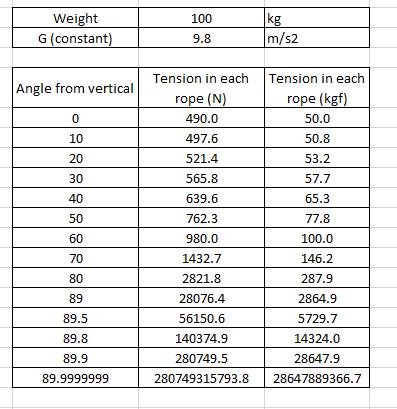
1 -
that link supports the tension in the rope increases with angle.pbartlett said:have you added a beam into the system eg like here? ie in the first case you have a rope with a weight and in the second case you have a 30deg rope but have added a beam?
Force and Tension in Rope due to Angle (engineeringtoolbox.com)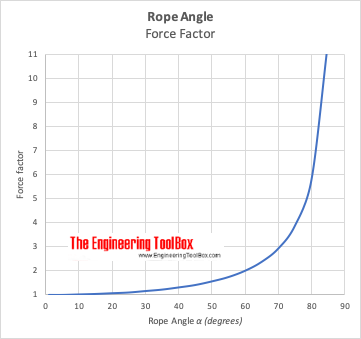
1 -
An alternative way to show that the tension increases is to start with one rope vertical and one horizontal
tension in vertical all the mass
tension in horizontal Zero(using massless ropes)
as you move the vertical rope further away the tension in the horizontal rope increases as the angle of the vertical rope.
1 -
You need to use increasing force because the ropes begin to pull against themselves. Imagine there was no weight there at all just a ring connecting the two ropes. As you pull on the ropes they become increasingly horizontal until you are effectively pulling two ends of the same rope with increasing force until the ropes (or the ring) break.coffeehound said:I was thinking of the edge case where if you tried to pull on the ropes to bring the load towards horizontal, you need to use increasing force. So therefore the ropes must see a higher weight as you increase the angle?1 -
Thanks that illustrates it nicely[Deleted User] said:
Yes, exactly this, tension increases with angle and approaches infinity as it gets nearer to 90 degrees.I did a quick spreadsheet to show the range of values, you can see it increase massively as it approaches 90 degrees1












Confirm your email address to Create Threads and Reply

Categories
- All Categories
- 353.6K Banking & Borrowing
- 254.2K Reduce Debt & Boost Income
- 455.1K Spending & Discounts
- 246.6K Work, Benefits & Business
- 603K Mortgages, Homes & Bills
- 178.1K Life & Family
- 260.7K Travel & Transport
- 1.5M Hobbies & Leisure
- 16K Discuss & Feedback
- 37.7K Read-Only Boards