We’d like to remind Forumites to please avoid political debate on the Forum.
This is to keep it a safe and useful space for MoneySaving discussions. Threads that are – or become – political in nature may be removed in line with the Forum’s rules. Thank you for your understanding.
CSH2
Comments
-
In the past, CSH2 has reported zero ERI with the implication that the returns were capital gains as a result of growth of the derivative or underlying collateral basket. It was remarked here that HMRC probably would not like that either as it transforms interest income into capital gain, and did so at a time when there was a generous nil rate band.
Around the time the CGT allowance was slashed, CSH2 started reporting almost all of its growth as ERI. When @aroominyork tried to get to the bottom of whether it was interest income or dividend income, Amundi suggested the latter.
So we have the following underlying collateral basket, and the swap to consider.
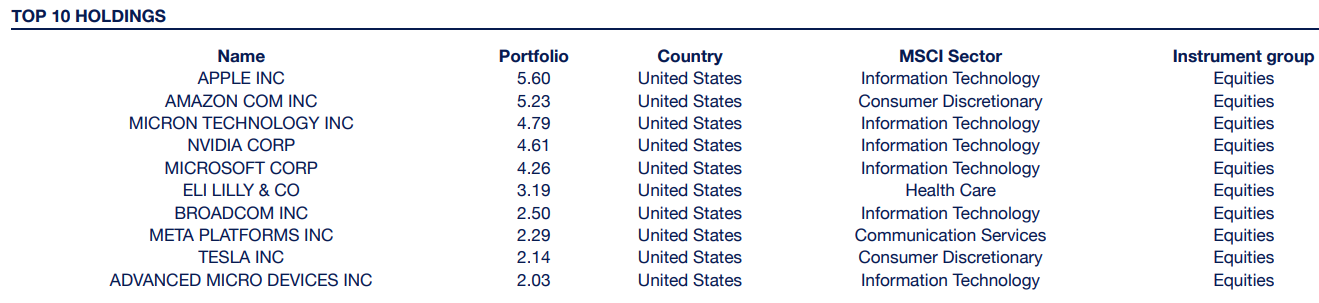
The question is, whether it is plausible for either to be the source of the latest figure of €25 (£21) per share ERI from Nov 2024-Mar 2025? That is about 1.75% for 4 months (against total growth of about 1.75% - in other words all of the growth). It represents around 5% pa.
It seems highly unlikely this can be attributed to dividends from the collateral basket, so it must be the case that the counterparty gets the benefit of those and all growth is from the swap.
Given the above, can it be generalised to other synthetic ETFs? It probably depends on the nature of the swap. But if HMRC applies the duck test, they could reasonably conclude the ERI is interest income.
2 -
Indeed. I had a thought that I might keep a few CSH2 shares to sell in early October (rather than end of September) so that I could use up some unused dividend allowance (ERI roughly £50 a share). However, given the uncertainty I decided against it. so all my profit for the last 10 months will (I think) be covered by CGT.
0 -
It seems highly unlikely this can be attributed to dividends from the collateral basket, so it must be the case that the counterparty gets the benefit of those and all growth is from the swap.
It never occurred to me that any of CSH2's return might be attributable to dividends; I assumed all the impact of the collateral basket - dividends and growth/loss - would go the counterparty and Amundi would receive SONIA in return. But if there was a tax benefit - to either/both parties - in Amundi retaining the dividends, I guess they could offset that against the SONIA-like payment from the counterparty.
One of the curiosities of ERI (I am rehashing the previous thread here) is that if you hold a share on the reporting date, you are liable for all of the year's ERI - there is no equalisation mechanism. So you can buy CSH2 on 30/9 and sell on 1/10 and have the full year's ERI to report as (according to Amundi) dividend income, taxed at a lower rate than income or CGT. And your purchase price, for CGT purposes, is increased by the ERI, generating an instant loss which can help avoid CGT when selling other assets. Since I have an unwrapped global equity fund running up a potential CGT bill this was tempting to me, but I heeded masonic's advice that it could be seen as tax evasion - carrying out tax-beneficial trades which you would not otherwise have placed.
0







Confirm your email address to Create Threads and Reply

Categories
- All Categories
- 355.7K Banking & Borrowing
- 254.9K Reduce Debt & Boost Income
- 456.1K Spending & Discounts
- 248.3K Work, Benefits & Business
- 605.8K Mortgages, Homes & Bills
- 179K Life & Family
- 263.6K Travel & Transport
- 1.5M Hobbies & Leisure
- 16.2K Discuss & Feedback
- 37.7K Read-Only Boards