We’d like to remind Forumites to please avoid political debate on the Forum.
This is to keep it a safe and useful space for MoneySaving discussions. Threads that are – or become – political in nature may be removed in line with the Forum’s rules. Thank you for your understanding.
Lifetime Isa
Comments
-
I also think the conclusions drawn in the other thread are questionable, especially as the sale apparently created a capital gains tax liability for him personally. I am not buying the simplistic argument that "legal interest" is limited to situations where there is a land registry paper trail. But the full facts in that case are unclear, and it is a rather academic discussion, given he didn't try to use a LISA and didn't believe he'd meet the property price limit if he did.
In this case, I think it is likely the daughter can legally enforce ownership rights, rather than simply the right to financial benefits from the property a beneficial interest would confer. But it really comes down to what a conveyancer will allow, given all of the relevant information, as they will need to sign a declaration that the funds will be used towards their client's first residential property.
But just to correct a potential misconception - the LISA can be used either way, but withdrawn funds may be subject to the 25% penalty if the purchase does not meet the scheme rules.
2 -
and of course the LISA could be saved up until she is 60 if it turns out the new house doesn't count as her first home (just make sure she finds that out before withdrawing the money).
0 -
Yes, not using the LISA for this purpose is probably the preferable option, and probably what to do if the money isn't absolutely required.
Regarding the eligibility, having done a little checking, a mistake was made in the other thread. The legislation does not limit prior ownership to mean having held a "legal interest" when defining "first time buyer" as an individual who has never been a "residential property owner":
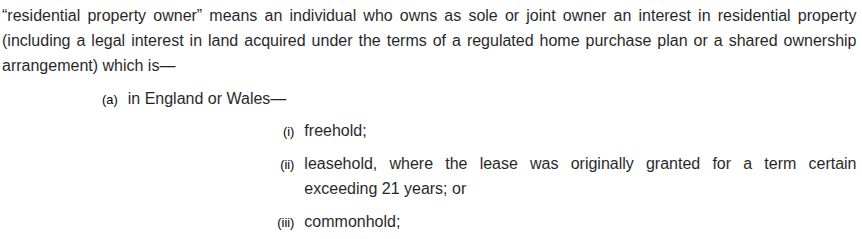
The term "legal interest" is used in paragraph 6(5) ("The purchase must be of a legal interest in land situated in the United Kingdom…")
The term "interest" is used in paragraph 7 to define "residential property owner" ("an individual who owns as sole or joint owner an interest in residential property…").
So the purchase made with the LISA must be for a legal interest, but any prior residential property ownership need only be an interest.
Where Parliament uses "legal interest" in one clause and drops it in another clause, the unqualified word "interest" should be read in its broad, natural legal sense, which would include a legal or beneficial interest.
1 -
I think you are right but one thing occurs to me. In the quoted definition of residential property owner after using the term "interest" it goes on to paragraph (a) and seems to be saying that the interest has to be "freehold, leasehold or commonhold" which are terms that relate to forms of legal ownership not beneficial ownership.
1 -
I believe that describes the tenure of the subject property (the type of estate in land being held), rather than qualifying the interest of the individual. So if the trustee were to hold the freehold for a beneficiary, then the beneficiary holds an interest in the freehold property.
1 -
Yes That is probably it.
0 -
A similar situation is where you have a beneficial interest through inheriting a property. However you are still a first-time buyer until the property is legally transferred into your name.
https://www.theguardian.com/money/2019/apr/22/if-i-inherit-my-mums-house-will-i-be-able-to-use-my-lifetime-isa
"HMT says you can still be classed as a first-time buyer if you inherit a property but ownership of it is never formally transferred into your name – for example the property is sold after the death of its owner and the cash proceeds are passed to you rather than the title of the property. HMT also makes it clear that being the beneficiary of property in the will of someone who is still living (like your mother), doesn’t stop you from being a first-time buyer for lifetime Isa purposes. So you should be OK if you buy a house before your mother dies and/or your brother inherit your mother’s house but it is sold rather than being put in your names at the Land Registry."
1 -
It is important not to conflate holding a beneficial interest (which does disqualify an individual) with being a beneficiary of an unadministered estate (where no interest in land is held yet).
Inheriting the property where it is sold within the estate is different and more like the situation with a discretionary trust. You don't yet have a beneficial interest. In the former situation, you never have an interest in the subject property, in the latter situation it is at the discretion of the trustee, and something else needs to happen (i.e the death of a relative occupying the property) before you have any rights over it (reversionary rights).
1 -
I updated that thread today.
I see no qualitative difference between the 'Santander' OP narrative , and this present situation.
As far as HMRC are concerned the 'bare trust' is an entirely look through arrangement with daughter both legally and beneficially entitled at age 18 to the property her parents are managing on her behalf. Failing to transfer the legal title to her is a red herring as far as LISA and FTB status is concerned.
I agree with the solicitor's summation of the situation, the Lisa bonus is not available for house purchase purposes, can't see why there was any doubt in this particular instance.
Incidentally, the fact that the parents 'choose' to continue to manage the investment property on her behalf does not escape the fact that she ( at age 18) was the de facto landlord as far as tenants' contract is concerned.
Therefore, the burden of those landlord obligations and duties fall on her shoulders and hopefully the tenants are under no mishapprehension as to who the real landlord is, if this has not been made abundantly clear by the tenancy agreement.
One last point continuation of this bare trust suggests it should have been registered on HMRC's trust register for money laundering due diligence purposes - I cannot see that either a general or specific schedule 3A exemption would apply here, OP might want to run this point past the solicitor:
There is a potential £5,000 penalty for non compliance.
3








Confirm your email address to Create Threads and Reply

Categories
- All Categories
- 355.8K Banking & Borrowing
- 254.9K Reduce Debt & Boost Income
- 456.2K Spending & Discounts
- 248.3K Work, Benefits & Business
- 605.9K Mortgages, Homes & Bills
- 179K Life & Family
- 263.7K Travel & Transport
- 1.5M Hobbies & Leisure
- 16.2K Discuss & Feedback
- 37.7K Read-Only Boards