We’d like to remind Forumites to please avoid political debate on the Forum.
This is to keep it a safe and useful space for MoneySaving discussions. Threads that are – or become – political in nature may be removed in line with the Forum’s rules. Thank you for your understanding.
Will AI put bond fund managers out of work?
Comments
-
I generally defer to you on the technical stuff – partly because some of it goes over my head – but a few points:
- Dynamic Income’s short positions are 1.58% on Morningstar, and the factsheet shows “single named corporate - derivatives” as 0.22% long and -0.47% short; surely none of that moves the dial much.
- You feel the high historic returns mean something is going on which will bring chickens home to roost. I would counter that in a decade of fund management we have seen no evidence that Golan takes reckless risk. His Citywire stats are very impressive.
- Does Trustnet weight by fund size? The methodology you earlier quoted didn’t say that.
- I do not understand offshore funds enough to say whether they are a sensible comparator, but surely you cannot compare IG and SCB – neither of which are short duration – to short duration ETFs during the 2022 rout.
If you believe in Golan's bottom-up approach - including looking for a margin of safety - then should his funds fall as part of a sectoral crash, it would represent a buying opportunity.
0 -
The short positions are quite small, and I don't think those would be the main part of the loss potential figure I suggested. But derivatives "may significantly multiply the gains or losses", so derivatives totalling 5.2% (as per factsheet) does not mean losses from these instruments are limited to 5.2%. So I mentally added a 10% penalty to account for this. To my mind, the heavy lifting is being done by the credit quality (70% sub-investment grade), the EM exposure, and the fact that the fund is managed with no benchmark constraint at all. That felt to me like double the loss potential of the SCB fund before considering the derivatives.
On "no evidence of reckless risk" and the Citywire numbers - A decade of good numbers is reassuring only insofar as it includes a real stress test, and it mostly doesn't. The one event in that window is 2022 (when interest rates sharply rose), and that's precisely the year his funds, on a fair duration-adjusted basis, had their weakest relative showing (see below). "No blow-up yet" and "no reckless risk" aren't the same. A concentrated, benchmark-free, sub-IG credit book with active duration hedging is the type of strategy that can look flawless right up until a genuine default cycle hits. The absence of a crisis in the sample period is not evidence the strategy would handle one well.
On whether Trustnet weights by size - I genuinely don't know. It was merely a guess at a possible explanation for the gap between the stated average and the simple mean of the numbers going into it. The stated methodology is ambiguous on this point.
On the duration-matching critique, this is fully fair. I did not look at the duration of the IG and SCB funds, they are somewhat longer at 5 and 6 years respectively. So I was unfairly penalising them for holding longer duration. Blending short-duration with total market duration fixes this: Having redone it that way: Man Sterling Corporate Bond now matches its duration-equivalent benchmark almost exactly in the 48-60 month window (-17% vs -17%), so I withdraw my comment about it underperforming. But the IG fund's gap is still there under the fairer comparison: -14% vs +3% for the blended benchmark.
I agree with you that these funds could be very attractive options for a market crash shopping list. Although I think the additional risks in Dynamic Income could see it suffer permanent loss of principal, which might be a more drawn out process, leading to a slower recovery once sentiment improves.
1 -
I'm sure bond fund managers will already be using AI tools to help with analysis and forecasts and that is only going to increase in the future so, yes, in the longer term AI will replace some human fund managers.
0 -
But the IG fund's gap is still there under the fairer comparison: -14% vs +3% for the blended benchmark.
Isn't it simple enough to compare IG to a corporate bond index fund, knowing the fund's BBB+ should perform slightly differently in up and down markets to the index's A- (going by Morningstar average credit rating)? IG has outperformed in all market conditions since its launch.
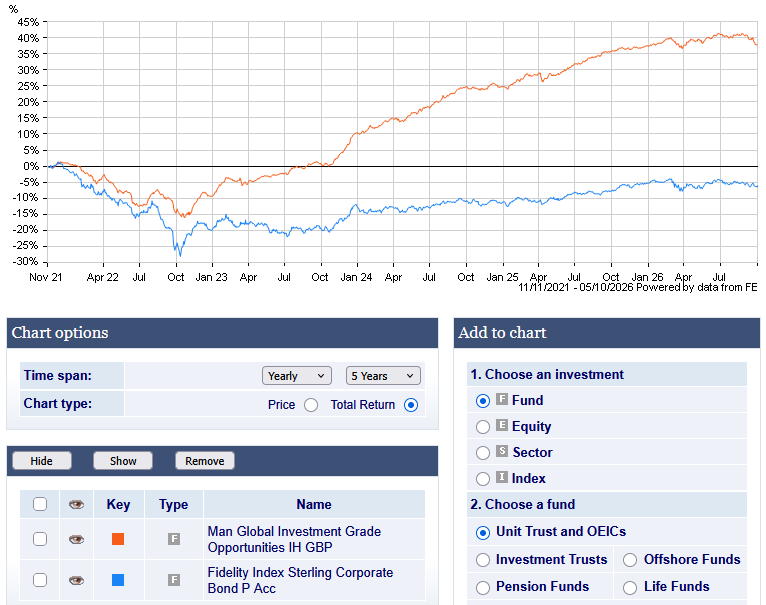
 0
-
It was duration rather than credit rating that suffered due to rates rising from historic lows. Next time it could be that lower credit ratings fall further - in fact that is likely based on where we are today. There is no precedent to test for that in these relatively new funds, but we've certainly seen it in others.
The IG fund has the dials turned down a bit relative to DI, but the risks are still there.
0 -
True enough, but you still have to compare like with like. The two funds I showed have maturities within a few months of each other, and there isn't a world of difference between A- and BBB+. As I've mentioned in other threads, corporate bonds is a sector where I avoid index funds.
0 -
An average rating of BBB+ doesn't account for the underlying distribution of the portfolio. A fund could achieve a BBB+ average by holding a tightly clustered basket of BBB+ bonds, or by running a "barbell" strategy. Credit risk isn't linear. The tail risk comes from the extremes, not the average. On that note, it's the extra BBB, plus the 10% BB and 10% B that has likely been making all the difference.
During a credit crunch or recession, lower rated bonds suffer far greater spread widening. If holdings get downgraded to junk, institutional mandates force mass sell-offs (fallen angel risk), driving down prices regardless of whether the company ultimately defaults.
0 -
Talking of widening credit spreads, how are they reflected in a single priced fund? Logic says either the sellers are getting a premium, the buyers are getting a discount, or some of each.
0 -
Credit spreads are the difference in yield between debt securities of different credit ratings, which impacts price, but isn't the difference between the buy and sell price.
So, for example, BBB corporate bond yields could be compared to US Treasury yields. At the moment the yield spread is quite low at around 1.5%, whereas in 2008 it peaked at 6%. Spreads on junk bonds can be double digit in a crisis. If a 5 year corporate bond moved +4.5%, then its price would fall about 20%. If its rating was downgraded, then it could fall significantly further.
0 -
Sorry - got my terminology wrong. I meant buy-sell/bid-ask spreads.
0







Confirm your email address to Create Threads and Reply

Categories
- All Categories
- 355.7K Banking & Borrowing
- 254.9K Reduce Debt & Boost Income
- 456.1K Spending & Discounts
- 248.3K Work, Benefits & Business
- 605.9K Mortgages, Homes & Bills
- 179K Life & Family
- 263.7K Travel & Transport
- 1.5M Hobbies & Leisure
- 16.2K Discuss & Feedback
- 37.7K Read-Only Boards