We’d like to remind Forumites to please avoid political debate on the Forum.
This is to keep it a safe and useful space for MoneySaving discussions. Threads that are – or become – political in nature may be removed in line with the Forum’s rules. Thank you for your understanding.
📨 Have you signed up to the Forum's new Email Digest yet? Get a selection of trending threads sent straight to your inbox daily, weekly or monthly!
ADR rejected EasyJet claim - Denied boarding - Looking for advice


easyJet denied us boarding over permitted avalanche rescue packs – AviationADR rejected our claim based on alleged tannoy announcements we never heard. What should we do next?
Looking for some advice on what to do next after AviationADR rejected my claim against easyJet.
There were two of us travelling from London Luton to Tbilisi on an easyJet flight in March 2026.
Here is exactly what happened.
There were 2 passengers, 2 checked suitcases and 2 avalanche rescue packs.
Each passenger had one avalanche rescue pack inside their own checked suitcase, and each avalanche pack contained one compressed-gas cartridge.
The compressed-gas cartridges were manufactured by Mammut, were approved for this type of air travel under the relevant requirements, and we had all of the relevant paperwork supplied by Mammut with us.
Before travelling, we had specifically checked easyJet's dangerous-goods policy.
Their published policy permits one avalanche rescue pack per passenger, subject to the relevant conditions, and states that this equipment has automatic operator approval.
We therefore did everything we could reasonably think of to make sure we were travelling correctly and weren't going to have an issue.
We arrived at Luton early, checked in normally and handed over both suitcases.
Importantly, I specifically informed the staff at the easyJet check-in desk about the compressed-gas cartridges.
I explained exactly what we had.
The staff told me that we were fully compliant, that there would be no issue, and that we did not need to take any further action other than checking in the two bags.
easyJet staff then accepted and tagged *both* bags.
We went through passenger security ourselves and proceeded airside as normal.
At no point did either of us hear our names called over the airport tannoy.
There was no announcement that either of us heard asking us to return to security, and nobody contacted either of us directly to tell us there was a problem with either suitcase.
We therefore had absolutely no reason to believe anything was wrong.
We remained airside and went to the boarding gate for our flight.
It was only at the boarding gate that we discovered there was an issue.
*One of the bags* had apparently been withheld by airport security because of the avalanche equipment.
So two bags with the same identical equipment got accepted, and only ONE got pulled by security.
We had not ignored a request to return to security.
As far as we were concerned, no such request had ever reached us.
Neither of us had heard our names called.
Neither of us had been contacted.
We had simply followed the instructions we had been given by easyJet staff and gone airside to wait for our flight.
We were then denied boarding and consequently did not travel on that flight.
We subsequently recovered both suitcases without issue.
Afterwards, we returned to the easyJet check-in desks to complain.
An easyJet manager there told us that this should not have happened and said that he could put us onto another easyJet flight free of charge.
The problem was that the next available easyJet flight was only around four days later.
We had already spent a substantial amount of money on this holiday, including accommodation, transfers and other arrangements.
Waiting another four days wasn't a realistic solution. We would have lost a significant part of the holiday that we had already paid for.
We therefore had to purchase last-minute replacement flights to Tbilisi from Stansted on the same day. Pay for more transfers, loose money on one night of a hotel stay. Etc.
In total, we lost more than £1,500 as a direct result of this incident simply so that we could continue with the holiday we had already paid for.
What happened before our return flight
This is an important part of the story.
While we were still in Georgia, before taking the return flight, I repeatedly contacted easyJet because I was extremely concerned that exactly the same situation was going to happen again.
I wasn't contacting them afterwards just to complain.
I was actively trying to prevent the same thing happening on the way home.
We still had the exact same avalanche rescue packs and compressed-gas cartridges with us.
After what had happened at Luton, I obviously didn't want us to turn up at the airport, follow exactly the same procedure again, and then find out at the boarding gate that one of our bags had been stopped.
So I repeatedly contacted easyJet asking for clear instructions about exactly what they wanted us to do differently.
I wanted them to tell us the correct procedure.
If there was some additional approval we needed, I wanted to know.
If we needed to go somewhere specific at the airport, I wanted to know.
If we needed to contact airport security ourselves, I wanted to know.
If we needed some written dangerous-goods approval or reference number, I wanted to know.
I basically spammed easyJet trying to get a clear answer because I absolutely did not want the same thing happening again.
Despite that, I could not get any different procedure from them.
Eventually, all I received was an email containing a screenshot of easyJet's own website policy, with easyJet effectively telling me again that they approve the equipment.
In other words, after the entire outbound incident, easyJet simply pointed me back to the exact same policy that we had relied upon before travelling in the first place.
They did not tell me that I needed to obtain separate written approval.
They did not tell me that I needed to contact airport security.
They did not tell me to take the cartridges somewhere separately.
They did not give me a dangerous-goods reference number.
They did not tell me that there was any extra step that we had supposedly failed to follow at Luton.
They simply sent me their own policy again and confirmed that the equipment was approved.
We then took the return flight with the EXACT same baggage, EXACT same avalanche rescue packs and EXACT same compressed-gas cartridges.
And we had no problem whatsoever.
This is one of the reasons the whole thing is so frustrating.
My issue with easyJet's “automatic operator approval”
I completely understand that airport security and an airline are two separate entities.
I also completely understand that airport security has to do its job.
If security wants to inspect a bag or verify a piece of equipment, I have absolutely no objection to that.
What I don't understand is how an airline can publish a dangerous-goods policy saying that this type of equipment has “automatic operator approval”, but then apparently have no effective process in place to make sure that approval is communicated or recognised when the baggage reaches airport security.
That appears to be exactly what happened to us.
easyJet's website effectively says:
“We approve this equipment.”
Their own check-in staff looked at what we had and told us:
“You're compliant, there's nothing else you need to do.”
They accepted and tagged both bags.
Then one of the bags reached airport security and was apparently stopped anyway.
If easyJet's approval isn't communicated to airport security, what exactly is the passenger supposed to do?
That seems to leave passengers stuck in the middle between an airline saying that something is approved and airport security apparently not knowing that it is approved.
And these aren't some unnecessary luxury items we just decided to take on holiday.
Avalanche rescue packs are genuinely life-saving safety equipment used when skiing in avalanche terrain.
- We showed up early.
- We checked easyJet's rules beforehand.
- We brought the manufacturer's paperwork.
- We proactively declared the cartridges to easyJet staff at check-in.
- We were specifically told by easyJet staff that everything was compliant.
- We were specifically told that there was nothing else we needed to do.
- Both bags were accepted and tagged.
- We went through security and waited airside for our flight.
- Nobody contacted us.
- We did not hear our names called.
- We did not hear any announcement telling us to return to security.
And then after this had happened, while I was still in Georgia and desperately trying to avoid the exact same problem on the return journey, easyJet once again simply sent me their own policy and told me that the equipment was approved.
I genuinely don't understand what more we could reasonably have been expected to do.
The AviationADR claim
I subsequently made a denied-boarding/expenses claim against easyJet and eventually took the matter to AviationADR.
AviationADR has now ruled entirely in easyJet's favour.
What concerns me most is the reason they gave.
The adjudicator accepts in the decision that:
- both passengers successfully checked in;
- both suitcases were accepted and tagged;
- there was one avalanche rescue backpack per passenger, each containing a single compressed-gas cartridge;
- easyJet's published dangerous-goods policy provides automatic operator approval for one avalanche rescue pack per passenger subject to its conditions;
- we said we only became aware of the problem at the boarding gate; and
- there were no issues with the same baggage on the return flight.
However, the adjudicator then says:
“The Airline has evidenced that attempts were made to contact the Passenger, and airport announcements were made requiring the Passenger to attend security. The Passenger did not attend when required and this led to them failing to present for boarding.”
This appears to be essentially the basis on which our claim was rejected.
And this is the part that I have a major problem with.
Neither of our names was called.
Neither of us heard an announcement asking us to return to security.
Neither of us was contacted.
More importantly, I have never been supplied with the evidence easyJet supposedly provided to prove that these announcements or contact attempts took place.
I haven't seen:
- a tannoy log;
- timestamps;
- the wording of the alleged announcement;
- which passenger was supposedly called;
- how many announcements supposedly took place;
- where those announcements were supposedly made;
- any telephone record;
- any message record;
- any airport security log showing that an attempt was made to contact us; or
- any other contemporaneous evidence supporting this claim.
AviationADR simply states in the final determination that easyJet “has evidenced” that attempts were made to contact us and that airport announcements were made.
They then rely on that to reject the claim.
That leaves me in the bizarre position of having my claim determined against me on the basis of evidence which, as far as I am aware, I was never shown and therefore never had any opportunity to inspect or challenge.
If easyJet really has contemporaneous evidence showing that our names were repeatedly called, I obviously want to see it.
But at the moment I have no idea what this supposed evidence actually consists of.
For all I know, easyJet simply told AviationADR that announcements were made and the adjudicator accepted that statement.
The evidential standard also seems strange
There is another part of the AviationADR decision that I find confusing.
At the beginning of the determination, AviationADR says that cases can be determined on the “balance of probability.”
However, when discussing whether our avalanche packs complied with easyJet's policy, the adjudicator says that our evidence did not establish “conclusively” that every condition of that policy was satisfied.
That seems to me to be a materially higher evidential threshold.
Surely there is a major difference between having to establish something on the balance of probabilities and having to establish it conclusively?
It seems particularly strange when you consider all of the surrounding evidence:
- the equipment was specifically permitted under easyJet's published policy;
- we had one avalanche pack per passenger;
- each contained one compressed-gas cartridge;
- we had the Mammut paperwork;
- we declared the cartridges at check-in;
- easyJet staff told us we were compliant;
- easyJet accepted and tagged both bags;
- easyJet subsequently sent me its own policy again and confirmed the equipment was approved; and
- we travelled on the return journey with the exact same equipment without any issue.
Yet AviationADR says compliance wasn't established “conclusively”.
Where things stand now
The final AviationADR determination says there is no normal right of appeal.
If I don't accept the determination, AviationADR will close the case after seven days, but I retain the right to pursue easyJet through the courts.
I'm not trying to relitigate the case simply because I don't like the result.
What concerns me is that the decisive factual finding appears to be based on alleged announcements/contact attempts which we categorically say never reached us and on evidence that, as far as I am aware, was never disclosed to me before the decision was made.
From our side, I genuinely cannot see what more we could reasonably have done.
We researched the rules.
We complied with easyJet's published requirements.
We declared the equipment.
We brought the paperwork.
We specifically asked the check-in staff about it.
We were told everything was fine.
The bags were accepted.
We went airside.
We were never made aware that security supposedly wanted us to return.
We were then unable to take the flight.
We spent more than £1,500 getting ourselves to our destination.
Then, before the return flight, I repeatedly contacted easyJet trying to establish exactly what additional procedure they wanted us to follow.
And easyJet's answer was simply to send me its policy again and confirm that the equipment was approved.
We then travelled back with the exact same equipment without issue.
Despite all of that, AviationADR has ruled against us because easyJet apparently “evidenced” that announcements were made — evidence that I have never seen.
What should I do now?
1. Should I immediately request from AviationADR and/or easyJet the complete evidence relied upon regarding these alleged tannoy announcements and contact attempts?
2. Is an ADR adjudicator allowed to rely on material evidence supplied by one party without providing the other party with an opportunity to see and respond to it?
3. Should I specifically ask for any tannoy logs, airport security logs, timestamps, call records and the complete easyJet submission to AviationADR? FOI request maybe?
4. If easyJet cannot produce contemporaneous evidence showing that our names were actually called or that a genuine attempt was made to contact us, would this potentially be worth pursuing through the County Court?
5. Is AviationADR's use of the word “conclusively” significant when the determination itself says that the applicable standard is the balance of probabilities?
6. Does the fact that easyJet staff told us at check-in that we were compliant, and that easyJet subsequently gave us the same instructions again before the return journey, have any significance if this goes to court?
7. Is there anything else I should be doing before the seven-day ADR deadline expires?
Any advice from people familiar with UK261, AviationADR, easyJet claims, aviation disputes or County Court proceedings would be appreciated.
Comments
-
I'd suggest submitting a subject access request to AviationADR, seeking copies of all data they hold relating to your case (specifically including the evidence submitted by easyJet), and asking that they keep the case open until you've been provided with this and had a chance to digest it.
3 -
I wish I had the answer, it's frustrating.
On balance of probability, anyone hearing their name being called in the airport will panic and hand themselves in to see what the problem is.
The issue you have is that both can be true, they make the announcement and you don't hear it. Who do they side with!? I wonder if the owner of the bag had a hearing difficulty what would have happened 🤔
I'm FTB, not an expert, all my comments are from personal experience and not a professional advice.Mortgage debt start date 11/2024 = 175k (5.19%)... Q1/2026 = PAID (3.94%)0 -
Questions 1-5: Yes
Questions 6-7: No
0 -
UPDATE: I found easyJet’s Defence Statement in the ADR case and their own timestamps raise even more questions
The ADR determination said:
“The Airline has evidenced that attempts were made to contact the Passenger, and airport announcements were made requiring the Passenger to attend security.”
Having now read easyJet’s Defence Statement, the underlying material looks much less clear-cut than that wording suggests.
easyJet says:
“It is recorded that attempts were made to call the passenger to attend security screening.”
It then adds:
“Airport announcements are a common method of requiring attendance for requested security procedures.”
Later, easyJet says:
“The records show attempts to call the passengers to security for mandatory screening and that airport announcements were made.”
The actual record they appear to rely on is an internal easyJet system note.
That note says:
- 07:29 – “ATTEMPTED TO CALL PAX”
- 07:29 – “AIRPORT MADE ANNOUNCEMENTS TO HAVE BAG CLEARED”
- 07:30 – “PAX DIDNT CLEAR BAG IN TIME FOR FLIGHT”
- 07:30 – “ONLY AT GATE WHEN STAFF MADE MORE ANNOUNCEMENTS”
- 07:30 – “HUSBAND ON BOOKING ALSO DECIDED NOT TO TRAVEL”
- 07:30 – “AS "female" WITH THE LVL 4 BAG”
- 07:30 – “WOULD NOT BE ABLE TO MAKE IT”
The flight was scheduled to depart at 07:50 and actually departed at 07:44.
So, unless there are earlier records which have not been disclosed, the first recorded attempt to call us / make an announcement was at 07:29.
Then, literally one minute later, the notes already say that the passenger had not cleared the bag in time and would not be able to make the flight.
The aircraft then left at 07:44.
That means there were only around 15 minutes between the first recorded attempt to contact us and the aircraft actually departing.
And according to easyJet’s own notes, by 07:30 they were already effectively treating it as too late.
That raises a fairly obvious question:
What realistic opportunity were we actually given to hear an announcement, realise it related to us, get from the gate/airside area back to wherever security wanted us, complete Level 4 baggage screening, and then get back to the gate in time?
Especially when neither of us heard our names called in the first place.
Neither of us received a phone call.
Neither of us received a text.
Neither of us received an email.
Neither of us heard our names announced.
We only found out there was a problem once we were already at the gate.
What also stands out is that I still cannot see any proper underlying tannoy evidence in easyJet’s Defence Statement.
There is no:
- tannoy log;
- recording;
- exact wording of an announcement;
- record of whose name was called;
- record of how many announcements were made;
- telephone number supposedly called;
- call log showing a call actually connected;
- text/email communication;
- or separate airport/security record confirming that our names were called.
So, unless AviationADR has further evidence that I have not seen, the decisive “evidence” appears to be an internal easyJet note stating that an attempt was made to call us and that announcements were made.
That is quite different from an independent contemporaneous airport record actually showing that our names were called.
There is another important point in the same Defence Statement.
easyJet does not dispute that avalanche rescue packs may be permitted under the relevant conditions, and accepts that the equipment was accepted at check-in.
Their own internal note appears to go even further and describes the gas canister as:
“AIRLINE APPROVED”
It also appears to record that both passengers had bags containing the same type of item and that one bag had actually cleared security.
So the real dispute seems to be much narrower than “you tried to travel with prohibited equipment”.
The real issue is:
Were we actually given a reasonable opportunity to know that security wanted one of us to return?
easyJet says yes.
We categorically say no.
And so far I cannot see independent evidence showing that our names were actually called.
There is also easyJet’s argument about me personally.
Their Defence Statement says:
“The Lead Claimant’s decision not to proceed with travel was voluntary and taken in order to accompany the second passenger.”
Their own internal note says:
“HUSBAND ON BOOKING ALSO DECIDED NOT TO TRAVEL.”
We were travelling together, on the same booking, as a couple.
My partner was apparently unable to board because her bag had been stopped by security, and the whole situation only became apparent to us at the gate shortly before departure.
I appreciate that legally two passengers are separate individuals.
But in practical terms, I’m not sure how reasonable it is to characterise me not simply boarding the aircraft alone and leaving my wife behind to deal with an unresolved airport security issue as some completely unrelated “voluntary” decision.
The reason I did not travel arose directly from the same incident.
The timing is the part that now concerns me most.
easyJet’s case gives the impression that we were properly called, failed to attend, and therefore missed the flight because of our own inaction.
But their own notes appear to show:
07:29 – first attempted call / announcement
07:30 – already saying the bag wasn’t cleared in time
07:44 – aircraft departs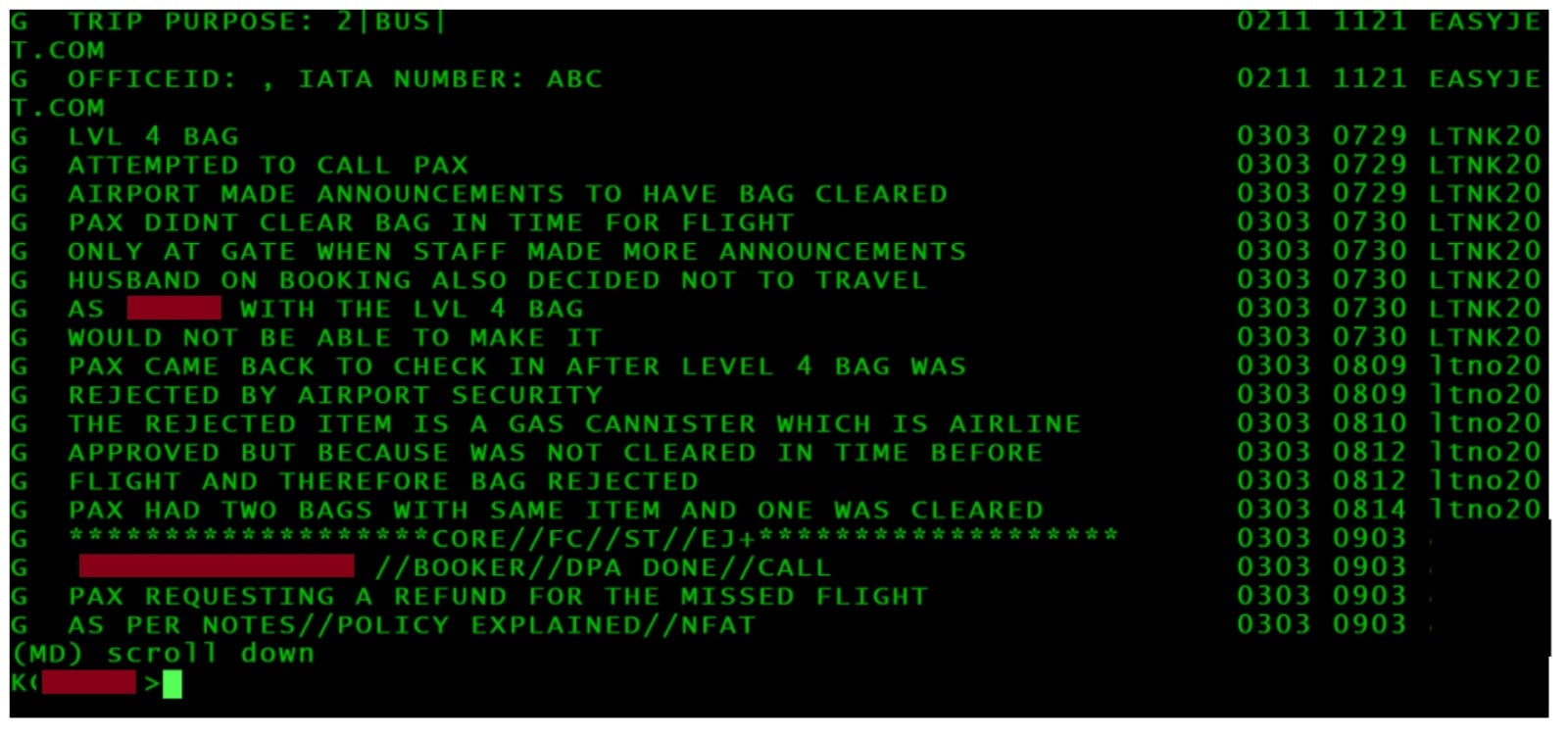
If 07:29 really was the first attempt to contact us, I find it very difficult to see how one minute later they could reasonably conclude that we had failed to comply with the security process.
I’m therefore going to make a Subject Access Request asking AviationADR for the underlying material behind those assertions, specifically:
- whether there were any announcements before 07:29;
- the exact time of every alleged announcement;
- what was actually announced;
- whose name was called;
- where it was broadcast;
- what number they supposedly tried to call;
- whether any call actually connected;
- any airport security / ground-handler records;
- and whether 07:29 / 07:30 are the actual event times or merely the times somebody entered notes into easyJet’s system.
I’d be very interested to know whether seeing the actual easyJet Defence Statement and these timestamps changes anyone’s view of the case.
In particular, would you consider an internal airline note saying “attempted to call pax” and “airport made announcements” sufficient on its own where the passengers categorically deny hearing or receiving any such communication?
0 -
I could be wrong but suspect that you may end up caught in between the airline and the airport, in that it's effectively the actions of the latter that led to you missing the flight, and therefore the airline is unlikely to be on the hook for incremental costs incurred?
In the absence of any other timestamps, it seems plausible that the airport security rejection of the bag was only apparent to EasyJet at or immediately before 07:29, and that therefore there was, as you say, no realistic prospect of resolving the matter before the gate closed at 07:30?
EasyJet's offer of transportation on their next available flight was then presumably effectively a goodwill gesture rather than the airline actually accepting liability for the situation?
0








Confirm your email address to Create Threads and Reply

Categories
- All Categories
- 355.8K Banking & Borrowing
- 254.9K Reduce Debt & Boost Income
- 456.2K Spending & Discounts
- 248.3K Work, Benefits & Business
- 605.9K Mortgages, Homes & Bills
- 179K Life & Family
- 263.7K Travel & Transport
- 1.5M Hobbies & Leisure
- 16.2K Discuss & Feedback
- 37.7K Read-Only Boards