We’d like to remind Forumites to please avoid political debate on the Forum.
This is to keep it a safe and useful space for MoneySaving discussions. Threads that are – or become – political in nature may be removed in line with the Forum’s rules. Thank you for your understanding.
📨 Have you signed up to the Forum's new Email Digest yet? Get a selection of trending threads sent straight to your inbox daily, weekly or monthly!
Doom scrolling and the next financial crash!
Comments
-
I think the only product which attempts to follow a true "whole market index" in the UK is Vanguard's FTSE Global All Cap Index Fund. That has, by Morningstar's measure, 0.81% in "Micro" stocks (for comparison, the S&P 600 is about 56% Small, 44% Micro). FTSE All World Index trackers have about 0.03% Micro. You can get coverage of smaller American stocks with an S&P 600 tracker, but it's hard to find global funds or ETFs that do. AVSG is 36% Micro, so a small holding in it can provide actual diversification needed for most of the "world trackers".
0 -
I prefer to tilt away from tech by going for Value or High Dividend indexes rather than Small or Mid Cap, but it really comes down to personal preference as we can't predict the future.
And so we beat on, boats against the current, borne back ceaselessly into the past.0 -
Whether it's a blip or the start of a trend isn't really answerable from 18 months of relative returns. It is just nice to get in just before a blip or start of trend, whatever it may be. If it is just a blip and cap-weighted equities continue to grow, then I'll be happy because they are 4x the weighting in my portfolio.
A few months (or even a year) of outperformance doesn't tell you much about valuation on its own. You'd need to look at where AVSG's holdings sit on various valuation metrics relative to their own history, as you could do for the top holdings in VWRP. I've not dug into that, and it wouldn't change what I do either way. Future performance is unknowable, and "is this a blip or a trend" is really a market timing question, which isn't the game I'm playing - it's a long term allocation, not a call on the next year or few years.
On the idea that F&F made it obvious, it got popular, got overpriced, and has underperformed ever since - I don't think the timeline supports that causal story. The original paper came out mid-1992. Investors who built small-value portfolios starting January 1993, right after publication, actually underperformed for the next seven years. If newfound popularity had repriced small value expensive, you'd expect that underperformance to just continue. Instead, the large-growth/dot-com trade unwound hard from 2000, and by April 2002 small-cap value's annualised return since January 1993 had moved back ahead of everything else, including the broad market. So there seems to be an element of coincidence, then the factor responded to a bubble unwinding in just the way it was anticipated.
You can examine US data going back to 1927 and small value has beaten the S&P by a few points a year on average. But there are decades like the 2000s where cap-weighted stocks underperform spectacularly and decades like the 2010s where cap-weighted stocks outperform spectacularly. But these are anomalies against that longer run, not the norm.
Is it popular and expensive right now? Possibly, but popular and expensive aren't the same thing, and I haven't seen anything suggesting AVSG's holdings are trading on high earnings multiples relative to their own history, and if you do then I'd like to see it. VWRP on the other hand…
On diversification, the constituents are already in the total market index at market weight, but they aren't in the S&P500, STOXX 600, etc, so I probably don't have overlap personally. This thread started from concern about mega-cap concentration, and that's exactly what tilting like this addresses: it's not diversification by adding previously-absent assets, it's diversification of exposure. You said the market as a whole has a wider spread of risk than AVSG. That's true of AVSG in isolation, but the market-cap index's spread is narrower than it's historically been. Add a small helping of AVSG to a broader portfolio and does it get more concentrated? I don't think so.
For what it's worth, my reasoning for holding it isn't a view that small value will outperform from here. I don't know that and wouldn't claim to. It's more that small-cap value tends to lag in momentum-led bull markets for large-cap growth (the 90s, and again the 2010s-20s) and tends to do relatively well in flatter, choppier markets where prior excess is being worked off (like the 70s or 2000s). My guess as to why is that in a flatter market there are always some out-of-favour stocks moving upward somewhere, and that has the potential to deliver a more consistent return profile decade to decade than the market-cap index, which is vulnerable to bubbles. It offers no protection at all in a recession though - it's still a risk asset, just a different flavour of risk. I think of it as there to do a job the rest of my portfolio can't when growth stalls.
0 -
That's true of AVSG in isolation, but the market-cap index's spread is narrower than it's historically been.
The number of quoted companies has shrunk due to mergers and fewer IPOs. I do not know what you mean by the market spread, but doubt that it is meaningfully reduced by merging companies. Having more companies owned by unquoted private equity on the other hand is not good.
Add a small helping of AVSG to a broader portfolio and does it get more concentrated?
The size of the mega caps is not a problem unless the market has overpriced them. You can say that overweighting small companies makes your portfolio "less concentrated". That does not help if others have done the same and pushed the price up before you buy. Overweighting small caps makes sense only if the market has underpriced them relative to the market as a whole.
0 -
Vanguard's prospectus says it is launching a super cheap ETF tracking the FTSE Global All Cap Index at the end of January. I think the AVSG advocates here are putting much more than a market weight into the fund. There was not much difference in the historical performance of the FTSE Global All Cap Index Fund and VWRP when I last looked.
0 -
To clarify, I wasn't referring to the number of listed companies or exchange IPO rates, but to weight concentration and sector/style distribution. I'm looking at distributing capital by weight between underlying holdings that aren't highly correlated with one another. But I do agree about private ownership concerns, and particularly the trend of later IPOs.
On your second point - that overweighting small caps only makes sense if the market has "underpriced" them - that treats factor allocation as a tactical market-timing bet. You don't need small-cap value to be temporarily mispriced for it to improve portfolio diversification, you just need its risk drivers to be distinct from mega-cap growth over the long term.
1 -
Here is a Vanguard article "What to consider when choosing between index weighting approaches":
Vanguard says that equal weighting does not reduce the risks. It changes them, which is true.
- Volatility: Equal-weighted indices can be more volatile than market-cap-weighted indices, as they are more sensitive to the performance of smaller companies – which tend to have higher volatilities than large-cap companies.
You can say that overweighting the small caps increases diversification (whatever that means), but if it increases volatility that increases the risk.
0 -
You're conflating two very different strategies here: equal-weighting a broad market index (e.g. S&P 500 Equal Weight) and a systematic factor tilt like small-cap value (AVSG). Vanguard's article addresses the former, which simply spreads weight equally across the exact same large-cap constituents. AVSG filters for entirely different fundamental risk factors (Size, Value, and Profitability).
Individual small-cap value stocks are going to be more volatile than mega-caps in isolation. But in portfolio construction, total risk depends on covariance (how assets move relative to each other). Adding a small allocation of a higher-volatility asset that isn't highly correlated with large-cap growth does not automatically increase overall portfolio volatility. It can actually smooth out portfolio-level returns over full market cycles.
By "risk", you seem to be referring to volatility, rather than structural risk. The risk that really matters is not the extent to which valuation can rise and fall in the short term, it's structural risk that creates things like lost decades. Just a reminder of the 3 funds with the same return and standard deviation example we've discussed before - it's hard to argue that these funds really have the same risk.
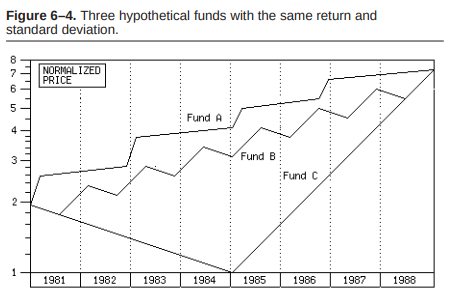
A small SCV allocation isn't about avoiding volatility, it's about ensuring the entire portfolio doesn't rely on a single macroeconomic narrative or market regime to generate returns, as that risks producing an outcome more like fund C. Even fund B with a bit more volatility than shown could be considered superior.
1 -
Interesting thread. I just checked Trustnet and the ISA is 38% US compared to the 70% plus of the global trackers, and supposedly 100% equities, but that can't be correct with a large chunk of PNL?? I'm happy with that "tech" ratio, ISA just breached 7 figures for the first time ever in the last few weeks.
The unwrapped is larger and also 39% US with a more believable 90% equity 10% mixed rating. Good enough to ride the wave. Cash is 5%.
0 -
Trustnet has tended not to be very good at classifying "non-subscribing" funds, which include many ITs.
1











Confirm your email address to Create Threads and Reply

Categories
- All Categories
- 355.8K Banking & Borrowing
- 254.9K Reduce Debt & Boost Income
- 456.2K Spending & Discounts
- 248.3K Work, Benefits & Business
- 605.9K Mortgages, Homes & Bills
- 179K Life & Family
- 263.8K Travel & Transport
- 1.5M Hobbies & Leisure
- 16.2K Discuss & Feedback
- 37.7K Read-Only Boards