We’d like to remind Forumites to please avoid political debate on the Forum.
This is to keep it a safe and useful space for MoneySaving discussions. Threads that are – or become – political in nature may be removed in line with the Forum’s rules. Thank you for your understanding.
Sigenergy hybrid inverter configuration





Hi,
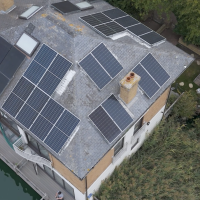
I'm thinking about a Sigenstor system. 20 panels across 4 roof aspects (N,S,E,W), all with different shade factors. I'm thinking of a 8 kW SP inverter to allow 3 strings of panels. If my DNO is limited to 3.6kW, do I have to have a 3.6kW inverter or can o/p to Grid be throttled to 3.6kW. If o/p throttled to 3.6kW, does this mean my house can only receive 3.6kW as well? Planning on installing an ASHP, so 3.6kW won't be enough in winter.
Many thanks.
Comments
-
I don't know anything specific about Sigenergy inverters, but your post has prompted questions of my own.
You've not had a response from the DNO yet, this is a hypothetical question?
If you've got four aspects, I think you'll need four MPPTs. If you only have three, I'd suggest discarding the North aspect panels.
How big a heat pump do you expect to need? 3.68kW would cover all operations of an 8kW HP and would deal with probably 95% of the running time of a 12kW HP.
N. Hampshire, he/him. Octopus Intelligent Go elec / Fuse gas / Vodafone BB / iD mobile. Kirk Hill Co-op member.Ofgem cap table, Ofgem cap explainer. Economy 7 cap explainer. Gas vs E7 vs peak elec heating costs, Best kettle!
2.72kWp PV facing SSW installed Jan 2012. 11 x 247w panels, 3.6kw inverter. 37 MWh generated, long-term average 2.6 Os.1 -
@QrizB Thanks. I haven't applied and am still at system design stage. ASHP will be 7.2kW on a 6.9kW heat loss house, so will be close to max in winter. I'm concerned about this running alongside electric oven, induction hob, washer, dryer, dishwasher, etc. 2 of the aspects are similar shade so could get away with 3 strings.
0 -
Assuming a COP of 3 in winter, if your heat loss is 6.9kW you will be drawing around 2.3kW continuously at those design temperatures, and maybe ~1.5-2kW continuous for much of the colder parts of Dec-Feb (I would also doubt a 7.2kW ASHP is capable of adequately meeting the needs of a property with a 6.9kW heat loss, but that's another discussion entirely best suited for the Heat Pumps forum)
As @QrizB says, wait and see what your DNO will allow. Apply for what you want and then you can tweak your system design from there.
I'm also not familiar with Sigenergy systems, but most systems should allow throttling of grid export to comply with DNO restrictions. The DNO can limit your inverter too, but often they will only limit the export.
However, I do agree you are right to be concerned about the inverter rating and how much power the battery/inverter can deliver to the house. In winter, it is not unreasonable to think you may be drawing 2kW for the ASHP, 3kW for an electric oven, 3kW for an induction hob, 3kW when boiling the kettle to make gravy, 1.5kW for the microwave etc. A 3.68kW inverter isn't going to come close to meeting peak house load when cooking a meal on a winter evening. What's the point of an expensive battery system that can't meet your peak house load and you end up importing from the grid at peak rate even when you have ample capacity stored in the battery.
Also, be aware that the SigenStor battery modules are limited to a charge/discharge rate of 50% of their capacity, so a 10kWh battery can only charge/discharge at 5kW regardless of the size of the inverter. This is a major limitation versus something like the Tesla PW3 that can discharge at the full 11.04kW inverter rating.
I am a Forum Ambassador and I support the Forum Team on the Benefits & tax credits, Heat pumps and Green & Ethical MoneySaving forums. If you need any help on those boards, do let me know. Please note that Ambassadors are not moderators. Any post you spot in breach of the Forum Rules should be reported via the report button, or by emailing forumteam@moneysavingexpert.com. All views are my own & not the official line of Money Saving Expert.2 -
I am not a fan of Sigenergy for 4 main reasons:
- Inverter is hardware sized (as in your case) vs. software programmed (eg. Tesla, SolarEdge) in the event of future increase in DNO export allowances. This forces an expensive replacement inverter instead of a cost free installer software change.
- Internal optimizers between cells. Good luck with aftersales when those fail!
- On that note, have a read of the comments from people who have invested in the brand.
- Fire risk
I am aware that several installers and influencers are promoting the brand as a Tesla alternative, in exchange for generous financial compensation (kickbacks or higher profit %) but it cannot compare where it matters.
A few additional points:
- I agree with @QrizB that the North aspect should go. Pure North aspects generate ~50% (+/- 5%) of a South facing aspect.
- If you haven't applied for the full 11KWh export allowance, I recommend going with a Tesla installer instead. I track the results for the people I help and around 30% achieve the full 11KWh allowance with 65% securing 8KWh or higher. DNOs appear to be responding to Tesla's investment in educating them about the grid balancing merits of the PW3. When paired with the right tariff, a higher export allowance can drastically improve the payback of a high end system.
- Tesla has a unit replacement warranty and has a track record of replacing a rarely failed PW2 with a new PW3. Sigenergy does not and as the above link should highlight, does not have a track record of treating their customers well when faults develop.
- Tesla is registered as a UK utility company. There is a near zero chance of a Chinese owned company being allowed supplier access to the UK grid. While I have only heard murmurs from employees during in person conversations, I expect Tesla will offer class leading tariffs exclusively for their hardware as they once did via Octopus. This is being done to avoid competing on price with brands like Sig etc.
- If your property heat loss is 6.9 KW, you will need a larger output heat pump. Most installers, including heat geeks, would recommend a 10KW Vaillant Arotherm Plus or the 9.5 KW Viessman Vitoal 200-A A10.
- 10 x 400w LG Bifacial + 6 x 550W SHARP BiFacial + 2 x 570W SHARP Bifacial + 5kW SolarEdge Inverter + SolarEdge Optimizers. SE London.
- Triple aspect: ENE (2.7 kWp), WSW (3.3 kWp), SSE (2.4 kWp)
- Viessmann 200-W on Advanced Weather Comp. (The most efficient gas boiler sold)Feel free to DM me for help with any form of energy saving! Happy to help!1 -
If you've got four aspects, I think you'll need four MPPTs. If you only
have three, I'd suggest discarding the North aspect panels.For reference, the Sigenergy single phase 10kW and 12kW inverters have 4 MPPTs which would allow for all four aspects should that north facing aspect be deemed beneficial. This is one area where the Sigenergy 10kW and 12kW inverter specs beat the Tesla Powerwall inverter spec.
I am a Forum Ambassador and I support the Forum Team on the Benefits & tax credits, Heat pumps and Green & Ethical MoneySaving forums. If you need any help on those boards, do let me know. Please note that Ambassadors are not moderators. Any post you spot in breach of the Forum Rules should be reported via the report button, or by emailing forumteam@moneysavingexpert.com. All views are my own & not the official line of Money Saving Expert.2 -
I'm not sure about the last sentence. Even if two aspects have similar shading, if they don't share the same approx orientation and pitch, then the poorer performing aspect may drag down the better at any given time.
So maybe just 3 aspects, or perhaps a Solaredge setup where each panel operates individually.
Thinking about it, you probably want to get a system where it can cap export (for example at say 3.68kW), but not output through the inverter, to allow greater power for household demand, whilst still throttling when export reaches any DNO limit.
Mart. Cardiff. 8.72 kWp PV systems (2.12 SSW 4.6 ESE & 2.0 WNW). 28kWh battery storage. Two A2A units for cleaner heating. Two BEV's for cleaner driving.
For general PV advice please see the PV FAQ thread on the Green & Ethical Board.2 -
This is spot on ^
- 10 x 400w LG Bifacial + 6 x 550W SHARP BiFacial + 2 x 570W SHARP Bifacial + 5kW SolarEdge Inverter + SolarEdge Optimizers. SE London.
- Triple aspect: ENE (2.7 kWp), WSW (3.3 kWp), SSE (2.4 kWp)
- Viessmann 200-W on Advanced Weather Comp. (The most efficient gas boiler sold)Feel free to DM me for help with any form of energy saving! Happy to help!2 -
I'd also think about battery storage (or at least an inverter that is suitable for battery storage in the future) to make use of cheaper off peak electricity. Think about how much electricity you'd need on a typical winter day and the length of off peak windows.
For example I have a Sunsynk 8 kW hybrid inverter and am on Octopus Go which has a five hour cheap rate so potentially I could put about 40 kWh of cheap electricity into batteries every 24 h.
Solar install June 2022, Bath
4.8 kW array, Growatt SPH5000 inverter, 1x Seplos V3 battery 15.2 kWh, 1x Seplos V4 battery 16.1 kWh.
SSW roof. ~22° pitch, BISF house. 12 x 400W Hyundai panels. Hyundai Kona 64 kWh EV.2 -
Wouldn't that depend on the Sunsynk batteries being able to charge at 8KW per hour? I know of few batteries that can charge at > 5KWh or 30KW during a 6 hour window.
- 10 x 400w LG Bifacial + 6 x 550W SHARP BiFacial + 2 x 570W SHARP Bifacial + 5kW SolarEdge Inverter + SolarEdge Optimizers. SE London.
- Triple aspect: ENE (2.7 kWp), WSW (3.3 kWp), SSE (2.4 kWp)
- Viessmann 200-W on Advanced Weather Comp. (The most efficient gas boiler sold)Feel free to DM me for help with any form of energy saving! Happy to help!1 -
I know of few batteries that can charge at > 5KWh or 30KW during a 6 hour window.
A sweeping generalisation, but most batteries are happy charging at C/5 (or better). If you had 40kWh of storage, it's likely that you could charge it at 8kW.
The Sunsynk W5.3, as an example, has a capacity of 104Ah (5.3kWh) and has a recommended charge rate of 50A (2.4kW). That's very nearly C/2.
If you had eight of those, to give 40kWh of storage, your recommended charge rate would be up to 19.2kW.
(The maximum charge rate on the datasheet is 100A but I wouldn't expect routine charging at that rate to be conducive to battery life.)
N. Hampshire, he/him. Octopus Intelligent Go elec / Fuse gas / Vodafone BB / iD mobile. Kirk Hill Co-op member.Ofgem cap table, Ofgem cap explainer. Economy 7 cap explainer. Gas vs E7 vs peak elec heating costs, Best kettle!
2.72kWp PV facing SSW installed Jan 2012. 11 x 247w panels, 3.6kw inverter. 37 MWh generated, long-term average 2.6 Os.1







Confirm your email address to Create Threads and Reply

Categories
- All Categories
- 355.7K Banking & Borrowing
- 254.9K Reduce Debt & Boost Income
- 456.1K Spending & Discounts
- 248.2K Work, Benefits & Business
- 605.8K Mortgages, Homes & Bills
- 179K Life & Family
- 263.6K Travel & Transport
- 1.5M Hobbies & Leisure
- 16.1K Discuss & Feedback
- 37.7K Read-Only Boards