We’d like to remind Forumites to please avoid political debate on the Forum.
This is to keep it a safe and useful space for MoneySaving discussions. Threads that are – or become – political in nature may be removed in line with the Forum’s rules. Thank you for your understanding.
RTS meter replacements: A fact finding mission.
Comments
-
That doesn't look like an all-in-one to me. That looks like a conventional dual-rate meter with an external time switch. Normally used with an electromechanical time switch, but could instead be used with an RTS one.
Where is the RTS box? Is it separate from the meter?
N. Hampshire, he/him. Octopus Intelligent Go elec / Fuse gas / Vodafone BB / iD mobile. Kirk Hill Co-op member.Economy 7 cap explainer. Gas vs E7 vs peak elec heating costs, Ecoflow Stream, Best kettle :-)
2.72kWp PV facing SSW installed Jan 2012. 11 x 247w panels, 3.6kw inverter. 37 MWh generated, long-term average 2.6 Os.0 -
yes, it is right beside the meter
0 -
@QrizB asked:
Where is the RTS box? Is it separate from the meter?
and @Cailleach26 replied:
yes, it is right beside the meter
Thanks for clearing that up. My last concern, about the RTS unit being mounted elsewhere, happily doesn't apply. Does this mean, then, that you are billed only for Normal and Low usage, with the offpeak (Low) timings determined by the RTS? Or is there a separate 'Heating' meter in the RTS box, also billed separately?
Thanks, too, for the photo. Sadly, it doesn't really tell us much. FYI, see my next post.
I'm not being lazy ... I'm just in energy-saving mode.
If you're asked to post a photo of your meter Meter Configuration Tables v2.0.xlsx2 -
Meter photos
When one or other of the regulars in this forums asks for photos of 'the meter', what we really need is, ideally,
- A close-up of the meter itself (with the display lit up by touching a button if necessary) clear enough to be able to read the display and all the markings on the meter itself. If it's a smart multi-rate meter (e.g. configured for Economy 7), give the precise time the photo was taken;
- A view of the whole backboard or meter box so we can see the main supply cable coming in from outside, and all the cables to and from the meter itself, along with any other equipment mounted there;
- If it’s not clear from the previous photo, if possible a close-up of any meter exchange label - the card left by the engineer giving the numbers and readings of both the old and new meters (assuming he did leave one, as he’s supposed to do);
- A view of each consumer unit (fuse box) with the lid propped open, clear enough to be able to read any labels the electrician may have left to say which breaker is which.
This will usually be enough, but there may be a need for more photos in specific cases, like of an RTS unit somewhere else or of time controls for space- or water heaters.
NB: The meter itself should have its serial number (MSN) printed on the front of it; nowadays, the MSN always starts with the year of original certification often followed by a letter or two and more numbers, but older meters' MSN may have a different format. This number can be used by anyone who knows how to reveal not only who the supplier is, but also the address where it's installed. You may want to obscure it before posting a photo of the meter itself.
I'm not being lazy ... I'm just in energy-saving mode.
If you're asked to post a photo of your meter Meter Configuration Tables v2.0.xlsx5 - A close-up of the meter itself (with the display lit up by touching a button if necessary) clear enough to be able to read the display and all the markings on the meter itself. If it's a smart multi-rate meter (e.g. configured for Economy 7), give the precise time the photo was taken;
-
@[Deleted User] suggested:
Also often useful, depending on the context of the request, is that the image clearly shows the make & model of the meter, and the certification date.
Thanks. I rather hoped that was covered by "… clear enough to be able to read the display and all the markings on the meter itself."
I'm not being lazy ... I'm just in energy-saving mode.
If you're asked to post a photo of your meter Meter Configuration Tables v2.0.xlsx3 -
I think we've moved off (the original) topic a bit. I started the thread to gauge a bit where (in which rooms, which positions) so-called "upgrades" were installed. Because from what I've seen in our region, installers just replaced the traditional meters with smart meters in exactly the same location, irrespectively whether these locations met the criteria of the local DNO for new or replacement installations. Hence I wanted to see how widespread this is.
The reason why I put a focus on the RTS meter replacements: 1. They are common in our remote region, very common. 2. The push for smart meters were pretty aggressive, in a manner of "no matter what".
The background for 1.: Cold climate, no gas grid, fuel poverty rife, many people just have storage heaters and an open fire, and for 2.: High costs associated with sending engineers to such remote locations, so the push was to get the job done even if corners may have to be cut, suppliers were not keen to return after required remedial work would be undertaken.
The individual set-up of my meter isn't particularly relevant in this context. It is for me, obviously, because the RTS box (when it still received a signal) used to switch the meter mode to "night" and only then the storage heaters came on. They were wired not to be operational outside these off-peak hours (no booster switch). Bills were based on what was recorded for day (peak) and what was recorded for night (off peak). The "benefit" of this was that during "night" ALL electricity consumption was cheaper (from dishwasher, washing machine, lights, everything). But obviously the day (peak) rate was high. Since the RTS signal has gone, the meter remains in "day" mode. I spare you the details to what muddy fight with my supplier this had led when it comes to billing, I've raised legal action and therefore don't need to discuss it here.
So back to the original topic: Odd places where smart meters as replacements were installed?
0 -
Since the RTS signal has gone, the meter remains in "day" mode.
I'm pretty sure that, whenever we warned smart meter opponents that their RTS meters might get stuck in "day" mode, one of the former regulars on this forum claimed this would never happen. It's a shame he's not around to find out it does.
(I'm not accusing you of being opposed to smart meters, but what has happened to you was entirely foreseeable and it's unfortunate that you weren't able to have your meter replaced sooner.)
The "benefit" of this was that during "night" ALL electricity consumption was cheaper (from dishwasher, washing machine, lights, everything).
That's entirely normal for E7-type tariffs. It's only obsolete "complex tariffs" that have entirely separate metering for stored heat.
I spare you the details to what muddy fight with my supplier this had led when it comes to billing, I've raised legal action and therefore don't need to discuss it here.
I have a vague recollection that Ofgem has issued guidance that allowe suppliers to bill RTS meters on the flat rate. @Scot_39 does this sound familiar to you at all?
N. Hampshire, he/him. Octopus Intelligent Go elec / Fuse gas / Vodafone BB / iD mobile. Kirk Hill Co-op member.Economy 7 cap explainer. Gas vs E7 vs peak elec heating costs, Ecoflow Stream, Best kettle :-)
2.72kWp PV facing SSW installed Jan 2012. 11 x 247w panels, 3.6kw inverter. 37 MWh generated, long-term average 2.6 Os.1 -
@Cailleach26 Sorry if you didn't find all of the responses you've had equally helpful. I had misunderstood the purpose of your post, which on re-reading appears mainly to express concern for the meter engineer's health and safety. While this is of course admirable, the ones I've come across are quite capable of looking after themselves.
@Cailleach26 wrote:
… our local authority … already have come across installations in our region that should not have gone ahead and where the meter position should have been moved to facilitate safe and correct installation.
I've come across reports of a number of installations in awkward spots. Yes, there are guidelines about, for example, distance from the floor. But a capable and resourceful meter engineer, if forewarned about the situation, will make light work of most situations. It might take ladders with mis-long legs to facilitate work in stairways, for example, or mini-scaffolds to provide a safe platform for working at height.
It's not immediately apparent why the DNO should be concerned about the location of a new meter, so long as it's not more than about 3m away from the service head. Even if it were, the installing engineer would know what extra measures would be necessary.
EDIT to add:
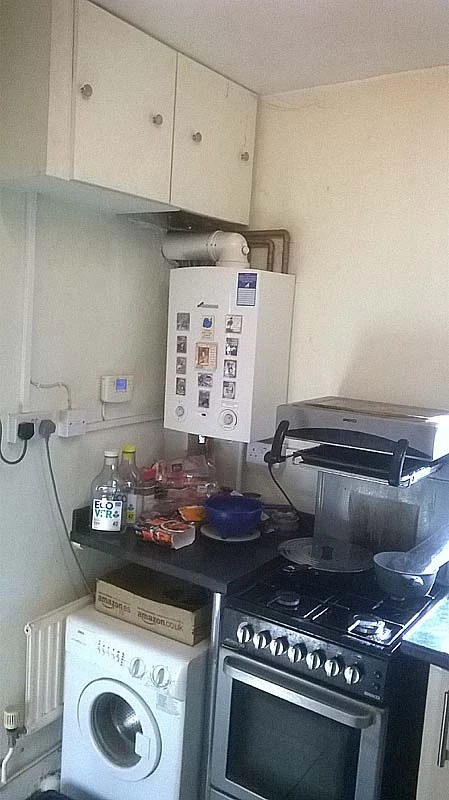
The customer in this case reported "the engineer turned up on the scheduled day and did an excellent job, carefully balancing with one foot on his stepladder and one one the worktop when needed" to reach and exchange the meter in the right-hand cupboard above the boiler/
I'm not being lazy ... I'm just in energy-saving mode.
If you're asked to post a photo of your meter Meter Configuration Tables v2.0.xlsx1 -
I am just answering the last two posts in one go…
Health and safety of an installer: it is their job and their employer's job to make sure they are not exposed to any dangers. Therefore it is up to them whether they want to balance on stepladders or on worktops and take risks. It is not my responsibility.
I am not particularly keen on a smart meter inside the house, you could probably guess that. The location of the RTS meter could be tolerated, but the RTS meter didn't need to communicate with anything. The whole point of a smart meter is that it can communicate. Dumb mode (that isn't completely dumb) doesn't make much sense. In the core of a remote house where no signal whatsoever gets through (up here smart meters use the mobile phone network that is patchy or even absent), a smart meter isn't smart.
It would only make sense if installed outside in a meter box where it may get at least some faint signal. Even this isn't really guaranteed… normally I get a (weak) signal when I walk about a mile to the next road.
So, whilst accepting that there is not really a way to avoid a smart meter in the long term, it was myself who reached out to the DNO to find out what best to do. When they assessed the situation, they stated clearly, that the installation of a smart meter in the location of the old RTS meter was not permitted. If installed indoors, it must be on the internal side of an outside wall. Where it is suitable. Both bathrooms have an outside wall. You can't install a meter in a bathroom. One bedroom has an outside wall. With a chimney. And a large window. Also the DNO excludes bedrooms (and rightfully so!) for meter installations. Our DNO also doesn't permit it in kitchens (concerns about vapours/dampness from cooking), or in attic rooms. Aside from that I wouldn't want a meter in my living room, the outside walls wouldn't be suited, again a huge chimney and large windows.
After all this consulting it was clear that the only way that I could get a smart meter installation at all would be to move the supply outside, on a wall in an external meter box. However, previous owners had "buried" the existing supply in such a stupid way that half of the house would need to be taken down to get to it and extend in to the planned new position. Hence DNO said they would have to re-route the supply completely from one of their overhead poles nearby with cables going underground and then to the front of the house. Quite some trench digging involved. I was quoted 15.400 £.
For over a year I had tried to discuss with my (useless) supplier the technical barriers. They didn't listen. They didn't care. All they cared was to push for a smart meter installation despite the DNO saying that a simple replacement wasn't possible. Not in the current position of the RTS meter. And nowhere else indoors. I didn't build this house. I didn't extend this house over and over again. I just have to accept the characteristics of this house.
So, it is not a simple matter of someone who tries to resist a smart meter which some do for not particularly valid reasons. But, would anybody want to fork out such a substantial amount of money for something the government wants you to have? The supplier wants you to have so their reach their installation target?
Nope. Not acceptable.
Also, what happened to the voluntary nature? Not so voluntary for people with RTS meters…
The comment about "foreseeable" getting stuck in peak rate. There was some scaremongering going on… people were encouraged to get a smart meter because their "heating and hot water may not work", their bills might increase because they "might be moved onto a single rate" (how I wish my supplier had done this!), their bills might be higher because their suppliers wouldn't know what consumption was day and what was night and might therefore estimate.
Nobody ever mentioned that (some) suppliers might resort to simply charging peak rate all day round without even an attempt to estimate and that they would refuse a single tariff.
I HAD in fact required a single tariff (and the terms and conditions of my supplier explicitly state it is available) until the technical barriers were solved. They didn't care. They still don't.
This is why I am raising legal action.
1 -
So, things become a bit clearer - thank you.
I'm still not convinced that the location of the meter is any of the DNO's business. Their responsibility ends at the service head, so they don't have to give permission for the installation. That's the supplier's headache (it was different in the old days when the electricity board was judge, jury and executioner …).
You say that ' … up here smart meters use the mobile phone network'. The first smart meters were installed in 2012, IIRC. The first smart meters to use a 2G/3G/4G connection were installed experimentally in, I think, 2024. so using a 'mobile phone network' is a new phenomenon. There are several ways of improving the connection between a meter and the SMWAN, with the latest - called VWAN - still in testing. This piggybacks on the household's broadband connection. Meanwhile, there are aerials and repeaters and flying leads to improve the odds.
You mentioned that '… the RTS meter didn't need to communicate with anything'. The R in RTS shows that the RTS unit did indeed need to be in radio communication with an Arqiva mast. OK, it was only one way, but that still counts as communication.
The 'scaremongering' that you claim was used to encourage RTS customers to upgrade to a smart meter was largely legitimate, mostly because no-one could say precisely what would happen when the signal was switched off. It would depend on so many factors that 'any or all of the above' could have happened. If the RTS system was still in place when the signal stopped, customers should have contacted their supplier to say what was happening. Otherwise, the supplier would have no way of knowing which of the scaremongers' scenarios had taken over.
What has the ombudsman had to say about your supplier's apparent overcharging?
I'm not being lazy ... I'm just in energy-saving mode.
If you're asked to post a photo of your meter Meter Configuration Tables v2.0.xlsx0









Confirm your email address to Create Threads and Reply

Categories
- All Categories
- 355.7K Banking & Borrowing
- 254.9K Reduce Debt & Boost Income
- 456.1K Spending & Discounts
- 248.3K Work, Benefits & Business
- 605.8K Mortgages, Homes & Bills
- 179K Life & Family
- 263.6K Travel & Transport
- 1.5M Hobbies & Leisure
- 16.2K Discuss & Feedback
- 37.7K Read-Only Boards