We’d like to remind Forumites to please avoid political debate on the Forum.
This is to keep it a safe and useful space for MoneySaving discussions. Threads that are – or become – political in nature may be removed in line with the Forum’s rules. Thank you for your understanding.
I give up




What's the point?
Comments
-
From a quick search the average state pension figure I get is ~£185. Where does that graph come from. It's surprising to see a greater than £20k state pension for 9% of people.
0 -
https://www.gov.uk/government/statistics/pensioners-incomes-financial-years-ending-1995-to-2024/pensioners-incomes-financial-years-ending-1995-to-2024
0 -
Don't we already have different increases for different bits of the state pension? Isn't the protected payment element excluded from the triple lock?
If this sort of thing was to be done I suspect it would be done by having different increases for Pension Credit than for the State Pension. That way the benefit of the extra increases could be "targeted to those who need it most".
The people who have the higher rate of state pension will be those with a lot of contracted in service. I think on here it is said that they lost out with the 2016 changes.
0 -
I don't believe the triple lock will last forever, but it will be impossible to replace it with something that is acceptable to all parties.
Losing the triple lock wouldn't be a disaster for us, but it could be for those on lower incomes. However, introducing some form of means testing, such as giving higher rises to those on less than £X per year, goes against one of reasons for introducing the new single tier pension. ie, greatly reducing means testing, as once we are out of the lengthy transitional period, the majority of pensioners will be on the single tier pension, which is just a couple of £s over the Pension Credit means test limit.
Even changing the triple lock to a double lock in 2022 caused a major drama, even though the decision to ignore the salary increase figure for that year was the right thing to do. Everytime someone whinged about this, I would explain why it happened - because, during the worst of Covid, many of those who couldn't work still received 80% of their salaries. Then, when they returned to work, their salaries were reinstated at the full amount. All these 20% 'increases' then artificially inflated the overall salary increase figure, which is why it was discounted. But some people are still bitching about it.
4 -
Not with the new pension, which will eventually be all pensioners. I believe it is the case with the old pension.
Pension credit already makes those who are only just below the threshold for receiving it much better off than those who are just above and very many people still don't claim it, which is probably why the government like it.
Anyone with SERPS or SP2 credits before 2016 kept them with the new pension. Well, I did anyway, though it didn't amount to much in my case; last time I saw a separate figure it was £11 a week for me.
0 -
Don't we already have different increases for different bits of the state pension? Isn't the protected payment element excluded from the triple lock?
Yes and yes, as I understand it. (I was going to say something similar but saw you'd already made the point!)
N. Hampshire, he/him. Octopus Intelligent Go elec / Fuse gas / Vodafone BB / iD mobile. Kirk Hill Co-op member.Ofgem cap table, Ofgem cap explainer. Economy 7 cap explainer. Gas vs E7 vs peak elec heating costs, Best kettle!
2.72kWp PV facing SSW installed Jan 2012. 11 x 247w panels, 3.6kw inverter. 37 MWh generated, long-term average 2.6 Os.0 -
So my suggestion is that while all state pensions increase in line with CPI [or wages if you prefer] meaning everyone is better off
in real terms [before tax anyway], that part of anyone's pension up to £241.30 a week still benefits from the triple lock, therefore gradually raising the relative income of the worst off pensioners.I'm thinking it's easier to do this - and to make the argument for it - than doing away with the lock completely for any pension of more than
£241.30 a week, though I can see a justification for that and wouldn't argue against it if the cliff edge isn't too problematical.That is how the new state pension currently works, anything up to the new full SP amount is uplifted with the triple lock and anything above that, the protected payment, is uplifted by cpi.
The old SP works in a similar way in that any basic pension is uplifted by the triple lock and any additional pension is uplifted with CPI.
There is already a benefit, pension credit, for poorer pensioners and that can be worth way more than any increased pension. A reason why on here anyone who will be reliant on just the SP below the full amount is recommended not to buy additional years as that could actually leave them worse off.
Never associate with idiots on their own level, because, being an intelligent man, you'll try to deal with them on their level - and on their level they'll beat you every time.
Being hated by idiots is the price you pay for not being one of them.
Jean Cocteau 1889-1963
0 -
Sure but the people who get the higher amounts of state pension will all be on the old pension for all or the greater part of their working life. Your suggestion will not bite on anyone who only has the new state pension.
0 -
But if those on low state pensions kept the triple lock they would be gradually be lifted out of - or further away from - pension credit territory, so means testing would diminish.
You say losing the triple lock would be a disaster for some but you don't need it, so isn't finding some way of keeping it for the poor and ending for the better off a reasonable idea?
0 -
Here is the most recent data available from DWP.
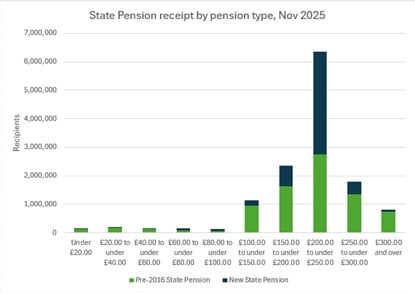
Most of those with incomes below £200 p/w are on the old State Pension, which receives Triple Lock on £184.90 of income and CPI on amounts beyond that. Most of these will be women, and all will be aged over 74. When their husbands die, most will get a higher amount via inherited pension.
So this policy could cost rather than save money, as it would expand the Triple Lock to those below £241 p/w. Although the savings from lower increases would probably outweigh the additional cost, albeit that there would not be any meaningful amount of savings until years into the future.
It has long been debated the merits of earnings-related State Pension at one extreme, and universal pension (ie no contributory requirement) at the other. Since 1978 we have steadily moved away from earnings-related and towards universal. In 2002, State Second Pension replaced SERPS, and added a lot more credits for non-workers, and a boost for the lowest earners. Over time the years needed for a full State Pension has dropped from 44 to 35 (setting aside complications arising from the transition to new State Pension).
It is now quite hard for newly retiring pensioners to avoid having a full State Pension if they have lived in the UK all their life, with many credits available for children, benefit receipt and disability during working life, and only 35 qualifying years needed. So any further moves toward universalism, which this policy would be, would favour those who spent long periods outside the UK in their life. That may not be politcally attractive at the current time.
Also consider the lead in time to enact and implement reforms, and sadly a very large proportion of recipients of the pre-2016 State Pension would be dead by the time the change came into effect. As can be seen in the chart above, it is pre-2016 pensioners that mostly have pensions under £200 p/w.
Changes that preserve Triple Lock on amounts up to the current level would only produce meaningful savings long into the future. No government is going to take the political hit such a policy would produce without benefitting from savings in the short-term. Don't underestimate how little people understand the details of policies - it would be easy for opposition parties to pin the badge of "Thieves Reeves stole your pension" or other such nonsense name-calling that we have descended into.
The policy could also further undermine confidence in the long-term future of the State Pension, by introducing the first bit of means-testing (of a kind) into the system.
Also worth noting that it would be another detriment to those who chose to be contracted in and so got a higher State Pension, compared to those who contracted-out and so have a lower State Pension.
5










Confirm your email address to Create Threads and Reply

Categories
- All Categories
- 355.6K Banking & Borrowing
- 254.8K Reduce Debt & Boost Income
- 456.1K Spending & Discounts
- 248.2K Work, Benefits & Business
- 605.8K Mortgages, Homes & Bills
- 179K Life & Family
- 263.5K Travel & Transport
- 1.5M Hobbies & Leisure
- 16.1K Discuss & Feedback
- 37.7K Read-Only Boards