We’d like to remind Forumites to please avoid political debate on the Forum.
This is to keep it a safe and useful space for MoneySaving discussions. Threads that are – or become – political in nature may be removed in line with the Forum’s rules. Thank you for your understanding.
Increased power consumption following Solar PV installation
Comments
-
Actual figures from May to illustrate. Production estimate 959 kWh actual 901 (+6.4% error). Export estimate 717 actual 740 (-3.1%). Import estimate 103, actual 105 (-1.9%).
Actual house consumption was therefore 105 + 901 - 740 = 266
Estimate from inverter figures 103 + 959 - 717 = 345 (29.6% error)
1 -
your conclusion is potenially erroneous. Are you assuming one of those readings is correct.
You have a query about possible increase in consumption since installation. You have one constant, the Octopus smart meter readings that is calibrated so you have a method of comparing a consistent before and after quantity measurement system that will still be accurate by design.
The crux is whether the apparent consumption increase is real or just not very accurate. Comparing two uncalibrated sources and ignoring the calibrated source of data is a poor way to go about your question. The two uncal sources ( smart plug and inverter) might both be wrong but useful indicative data.
It is quite possible ( nay certain!) that your 1200watt hair dryer is not drawing that amount of power. For various reasons -such as supply voltage, heating element temperature variation etc- it will be different....... so now you are comparing three unknowns quantities.
That is why I have suggested comparing the unknown accuracy methods with the known one, the Octopus 30 minute data. Using those periods for comparison virtually avoids data sample rate errors too that are inherent in other short duration readings as mentioned in other posts, plus the accumulation of accuracy errors also mentioned above.
1 -
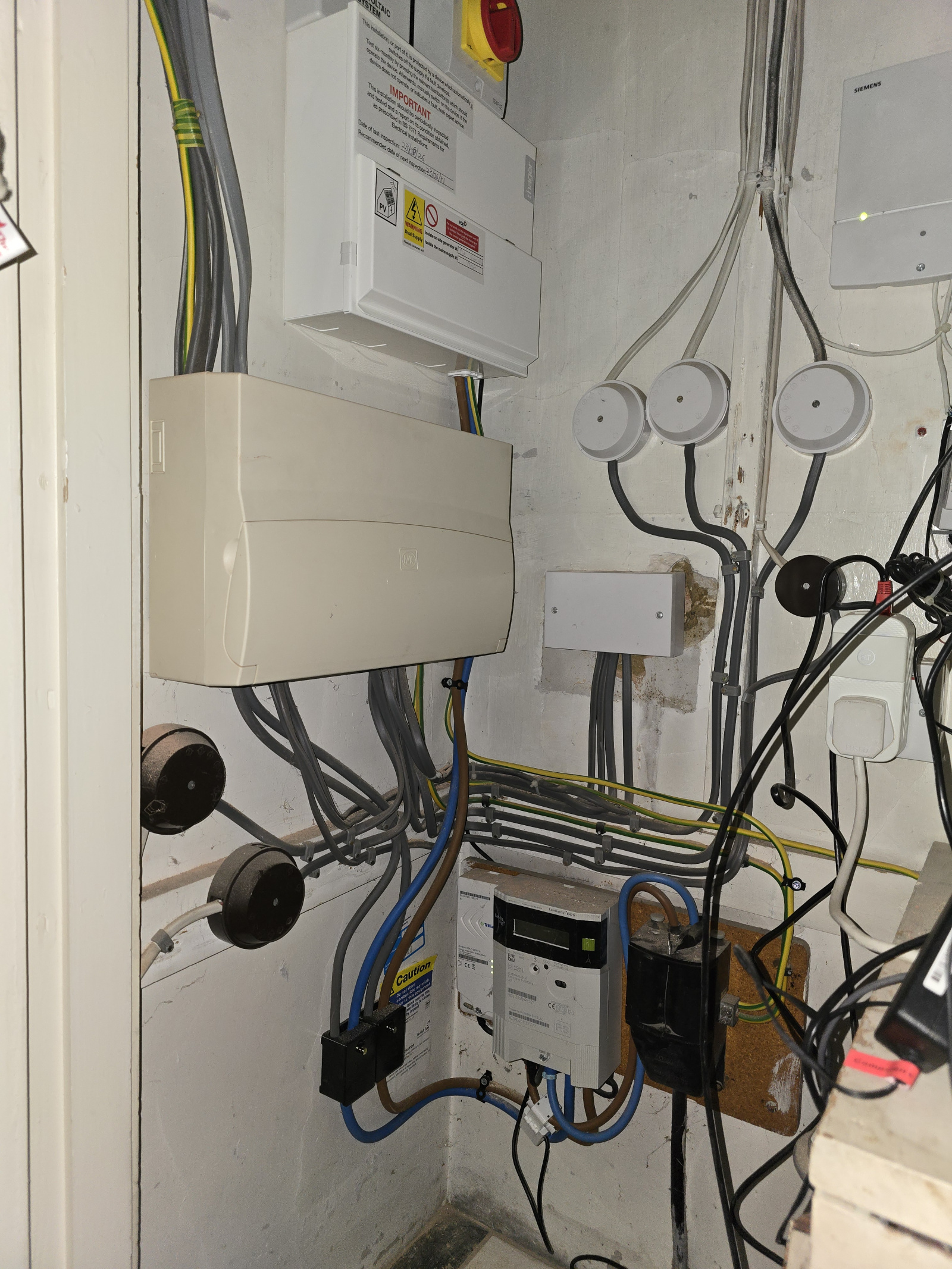
I don't know exactly how the system is wired I'm afraid - the cabling in the meter cupboard is a bit of a vipers nest at the moment. The consumer unit installed with the solar PV system is top left. The main consumer unit is below it.
I don't know how the inverter derives its house load figure. I do know that there is always a small power draw from the grid (single digit watts), even when there is masses of excess solar energy being generated. For example at 9:30 this morning the app reported a house load of 676W, Solar generation of 3.91kW, Battery charging at 3.23kW, and a grid import of 3W.
 0
0 -
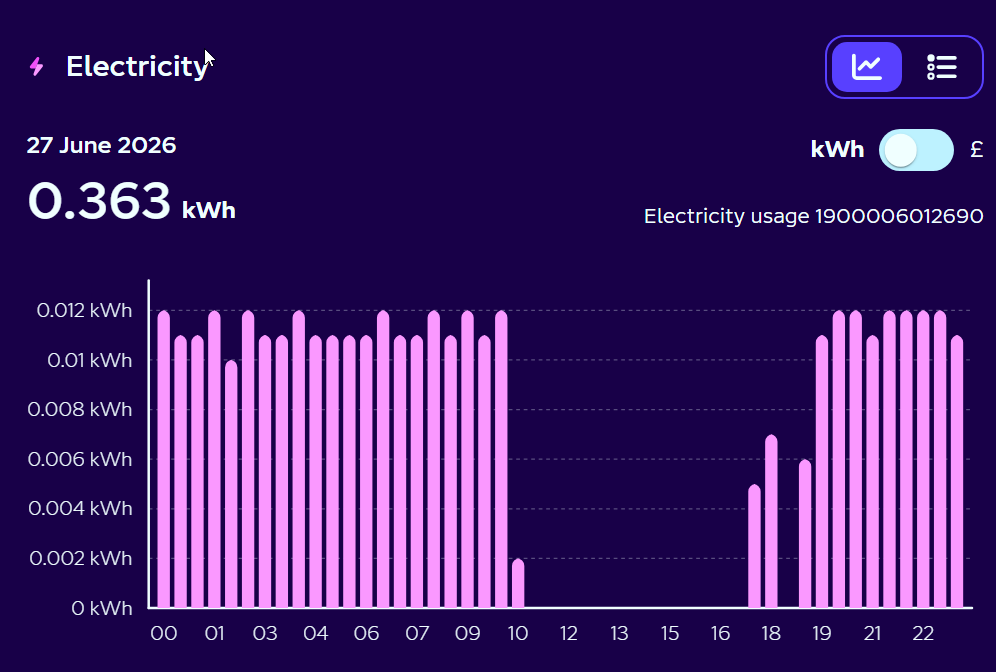
Unfortunately the Octopus 30 minute data which I have been downloading reports energy being imported from the grid, rather than the actual house load. So for most of the day that figure is going to be skewed by the contribution of solar or battery usage. For example, if you look at Saturday's data from Octopus it shows zero consumption for much of the day (when the sun was out), and reduced consumption for the rest of the day when the battery was discharging. Data downloaded to CSV shows the same thing,
I don't know of any other way of deriving actual house consumption from the Octopus data.
 0
0 -
That's an interesting question. The battery is a Fox-ESS EP12, which does have a heating option. According to the app it is currently turned off, however.
0 -
I've just reported this to the installer and they responded with:
"Please leave this with us and we will come back to you ASAP with a solution / further comment.
We are working on this with FOX now"So I'm wondering if I am not the only one experiencing this issue…
0 -
I don't know of any other way of deriving actual house consumption from the Octopus data.
Turn off the solar, the battery and the inverter; then Octopus will measure your house consumption. Turn on the inverter and you can discover how much power it uses itself as measured by the Octopus meter.
0 -
You can ignore the 3w figure. It is so small to be irrelevant and will be a measurement zero error or the power used to power the smart meter. You should be interested in the large differences rather than such a small figure.
Regarding the Octopus figures being 'skewed' they are reporting g as you say energy drawn from the grid. There have been several posts now advising you how to get it to report the house consumption figures by switching off/ isolating the solar/battery/inverter for one or more of those 30 minute periods thus the grid draw when those are off is the consumption.
Start from that position and sequentially for 30 minute periods add them back in ( eg on the hour and half hours ) to get comparisons with the Octopus readings and thus see if they are accurate enough to use them to make decisions and also then see why there are differences. Little point jumping to conclusions as to the possible reasons without that basic data.
If you do not understand that or how to do it please just say so. Many posters here to help and very willing to do so.
0 -
Thanks for that.
I was hoping there might be a way of diagnosing this without actually turning it off. TBH I'm a little nervous about switching off the inverter myself, as the installer had problems connecting it to my account when first installed, and couldn't work out why the display was showing "mode off" after powering it on. I'm concerned that if that happens again after restarting it I'll be left stranded until I can convince the installers to come back and take a look.
In the meantime the installers have responded again with this update:
"I have spoken with *******@fox-ess.com at FOX who is pushing through a software update. Sometimes after initial install the system will behave erratically until it gets its bearings. We are going to monitor the input load over today and tomorrow and then may need to review the CT clamp position.
Please bear with whilst we make these changes"
0 -
That's good that you are getting support from the installers.
I can understand your nervousness switching things off if there have been start up problems. In thar case if they visit get them to cycle everything off and on a few times to make sure things are stable.
Everything ought to be 100% reliable as you need to be able to turn everything off/isolate whenever needed without issues. Even if you don't need to do it yourself, a grid loss will do it for you. ( we had an outage a few days ago as the grid tripped owing to lightning strikes, everything cane back on automatically, as it should)
0







Confirm your email address to Create Threads and Reply

Categories
- All Categories
- 355.7K Banking & Borrowing
- 254.9K Reduce Debt & Boost Income
- 456.1K Spending & Discounts
- 248.3K Work, Benefits & Business
- 605.8K Mortgages, Homes & Bills
- 179K Life & Family
- 263.6K Travel & Transport
- 1.5M Hobbies & Leisure
- 16.2K Discuss & Feedback
- 37.7K Read-Only Boards