We’d like to remind Forumites to please avoid political debate on the Forum.
This is to keep it a safe and useful space for MoneySaving discussions. Threads that are – or become – political in nature may be removed in line with the Forum’s rules. Thank you for your understanding.
Clarification of responsibilities in common areas.




A poster ( ndelightfullyvaguely) has raised an issue ( on the DIY forum ) that might be better helped in this area.
It started as an electrical issue with the supply in the common area but to my mind it needs the party responsible clarifying regarding the electrical supply in a common area. Can anyone help? It has originally been posted 2 years ago but is still a problem.
Comments
-
Normally there would be a Landlord supply that feeds the common parts, and the Landlord would be the party that has the account for that particularly electricity supply, pays the bill, maintains the common parts, and serves service charge bills to leaseholders in accordance with the terms of their leases.
The response from the freeholder in that post suggests that they don't act as a standard Landlord, in that there is no dedicated Landlord supply, and that service charges only cover ground rent and insurance. So no on going maintenance, no communal charges etc. The part quote from the lease suggests that the leaseholders (individually and collectively) are responsible for the common parts - but that would be only in terms of maintaining/repairing.
Amending the electrical infrastructure to enable installation of a smart meter would be an improvement rather than a repair IMO. The freeholder would own the infrastructure between the DNO cut-out and the individual apartment consumer units, with the exception of the physical electricity meters which are owned by the respective energy supply companies. There's no legal right to a smart meter installation, so I don't see how the freeholder/Landlord could be made to upgrade the infrastructure. The install does look awful, but pretty typical for older (conversion?) buildings.
You would need to installing a new ryefield or multi-service distribution board adjacent to the existing cut-out with a switch fuse, assuming there is space. You would then need the DNO to disconnect the existing supply, and rewire into the switch fuse and board. As there are probably 4 different energy suppliers, you would then need 4 different meter installers to move and rewire their meters into the new board. Inbetween, your own electrician would be preparing their parts of the installation and making final connections back to the individual flats. So trying to coordinate 6 different organisations, all of whom are notoriously difficult to schedule and without any electricity to the entire building from start to finish. The chances of doing it smoothly, even if you get permission from the freeholder and are prepared to pay all the costs, are virtually zero…
0 -
Thanks for that; some further thoughts.
In general I think I understand what you write and if that is correct that makes management of the common area potentially a nightmare!
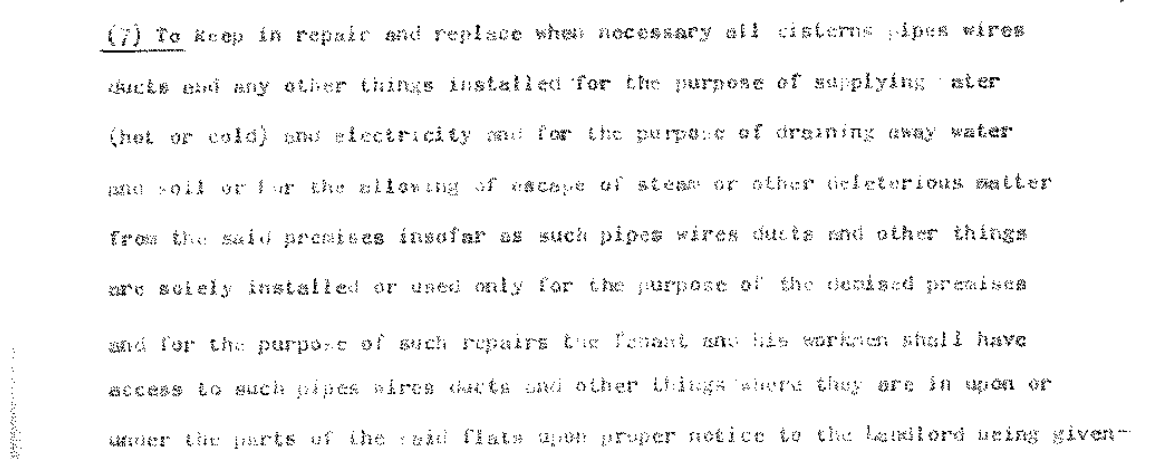
However my layman's interpretation is that the lease's section 7 ( quoted) defined responsibilities all depends on what the Demised Property consists of. That surely will be elsewhere in the lease and it is important that the Demised Property therefore is understood.
A far as the technical side goes I would disagree that the electrical installation is just messy and would argue that it might not meet legal requirements. Much depends upon the actual condition and that is impossible to tell from a couple of photos but they certainly do not give a warm feeling! That meeting of actual legal requirements ( not simply guidance) is especially questionable if the common area is not Demised and the responsibility for it then lies with landlord/ freeholder or their agent. In that case the area falls under the Electricity at Work Regulations 1989 ( amongst other legal Regulations ) and an EICR report would be unsatisfactory (if not a categorised defect) as it could possibly not be meeting the British Standard (for EICR reporting) every five years maximum. No doubt that is why electricians have had raised eyebrows and cannot be involved unless working on behalf of the responsible party.
0 -
Heedtheadvice said
Clarification of responsibilities in common areas.
It started as an electrical issue with the supply in the common area but to my mind it needs the party responsible clarifying regarding the electrical supply in a common area.
I think you might be taking things in the wrong direction. My understanding of the original question is as follows:
The original question is about responsibility for some wiring in the building, and the lease seems to answer that.
The wires might or might not be in a common area, but that's not relevant.
The lease explains that the leaseholder is responsible for wires that exclusively serve the leaseholder's flat. The physical location of the wires would probably be irrelevant - i.e, whether parts of those wires pass through common areas, pass through other people's flats or pass anywhere else.
So looking at the OP's original photo of the "rats nest" of wires:
- The wires in that "rats nest" of wires that supply electricity to flat 1 are the responsibility of leaseholder 1
- The wires in that "rats nest" of wires that supply electricity to flat 2 are the responsibility of leaseholder 2
- The wires in that "rats nest" of wires that supply electricity to flat 3 are the responsibility of leaseholder 3
- The wires in that "rats nest" of wires that supply electricity to flat 4 are the responsibility of leaseholder 4
- The wires in that "rats nest" of wires that supply electricity to flat 5 are the responsibility of leaseholder 5
But in simple terms, Smart Meter fitters are saying "I'm not touching any part of that rats nest of wires. The only way I will agree to install a smart meter is if the whole rats nest of wires is removed, and it's replaced with new compliant wiring."
So it sounds like the OP needs to talk to his neighbours (the other 4 leaseholders) and convince them that the rats nest of wires needs to be removed and replaced, and that each leaseholder should contribute 1/5th of the cost.
1 -
Thanks for that further contribution.
Regarding the responsibility ss you wrote you could well be right!
" The original question is about responsibility for some wiring in the building, and the lease seems to answer that.
The wires might or might not be in a common area, but that's not relevant."
As I posted above I believe that the extract from the lease does not answer the question ( but I could be wrong of course).
That extract defines obligations of the Tenants ( water gas, pipes electricals etc. )
" insofar as such pipes wires ducts and other things are solely installed or used only for the purpose of the demised premises"
Nowhere that we have information about defines those particular Demised Premises of the Tenant. It could be that the common areas are not Demised or that they are. If the wiring is part of the common area and it is not Demised then that cannot be the responsibility of Tenant(s) unless it is solely for the purposes of Demised areas. It will no doubt be mainly for the benefit of all the Flats but possibly not solely if for example it feeds lighting in a non Demised area or the landlord ownes one of the flats and it is not one of the Demised areas etc.
Who knows? That uncertainty I am suggesting needs clarified.
Notwithstanding whatever is written in the lease the Landlord still has a statutory duty of care!
I think my view is backed up by much written and available on the net such as from https://coel.co.uk/statutory-electrical-obligations-for-commercial-landlords/
Quote "
Responsibilities Across Lease Structures
Lease structure plays a significant role in how electrical responsibilities are managed, but it does not remove the landlord’s underlying duty of care.
In full-repairing and insuring leases, tenants may be responsible for
internal maintenance, while landlords typically retain responsibility
for base-building systems and incoming electrical supplies. In multi-let
buildings, landlords often manage electrical safety within shared
spaces and coordinate compliance across occupiers.Clear communication and accurate lease documentation help prevent uncertainty and reduce the risk of compliance gaps."
1 -
Thanks for this thread.
The way the property management company/freeholders are seeing this is that everything in the cabinet is there to provide for the 4 flats solely. There's no communal power or lighting as such.
The way I read the lease is that while we only own the inside of our individual flats, we are jointly responsible for the parts we don't privately own (communal wiring, roof, etc.) on an ad-hoc basis when repairs pop up. We don't have a regular service charge, just ground rent.
Both Octopus and the DNO are just saying "It's a BNO issue," but does that actually mean us 4 leaseholders are the BNO as a collective?
One person in the block has actually managed to get a smart meter fitted previously soI assume they just had a brave engineer who wanted to get the job done and ignored the layout! Of the other two, one rents so they aren't bothered, and the remaining owner also isn't bothered. They aren't going to want to fork out hundreds of pounds each for no reason other than for me to get a smart meter, sadly. There's no real way I can force them either.
One thing that is interesting is that when I bought the flat, I rented it for the first month because completion was delayed. The seller had to get the landlord gas and electric certificates done, but I am guessing those engineers only check "inside" the flat itself. None of the conveyancers or surveyors picked up on the cupboard layout when I was buying it either.
0 -
Heedtheadvice said
As I posted above I believe that the extract from the lease does not answer the question
I'm not sure, but I think you might be misunderstanding the purpose and scope of the lease.
- It sounds like you are trying to interpret that paragraph in the lease to be a description of who is responsible for all the wiring in the building (based on what has and hasn't been demised to various different people).
- It's not that. It's specifically the OP's lease. It's specifically referring to the premises demised to the OP, and it's telling the OP what wiring the OP is responsible for.
- That paragraph in the OP's lease isn't attempting to tell the OP what other parts of the building are demised on not demised, or who is responsible for other wiring in the building.
So in simple terms, the wiring is likely to be equivalent to this:
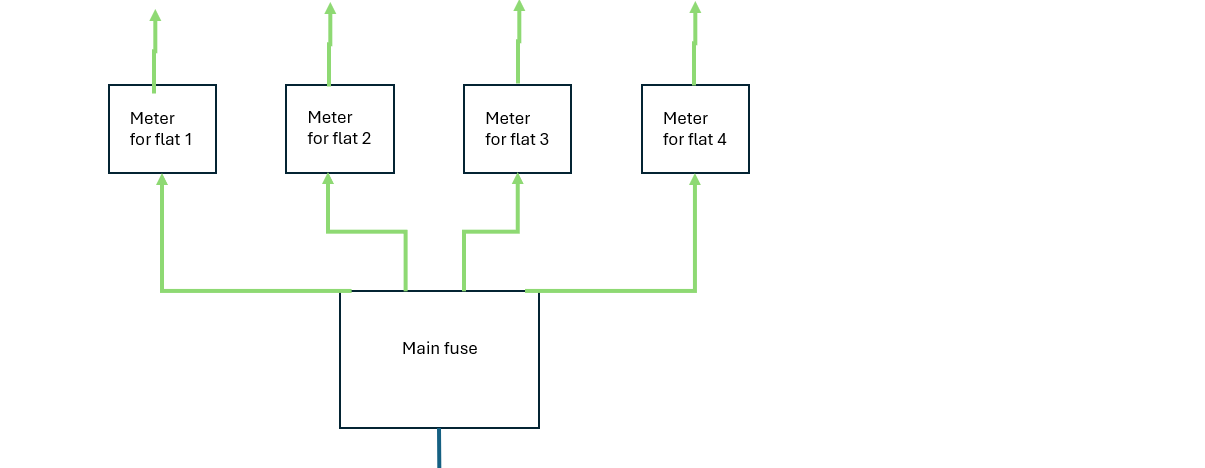
Assuming the OP owns flat 1, the lease is saying that they are responsible for the wiring shaded blue:
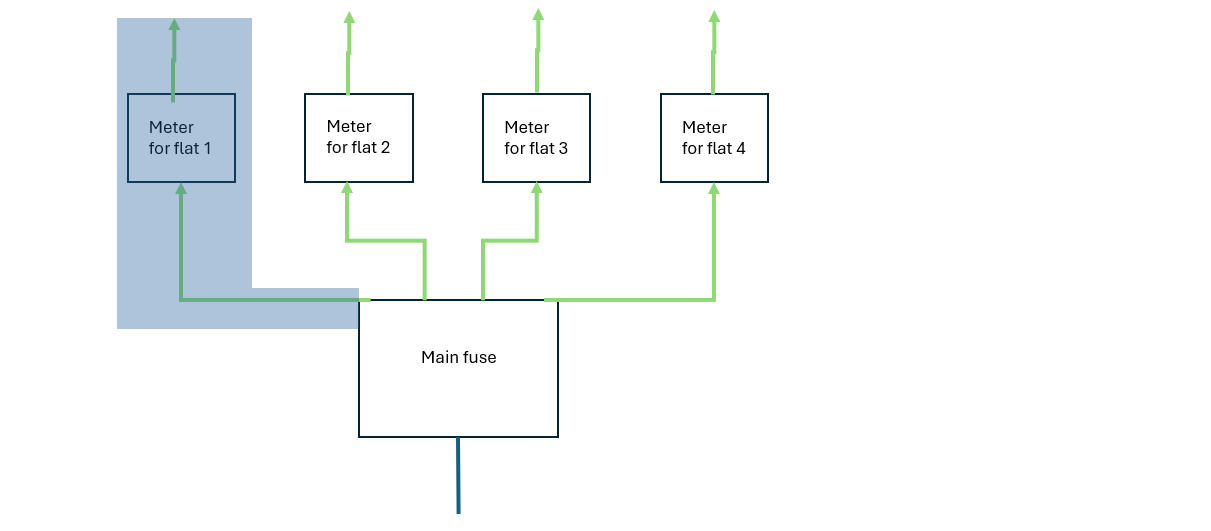
The OP's lease does not attempt to explain who is responsible for any of the other wiring.
1 -
ndelightfullyvaguely said
Both Octopus and the DNO are just saying "It's a BNO issue," but does that actually mean us 4 leaseholders are the BNO as a collective?
Yes - so I would interpret that as follows:
Octopus and the DNO are saying that the freeholder is responsible for all the wiring shaded orange:
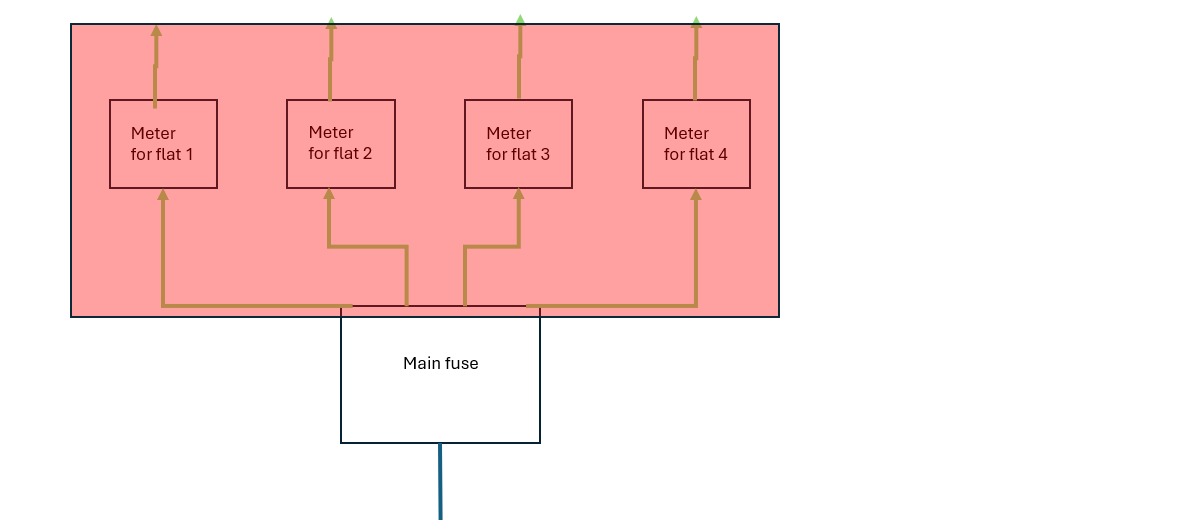
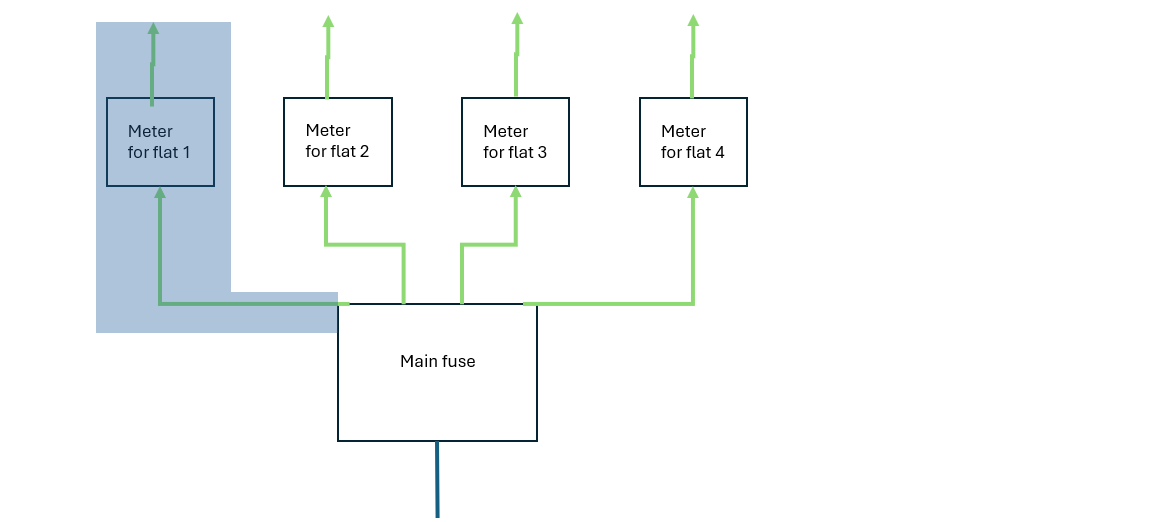
And your freeholder has passed some of that responsibility to you, as stated in the lease.
So when you bought the lease, you contractually agreed to take over responsibility for the wiring shaded blue from the freeholder:
 0
0 -
Thanks, it is like this but there are also smaller fuses coming off the main one.
So there's a huge green box that I think has the main fuse, then there are smaller 80 / 100A ones.
Annoyingly I can't get into the conveyancing portal to get a copy of the full lease but I have just asked for it from the Conveyancers I used and the management company.

 0
0 -
Heedtheadvice said
Lease structure plays a significant role in how electrical responsibilities are managed, but it does not remove the landlord’s underlying duty of care.
Yes - so perhaps the freeholder should be 'screaming' at the OP (and the other leaseholders) "The wiring you are responsible for is dangerous, so you need to get it sorted."
And if the OP (and other leaseholders) refuse to get it sorted, the freeholder could report them to the council, and/or start taking enforcement action for breach of lease. (Ultimately, that could mean forfeiture of the lease - i.e. losing ownership of the flat)
0 -
It's completely the opposite; they aren't interested at all.
Unfortunately, they have confirmed our position that the responsibility is not that of the Freeholder. We collect payment for Ground Rent and Insurance only, moreover there is no dedicated landlord supply therefore the problems of which you are faced is the responsibility of the leaseholder as we have no repair obligations.
It then comes down to who should arrange it? Is it down to leaseholders to figure it out and then chase each other for the money or isn't that the job of the property management company? To manage the property 🤣
Let's say the work is £2k between 4 of us, it's not like one of us would want to pay that up front and have to chase the other 3 for their share.
0




Confirm your email address to Create Threads and Reply

Categories
- All Categories
- 355.7K Banking & Borrowing
- 254.9K Reduce Debt & Boost Income
- 456.1K Spending & Discounts
- 248.3K Work, Benefits & Business
- 605.8K Mortgages, Homes & Bills
- 179K Life & Family
- 263.6K Travel & Transport
- 1.5M Hobbies & Leisure
- 16.1K Discuss & Feedback
- 37.7K Read-Only Boards