We’d like to remind Forumites to please avoid political debate on the Forum.
This is to keep it a safe and useful space for MoneySaving discussions. Threads that are – or become – political in nature may be removed in line with the Forum’s rules. Thank you for your understanding.
📨 Have you signed up to the Forum's new Email Digest yet? Get a selection of trending threads sent straight to your inbox daily, weekly or monthly!
How to solve this toilet connection




Been living in my house 14yrs never had a problem before but in 5 months had 2 rats come up from sewer pipe into the downstairs toilet pipe and chew through the flexipipe. The reason the plumber did a flexipipe is height difference between the pan and pipe on the wall which is cast iron and sits lower.
Note this is toilet under stairs.
Here is picture...I had to wrap duck tape round it to make it dark so the rat would stopped trying and obviously Im not using this toilet...so far its working it hasnt been back but obviously I would want to fit a rigid pipe but im not sure would an offset pipe help? Would offset causes blockages? Im not keen on ratflap to the drain because of the annual check id have to pay to check its working etc.
What are my best options? I measured from tile on floor to middle of the waste pipe in the wall and its 15cm so its only a 2-3 cm difference to pan connector. Im leaning towards offset connector but also concerned with risk of blockages
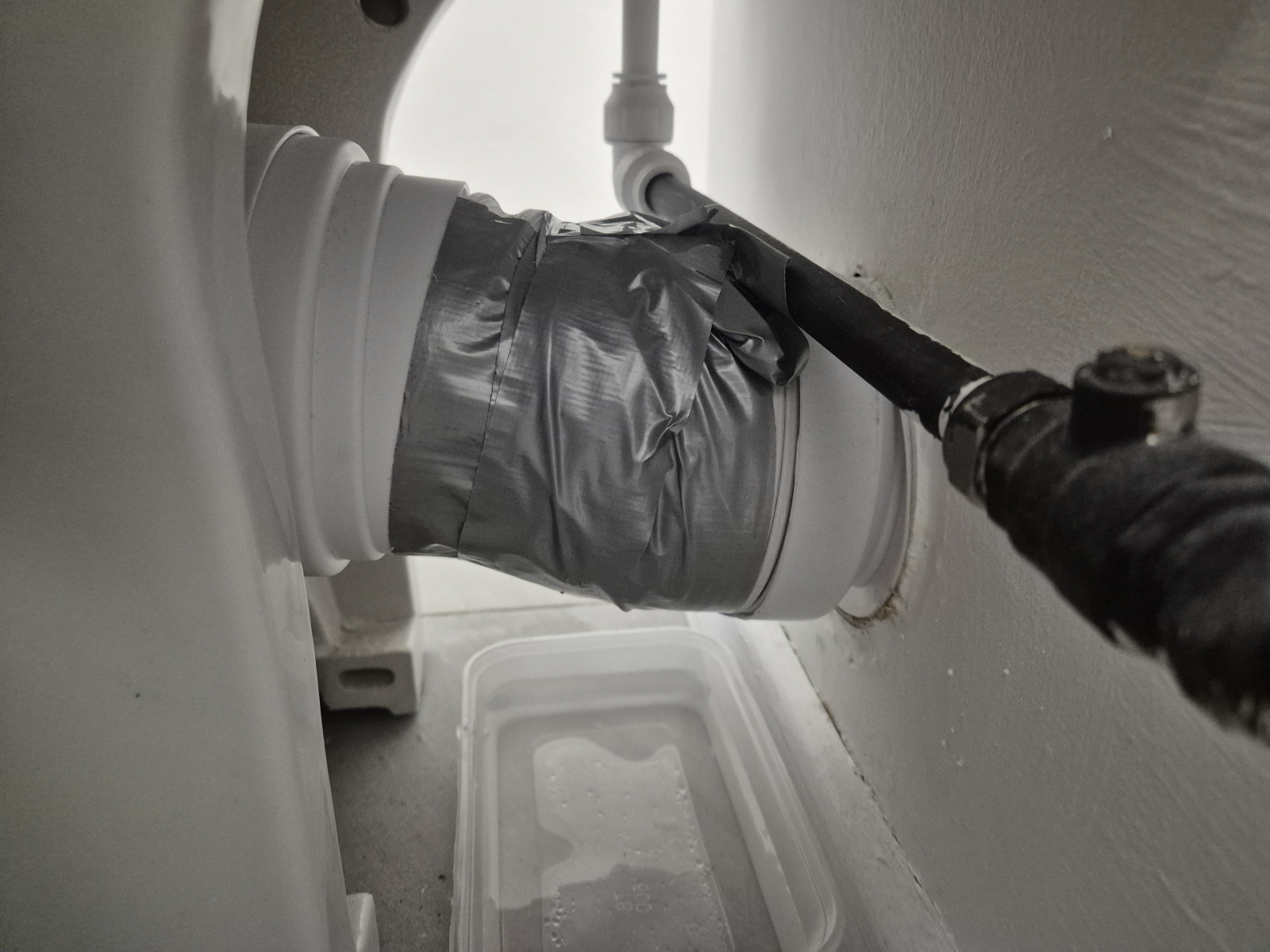
Thames Water have been or checked sewer and nothing wrong we saw rat droppings but since the main sewer is fine there is nothing else they will do.
Comments
-
No risk of blockage - it's exactly what these offset connectors are designed for.
But, lawdie, rats come up through the pipe? Jeepers. Are flaps the only answer?
I wonder if there's a deterrent that can be added to the cistern water to put them off? Bleach or similar?
0 -
Ok great think ill go with that first and try it. Its been suggested to get rat flap on the drain pipe but irs £400 install and then each year you have to check its working and not getting clogged up and thats just additional cost.
This is first time in 12yrs its been happening well ok second time but 5 months apart ...just think a hard pipe which they cant easily chew through and doesn't let light through is better option
0 -
An offset would work if you could find one the correct dimensions and is no more likely to block than the flexi. You might have to try a few. That’s almost certainly why the plumber went for a flexible connector which will fit most situations.
An offset is still plastic though, albeit thicker plastic. A metal non return flap at the inspection chamber would be better to stop the rats. Why would you have to pay to have it inspected though? Have Thames water told you that?
AFAIK you are responsible for the pipe until it joins the main sewer and the NRV is usually fitted into your pipe, so whether it works or not is up to you. You could lift the cover and check it every year if it bothered you.
0 -
Try a buffalo drain rat stopper in the inspection chamber…
Buffalo Drain Rat Stopper | Buffalo Flood Systems
… it's push fit so pretty simple to install.
1 -
As said, the rigid connector isn't the answer to your rat problem, but is a far more professional and hygienic (no ridges) way to make that connection.
Absolutely fit the rat guard - what else will stop them? And that Buffalo looks ideal.
£60-odd, and should be fittable by any plumber or handyperson in 10 minutes.
0 -
£400 is a bit rich. Even the Metex TX11 (which looks like the Rolls Royce stainless steel version of the Buffalo) is £220 retail. If someone’s fitting it for you and getting that at trade price then they’re making a hefty markup.
1 -
Anti-rat flaps are a bit like spray foam insulation. On paper a good idea, but in practice problematic and only really beneficial for those who are selling a wonder product.
LA's and water companies have been spending good money getting rid of non-return valves and interceptors installed when they were last popular in Victorian/Edwardian times. Anything in the pipe bore which has the potential to snag 'stuff' flowing along with the water is likely to lead to a blockage sooner or later. They need regular inspection (I'd say a year is too long) and cleaning - not least because if the flap is getting gunked up it won't be closing properly, and rats are clever animals and if they want to get through something they will find a way, which is more likely if the valve is gunked up and not operating correctly.
An internal push-fit flap will reduce the pipe bore and restrict flow - claims otherwise are simply not true. Worse, the types using multi-fit rubber sealing rings will act as a weir, so holding water back in the drain to a depth of the new effective invert level. This ruins the self-cleansing design every good drainage engineer tries to achieve.
I'm trying to think of a question where "Fit an anti-rat flap" is a good response.
Rats shouldn't be in the sewers in the first place. If a rat is getting into the sanitary drainage and then trying to chew its way out it indicates something is wrong with the drainage - like a missing drain grate, an inspection cover which is broken or missing, an old connection which hasn't been blocked off properly, or an air vent which isn't rodent-proof. The first step is to make sure all those have been eliminated, and for the neighbours a couple of doors either side to do so as well.
AFAIK you are responsible for the pipe until it joins the main sewer and the NRV is usually fitted into your pipe, so whether it works or not is up to you. You could lift the cover and check it every year if it bothered you.
The property owner/occupier is responsible for the drain/sewer up to the point where it becomes a public sewer, which won't necessarily be a main sewer. A manhole (if there is one) on the public sewer where the private drain connects, is also part of the public sewer system. So (without the permission of the water company) you can't legally fit a rat flap unless you have a suitable manhole or inspection chamber which is wholly located within the length of your own private drain.
3 -
Thanks this is exactly what ive been reading and really against doing.
Thames Water came out and via inspection chamber in my garden where my pipes feed into they put a camera down along the entire sewer line both directions said they cant see any issues with sewer itself they even fed it up my private section and said its all good too (the guy was really nice to do that). No idea how those 2 rats got in and its been 12yrs without no issue until past 5 months ths. Might even be the same rat. So nothing more Thames Water will do now.
I think ill try the offset connector at least the pipe will be rigid and doesnt let light in. So if in future one swims up it turns back round when it realises there is no exit route.
1 -
I'm with Section62, you need to stop rats getting that far, it's only a few more inches to your bum!
Tall, dark & handsome. Well two out of three ain't bad.0 -
Very useful info as always @Section62 I was considering one of the Buffalo NRVs, not for rats, but to stop very occasional flooding into a relative’s garden from an old Victorian sewer. Looks like I’ll have to think again!
The neighbours will keep putting things down the drains which they shouldn’t but, when the pipe eventually blocks and a downpour of rain overwhelms it, the cr*p comes up the rainwater gully and ends up in my relative’s garden.
0







Confirm your email address to Create Threads and Reply

Categories
- All Categories
- 355.8K Banking & Borrowing
- 254.9K Reduce Debt & Boost Income
- 456.2K Spending & Discounts
- 248.3K Work, Benefits & Business
- 605.9K Mortgages, Homes & Bills
- 179K Life & Family
- 263.8K Travel & Transport
- 1.5M Hobbies & Leisure
- 16.2K Discuss & Feedback
- 37.7K Read-Only Boards