We’d like to remind Forumites to please avoid political debate on the Forum.
This is to keep it a safe and useful space for MoneySaving discussions. Threads that are – or become – political in nature may be removed in line with the Forum’s rules. Thank you for your understanding.
📨 Have you signed up to the Forum's new Email Digest yet? Get a selection of trending threads sent straight to your inbox daily, weekly or monthly!
Cash buffer dilemma
Comments
-
SWR might still be relevant to you, but to a (much) lesser degree than someone relying solely on a high equity portfolio......you also have to remember it's not just equity market returns you need to consider - a period of high inflation early in the drawdown phase could have as equally damaging an effect as any equity market crash......inflation generally stays with you forever.....
3 -
I can see that maintaining a cash buffer can help you feel protected against market downturns and hence help you sleep at night. One thing that seems to be missing though is any definition of what will trigger the use of a cash buffer, other than the vague notion of a market downturn. How is a downturn defined and when is a downturn over? In the absence of such a definition, it’s hard to see how a cash buffer strategy can be implemented in practice. Perhaps it’s the psychological effect of having cash available that is the main benefit of a cash buffer strategy.
3 -
Exactly. Even if you have a cash buffer today, should the market draw back to whatever extent you deem undervalued you then draw from the cash buffer - you are now short of cash according to the 'cash buffer' strategy so doesn't it need replenishing.
All this seems to be based on an underlying assumption that the current share price level is somehow wrong - in this case because it has been higher in the past and that this is a reliable signal that it will be higher again in future. If you are able to predict the markets then you don't need a cash buffer, merely some good ideas on how to spend your billions….I think....1 -
There are so many ways to implement a cash buffer, it's hard to generalise about their use.
There seems to be pervasive view though, among those against using a cash buffer, that it has to be a binary choice for your annual drawdown.....all from the asset portfolio when it's up, all from the cash buffer when it's down, but it doesn't have to be that way. You could, for example, draw part from the cash buffer when the portfolio is down (how much depends on how much the portfolio is down), and when it's up, draw more than the required drawdown to top up the cash buffer (again, how much depends on how much the portfolio is up).
My own variation on that is to take all drawdowns from the cash buffer, and top that up annually from portfolio sales.......the level of which is directly linked to equity portfolio performance.......but for the record, our portfolio is at about 60% equities, 40% gilts/ bonds, with an additional 3-4 years spend in the cash pot.
1 -
When I came across the concept of the cash buffer I created a worksheet where I took a fixed % from the equity pot (on a quarterly basis) and if necessary topped it up from my cash/nr cash pot. I then added in a ‘rule’ that if equities hit X I would add part of the growth to the cash pots. This meant a 5 year pot lasted much longer.
As my OH has continued working I have not had the chance to implement this. I have moved some equity gains to income focused investment trusts which will hopefully produce steady income (at the cost of growth) at about 5% of current capital values, (Linton has an income fund at about 6%, from memory) which reduces the WR requirement from the balance. I have cash available to cover SP in the run up to SPA.
As far as the OP is concerned if the key is retiring at a specific time on a specific income and he can guarantee that now through a combination of any of fixed term annuity, annuity, cash, short term bonds, etc etc then put that in place. At SPA he can then adjust. We were happy to be flexible (as we have been through our working lives) so have, until recently, been too heavily (according to ‘normal’ guidance) in equities.
1 -
A vague notion may be enough. If I am drawing on the equity pot and I see the value of that pot fall - let's say 10% - and I need money from that pot, then I could turn to the cash pot. I could continue to have that option until the pot regains its value prior to the 10% drop. Of course it may fall even more, and may not regain its value for years, but at least I won't be drawing on it for as long as the cash pot lasts. Given my cash pot multiple is @10x whatever my annual draw is on the equity pot, chances are that will be adequate.
Cash pot can be replenished when equity pot regains value - by selling funds.
Not sure why a cash pot is seen as psychological. It is surely is a reasonable method of avoiding drawing on equities in a downturn.
2 -
isn’t this somewhat overblown? if you’re mainly looking at a cash buffer as a hedge for SORR so a limited period at the start of retirement, then the exposure to fiscal drag may be limited. And for inflation - assuming you’re in MMF or similar, it will very likely react to inflation hikes as base rate will likely follow. There will be some lag but that may help head off some of the negatives of inflation.
1 -
FWIW, the historical effect of an allocation to cash on the maximum 'safe' withdrawal rate (MSWR) for a UK retiree for a 30 year retirement (see note 1) is shown in the upper panel of the following figure (cash allocation = 100 - equity allocation), which shows that the MSWR increased very slightly between an allocation to equities of 100% (i.e., cash=0%) and an allocation of about 85% (i.e., cash allocation of 15%).
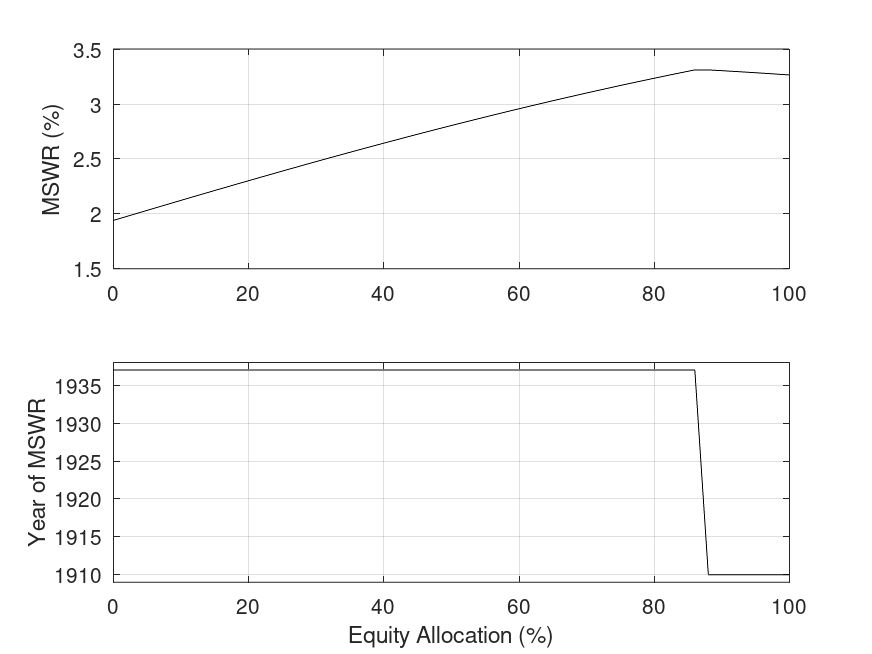
The lower panel shows the retirement start year in which the worst case SWR (i.e., the MSWR) occurred. For equity allocations below about 85% this was 1937, while for those above 85% it was 1910. This indicates that the worst historical case, not really that surprisingly, actually varied with asset allocation (it also varies with the type of asset - e.g., bond duration).
Bear in mind:
- This is historical behaviour and future behaviour may differ. Even historically, (not shown) adding cash to some (most) retirements reduced the SWR while it increased the SWR of others (including 1910).
- The retirement horizon changes the effect (for shorter horizons cash has stronger effect on the MSWR and vice versa)
- This is not a true cash buffer since it has been modelled as a mixed portfolio rebalanced each year. However, in very poor years for equities, the withdrawal will consequently be taken from cash. Implementing (and modelling) a cash buffer (see note 2) probably requires a target amount (which ought to be updated by inflation), a rule for withdrawal and a rule for replenishment.
Note 1: UK equity returns and cpi from macrohistory.net, 3 month treasury bill returns (used as a proxy for cash) returns calculated from yields in a 'Millennium of Economic data'. Constant inflation adjusted withdrawals were made at the start of each year over a 30 year period with the SWR for each retirement start date then defined as the highest value of withdrawal (expressed as a percentage of the initial portfolio value) which exactly exhausted the portfolio after 30 years and the MSWR defined as the lowest value of SWR observed across all historical retirements.
Note 2: There appear to be a number of approaches to implementing a cash buffer - ranging from a type of bucket to a pipeline for cashflows.
For the OP two considerations are
- Given the significant income flooring in place (DB pension and eventually, SP) - how important are the portfolio withdrawals to you?
- Over your joint portfolio, you already have a significant amount of cash - maybe that is enough
7 -
In this analysis the cash buffer is providing a diversification/dilution effect to equities. In set this role is normally assigned to bonds as they have historically behaved counter cyclically at least to limited extent so my understanding is that a cash buffer should be modelled separate to whatever equities/bonds mix is in the non buffer part of the portfolio.
I am also not sure that your comment re rebalancing acting as effectively meaning that drawdown will come from cash when markets are down is correct?
I think....1 -
OP does your DB pension have the option to exchange some of the annual income for a tax-free lump sum?
If the commutation rate is good then you could consider using this to provide some 'insurance' against a market crash however that's not a decision to be taken lightly.
0













Confirm your email address to Create Threads and Reply

Categories
- All Categories
- 355.8K Banking & Borrowing
- 254.9K Reduce Debt & Boost Income
- 456.2K Spending & Discounts
- 248.3K Work, Benefits & Business
- 606K Mortgages, Homes & Bills
- 179K Life & Family
- 263.8K Travel & Transport
- 1.5M Hobbies & Leisure
- 16.2K Discuss & Feedback
- 37.7K Read-Only Boards