We’d like to remind Forumites to please avoid political debate on the Forum.
This is to keep it a safe and useful space for MoneySaving discussions. Threads that are – or become – political in nature may be removed in line with the Forum’s rules. Thank you for your understanding.
📨 Have you signed up to the Forum's new Email Digest yet? Get a selection of trending threads sent straight to your inbox daily, weekly or monthly!
Cash buffer dilemma
Comments
-
Checking Vs historical performance generally shows that cash bucket strategies have lower safe withdrawal rates and are a purely psychological prop.
I think....4 -
Many similarities to ourselves. Wife more DC oriented with a small amount of DB whereas I have quite a bit more DC and DB to her.
Mapping it out the DB and eventually the SP will cover the bills comfortably. They commence ages 60,65,67 so you get richer as you age. All the fun and extras will come from the DC earlier in retirement.
We're quite equity heavy so building up a cash buffer atm. This is addition to emergency funds. As said before this can exist anywhere as it sounds like your DB will use all your personal allowance.
I'm embarrassed as I studied gilts decades ago to pass professional exams in a previous career but now my mind is a complete blank, lol!
Cheers!
1 -
I've thought 100% equities over the long term might well be the best return, cash in times of inflation is eroded but we'll still need some for spending so just how much would one be giving up for a psychological crutch. I like the idea of a couple of years of expected spending for sequence of returns risk but I was not convinced by the oft quoted 60:40 stocks:bonds split when accumulating I doubt I'll use it deaccumulating.
More important I suppose is historically how much SWR is given up by holding cash buckets, is it a few percent or percents of that?
0 -
......does it though?........the studies I've seen use very rudimentary cash buffer strategies.
In any case, the cash buffer is a mechanism to mitigate bad scenarios rather than to maximise returns.........history also suggests that 100% equities will generally have a higher SWR too, but few will go that way either.......
0 -
More important I suppose is historically how much SWR is given up by holding cash buckets, is it a few percent or percents of that?
You might like to read through a few of @OldScientist 's prior posts on the topic of investment outcomes and SWRs.
From memory, higher equity holdings give higher average returns but there's 10-20% of outcomes where it all goes horribly wrong.
We don't get to live 100 parallel lives and pick the one we prefer. How much risk do you want to take with the one you've got?
(It's a bit like a game of Russian roulette. Sure there's a 5-in-6 chance that you'll walk away, but the other 1-in-6 outcome is pretty terrible.)
N. Hampshire, he/him. Octopus Intelligent Go elec / Fuse gas / Vodafone BB / iD mobile. Kirk Hill Co-op member.Economy 7 cap explainer. Gas vs E7 vs peak elec heating costs, Ecoflow Stream, Best kettle :-)
2.72kWp PV facing SSW installed Jan 2012. 11 x 247w panels, 3.6kw inverter. 37 MWh generated, long-term average 2.6 Os.1 -
I used to offer the opinion of Russian roulette as a binary outcome, bullet, no bullet. As for SWR and equity balance it's all what helps you sleep at night. I don't necessarily need a SWR as I'm happy to erode capital. It's become much easier to think of spending down the pot when as it gets bigger and I get older and frailer, I have for now abandoned immortality. The pot was built with the purpose of indulging me in a post employment time. I was and have generally been a high equity investor and have probably benefited from those supposed higher returns. I recall studies that have shown the cost of apparently safer ratios didn't cost that much. Those that probably the OldScientist has seen
I don't think it costs a few percent SWR for a cash bucket more like percents of that but as I said SWR isn't my focus.
1 -
A SWR isn't about not eroding capital, it's about not running out of money completely.
0 -
Cash buckets aren't about average outcomes, they are to protect against particular unlikely events. If we just wanted to use the historical best average outcomes we'd all be 100% equities. If you think about the efficient frontier between return vs risk, your asset allocation should probably be where the return is high the risk is relatively low and gradient of return vs risk is also low. This happens when you have equities, bonds, and usually some cash, in your portfolio.
And so we beat on, boats against the current, borne back ceaselessly into the past.1 -
Must admit I missed the OPs original DB pension, so in the context of my reply, the reliance on equities is much reduced. I'd still recommend a cash buffer equivalent of at least 5 times of whatever may be drawn down annually from the equities pot - on average - just to cover any downturn and to avoid drawing on the equity pot whilst in a downturn. I can afford 10x at present so that is what I have done. Cash ISA as it happens.
Downturns taking 10 years plus to recover have been far more recent - dot.com bubble early 2000s?, hence my decision. My multiple may reduce slightly if I draw more from the equity pot, but future SP may offset any reduction.
I think the important point is to at least have a cash buffer if you believe you may draw on any equity based pot. How much to have as a buffer is largely down to the risk tolerance of the individual, but a multiple of annual draw from it based on how many years any recovery may take would seem sensible.
0 -
Statistically, they are more likely to result in a lower return. However, they come into play when there is a significant negative event. So it may smooth out the upper end a little, but it also smooths out the lower end.
Most people in retirement aren't 100% in equities anyway. So allocating a cash buffer against your defensive amount is a perfectly sensible way of planning. Eg, if you are 60% equities, then rather than having 40% in bonds have X% in your cash buffer and reduce your bonds allocation. That way you retain your equities content, and you're only adjusting the defensive part of your portfolio anyway.
If you do it that way, then you're not really affecting any theoretical safe withdrawal rate but you are protecting yourself from those one-in-50-year events or one-in-100-year events.
People who were 100% equities on the 1st of January 2000 drawing what many consider to be a safe withdrawal rate would have run out of money. I cant do indexation on this particular bit of software but 4.8% level withdrawal is actually a lower rate of draw than 4% increasing annually and take a look at the 100% global equities value relative to the mixed assets.
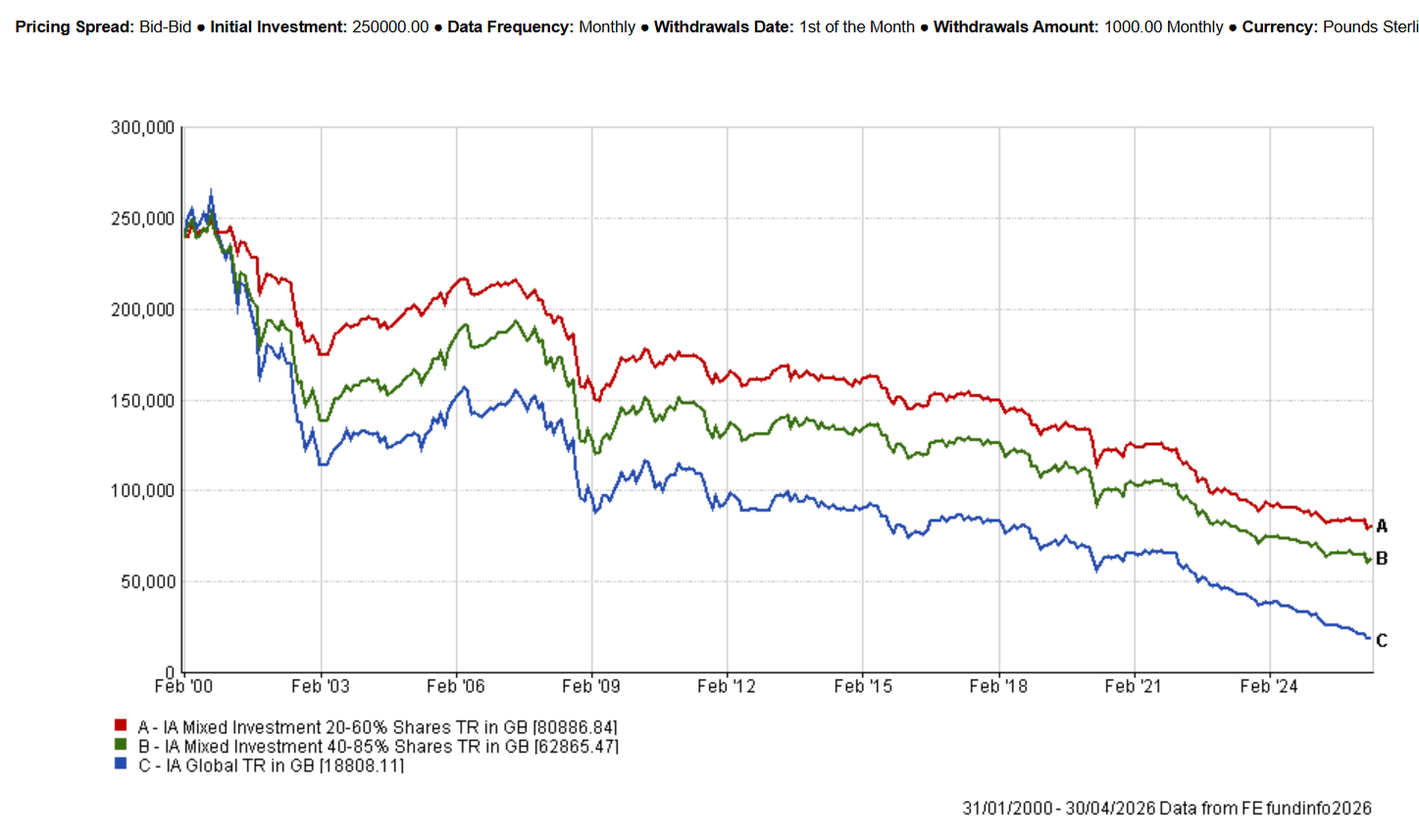
Again, I can't model it on this particular piece of software, but the person had a cash float available and used it between 2000 and 2003 and used it again following the credit crunch, they wouldn't have had to sell equities during their negative period and wouldn't have seen such a valuation decline.
I am an Independent Financial Adviser (IFA). The comments I make are just my opinion and are for discussion purposes only. They are not financial advice and you should not treat them as such. If you feel an area discussed may be relevant to you, then please seek advice from an Independent Financial Adviser local to you.4














Confirm your email address to Create Threads and Reply

Categories
- All Categories
- 355.8K Banking & Borrowing
- 254.9K Reduce Debt & Boost Income
- 456.2K Spending & Discounts
- 248.3K Work, Benefits & Business
- 606K Mortgages, Homes & Bills
- 179K Life & Family
- 263.8K Travel & Transport
- 1.5M Hobbies & Leisure
- 16.2K Discuss & Feedback
- 37.7K Read-Only Boards