We’d like to remind Forumites to please avoid political debate on the Forum.
This is to keep it a safe and useful space for MoneySaving discussions. Threads that are – or become – political in nature may be removed in line with the Forum’s rules. Thank you for your understanding.
Octopus Intelligent Go 6 hour changes being rolled out.




Upcoming changes notice, from octopus
Electric vehicles are booming. In March 2026, over 22% of new cars sold in the UK were electric, and the old fear of "range anxiety" is practically dead. With modern ranges hitting 300 miles and a rapidly growing network of ultra-rapid chargers, most drivers just plug in every few days to keep things topped up.
At the same time, renewable energy is smashing records. Between wind and solar, we’re generating more green energy than ever before. But here’s the catch: if millions of us all come home at 6:00 PM and plug in our cars, the power grid will buckle. We can't just build a bigger grid; we have to build a smarter one.
That’s exactly what Intelligent Octopus Go is built for. We use smart scheduling to soak up cheap, green energy when it's abundant, balance the grid, and ensure your car is ready when you need it.
We’ve recently made some important changes to how Intelligent Octopus Go works to keep it competitive, simple, and fair.
These changes are rolling out now – have a look in the Devices tab in your Octopus app to see if your account has been enabled (we’ll also send you a notification, so make sure they’re turned on).
Here’s what you need to know:
The big change: six hours is the magic number
Our data shows that over 80% of EV charging sessions take less than 6 hours. So, instead of spreading the off-peak rate too thin or creating a dozen confusing tariff variations (yes, we’re looking at you, Octopus Go Faster), we’ve tailored Intelligent Octopus Go to work brilliantly for how people actually charge.
We’ve split out your car charging and your home use, creating a dynamic 4-rate system. It sounds complicated, but it boils down to four simple rules:
Your home off-peak: Your house always gets the cheap off-peak rate between 23:30 and 05:30. Reliable, consistent, cheap green electrons every day.
Your car allowance: Your car gets up to 6 hours of off-peak charging per day (measured midday to midday). We might schedule this during your home's off-peak window, or at other times of the day when the grid is greenest.
Your freebie (the bonus home rate): If we schedule your car to charge outside of the 23:30–05:30 window, your home also gets the off-peak rate for that half-hour when it’s within your car allowance.
Your standard rate: The default for your home, outside its off-peak window. If your car charges for more than 6 hours (or you decide to Boost charge), the car rate flips back to this rate (even if it happens at 2:00 AM while your house is still getting the off-peak rate).
The Golden Rule: Treat your EV like you’re sipping a nice drink, not downing it in one go. Plug in frequently for shorter bursts rather than waiting until the battery is empty, and you'll get the most miles for the least money.
Charge Cap and smarter billing
We’ve worked hard to make living with Intelligent Octopus Go a better experience.
Charge Cap: For total peace of mind, Charge Cap is a new feature in the Octopus app. Turn this on, and your car will automatically stop charging before it hits the expensive peak rate. If your account has Charge Cap available, you’ll find the toggle in your device settings.
Turn on notifications: Make sure your app notifications are on! If you're going to exceed the 6-hour window or miss your target charge, we will ping you to let you know.
Stop waiting on statements: We’ve moved the daily breakdown of your half-hourly data out of your monthly statement and into the Octopus app. You can now see separate graphs and tables for your home and car, just a a day or so behind real-time.
Ditch the in-home display: Because Intelligent Octopus Go dynamically schedules your charging on the fly, those little smart meter displays simply can't keep up with the math. Best put it in a kitchen drawer to gather dust and rely on the Octopus app instead.
A quick note on half-hour billing: We bill in 30-minute chunks. If your car charges for just 10 minutes, that entire half-hour is billed at the off-peak rate for both your car and your home.
The Outliers: Ohme, BMW, Mini, and Polestar
For some manufacturers, things work a little differently. If you use an Ohme charger or drive a BMW, Mini, or Polestar, the 4-rate tariff still applies, but your experience works a little differently.
If you have an Ohme Charger: You will manage your schedules entirely in the Ohme app, not the Octopus app.
To keep your charging under 6 hours, go to Charging > Prioritise and select Prioritise Savings.
If you select "Prioritise Charge Target" instead, Ohme will happily charge past the 6-hour mark, and you will pay peak rates for the extra time. (Make sure Ohme's app notifications are on so they can warn you!)
If you drive a BMW, Mini, or Polestar: You will set your target battery percentage and departure time in your car’s native app. However, these apps don't have a built-in feature to stop you from exceeding the 6-hour limit.
This makes the Octopus app notifications even more important.
If your settings are going to push you over 6 hours into peak rates, we’ll send you a notification suggesting an alternative target. You’ll then need to open your BMW, Mini or Polestar app and manually lower the target to keep your charging in the cheapest times.
What about solar panels and home batteries?
If the sun is charging your car, we don't want to bill you for it.
Because we can't perfectly see the split of where your car's energy comes from (whether it’s the grid, solar, or battery), we keep it fair and simple: we bill based on what your smart meter imports from the grid.
So If your solar panels generate 2.5kWh, your home uses 2kWh, and your car uses 3.2kWh... your smart meter will show that you pulled 2.7kWh from the grid to make up the difference. We will only bill you for that 2.7kWh, rather than the 3.2kWh your car charged.
If you’re charging on a blazing sunny afternoon and importing absolutely nothing from the grid, your bill is zero. Plus, that time won't count toward your 6-hour off-peak allowance!
Battery Pro-Tip: If you have a home battery, ensure it is "blinded" to your car charger (so the battery doesn't try to drain itself into your car). Don’t use solar-divert settings to charge your car; it's better to just let your surplus solar export to the grid.
Published on 7th May 2026 by:
Comments
-
Great copy and paste job......
2 -
Yep, couldn't figure out how to link to it.
0 -
Yep, couldn't figure out how to link to it.
I'm glad you did it this way; it's all in one place and won't change if Octopus update the details in future.
If anyone wants a link, it's here:
N. Hampshire, he/him. Octopus Intelligent Go elec / Fuse gas / Vodafone BB / iD mobile. Kirk Hill Co-op member.Economy 7 cap explainer. Gas vs E7 vs peak elec heating costs, Ecoflow Stream, Best kettle :-)
2.72kWp PV facing SSW installed Jan 2012. 11 x 247w panels, 3.6kw inverter. 37 MWh generated, long-term average 2.6 Os.2 -
I'm new to IOG but I don't think this changes much, the only problem arises if you need to charge your car for over 6 hours per day.
Thrifty Till 50 Then Spend Till the End
You can please some of the people some of the time, all of the people some of the time, some of the people all of the time but you can never please all of the people all of the time0 -
the only problem arises if you need to charge your car for over 6 hours per day.
That's not likely to bother us for the moment, as Mrs QrizB's e-UP! has a ~33kWh battery and will charge from flat in less than five hours. We'll only ever be in a position to ask for more than six hours in a day if we've charged, then driven and drained it, then returned home and asked for a refill all in the same 24h.
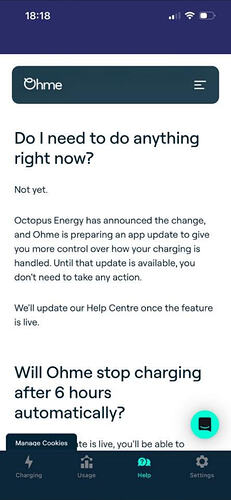
I can't find the "prioritise savings" setting in my Ohme app; does anyone else have that option yet?
N. Hampshire, he/him. Octopus Intelligent Go elec / Fuse gas / Vodafone BB / iD mobile. Kirk Hill Co-op member.Economy 7 cap explainer. Gas vs E7 vs peak elec heating costs, Ecoflow Stream, Best kettle :-)
2.72kWp PV facing SSW installed Jan 2012. 11 x 247w panels, 3.6kw inverter. 37 MWh generated, long-term average 2.6 Os.0 -
glad you’ve mentioned this too - OH said to me - it would be the OHME eh?’
Lancashire
PV 5.04kWp SW facing
Solar Battery 6.5 kWh
🐙 Intelligent Go
Mortgage freedom January 2024 - paid off 7 years early by making overpayments where we could.0 -
You should find the details in the Ohme app…
 0
0 -
The proposed setting isn’t in my Ohme app either.
1 -
In reality nothing has changed from when 1st announced last year. Only that they have now sorted out the implantation of how it is going to work.
No changes in OHME app either here. Android ver 2.19.1 (2020620)
Although do not have one of the 3 brands listed. Or ever used the Octopus app for charging. 🤷♀️
Life in the slow lane1 -
No changes in OHME app either here. Android ver 2.19.1 (2020620)
That's my version too. I guess we'll need an update before the new feature can be implemented.
N. Hampshire, he/him. Octopus Intelligent Go elec / Fuse gas / Vodafone BB / iD mobile. Kirk Hill Co-op member.Economy 7 cap explainer. Gas vs E7 vs peak elec heating costs, Ecoflow Stream, Best kettle :-)
2.72kWp PV facing SSW installed Jan 2012. 11 x 247w panels, 3.6kw inverter. 37 MWh generated, long-term average 2.6 Os.0










Confirm your email address to Create Threads and Reply

Categories
- All Categories
- 355.7K Banking & Borrowing
- 254.9K Reduce Debt & Boost Income
- 456.1K Spending & Discounts
- 248.3K Work, Benefits & Business
- 605.8K Mortgages, Homes & Bills
- 179K Life & Family
- 263.6K Travel & Transport
- 1.5M Hobbies & Leisure
- 16.2K Discuss & Feedback
- 37.7K Read-Only Boards