We’d like to remind Forumites to please avoid political debate on the Forum.
This is to keep it a safe and useful space for MoneySaving discussions. Threads that are – or become – political in nature may be removed in line with the Forum’s rules. Thank you for your understanding.
Solar Panel Quote




Hi, currently in the process of gathering quotes.
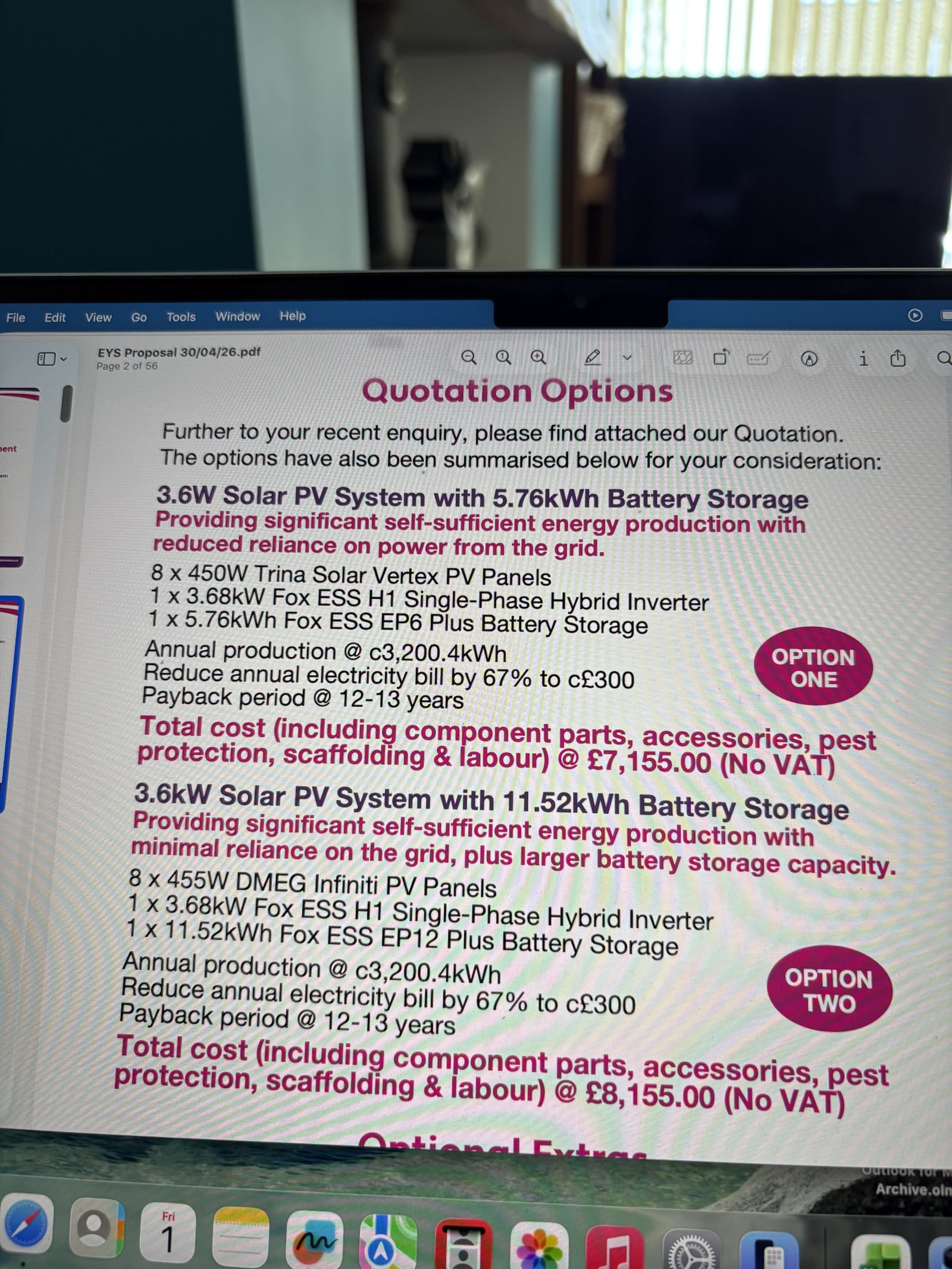
I have received 2 x quotes so far, one from EON which I have already discounted and 1 from a local installer, no site survey from this one yet (see below). I have emailed this guy back requesting requote for 10 x panels and a 5kw inverter.
I have just had another local installer round who said I could fit 10 x panels on my roof rather than 8 in the first quote but uses chinese batteries like previous quote 10kw Ampwr and I am awaiting his quote.
My current usage is around 3200kw annually but likely to climb with an EV currently on close horizon.
So question is with my usage would a battery be beneficial and feedback on the quote please.
Comments
-
From what you’ve shared, a battery won’t make fiscal sense for your household, given the low consumption.
EV charging will give you access to a cheap night time tariff when you can schedule your heavy appliances to run, likely further reducing the financial benefit. We do this in our household and export nearly everything for 16p per kWh.10 X Eurener 515W bifacial panels paired to a SolarEdge 5kW inverter with optimizers, should cost no more than £5.5K installed. 10 year workmanship warranty, 20 year extended inverter warranty, bird netting and G99 all included,
Hope that gives you a helpful steer on the right sort of money for right kit,
- 10 x 400w LG Bifacial + 6 x 550W SHARP BiFacial + 2 x 570W SHARP Bifacial + 5kW SolarEdge Inverter + SolarEdge Optimizers. SE London.
- Triple aspect: ENE (2.7 kWp), WSW (3.3 kWp), SSE (2.4 kWp)
- Viessmann 200-W on Advanced Weather Comp. (The most efficient gas boiler sold)Feel free to DM me for help with any form of energy saving! Happy to help!2 -
I agree with @Screwdriva comments above.
Regarding inverter size:
Installers do not need permission to install systems (inverters) up to 3.68kW - they can install and notify the DNO afterwards using the G98 process.
To install systems (inverters) larger than 3.68kW requires permission from the DNO first before you connect to the grid (G99 process).
This is relevant for you, with space for 8-10 panels.
8 x 450W panels = 3.6kW system so a 3.68kW inverter on a G98 process would be absolutely fine.
If you move up to 10 x 450W panels, that's 4.5kW which may still be reasonable on a 3.68kW inverter, depending on orientation and shading, but maxing out your roof with 10 x 515W panels as suggested by @Screwdriva takes you to 5.15kW where a larger 5kW inverter makes more sense (although the installer may try to sell you a 3.68kW inverter to keep their quote low and make the application process easy for them)
So the question becomes do you want to absolutely max out your available roof space or are you happy with a ~4kW system? I have yet to see anyone say they regret installing more/larger solar panels.
I am a Forum Ambassador and I support the Forum Team on the Benefits & tax credits, Heat pumps and Green & Ethical MoneySaving forums. If you need any help on those boards, do let me know. Please note that Ambassadors are not moderators. Any post you spot in breach of the Forum Rules should be reported via the report button, or by emailing forumteam@moneysavingexpert.com. All views are my own & not the official line of Money Saving Expert.3 -
Thanks guys, understood.
So from what you are saying adding a battery would be complete overkill and a waste of money for the amount of power that could be generated from 8-10 panels.
Would adding a battery not make any sense for cheap import prices that I've read about on this forum, sorry for the daft questions?
1 -
We're all learning on this sub forum. In short, buying cheap and selling higher seems like a great idea but it requires higher grid import (consumption) to justify the upfront costs. Things are always changing with UK renewables so this may not always be the case.
- 10 x 400w LG Bifacial + 6 x 550W SHARP BiFacial + 2 x 570W SHARP Bifacial + 5kW SolarEdge Inverter + SolarEdge Optimizers. SE London.
- Triple aspect: ENE (2.7 kWp), WSW (3.3 kWp), SSE (2.4 kWp)
- Viessmann 200-W on Advanced Weather Comp. (The most efficient gas boiler sold)Feel free to DM me for help with any form of energy saving! Happy to help!1 -
My advice is always fit as many panels as you can from inverter/roof area allows perspective. Hopefully this might help you somewhat with regards to Batteries and import prices…
This is my setup…
I have approx 7.3wk panels installed over both sides of the roof (NW/SE), 6kw inverter and 13kw/h batteries. I am on Economy 7 energy tariff.
This was my graph for today… as you can see panels had a nice curve (green) due to the constant sunshine today (I exported 21K/wh today!). In the summer I import very little, only on really bad days or when i use heavy devices like shower/cooker/etc… In winter the batteries give me about 11.5Kw of energy imported at E7 prices… they are worth it if you have a cheap off-peak tariff when you can charge them up, saves me £2 a day.
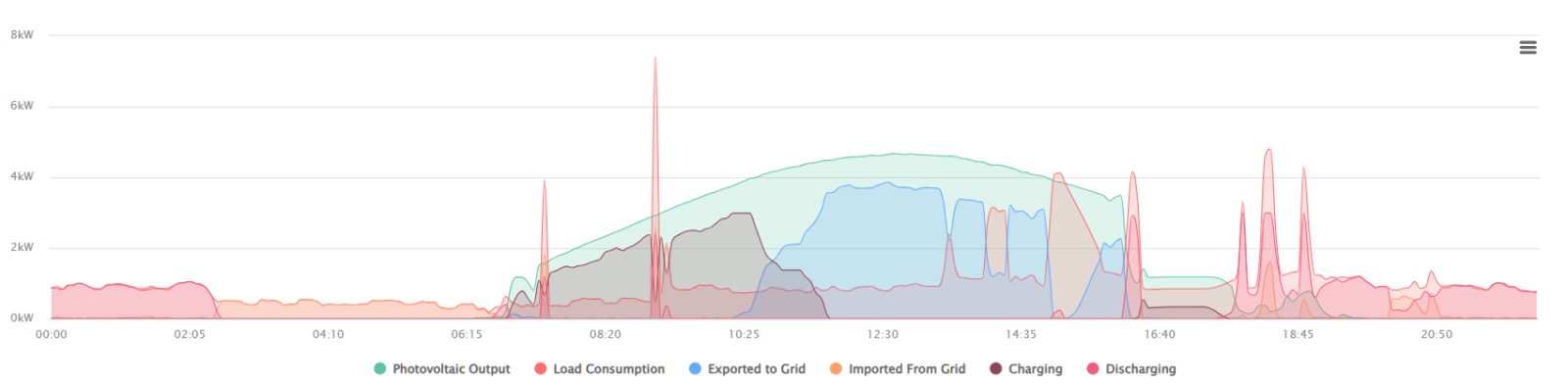
Later on in the year (July/August) I can get the full 6kw/h output, bit early in the year atm due to not hitting the full solar zenith, but still hitting nearly 5kw/h (Midlands).
I know I could tweek this to get a bit more savings, but can't be bothered to micro manage it. We installed it about 4 years ago and due to the cost of energy increase, it will have paid itself either later this year or early next year. Maybe I got lucky with the timings, but it does give us piece of mind in the summer, bills of maybe £40 a month of which £25 of that is standing charge.
Feel free to DM me if you want more info.1 -
The way I look at it, if you are a low home user (3200kWh), but plan to add an EV, you will almost certainly be best off using a cheap overnight EV tariff.
You may also be able to shift some of your house load to the cheap overnight rate, and in summer you will likely be able to cover the rest of the day from solar generation.
If you can shift some of your house load to the cheap overnight rate, you may only be using 2,000kWh per year at day rate (maybe 5-6kWh/day), and for 6 months per year that is going to be largely covered by solar. A battery may allow you to import 4-5kWh per day for 6 months a year at cheap rate (currently 9.5p on Octopus Go) instead of the day rate of 32.5p, saving you around £1 per day for 6 months of the year, so around an additional £180-£200 per year over not having a battery. Most of the savings have already been realised from the EV tariff, load shifting to the cheap overnight rate and solar covering most of what's left.
I am a Forum Ambassador and I support the Forum Team on the Benefits & tax credits, Heat pumps and Green & Ethical MoneySaving forums. If you need any help on those boards, do let me know. Please note that Ambassadors are not moderators. Any post you spot in breach of the Forum Rules should be reported via the report button, or by emailing forumteam@moneysavingexpert.com. All views are my own & not the official line of Money Saving Expert.3 -
Here's a illustrative calculation I did last year for someone on the Motoring form who was thinking of getting solar PV and an EV:
You could use it as a template for your own calculations.
(I don't think that particular forumites has purchased either solar or an EV yet, mind, despite the savings.)
N. Hampshire, he/him. Octopus Intelligent Go elec / Fuse gas / Vodafone BB / iD mobile. Kirk Hill Co-op member.Economy 7 cap explainer. Gas vs E7 vs peak elec heating costs, Ecoflow Stream, Best kettle :-)
2.72kWp PV facing SSW installed Jan 2012. 11 x 247w panels, 3.6kw inverter. 37 MWh generated, long-term average 2.6 Os.3 -
Not a daft question, a really important one. You're suggestion of getting an EV does have an important impact on the battery question. An EV leccy tariff is typically very low, which as you mention, opens the door to you charging the battery from cheap rate during the lower PV generation months. This reduces your leccy bills even more by avoiding day rate leccy consumption. During the sunnier months, your PV will cover a lot, and having batts will allow you to displace day rate import.
So it's the tricky balance / game of whether batts add value to your install. But there is another potential factor, and that's system size. Hopefully as others have mentioned, you can go bigger with the PV, and if necessary, even go bigger with the inverter size. But if there are DNO issues of going over 3.68kW, then a battery on the DC side, allows the inverter to 're-direct' some of the PV generation straight into that battery, rather than potentially clipping generation. I appreciate this is getting more complicated (or fun, when the PV bug has fully infected you), so more can be explained/discussed if of interest to you.
Perhaps, if you don't mind, you could advise on whether the whole roof potential of PV is being maxed out, and also PV only quotes v's PV + batts, for a comparison.
Best of luck.
Mart. Cardiff. 8.72 kWp PV systems (2.12 SSW 4.6 ESE & 2.0 WNW). 28kWh battery storage. Two A2A units for cleaner heating. Two BEV's for cleaner driving.
For general PV advice please see the PV FAQ thread on the Green & Ethical Board.3 -
I agree with @Martyn1981 . If you have a battery and cheap electricity at certain times of day then you can charge your battery when electricity is cheap and run your house from the battery when electricity is expensive. With a big enough battery you could potentially shift almost your entire 3200 kW annual consumption to the cheap rate you will get for your EV, without even bothering with solar panels. With solar panels then your 3200 kW could either be cheap or free. It gets really complicated if you can export electricity for more per kWh than the cheap rate in which case, with a battery, you might save more money exporting your solar electricity than using it.
Reed2 -
just to be clear you not going to be charging you ev from the battery. The EV will give access to different tariffs. As above you can the move other. Appliances to use the overnight cheap rate.
I think an attractive option for you is to find an export tariff. Exporting all surplus energy at 16p and charging you ev at low rate at night. That does not need a battery. Make sure the inverter can support a battery Thu for future upgrade if things change.
3










Confirm your email address to Create Threads and Reply

Categories
- All Categories
- 355.7K Banking & Borrowing
- 254.9K Reduce Debt & Boost Income
- 456.1K Spending & Discounts
- 248.3K Work, Benefits & Business
- 605.8K Mortgages, Homes & Bills
- 179K Life & Family
- 263.6K Travel & Transport
- 1.5M Hobbies & Leisure
- 16.2K Discuss & Feedback
- 37.7K Read-Only Boards