We’d like to remind Forumites to please avoid political debate on the Forum.
This is to keep it a safe and useful space for MoneySaving discussions. Threads that are – or become – political in nature may be removed in line with the Forum’s rules. Thank you for your understanding.
Short term gilt yields




I’m trying to understand how the forward short term base rate is reflected in gilt yields. My starting point is > Latest yield curve data > OIS daily data current month > fwds, short end / fwd curve. It shows six months forward at 4.24%, 12 months forward 4.37%, 18 months forward 4.31%, and 24 months forward 4.20%. So, roughly, the base rate is expected to rise half a per cent in the next six months and then stay reasonably stable until this time 2028.
Gilt yields for those appropriate six month periods are (from )
- 3.83% for T26A maturing in October 2026
- 4.33% for both TS27 maturing March 2027 and TG27 maturing July 2027
- 4.33% for TG27 maturing July 2027 and 4.35% for TR27 maturing December 2027
- 4.43 for TE28 maturing March 2028 and 4.42 for TS28 maturing June 2028.
This seems to show that for short duration (excluding ultra-ish short T26A) gilt yields track base rate forecasts quite closely. Is that correct?
Comments
-
More or less, yes. The forward curve aims to isolate each slice of time, whereas the gilt YTM covers the entire period from today until maturity.
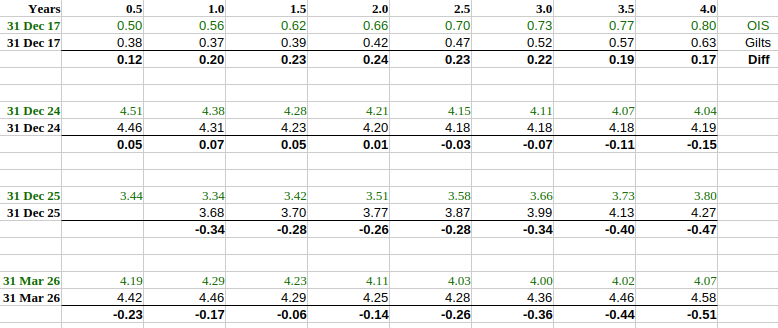
I don't know about your comment on the two short term rates generally tracking closely. Gilt yields can be persistently above or below SONIA forecasts, and the two forward curves would therefore diverge.
1 -
You would expect the overnight index swap rates and short term gilt rates to be consistent with what base rate currently is and is expected to be over a short time frame.
Remember the banks themselves bank with the Bank of England. So if you save with say Nat West they pool your savings with those of other savers and bank that saved money overnight with the Bank of England. The Bank of England then pays interest at base rate to Nat West on that overnight money (reserves). That's how monetary policy works to set interest rates.
If say treasury bonds (essentially short term gilts) were offering a lower rate than base rate was or was expected to be, then Nat West wouldn't buy them because they could just hold the money as reserves at the Bank of England instead and get paid bank base rate. And if the government offered a higher rate on an issue of treasury bonds than base rate was or was expected to be, then they would be sabotaging their own monetary policy, as Nat West would buy those treasury bonds rather than leave the money overnight with the Bank of England.
The knock on affect is that overnight index swaps also reflect short term base rate.
I came, I saw, I melted3 -
So if I hold SIPP funds in a STMMF that I will not need this financial year and I want to punt on the base rate being held or only rising 0.25%, I would buy TS27. I realise this also depends on the timing of base rate changes; the sooner it happens, the sooner the MMF equalises the difference.
Many thanks, SnowMan, for explaining how an announcement on interest rates is put into practice.
0 -
Some interesting commentary on the correlation between SONIA and short gilt yields here (timestamped): youtu.be/-hjHuksSkE0?t=1552
Illustrates the point I was making earlier about there sometimes being a disconnect.
Looking over a few different historic dates also shows the variation:
 0
0 -
I didn't word or explain what reserves are at all well, given that reserves in the first place come from government spending less taxation (with adjustment for gilts) that have worked their way into savings (net of loans). But I wasn't suggesting and didn't say that the banks in aggregate pooled savings to create reserves.
With quantitative easing the Bank of England did of course create reserves by creating electronic money to purchase those gilts, and so increasing private sector bank balances. Hence the connection between account balances and reserves.
If I switch my savings to bank A from bank B then bank A's balance at the Bank of England (reserves) goes up and bank B's balance at the Bank of England (reserves) goes down by the same amount. But from bank A's perspective it has higher reserves (an asset) at the Bank of England as a result of my transaction together with a matching liability to pay me back my deposit. Bank A gets paid bank base rate interest on that extra reserve amount. In turn the bank has to pay me interest at whatever rate the account pays.
My point was that as banks have reserves at the Bank of England (which in an oversimplified and clumsy one sentence description could be very loosely described as their combined customer savings net of loans) they have the choice as to whether to use some of those reserves to buy gilts or leave them as reserves and get paid bank base rate.
I came, I saw, I melted1 -
Thanks for the Pensioncraft video link, masonic . It is interesting that short duration gilt YTMs were, in mid-February, returning less than SONIA whereas now they are higher than SONIA – the shift is nearly 1%. That reflects an expectation that base rates will increase, aligning with the MPC’s “probably soon but not yet”. It is also why, in an environment where base rate increases are baked into gilt yields but not into STMMFs, short duration gilts are more attractive (the starting point for this thread; I made the switch into TS27 first thing yesterday morning), while, in an environment where there is an expectation of base rate cuts – baked into gilt yields but not into STMMFs – money market funds are more attractive.
0 -
When the economic climate is fairly smooth, no doubt that is how things work. However, there are times when markets overreact, or are irrational. Not so long ago there was media speculation about the base rate rising 1% over the course of this year, apparently fuelled by movements in gilt yields. If you look at the historic YTM chart for T27A you do see this:
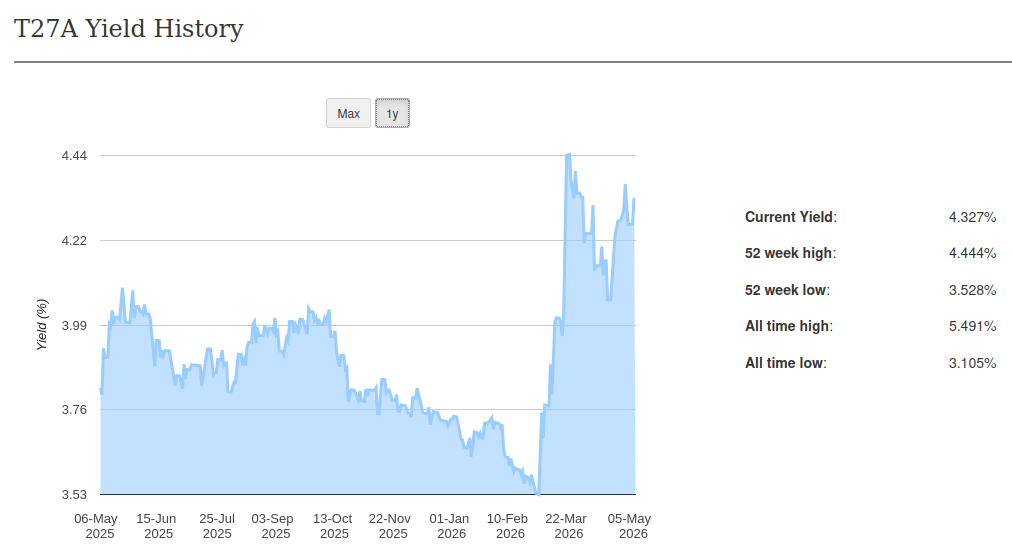
Before March, this was tracking the expected interest rate policy pretty well. But the 4.44% spike lacked any credibility as a prediction for base rate, even at the time. The subsequent ~4.1% easing started to look more reasonable, but now we're back up above 4.3%. We'll only know with the benefit of hindsight, but I think looking back this will be an overreaction. The MPC likely realises the futility of raising rates to combat an external supply-side inflationary shock, especially one involving an essential resource. Under those circumstances, such fall in gilt prices can be explained as an additional risk premium.
On the topic of markets being irrational, this was seen during the zero interest rate era, when gilt yields were fairly decoupled from base rate for extended periods.
3 -
"So, to be clear: you are agreeing with my proposition that the situation when short-term gilts are more favourable than STMMFs is not when base rates are expected to rise, but when the rise will be less or slower than gilt prices/YTMs are implying. And you argue that the latter does currently hold."
I agree with the principle that one should expect some risk premium for taking on duration risk, even at the shorter end of the curve. But my observation is that gilts are not always priced to deliver that. The risk premium for short duration is going to be small unless there is a more systemic asset class risk premium (some would use the word use the term "moron risk premium"). But future interest rate policy will also have a significant effect as nobody is going to lock into a 1 year gilt paying 4% if they believe money markets will be delivering a 4.5%+ return over the same period. So it is quite easy for such a small risk premium to be overwhelmed by other factors, which could result in a larger premium or a discount. Currently we appear to be in the larger premium phase, having recently transitioned from a discount period, albeit a brief one.
"The MPC is certainly aware that raising UK base rate can't counter an external inflationary shock, but that doesn't mean they won't raise base rate anyway, as they have done before. A spike in the price of an essential import makes the UK as a whole poorer, and the question is how that pain is to be distributed. The MPC does not want too tight a labour market in this situation, because they don't want workers to be in a position to demand sufficient wage increases to insulate themselves from the price shock. The MPC would call this avoiding second-order inflationary effects, I'd call it class warfare.* However, the price shock may cause an economic slowdown by itself, without any action from the MPC, so how much they will decide to raise base rate is difficult to say."
To be clear, I expect there to be some action from the MPC too, just not the short term +1% priced in to markets recently (and almost that much currently). At a guess, I'd think one 0.25% rise is very likely in one of the next two meetings, and then perhaps one more rise before the end of the year - maybe in autumn. But that does rather depend on how things play out with the orange toddler and his latest pet war.
2 -
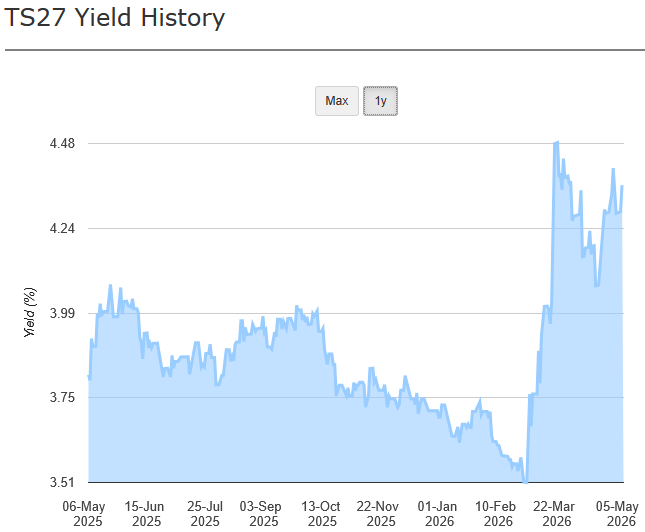
I agree that in theory the gilt yield at the short end should reflect the weighted average of the base rate until maturity (with a small risk premium) but an increase of nearly 1% compared to SONIA would, in a rational market, suggest a more immediate and steep rise in the base rate than seems likely. If the markets expect say three 0.25% base rate increases in M3, M6 and M9 from a 3.75% starting point, the effect on a one year gilt should be an increased yield of 0.375% (average of 3.75%, 4%, 4.25% and 4.5% = 4.125%, less 3.75%). But we saw a greater shift: the yield on TS27, maturing 7 March 2027, rose from 3.51% to 4.48% before falling back a little. That is the overreaction/irrationality mentioned by masonic.
Also, and on my point of gilt yields pricing in base rate expectations while STMMFs have to wait until they occur, then even if the gilt price adjusted more rationally, I could potentially exploit that by switching from STMMF into a short term gilt until one of two of the base rate increases materialised and then, for the latter part of the year, reverting to the STMMF.
 0
0 -
If my interest earned is below the tax allowance and savings rates are better than bond/gilt rates (I am not sure whether I have understood it correctly), apart from being able to access my money, would there be any other reasons to choose bonds/gilts as the return seem to lower than savings ?
0





Confirm your email address to Create Threads and Reply

Categories
- All Categories
- 355.8K Banking & Borrowing
- 254.9K Reduce Debt & Boost Income
- 456.1K Spending & Discounts
- 248.3K Work, Benefits & Business
- 605.9K Mortgages, Homes & Bills
- 179K Life & Family
- 263.7K Travel & Transport
- 1.5M Hobbies & Leisure
- 16.2K Discuss & Feedback
- 37.7K Read-Only Boards