We’d like to remind Forumites to please avoid political debate on the Forum.
This is to keep it a safe and useful space for MoneySaving discussions. Threads that are – or become – political in nature may be removed in line with the Forum’s rules. Thank you for your understanding.
📨 Have you signed up to the Forum's new Email Digest yet? Get a selection of trending threads sent straight to your inbox daily, weekly or monthly!
Estate - Investment Bond - How to complete "Tax Declaration for an entity"




Hi all, I hope someone can help me with this, I'm struggling.
My dad sadly passed away towards the end of last year. My sister and I are executors of the estate and everything was left to my mum in the will.
Most of dad's assets were jointly held apart from a stocks and shares ISA and an Investment/Portfolio Bond with Life Assurance - it is the Investment Bond that is proving to be the most tricky to deal with, and I'm struggling with the following issue in particular.
The bond is currently run by ReAssure.From what I have gathered it is a whole of life policy, joint-life second death, and hence does not pay out at this point.
Mum has an identical policy of which she is the sole owner. (an arrangment that seems a bit odd to me - but that's not the immediate point of this post).
ReAssure have sent a letter addressed to the Executors asking for our tax residency "because you're the new owners of this policy", and a form; a "Tax Residency Declaration for for an entity".
We have to fill this declaration "in your role as an 'entity', not as an individual.
I'm assuming in this case that the estate is considered an entity, hence the form?
ReAssure have thus far been unable to help me with this form in any way. Does anyone have any experience of this?
I've had a look on the forum, but can't see anything on this... I'm sure someone will have unfortunately had to deal with a similar situation and encountered such a form (not necessarily from ReAssure).
My specific questions regarding the form are:
- It asks for the name of the entity - is this simply "The estate of the deceased"?
- There are then a number of "entity types" to choose from, and I'm unsure as to what is the correct option.
- The only options which I think might apply to an estate of a deceased person are:
Active non-financial entity (NFE)
Passive non-financial entity (NFE)
- The only options which I think might apply to an estate of a deceased person are:
- If it is one of those options, then it goes on to ask for the details of controlling persons and their NI numbers. Are these the executors? Does it include the deceased?
- In the case of a Passive NFE it also asks each controlling person to select a definition as to why they are a controlling person:
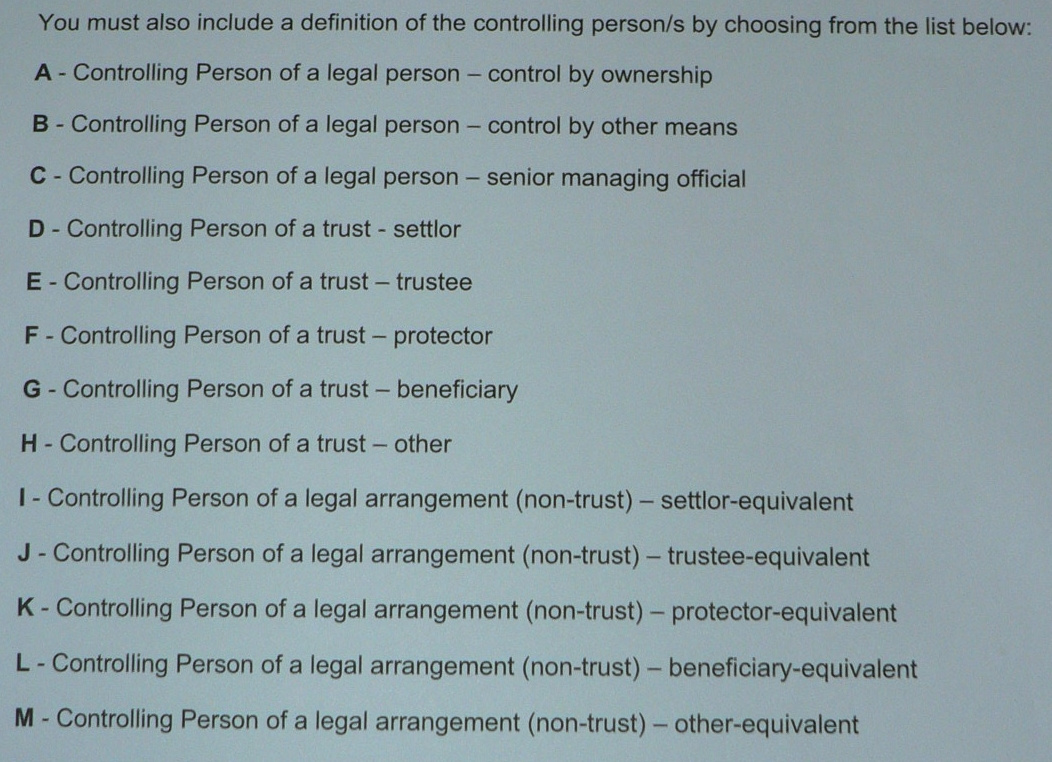
As far as I know this isn't a trust - although I think it was orginally intended to be (that's another issue). I will contact ReAssure again today to see if they can clarify this.
Interestingly only one person signs the form, acting on behalf of the "account holder" which I presume is the entity?
I hope this makes sense (I'm having to compose this at an ungodly hour, so apologies for the mess!) and thanks in advance for any help.
Comments
-
The initial preamble and explanation in your post, pointed to this bond being the primary asset of some form of investment bond trust arrangement, but you say it isn’t in trust but should have been?
If the bond was in trust, Reassure should be aware of this since they would have been notified of this from outset and have records of who the original trustee/s were ( likely to have been your parents) since it is the trustee/s who own the policy.
Suggest you therefore clarify with Reassure whether there is any evidence of an ongoing trust for the policy in their records, since it is possible your father may have made himself sole trusteee, so on his death his executors automatically assume his trusteeship.
1 -
@poseidon1 Thanks so much for the reply.I should get a chance to ring them shortly this afternoon and hopefully get some clarification on this.
1 -
Whilst awaiting Reassures response best be aware that they were likely not the original company that establish your father's investment bond, or sold him on the idea of a trust arrangement.
As you will see from the link below, ReAssure is primarily a consolidator (a kind of insurance warehouse ) of policies from other insurance companies that no longer write insurance/assurance business. As such ReAssure typically did not sell policies to new clients -
Therefore amongst your father's papers could be paperwork for an insurance business that no longer exsists but actually relates to the investment bond ReAssure are now responsible for.
Hopefully ReAssure retained a full complement of all the relevant paper work for the original insurance company your father did business with.
1 -
@poseidon1 I should perhaps have mentioned this in my previous reply but was pressed for time:
From the bits of paperwork I've found so far it looks like this was originally set up via Alliance & Leicester and was an L&G Portfolio Bond (which was later sold on to ReAssure). I have a document which outlines the outcomes of a Personal Financial Review meeting in 2008 a couple of days before the Bond contract date, with A&L recommending the above bond, and an outline of the bond.There is a sole mention of a trust in this document, in the following paragraph:
"I have made you aware that you still have a potential IHT liability and this is looked at as soon as is convenient for yourself in the near future. You must arrange with your solicitor to incorporate the trust wording into your wills."
This was all set up by my dad but I think due to his dementia in later life the paperwork is very bitty, disorganised and there are many gaps I'm trying to fill.0 -
@poseidon1 I rang ReAssure ealier today and essentially I have to ring back tomorrow (I hope to do so in the morning).
I talked to the Bereavement Team, and they could only give me limited information because according to the representative: the policy still in force, it's active and that mum was the policy holder (?!). They could see there were two policies and stated that the Executors are the second owner of my father's policy, which seems contradictory to the previous assertion. (And contradictory to the letter in my original post).
They could not answer as to whether there is evidence of an ongoing trust - it's a question for the Life Assurance team which they could put me through to. The same for any questions about the Tax Residency Declaration.
I was put through to the main contact centre and got someone from the Pensions Team who said that all the Life Assurance team had gone home and that he could not help me.
As an aside: The Bereavement Team member could answer some questions regarding value at death for estate (told me no value as still in force until second death), and Probate (told me not needed for transfer to mum, if I have the Will showing everything left to mum). They are also sending some info outling the policy and the 'next-step' options, but to my mum.And thanks again @poseidon1 the ReAssure info is useful.
0 -
OK, best see if the Life Assurance team have anything useful to add with regard to the possibility of the bond being the subject of any kind of packaged trust arrangement.
If it transpires there is no trust, then you and your sister are just mere executors of an unadministered estate until such time you transfer the bond into your mother's personal ownership. In the interim you have temporary legal control of the bond pending the transfer, but clearly you are not beneficially entitled.
Therefore although I can see that you as executors can be fairly described as Passive NFEs, the only sub category of Controlling Persons you loosely appear to fall under is M.
In the absence of any intermediate trust none of the other categories particularly come close to describing your executor status, as it bears on your executor's responsibility to your mother as the sole beneficiary under your father's will.
I must confess, I find it odd that the executors' function of a deceased estate is not listed as an unambiguous category in its own right.
However, this Tax residency declaratory system imposed on financial institutions was something foisted on the UK, when the USA introduced a world wide tax compliance system ( acronym FATCA) to keep track of its own citizen's compliance obligations. Therefore should'nt be overly surprised that something occasionally gets loss in the translation, when implementing another country's compliance rules for their benefit rather than ours.
0 -
@poseidon1 I think you're right in the case of there being no trust, and that is my instinct; Passive NFE and sub catergory M.
I too am surprised by the ambiguity of the form regarding the executors of a deceased estate (and the difficulty in getting clarification).
Thanks for the info on FATCA, that makes sense as to why a lot of the terms seem to be those used in the US, and why the default is to provide a Tax identification number (with NI number accepted for the UK):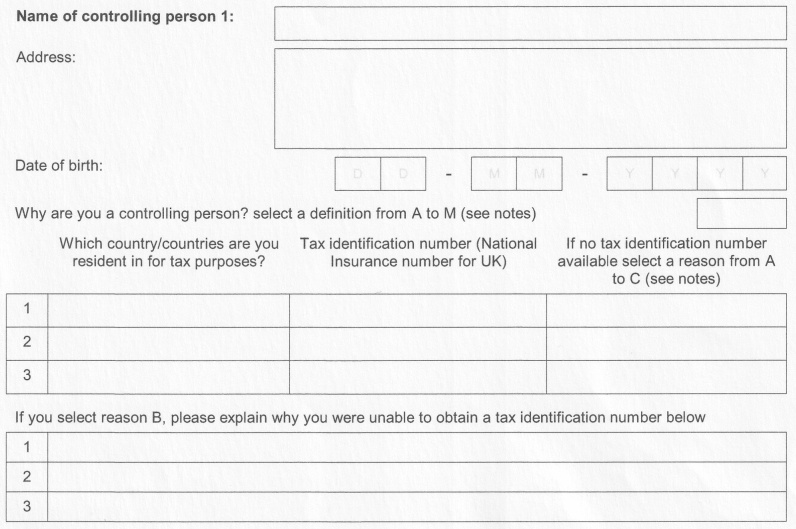
Hopefully I get some clarity from ReAssure tomorrow. Many thanks again.
1 -
@poseidon1 Just a quick response as unfortunately I'm pressed for time, I can add more info tomorrow but I think these are the salient points regarding the Tax Declaration form, albeit brief. I think a lot of this confirms your thinking.
I had a generally useful call to ReAssure, and they clarified that there is no trust for the policy.
Apparently what I was told previously regarding my mum being the holder of this policy was incorrect, as I suspected.
The executors are the owners, but it seems in a loose sense, as you say actually legal controllers. Apparently we act as an entity - hence the entity version of the form.So in this case I think the name of the entity (Q1 on the form) would actually be "The executors of the estate of ...".
They could not give direct advice on how to complete the form.
Tellingly, when I said there was something in particular I had been struggling with, they asked "Is it the Tax residency Declaration?".
However, while talking to ReAssure I realised that I was missing some pages of notes and descriptions that accompanied the form. I managed to find these (mum was quite ill when this correspondence arrived last month and absent-minded, she had mixed them in with other paperwork).This includes:
What is your entity type?
lf you're completing the declaration as a trustee, settlor or benficiary of an individual trust, it's likely that you are a 'Passive NFE', but you should check if any of the other entity types apply to you before ticking. lf you're completing it for a debt or equity interest in investment (including a professionally managed trust), a pension scheme, company, bank, institution or international organisation you shouid select the appropriate entity type. We can't tell you what this is, so you should seek advice if you're not sure.
You can find definitions of entity, and some of the entity types, in the descriptions section…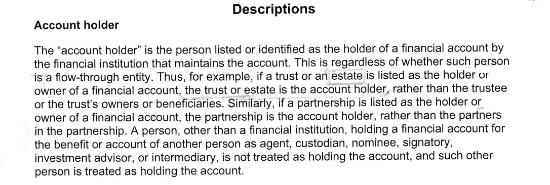

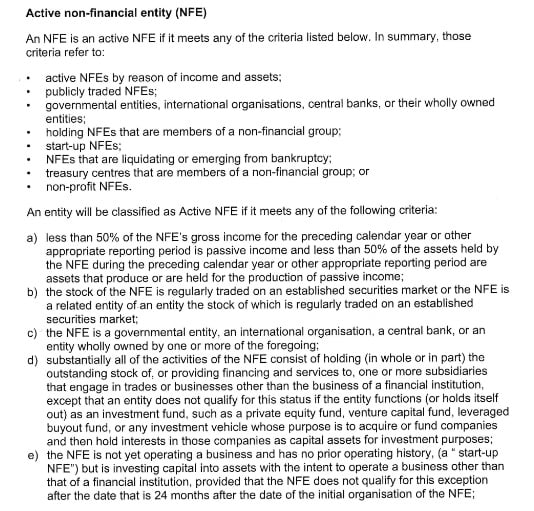
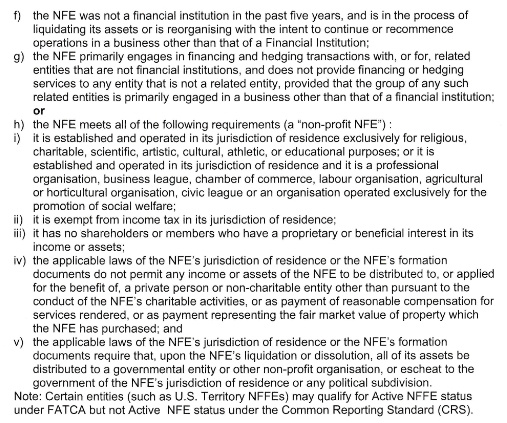

Sorry for the information overload, and that I didn't have this sooner, although I think this still points to the same conclusions.
(And of course, it might also be useful for others).
It's really not that easy without the executors' function of a deceased estate being listed as an unambiguous category in its own right, as you said previously. The ReAssure rep had some sympathy with this and seemed genuinly frustrated with this.
I'll have to leave it at that for now, as before I hope this makes sense.0 -
OP I am happy that your response here should be as a passive NFE, using the controlling person category M and your entity ' The executors of the estate of ..….' tax resident in the UK.
In reality the only relevance of this exercise is if you as controlling person, or mother as ultimate beneficiary were to declare to hold USA tax residency status which would then trigger a report by ReAssure to the IRS who in turn would check whether you or your mother were compliant with submitting your non US resident tax returns ( all American citizens or green card holders are liable to US tax wherever in the world they reside). Since presumably none of you have an American connection, this is really just a complicated tick box excercise.
For a bit of background I was ( prior to retirement) involved in making FATCA compliance reports direct to IRS compliance portal on behalf of family trusts my firm administered where either the original settlor was American, or where the wider beneficial class included Americans or non Americans tax resident in the USA. The following article gives a bit of background behind what those in my profession had to contend with-
Having said all that, I think the manner in which ReAssure has addressed this (essentially) USA compliance has been unhelpful.
For contrast, I had a look at the Prudential's version of the Tax residency declaration pdf link below.
Although it similarly does not overtly mention executors of estates, at least it refines the questions in such a way that the only option for executors is the catch all response at 2.4e under the entity heading.
ReAssure in my opinion should take a leaf out of Prudential's book.
2 -
@poseidon1 Thank you so much for your help with this, I'm finding dealing with the estate to be quite a difficult experience, but I've really struggled this declaration in particular as you can probably tell (I think it's aged me!). So your advice is very much appreciated.
Ah, regarding your background that makes sense; I wondered how you were so knowledgable and what your background might be so I appreciate that. I had a brief look at the FATCA article, and it looks like a headache!
Interesting to note that I was told by the last ReAssure agent I talked to that the form had been sent automatically due to an account change and the details should only be needed to be sent to HMRC by them if a "chargeable gain" occurs, such as if we surrendered the policy rather than transferring it to our mother's personal ownership. However the notes say that if not returned within a set time then they would "assume you are an overseas tax resident and pass on your detials to HMRC".
The last and most helpful ReAssure agent I talked to seemed to be of the same view as you when you say "this is really just a complicated tick box excercise"; he appreciated the fact that I must have a lot on my plate and that this seems to be made more difficult than it should be especially when someone is dealing with the affairs of a recently deceased loved one.
However, they have a policy of not being able to give advice or a personal recommendation (although to be fair he tried to clarify and steer as much as he could).
I agree this could be much better adressed by ReAssure, and especially in the case of executors I think the declaration is unnecesarily obtuse. Add to that the general advice available. I hope this thread might help others.
I just had a look through the Prudential form and if I read it correctly, in the case of the executors, as you say, the only option is 2.4e and then you simply sign the declaration and return; you wouldn't need to provide all the details of each controlling person along with NI numbers at all - which you do have to with the ReAssure form!1


Confirm your email address to Create Threads and Reply

Categories
- All Categories
- 355.8K Banking & Borrowing
- 254.9K Reduce Debt & Boost Income
- 456.2K Spending & Discounts
- 248.3K Work, Benefits & Business
- 606K Mortgages, Homes & Bills
- 179K Life & Family
- 263.8K Travel & Transport
- 1.5M Hobbies & Leisure
- 16.2K Discuss & Feedback
- 37.7K Read-Only Boards