We’d like to remind Forumites to please avoid political debate on the Forum.
This is to keep it a safe and useful space for MoneySaving discussions. Threads that are – or become – political in nature may be removed in line with the Forum’s rules. Thank you for your understanding.
ETFs




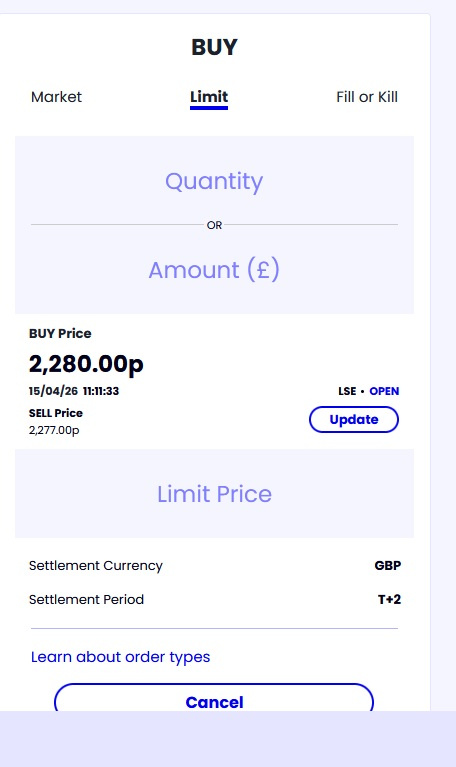
First time buying ETFs, on ii it has 3 subheading : Market | Limit | Fill or Kill'
- and explains the 4 types of orders, I can only see 3 types :
- Market orders / Limit orders / Fill or kill and cannot see 'Stop loss orders' - is this correct?
- I would like to know:
- 1. are there only 3 types of 'order'? on ii
- 2. to keep unnecessary fees to a minimum would it be better not to use the ' Fill or Kill' order? 'As it combines a limit order with strict execution rules: the entire quantity must be filled immediately at your limit price or better, otherwise the entire order is cancelled ("killed").as it may create a multiple commissions on a large trade. '
- 3. Is there a difference between ordering in 'quantity' or 'amount'? if you have the set amount of money to spend and want to buy immediately (and not set a low or high price) will it not be the same? and are there any benefits to use either?
- 4. Any other information welcome.
Comments
-
I rarely bother with other order types. A market order will get you the best execution price at that moment in time and you can usually see a quote before confirming.
Ordering by quantity gets you a specific number of shares for a price yet to be determined, while ordering by amount gets you the number of shares your specified amount can buy.
2 -
I use limit orders where the spread can vary widely during the day. AGBP, for example, can move between say 0.3% and 0.6% (or as much as 1%+ at the beginning of the day's trading) so placing a limit order can save a meaningful amount on a large trade.
1 -
What method would you use to decide when or which fund to use your ISA allowance on ? I am looking at investing £2000 into this commodity fund (mentioned by Masonic in my other post.)
0 -
A stop loss order only applies to selling, not buying, which is why you did not see it. When I look at the options for selling an ETF I already own on ii, I do see it.
The explanation you've copied for "fill or kill" is about large orders that might have to be split up to be fulfilled - which I doubt would apply to you (you can check on the LSE on the size of transactions for an instrument, but most will manage the £20k of a ISA contribution in one trade without a problem). The other reason to use it, which the ii page also mentions, could be when the market is closed, and you don't want to buy at too high a price when it does open. However, currently, with the LSE closed, ii is not offering me "fill or kill" as an option, for buying or selling - not sure why. I can't say I've ever used it.
I have sometimes used a limit order, both buying and selling - when I'm happy for the order to be potentially delayed, and I reckon there's movement in the price going on that I stand a chance of taking advantage of. But it can mean you end up not getting it executed at all, and you have to accept a worse price than when you started. On the whole, it's simpler to just buy and sell at the market price.
1 -
I pick the fund which best fits my long term investment goals, and fund as soon as the funds are available.
2 -
The LSE website no longer shows the Exchange Market Size (EMS), or if does, I cannot find it. Market makers may be willing to quote above the EMS, but they are not required to do so. The spread quoted by the LSE is of little use. You will normally trade within that. What maters is the price that you are quoted. If you are quoted a worse price for a large trade, consider splitting it.
1 -
I have only bought one OEIC fund mainly because it is easier to for me to do my self assessment and also it has only one price a day compare to the 'excitement' of ETF prices changing through out the day.
With ETF there seem to be a lot more fund and cheaper fees? what other benefits compare to OEIC?
2 -
I see ETFs as a solution looking for a problem. If you are an investor rather than a trader, taking the day's price should be good enough for you. ETFs are tradeable throughout the day - do investors really need that?
1 -
Good point, (as I am not a trader and do not wish to be one). One of the thing I do not like about OEIC in my experience is that when the platform is slow or having 'technical issues' my request did not make it to the cut off time can be frustrating as even with doing whatever I can to minimise that risk it still not preventable. I do not think there is any way around it apart from transferring to another platform.
I have not invested using ETF, even though the funds are want are almost all ETFs.
I am just reading :'Fund Selection: Choose between index funds (often better for smaller regular savings) and ETFs (sometimes better for large lump sums due to lower holding charges, though they may have transaction fees). I will be doing lump sums, so maybe OEIC is right for me. And I will use the ETF to buy the commodity fund.
0 -
ETFs are cheaper to run and can be cheaper for us.
0






Confirm your email address to Create Threads and Reply

Categories
- All Categories
- 355.7K Banking & Borrowing
- 254.9K Reduce Debt & Boost Income
- 456.1K Spending & Discounts
- 248.3K Work, Benefits & Business
- 605.9K Mortgages, Homes & Bills
- 179K Life & Family
- 263.7K Travel & Transport
- 1.5M Hobbies & Leisure
- 16.2K Discuss & Feedback
- 37.7K Read-Only Boards