We’d like to remind Forumites to please avoid political debate on the Forum.
This is to keep it a safe and useful space for MoneySaving discussions. Threads that are – or become – political in nature may be removed in line with the Forum’s rules. Thank you for your understanding.
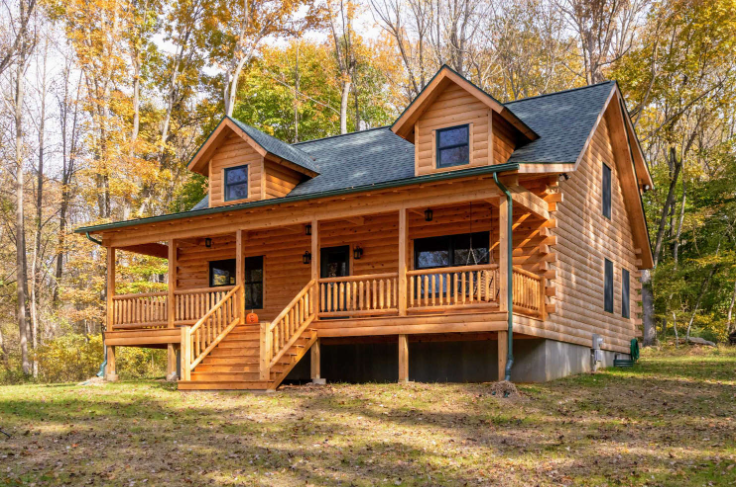
Why don't we build more timber homes, like the US does?




We don't have hurricanes, serious floods, wild fires, extreme winds or anything. I don't understand why we don't build more timber homes? I'd love to one day own a really nice timber home, something like this would be amazing
Comments
-
Houses are generally built with the durable materials that are available locally, hence brick-built where there's a supply of clay, stone-built where quarries etc.
All houses used to be built of wood but there is an obvious problem with high-density housing (think terraces) and fire (eg 1666 in London or Chicago 1871).
Timber-built is really only suitable for detached dwellings and is often used (at least round these parts) by self-builders.
1 -
Timber rots. Timber rots more rapidly when it undergoes cyclic wetting and drying.
In some parts of the US the weather is drier than the UK. In a dry climate timber makes for a good building material.
In a wet climate, like most of the UK, timber makes a poor building material.
Yes, you can treat timber to delay the onset and rate of rot (and other decay), but without regular treatment the rot will always win.
Temperature also makes a difference - achieving thermal stability with timber is less easy than it is with stone/brick/clay. Timber buildings are less suitable where keeping the cold out is important.
There has been a history of using timber as a building material in parts of the UK where stone was not readily available… but with transport becoming more affordable the use of brick displaced timber, other than where appearance and style were the most important factors.
8 -
They are popular for holiday parks but due to the weather related issues, I would assume a timber building would be more suited/last longer in say Kent, rather than somewhere like the Lake District.
1 -
Timber houses are very common in Scandinavia, using brick there can be very expensive, only for the wealthy, timber is much less expensive. My OH is Norwegian, from north of the Arctic circle, it can be - 20 C , or less, in winter but the houses are not cold, they use very thick insulation.
His family home was built in its present position in 1941, before that it was a school building in the Lofoten Islands. His Dad and Uncle dismantled it and took all the labelled timbers on their fishing boat to its current position, they could not get building materials during WW2. Our nephew owns it now and has modernised it all.
Even in very wet areas such as Bergen, houses are mainly built of timber. It does require good maintenance of course, that is the main disadvantage.
The other problem in UK is getting a mortgage for a timber house, and insurance. We have a timber frame house with brick skin, a few insurers will not quote or want to charge a lot, others are more enlightened.
6 -
Another thing, I used to be a painter and decorator. I was looking to buy in a conversion. I personally would avoid anything that had a problem to decorate, and needs painting every 5-10+ years. Just looks bad.
Easier to buy brick. They looks smarter. Go somewhere where everything is new / rebuilt / wooden. Whole road looks awful after a while. Doesn't happen when everything is brick.
It is probably the first thing I look for.
0 -
I'm more interested in why the US builds timber homes even in the places which are subject to tornados etc.
2 -
Because of storms - that is precisely why, as it doesn't matter if they are flattened. They are cheap to rebuild. That is why.
1 -
It is about the fundamental decision in almost all construction - build to resist, or build to accommodate.
As well as jones_guitar's point about being cheap to build, a lightweight clapboard-style house is quick to build. Also being lightweight gives the occupants a slightly better chance of survival in case of collapse. If a brick or stone wall falls on you then you have little chance of survival. A clapboard wall or tin roof falling on you can certainly kill you, but you have a chance, and in particular a chance of self-rescue.
So if you aren't confident you can build a brick or stone wall which is capable of sustaining the weather loads imposed on it, then you are likely to be better off building a lightweight structure with a lower risk of harm when it fails, accepting the fact it is more likely to fail.
Similar considerations apply in earthquake areas.
1 -
In a previous life I worked in the UPVC industry ( manufacturing). The quality of US manufactured UPVC building products, particularly things like cladding, windows etc was much lower than in Europe. It was because in the US, houses in general were not built to last.
3 -
Scotland has plenty of new build timber houses, especially in very remote areas and islands where it is expensive to transport materials.
0







Confirm your email address to Create Threads and Reply

Categories
- All Categories
- 355.7K Banking & Borrowing
- 254.9K Reduce Debt & Boost Income
- 456.1K Spending & Discounts
- 248.3K Work, Benefits & Business
- 605.8K Mortgages, Homes & Bills
- 179K Life & Family
- 263.6K Travel & Transport
- 1.5M Hobbies & Leisure
- 16.2K Discuss & Feedback
- 37.7K Read-Only Boards