We’d like to remind Forumites to please avoid political debate on the Forum.
This is to keep it a safe and useful space for MoneySaving discussions. Threads that are – or become – political in nature may be removed in line with the Forum’s rules. Thank you for your understanding.
📨 Have you signed up to the Forum's new Email Digest yet? Get a selection of trending threads sent straight to your inbox daily, weekly or monthly!
Investing in current times
Comments
-
So perhaps, rather than look at history that cannot be changed, it may be better to look at today markets and current events to see if there are any appropriate ways to further reduce or mitigate risk.
If you cannot close your eyes to it and let it do its thing and feel inclined to move defensively because of a minor short-term drop, then you are invested above your risk profile.
I am an Independent Financial Adviser (IFA). The comments I make are just my opinion and are for discussion purposes only. They are not financial advice and you should not treat them as such. If you feel an area discussed may be relevant to you, then please seek advice from an Independent Financial Adviser local to you.6 -
How long term do you think the investing future is of a 76 year old, is it 5 years 3 months long enough to be able to recover the 48% drop in the FTSE AW in 2007? Statistically, perhaps it is but I wouldn't want to give odds on that! If taking profit is not part of investing, long term or not, that seems like an odd concept. Perhaps that's true if you're a died in the wool, long term hold at all costs sort of investor but I'm doing this to make money and part of that is practising risk aversion and protectionism.
0 -
What you are describing here is reducing risk to align with your changing investment horizon, which is sensible.
3 -
Since the OP has only opened the S&S ISA 18 months ago, with one investment, I think their time frame is probably long enough to consider equities, but they didn't reply to questions about what their plan was.
Of course, you need a plan for when you've reached your target date as well - retirement planning is a whole other set of considerations, but like the above, should be considered in advance, not as a reaction.
0 -
I do not believe that risk or risk profiles are static, I have always believed that risk tolerance is a variable based on the interpretation of known current events and forecasted future actions. Risk itself is not static. Risk tolerance is not something that changes frequently but I do believe it involves step changes and that current events constitute one of them.
0 -
Didn't you very recently reply to me by saying, "It does worry me when people jump to sweeping generalisations"! ..:) Of course everyone should make robust plans and consider every avenue from the outset and factor those things into their plans. But the reality is that most do not and nobody can consider every eventuality. Hand on heart, how many average retail investors today, constructed their portfolio's in the knowledge that todays events might become a reality and mitigated the risk in their asset allocations?
0 -
Absolutely - it does worry me if anyone starts saying 'everyone is doing/saying X' and using that as a reason behind their decisions. Saying that 'most do not' make robust plans is likewise something I don't think anyone can say with much confidence, unless there's been some survey that supports it I guess. Even if it's true, it doesn't make it a sensible thing to follow.
0 -
I do not know what kind of health you are in, but for the general UK population a man at 76yo has a life expectancy of 88yo (i.e., a roughly 50% chance of getting to that age), and a 10% chance of reaching 96yo, i.e., planning horizons of 12 and 20 years, respectively. For a female, the horizons are slightly longer at 13 and 22 years, respectively (and for a couple, the odds of one or both surviving are higher again). I note that, historically, over rolling periods of 20 years, UK equities beat UK cash in 97% of cases (89% for rolling 12 year periods). Of course, the future is unknown.
Personally, I withdraw from the portfolio so as to rebalance towards the target allocations (which themselves vary with age since our dependence on the portfolio income will decrease once passed SP age) of equities and fixed income and, within those broad assets, rebalance between funds too. In other words, 'taking profits' can be a part of an algorithmically determined process even for a generally 'buy and hold' investor.
3 -
At 76 I am fast approaching bonus years territory when compared to my known family members, but I will try my best to set a new record!
I have an amount in mind that I want to leave in my investment portfolio for my wife, anything over that is to be spent on life's luxuries, such as the week we will spend in Hong Kong next month. Thanks to you I can now classify that trip as a rebalancing effort and shall feel slightly less guilty. :)
Subsequent to previous comments I have been giving more thought to the subject of risk and have been reading more on the subject. AI has a nice little summary that explains my view much better than I can and this is set out below. I now more than ever believe that investment risk is fluid and dynamic and that in turn means inidividual risk profiles must be the same. Some senior investors have suggested that making changes to a portfolio means that "your" risk profile is inapprorpriate, which I say is not always true. Granted, there is an emotional aspect to risk and market losses but there is also a shifting sands and changing risk levels, which people need to be able to respond to. For example, few people I imagine will want to remain 100% invested if nucleur war breaks out and even fewer will have built that possibility into their asset allocations when they selected funds at the outset.
Market and Economic Shifts:Investment risk changes with the economic landscape, including fluctuating interest rates, inflation levels, and political instability.For example, when interest rates rise, bond prices generally fall, increasing interest rate risk.Changing Asset Performance:The risk level of a portfolio is not constant because the underlying companies or sectors can take a turn for the worse, or overall market volatility can increase, causing risks to rise in uncertain times.Personal Circumstances (Risk Tolerance):An individual's willingness and capacity to take on risk change based on factors like income, age, family responsibilities, and retirement status.Portfolio Drift:A static portfolio (one that is never rebalanced) will naturally become more or less risky over time as some assets grow faster than others.- Richmond Quantitative Advisors +6
Because risk is dynamic, experts recommend regularly reviewing investments to ensure they remain suitable for your current situationand market conditions.0 -
I don't know what you see but I see the major indicies all falling between 7% and 9% over the past 30 days. There is a steady but consistent downwards trend with no indication that things will do other than remain the same or get worse. So no, I don't think that "downward spiral" is necessarily overly dramatic, it strikes me as a fair and accurate assessement.
"Steady but consistent downwards trend" - what are you invested in? f the OP had invested in a global tracker, they'd still be considerably up on their investment.
(e.g. Vanguard FTSE Global All Cap Index Fund - funds without small caps would be up even more):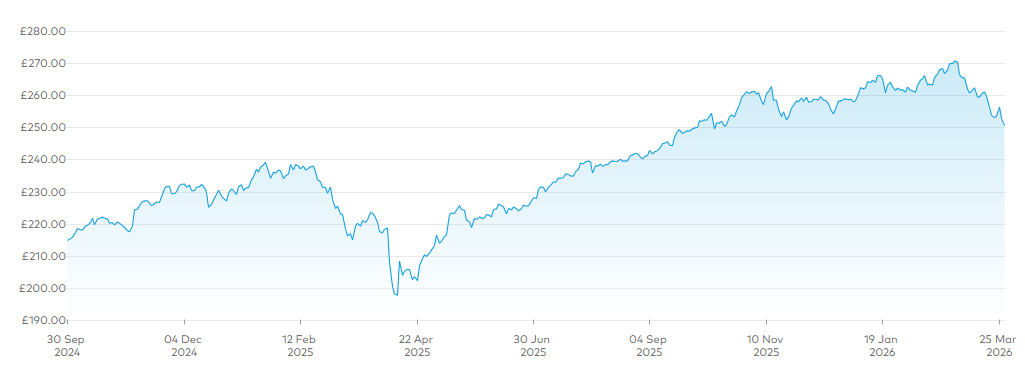
To get these sorts of returns from a savings account paying interest monthly, the interest rate would have needed to be over 10% over the same period.
Personally if these sorts of relatively minor dips cause you anxiety, I'd suggest you may be invested above your risk tolerance.
Know what you don't0














Confirm your email address to Create Threads and Reply

Categories
- All Categories
- 355.8K Banking & Borrowing
- 254.9K Reduce Debt & Boost Income
- 456.2K Spending & Discounts
- 248.3K Work, Benefits & Business
- 606K Mortgages, Homes & Bills
- 179K Life & Family
- 263.8K Travel & Transport
- 1.5M Hobbies & Leisure
- 16.2K Discuss & Feedback
- 37.7K Read-Only Boards