We’d like to remind Forumites to please avoid political debate on the Forum.
This is to keep it a safe and useful space for MoneySaving discussions. Threads that are – or become – political in nature may be removed in line with the Forum’s rules. Thank you for your understanding.
📨 Have you signed up to the Forum's new Email Digest yet? Get a selection of trending threads sent straight to your inbox daily, weekly or monthly!
How to fix table leg




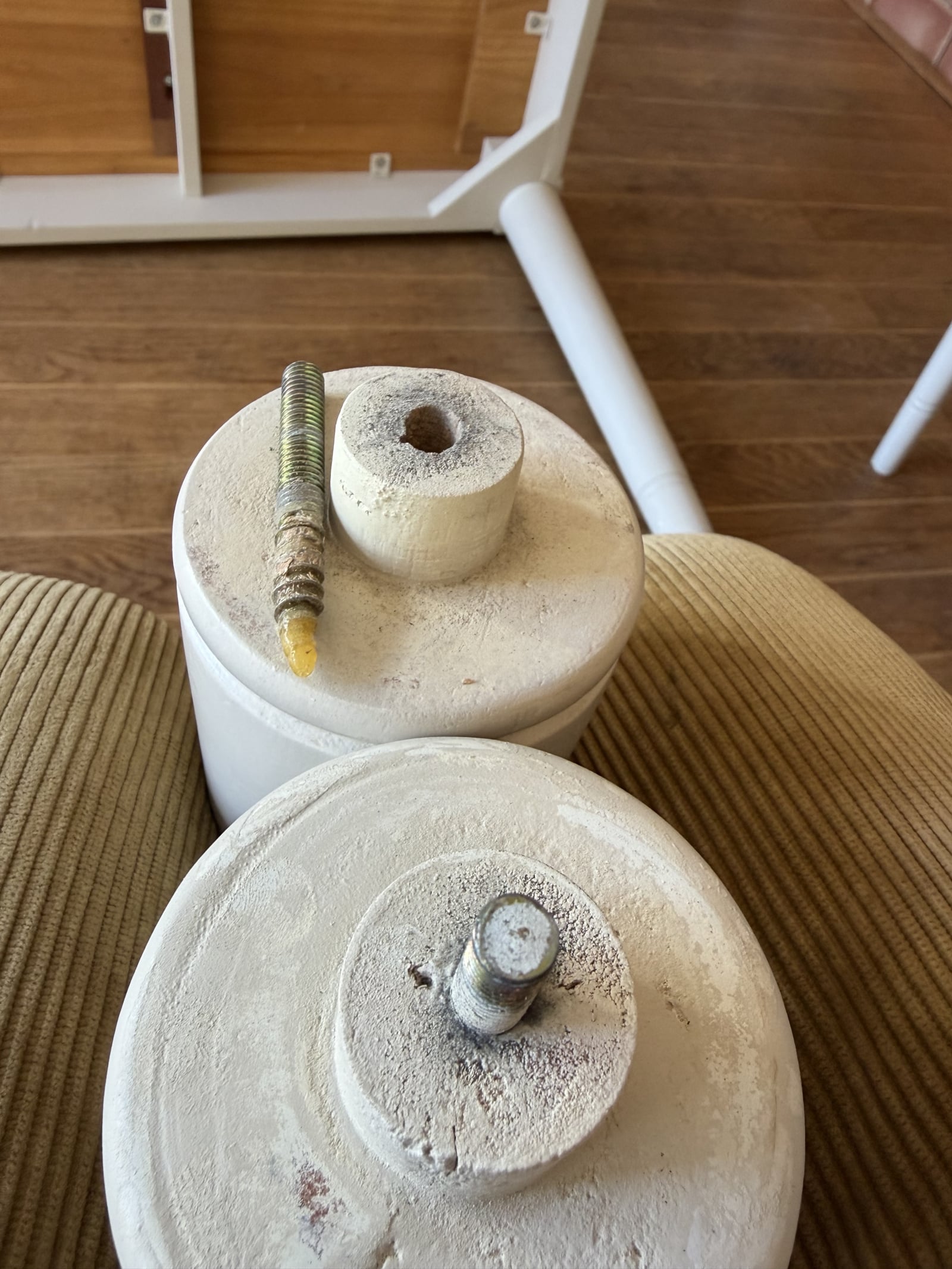
I have a broken table leg and am after some tips and suggestions on how to fix. Picture attached with broken leg and an unbroken leg. The bolt has worked loose from the leg and I need to refix. The material appears to be mdf. I am thinking of getting some araldite and glueing the bolt in place. Wondering whether this is a good idea and if so best epoxy to use.
Comments
-
no more nails or similar, I use it for all sorts, even to fix a radiator back on the wall :)
I am a Senior Forum Ambassador and I support the Forum Team on the Wales, Small Biz MoneySaving, In My Home (includes DIY) MoneySaving, and Old style MoneySaving boards. Please note that Ambassadors are not moderators. Any posts you spot in breach of the Forum Rules should be reported via the report button, or by emailing forumteam@moneysavingexpert.com.All views are my own and not the official line of MoneySavingExpert.2 -
Was the metal component originally screwed into the MDF, but now the hole is stripped out and oversized so the thread on the metal part won't bite into it?
I wonder whether the best approach might be to drill out the hole to a larger size, then glue in a close-fitting plug of solid wood and drill a fresh hole? Then you can screw the part into the new hole, maybe with a bit of glue if desired. I've done similar in other situations like when trying to refit hardware on wooden doors and window frames where the original wood is too chewed up by old screw holes for a good fixing to be made.
1 -
Unless you have more helpful replies, for a table leg under heavy duty I'd use the stuff that sticks brick and cement.
It comes in tubes from building supplies. Different brands but is blooming brilliant 🙂
I can rise and shine - just not at the same time!
viral kindness .....kindness is contageous pass it on
The only normal people you know are the ones you don’t know very well
1 -
Thank you. it appears to have been half screwed and half glued. I had thought of doweling but thought maybe gluing easier and just as effective hopefully.
0 -
I'd use epoxy rasin because it fills a gap and doesn't shrink when setting (unlike most adhesives).
https://www.screwfix.com/p/easyfix-styrene-free-polyester-resin-165ml/292px
This one is for anchor bolts and is just £5. Not sure what gun it fits. Most likely it's overkill in this case and simple https://www.screwfix.com/p/no-nonsense-2-part-epoxy-adhesive-tubes-opaque-30ml/111kh will do the job
1 -
Your own solution is the best, and will almost certainly work perfectly.
A few things that will help: clean up the coarse thread on that stud, using - say - a hacksaw blade.
Work out just how much threaded rod needs to actually protrude once it's in place to easily allow the nut to still go securely on - now drill the hole in the leg deeper if possible to fit the stud in to this max depth. If you can drill the hole deeper for this, then also make it a 'pilot' hole to hopefully allow the stud to actually 'catch' in this fresh timber as it's screwed in.
Then you have a decision on how to secure the stud in place. I'd suggest you have two options - the first is as you suggested, which is to roughen the sides of the hole, and copiously coat the coarse stud with epoxy resin - Araldite is good and one of many - and insert the stud with a gentle twisting action as deep as you can afford to go. Wipe up level with the top. Jobbie should be jobbed.
The other is similar, but will use Polyurethane wood glue (Gorilla, expanding) along with wood slivvers or matches. This method will need you to be able to screw the stud in firmly, so you'll need really good purchase on the fine thread without damaging it. The easy way is to slip on two nuts, and lock them against each other - make the top nut flush with the end of the thread. Then you use your spanner to drive the whole stud in.
Get your wood slivvers ready - matches should be ideal - and stack them up around the perimeter of the hole to check that the resulting centre hole will be a really nice 'cutting' fit for the coarse thread - in effect a 'pilot' hole. Remove the matches, coat the inside of the hole with Gorilla, add a few more drips, and then coat each match as you reinsert them. Quickly give the coarse thread a smear too, and then drive it in. Once set, trim the sticking out sticks flush.
For both solutions, make sure the stud is sitting nicely perp.
Which method? They should both work, but the Gorilla will likely be more work as you'll need to properly drive the stud in. But I also think it will be stronger. Choose the adhesive you'll have more further use for :-)
Adding sticks for the Araldite method will likely strengthen it too, but I'm hoping is not 'necessary'.
1 -
Clean up the coarse thread on that stud, using - say - a hacksaw blade.
Wet some toilet paper and tear it up. Mix with a good amount of PVA wood glue. Fill the hole with it. Screw the bolts back in, the filler will pack around it. Leave to set. Job done.
The toilet paper helps pack it out and gives something additional for everything to bond to.
1 -
That's a nice and easy solution for many repairs, but I suspect it won't be good enough here.
PVA is effectively a thermoplastic, and is quite soft when set, unless it's in a very thin layer where this won't matter - like joining two flat timber surfaces. It's not a very good gap filler, as it's flexible.
The leverage on the leg will be considerable, with a strong force trying to pull that stud out - I suspect the PVA will tear.
I also imagine it'll take a few days to dry out fully.
For a lesser-strength job, it's sounds a good solution.
0 -
I’d second the epoxy resin, although the product I used for a chair leg was Gorilla epoxy resin glue.
Blow out any wood dust etc. then simply mix it and squeeze into the hole in the leg, insert the threaded bolt and leave to harden (making sure it’s perpendicular).
It forms a very strong bond, almost certainly stronger than it was originally.
2 -
And if the hole is too smooth-sided and parallel, which could allow this set resin plug to be drawn out, then a drill can be first used to dig notches into the sides, and even widen it slightly towards the middle area.
GreenFrog, make sure there are no voids - use enough resin to completely fill the gap. Slowly 'screw' the stud in so as not to trap any air bubbles and not squirt out too much resin.
(This thread could run and run...)
1











Confirm your email address to Create Threads and Reply

Categories
- All Categories
- 355.8K Banking & Borrowing
- 254.9K Reduce Debt & Boost Income
- 456.2K Spending & Discounts
- 248.3K Work, Benefits & Business
- 606K Mortgages, Homes & Bills
- 179K Life & Family
- 263.8K Travel & Transport
- 1.5M Hobbies & Leisure
- 16.2K Discuss & Feedback
- 37.7K Read-Only Boards