We’d like to remind Forumites to please avoid political debate on the Forum.
This is to keep it a safe and useful space for MoneySaving discussions. Threads that are – or become – political in nature may be removed in line with the Forum’s rules. Thank you for your understanding.
📨 Have you signed up to the Forum's new Email Digest yet? Get a selection of trending threads sent straight to your inbox daily, weekly or monthly!
Reduction to existing fix rates from April - will there be a cut off date for signing up?




I asked this in another thread, but maybe it needs a space of its own.
My fix rate tariff ends in early April. I’m aware of the “£150 reduction” coming up from 1st April and I know that the energy companies are (mostly) planing to apply this reduction to their existing fixed rate customers too by reducing the fix that they are on. So, I wonder if there will be a cut off date to have signed up for a fix in order to get that reduction from April 1st? Will it be possibly to sign up for a 12m fix on, say, March 31st and then have it reduce from April 1st?
e.g. Sign up for a 1 year electricity fix at 5.5p per unit on March 31st. Then that fix reduces from April 1st and you actually are fixed at, say, 5p per unit for the next 364 days?
Sorry if this is a silly question but I want to time it right when I sign up for a new fix.
Thanks!
Comments
-
No one knows yet as the details have not been confirmed.
1 -
You can't be charged exit fees if you've 49 day or less left on your fix
Under Ofgem rules, suppliers can't charge exit fees in the last seven weeks of fixed-term deals. So if you're near the end of a fix, you won't have to pay a fee to leave it and move to a new tariff or supplier– provided you start your switch within the last 49 days of your current deal.
You have a 14 day cooling-off period if you change your mind
If you do switch, regardless of what tariff you go for, you have a 14 day cooling-off period, which starts from the date you submit your switch. So if you change your mind, you can just go back to your original supplier, and you won't have to pay any exit fees.
1 -
Does anyone know roughly when a solid announcement will be made concerning how the energy companies will work out this reduction for existing fixed rate customers? Will it be around the time of the price cap announcement this month? Right at the last minute? Have they even decided how to approach this yet or are they still having arguments in meetings and frantically scribbling on white boards?!
0 -
The only solid answer is "before it comes into force". The government made a political announcement, not a legislative one, then asked the energy suppliers to figure out how they might do it. The energy suppliers are consulting with Ofgem to not set a complicated precedent or breach their supply licenses. It will be ready when it is ready, you need to wait like the rest of us.
2 -
-
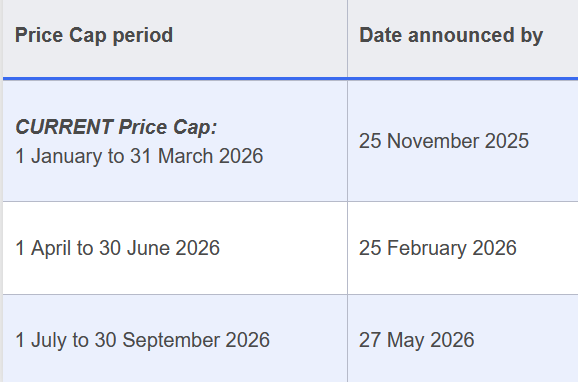
25 Feb we know what the capped tariffs will be in April, including the £150 average reduction in unit rates, but will the companies offer fixed rates including the reduction before April and will the long delayed zero/low standing charge tariffs also turn up, at the very least taking that £150 off the s/c's instead on the unit rates - that process may be why there is a deadly silence on the zero s/c tariffs which were supposed to turn up now.
1 -
The charges being moved are according to mse going to be via the unit rates not the SC.
Low users save less, high users save more. There is no universal £150 - or for some cases it seems now even only £90.
There is also speculation about how it might impact non capped special tariffs - like say agile or other dynamic tou rates etc.
[I suspect tge low / zero SC tariffs are delayed because there just isnt a sensible way to implement that guarantees no additional siynificant cross subsidiy risk without offering such minimal benefit to even the lowest of users, their just isnt going to be a big market for them. About turn of decade c2018 -just pre cap - but some were small and collapsed in crisis - iirc i found a list for when last searched - there were 6 firms offering zero SC variable tariffs and/or fixes. There is now only 1 - and now even they only do on prepay. If annualise their SC equiv recovery threshold on 1st 2kWh per day = 770kWh - or just c40% of lowest quartile profile class 1 (1800kWh pa) or 35% of lowest quartile profile class 2 (2200 kWh pa). That cannot leave many users - who are unlikely not to be excluded (e.g. second homes).
None of the last set of possible proposals by Ofgem were problem free.]
As to the £150 - it would be best to consider carefully which baseline you use.
And of course its a treasury derived - not even Ofgem cap linked - figure.
As to fixes, surely the real question is not what suppliers will do with new fixes.
Which I believe generally follow the net sum impact of all previous govt policy changes - so for instance that might be this mythical £150 - say last 2 caps £62 increase in policy and network costs (all other things equal - which they wont be - anc bearing in mind one was a treasury average and the caps a median tdcv based figure) - so £88 for typical dual fuel household if compare with a fix taken in Q3 2025
But whether they IMO rightly argue they should be allowed to do the same net sum if and when alter all existing fixes, as Miliband has written requesting them to pass on tgese abnormal cuts (via shift to taxation so not cuts) - in a desperate attempt to offset - in part just temporarily - his expensive energy policies ongoing additions to our electricity bills. Last 2 caps - so in just 3 months - all elecric up 7.4%.
And of course it wont be £150-any such net offset if allowed for existing fixes - but only on charges going forward for remainder of fix. So pro rata - half for 6 months - 1/4 for 3 months etc.
And its not even £150 for 100% of suppliers anyway as some small reportedly were excluded from part of the charges being shifter to taxation..
But theirs going to be a lot of anger out their though against way govt have pushed this as £150 simplistic figure - from the where is my £150 brigade regardless.
After all the crisis £150 CT rebate was fixed, as was the £400 EBSS for those who qualified. And as is - at least notiinally the other govt £150 - the WHD.
Just as we found with the cap itself and the epg cap on the cap at crisis peak.
The unit rate change isnt as sexy a headline for our leaders - or possibly even still well enough understood.
The best advice above - wait and see the actual change as implemented re budget promise.
1 -
A number of us did answer you on your original post.
I think that you are still outside the 49 days where you can leave your existing fix and therefore would have to pay early exit fee to leave now.
What is your existing fix - are the rates cheaper than the best available? Is it better for you to leave early and get 2 months of a different rate.
The reduction will be applied to you if you fix today or post April 1st. At some point over the next 2 months Energy Suppliers may start to announce fixes including the reduction. MSE are monitoring to ensure fairness and I am certain that they will be raising with government if there are any concerns.
Nobody knows what is going to happen over the next two months with energy fixes - they could go up or could go down. I did a fix with Outfox 3 weeks ago. If I had waited I could have got a cheaper fix today and saved myself £1.03 per month on my estimated annual consumption . I noticed that there have been a few suppliers releasing new tariffs all within £5 per month of each other over the last couple of days. The latest Octopus fix works out a little more expensive but has no early exit fee. Maybe something to consider if you are worried that you may be missing out and want to change. Also Octopus have an excellent feature where you can download the data from your energy meter which is a very useful tool.
There is also a new Fuse Energy Fix that is 18 months long but will not get the full discount because it is not a member of the ECO scheme.
I am guessing that there will not be a great deal of difference if you fix before or after April 1st with respect to the discount being applied. I could be wrong though.
What we don't know - will there be a big change in energy wholesale costs over the next 2 months.
For ordinary fixes I think we understand the amount of reduction. What has not been advised yet is how the reduction will impact more complex tariffs with time of use and Solar buy back etc.
As said, I made the jump 3 weeks ago and fixed. Unless a new fix comes out over the next 10 months that will save me over £150 I will be staying where I am. Hope this helps.
1 -
Thank you. That’s a great answer full of lots of useful info.
0 -
@Scot_39 wrote:
As to the £150 - it would be best to consider carefully which baseline you use. And of course its a treasury derived - not even Ofgem cap linked - figure.
Yep, it's a real back-of-the-Treasury-fag-packet calculation. Guess how much suppliers would have to pay in total for ECO4 and ¾ of the RO, then guess how many households there are in GB (nobody knows), then divide the one by the other to find the average reduction per household. This is how gov.uk explains it [Budget_2025_-_Data_Sources.pdf]:
The £150 is a rounded £154 average per household figure. This is composed of a forecast £88 saving from funding 75% of the domestic share of the Renewables Obligation (RO) via the Exchequer, £59 is from not renewing the Energy Company Obligation (ECO), and £7 from VAT savings as a result of these measures. The RO bills impact is obtained by dividing the total forecast cost of the RO to households in GB in 2026/27 by the number of households in GB. For ECO the average bill impact is the projected spending that would have happened on this scheme divided by the number of GB households. The number of households in GB is taken from the ONS Living Costs and Food Survey for 2021-24 and this is grown in line with the OBR’s over 16 population determinant. Ofgem’s energy bill price cap is measured for the current typical domestic consumption values for a dual fuel household – based on median consumption levels using data from 2019 and 2021 (these measures predominantly affect electricity bills). The impact is equivalent to £134 off the price cap (based on policy costs in the Q1 2026 dual fuel cap announced on 21 November 2025). This is composed of £67 for RO, £60 for ECO, and £6 of VAT savings (rounded to the nearest £1).
I'm not being lazy ... I'm just in energy-saving mode.
If you're asked to post a photo of your meter Meter Configuration Tables v2.0.xlsx1








Confirm your email address to Create Threads and Reply

Categories
- All Categories
- 355.8K Banking & Borrowing
- 254.9K Reduce Debt & Boost Income
- 456.2K Spending & Discounts
- 248.3K Work, Benefits & Business
- 605.9K Mortgages, Homes & Bills
- 179K Life & Family
- 263.7K Travel & Transport
- 1.5M Hobbies & Leisure
- 16.2K Discuss & Feedback
- 37.7K Read-Only Boards