We’d like to remind Forumites to please avoid political debate on the Forum.
This is to keep it a safe and useful space for MoneySaving discussions. Threads that are – or become – political in nature may be removed in line with the Forum’s rules. Thank you for your understanding.
Dishwasher fit - too much pipework?
Comments
-
Our son and his wife were house hunting a few years back and one house they viewed had 2 dishwashers, which they could not understand.They asked the person showing them round, a parent of the owners apparently, why 2 dishwashers ? The answer was “one for the dirty dishes and one for the clean dishes.” Perfectly logical if you have the space.
2 -
WIAWSNB said:What I would do in that situation is first confirm whether repositioning that vertical pipe and U-bend to the back wall will do the job, allowing for the fact the water pipes behind it will keep it off the wall an inch or so.So, get the answer to that!If it is good enough, then I'd undo the black elbow from the tee - you slacken that serrated collar on the tee, and pull the elbow out with a rocking motion. Remove the vert pipe and bits.Now test the vertical pipe for size for fitting straight into the tee. Is it the correct size? If 'yes', then you can use that old vert pipe for your extension piece :-)Slacken the two other collars on the tee, and rotate it until the tee is upwards. Retighten.I bought and fitted one of these a couple of weeks ago: https://www.screwfix.com/p/floplast-washing-machine-trap-white-40mm/18640 They are very decent quality, and cracking value. It also has two clips... I suggest you use this new WM waste and a new compression elbow and the old vert waste pipe to make up your new assembly.Ie, lose the old black elbow and the strange-coloured connecting pipe. You will instead be using the new WM waste and U-bend, a new compression elbow, and the old waste pipe cut to suitable lengths to join them all - between the U and the elbow, and the elbow and the tee.Does that make sense?Give all the compression parts a smear with washing up liquid to make it smooth to assemble.Thank you again so much for all the help you're giving me to spell this out! To check I've understood, if using this method (if it would give enough space for the dishwasher), I would:1. remove all the bits from the tee's 'trunk' i.e. from the black part, onwards. The only part I would use again is the vertical standpipe (with parts cut off).2. turn the tee (in the way you've described) so it's pointing upwards (perhaps not quite vertical, because everything needs to work around the other pipes on the back wall)3. What's the first thing I then put back into the tee? Are you suggesting I cut a piece off the vertical standpipe (having checked it fits the tee) and use that to gain sufficient height so that the trap can sit above the horizontal waste pipe?4. After that comes a new compression elbow, then another piece cut off the vertical standpipe, then the new trap you suggest, and then the remainder of the vertical standpipe - ensuring it's somewhere between the min / max height needed. And I could use the method you suggest with bits of wood stuck to the back wall that I secure it to (due to the copper pipes preventing it from being against the wall).Have I understood your suggestion?Also - for interest - how is the trap you suggest different to the one that's already in? Or is it just a good idea to get a new one sometimes? And does it matter that it says it's for washing machines whereas this is for a dishwasher?Is this the right type of elbow? https://www.screwfix.com/p/floplast-wc11-universal-compression-waste-bend-90-40mm/35203
Many thanks1 -
You understood perfectly, every detail.
Why a new WM/DW waste assy? Because you're worth it.
And it's only £4.
And you'll need a couple of short pieces of connecting pipe in any case. So if the old pipe is the correct size, it would be a good use of it.
DW & WM wastes are identical. And that elbow should be correct.
My only concern is that the vertical pipe is not 40mm or thereabouts, but I hope it will be. Easy to check in the tee and U-bend compression fitting.
1 -
WIAWSNB said:IF moving the vertical pipe to flat against the back wall - which will mean it won't stick out any further than the horizontal pipe - will do the job, ie allow the DW to move in far enough for you, then that is unquestionable the most obvious solution and easiest solution.Failing that, I think I'd be looking at a hose extension, and drilling small - 1" - holes at the back/tops of the adjacent unit sides where it just won't be seen, and threading that hose through to the sink base. The hose end then just pushes (and clips for security) on to a hose spigot, which may need to be added - easy.Thank you for the above! If I need to go down the hose extension route, I have some more questions!Here's the plumbing under the kitchen sink:
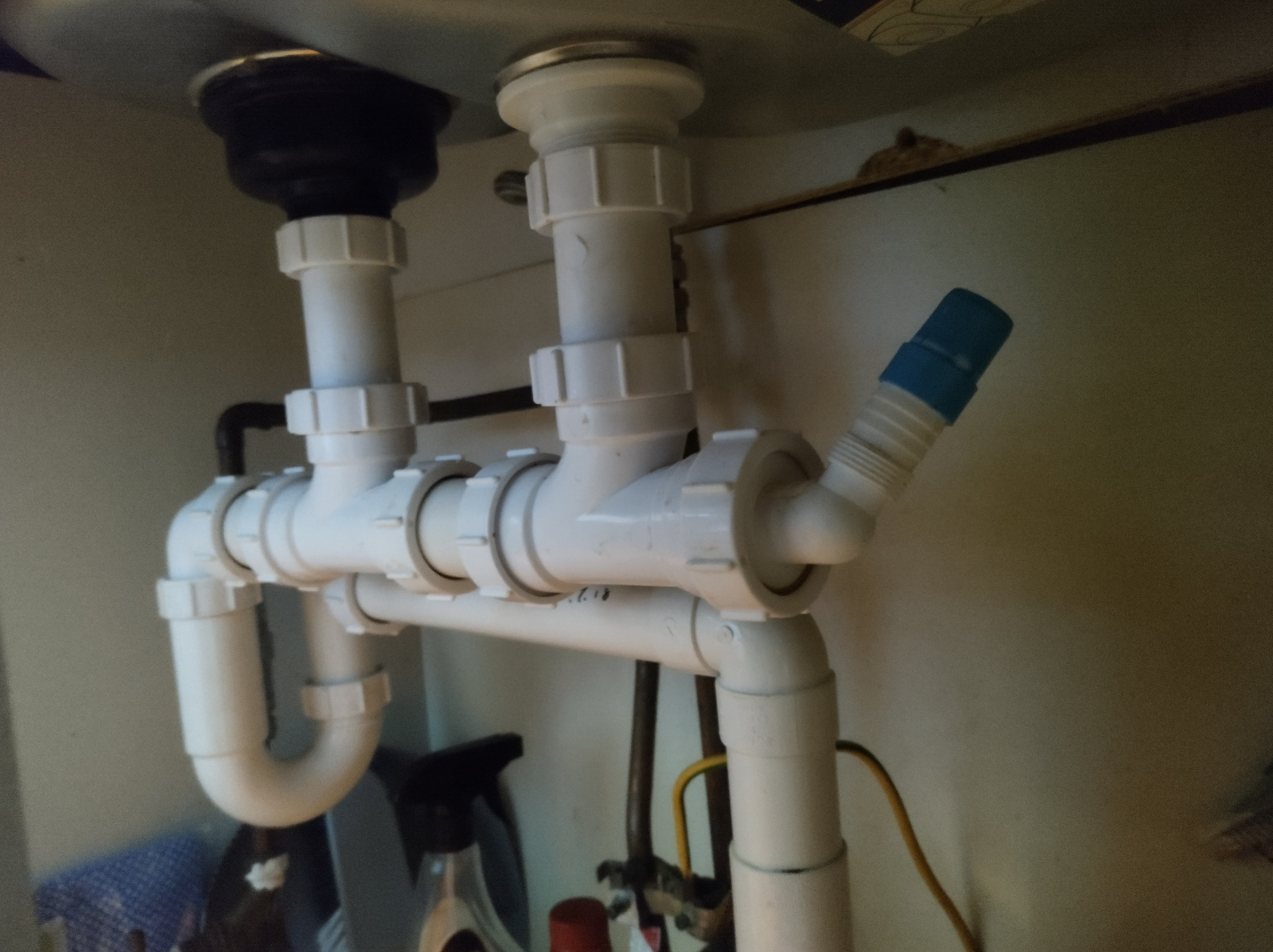
Would the DW hose go into the bit with the blue cap - is that in the right position? Apart from the extension hose, do I need to buy any extra bits to make them fit together?
Where does the ‘high loop’ in the DW hose need to happen, to prevent dirty sink water going into the dishwasher?
You mentioned passing the hose through the back of the units. Would that be through the easily accessible bit i.e. inside the cupboard with its pots and pans, towards the top back? Or is there a clever way of passing the hose along the space between the back of the cupboards and the back wall (the space where the other pipework is) without taking everything apart?
For interest – you mentioned one reason for a vertical standpipe is so that air can be drawn in along with the ejected water. If attaching directly to the sink waste, why is the air not needed? Or is the air coming in through the sink’s plug hole, providing the plug isn't in?
1 -
Joy_12345 said:...
For interest – you mentioned one reason for a vertical standpipe is so that air can be drawn in along with the ejected water. If attaching directly to the sink waste, why is the air not needed? Or is the air coming in through the sink’s plug hole, providing the plug isn't in?
The reason isn't to draw air in as such, but to have an air gap open to the atmosphere so there will never be a situation where the drain 'sucks' the water out of the dishwasher. Even if the plug is in the sink the sink's overflow provides the same venting function to make sure the air gap never drops below atmospheric pressure.In rearranging the standpipe behind the dishwasher, one thing to be aware of is manufacturers generally specify minimum and maximum heights of the top of the standpipe (above the bottom of the machine) and a minimum distance between the top surface of the water in the trap and the top of the standpipe. Yours might have been installed in the way it has to make sure these requirements are met.2 -
The extension hose kit should come with a double-ended connecting piece. A couple of 'jubilee' clips would be advised too.Joy_12345 said:WIAWSNB said:IF moving the vertical pipe to flat against the back wall - which will mean it won't stick out any further than the horizontal pipe - will do the job, ie allow the DW to move in far enough for you, then that is unquestionable the most obvious solution and easiest solution.Failing that, I think I'd be looking at a hose extension, and drilling small - 1" - holes at the back/tops of the adjacent unit sides where it just won't be seen, and threading that hose through to the sink base. The hose end then just pushes (and clips for security) on to a hose spigot, which may need to be added - easy.Thank you for the above! If I need to go down the hose extension route, I have some more questions!Here's the plumbing under the kitchen sink:Would the DW hose go into the bit with the blue cap - is that in the right position? Apart from the extension hose, do I need to buy any extra bits to make them fit together?
Where does the ‘high loop’ in the DW hose need to happen, to prevent dirty sink water going into the dishwasher?
You mentioned passing the hose through the back of the units. Would that be through the easily accessible bit i.e. inside the cupboard with its pots and pans, towards the top back? Or is there a clever way of passing the hose along the space between the back of the cupboards and the back wall (the space where the other pipework is) without taking everything apart?
For interest – you mentioned one reason for a vertical standpipe is so that air can be drawn in along with the ejected water. If attaching directly to the sink waste, why is the air not needed? Or is the air coming in through the sink’s plug hole, providing the plug isn't in?
(You'd think that all WM/DW hoses would be the same diameter, but I used a Screwfix kit a few years back to replace sil's damaged Samsung WM hose, and it was a loose fit. I had to cobble a method of sealing it. Hopefully that wouldn't be the case with yours.)
Yes, it would connect to that serrated, blue-capped hose spigot, and yes the sink 'waste' and overflow in the bowl above will provide the air-break.
With the original idea of wall-mounting the waste, S62 makes a very good point about the U-bend being higher than usual with this new setup, and the truth is I've no idea if this will affect things. Every situation is slightly different - ie the source of other waste water, the quantity, the angle of the waste pipe - Ie how easily it flows, etc.
A shorter vertical pipe gives less capacity to take the flow from the DW, and if it doesn't escape around the U-bend quickly enough, it could back up and overflow. I'm going to hazard, tho', that it'll be fine, since it has a fair margin in any case, and a DW - I think - ejects waste water more steadily, and not in a large gush like a WM?
Even the stated heights for the top of the vertical pipes have a large range, from around 600 to 900, so it can't be that critical - he says.
If you go for the positioned waste method, then I'd - initially at least - keep the vert pipe top a good 800 from ground level, but still allowing easy space for the hose to be fitted into it.
What's the make and model of your DW? I'll have a look at what it says there.
*This 'height' will equally apply to the extended hose-run method - the first hole in the unit side from the DW space will be at this recommended height - and higher than the sink's spigot. Then make the subsequent holes stepped progressively downwards towards the spigot's height so it has a small 'fall' and always drains.*
Yes, initially I was suggesting - for ease of fitting - to have these holes within the actual base units, and this should be doable very neatly with a ~30mm hole saw, and the holes and hose will only be visible if you are staring up inside the base unit from on yer knees level. A few 'spring' clips will keep the hose neat and prevent it from sagging.
There will be ways of setting it right behind the unit back too so it's full hidden - there are ways of doing anything! - but I can't see it being easy to do. On some units, the back panels don't actually go all the way up to the worktop for some reason, so that would help, but I suspect most do these days. Drilling the first hole from the DW space will be easy, but subsequent ones not, and then you'd have to invisibly thread the hose through.
Someone mentioned earlier about running the hose under the units, but I can't see that working correctly - but again I'm not sure. It seems clear to me, tho', that with doing this most of the hose would have standing waste water in it - surely not good.
Phew!
So, you are back to trying the new waste against the back wall - I think it'll work - or running the extended hose to the sink, which definitely should.
* Almost certainly wrong there. I had in mind that the hose exited the DW near it's top for some reason. Hoses actually exit DWs (and WMs) near their base. In which case, it can continue at that low level, under the base units, behind the plinths, until it reaches the sink base. Here it would come up inside the unit, 'loop' at the recommended height which should ideally be higher than the receiving spigot, and be hose-clipped into place.
1 -
WIAWSNB said:
With the original idea of wall-mounting the waste, S62 makes a very good point about the U-bend being higher than usual with this new setup, and the truth is I've no idea if this will affect things. Every situation is slightly different - ie the source of other waste water, the quantity, the angle of the waste pipe - Ie how easily it flows, etc.
A shorter vertical pipe gives less capacity to take the flow from the DW, and if it doesn't escape around the U-bend quickly enough, it could back up and overflow. I'm going to hazard, tho', that it'll be fine, since it has a fair margin in any case, and a DW - I think - ejects waste water more steadily, and not in a large gush like a WM?
Even the stated heights for the top of the vertical pipes have a large range, from around 600 to 900, so it can't be that critical - he says.
If you go for the positioned waste method, then I'd - initially at least - keep the vert pipe top a good 800 from ground level, but still allowing easy space for the hose to be fitted into it.
What's the make and model of your DW? I'll have a look at what it says there.
This 'height' will equally apply to the extended hose-run method - the first hole in the unit side from the DW space will be at this recommended height - and higher than the sink's spigot. Then make the subsequent holes stepped progressively downwards towards the spigot's height so it has a small 'fall' and always drains.Hello, and thank you very much WIAWSNB and Section 62 for your responses.I’ve tried loosening the tee and twisting round the existing pipework (see photo). As expected, this does save a bit of space. I estimate the dishwasher would still stick out about 8cm, and albeit not perfect, I could live with that (at least temporarily and could always try a different solution at a later date). So that’s one option, and I wonder if this is how it was with the previous dishwasher given it does protrude a bit in my photos from when I viewed the place. If I decide to leave like that, I would reattach the standpipe to the cupboard. Should I support the U with something underneath? And does it matter that the water has to travel uphill after passing through the u/p trap (the pipes seem to be fixed that way - they resist when I try to lift the trap higher). Also, does it matter if plastic pipe touches the copper pipes? If so, can I just put some padding in between?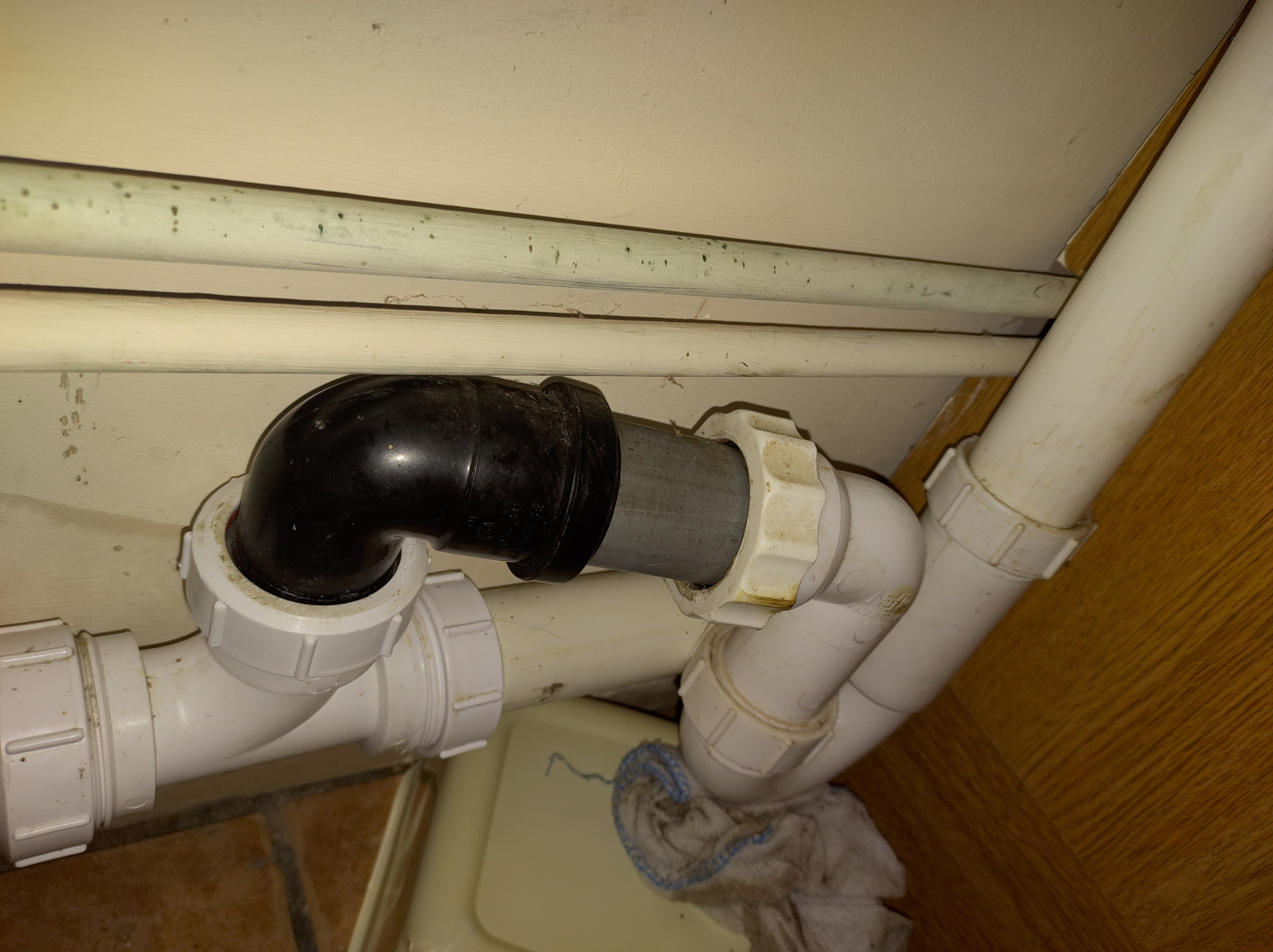
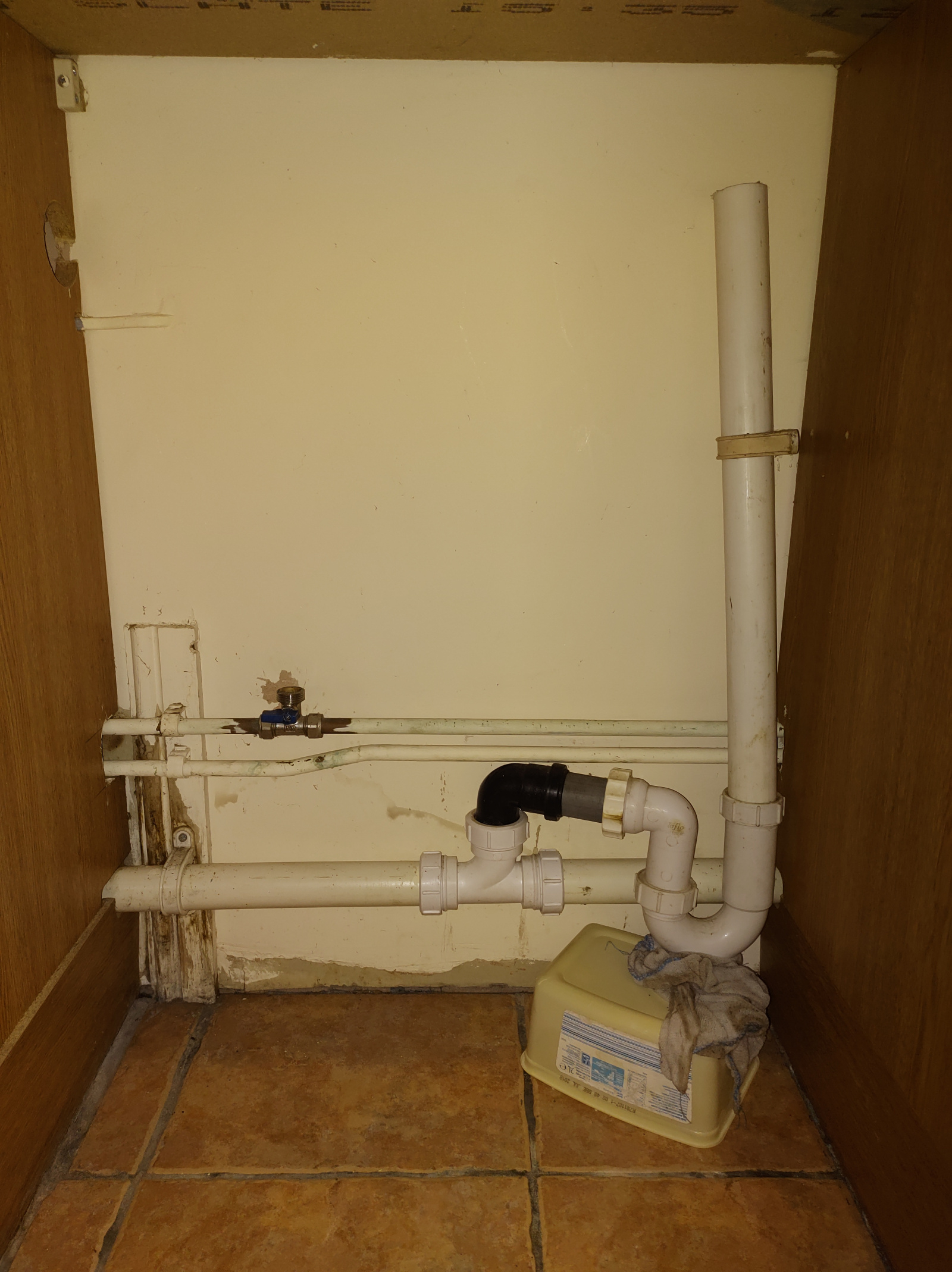
I also tried the standpipe directly in the tee and it does fit (although it's very tight). So I could cut it into pieces to use as connections if taking the other approach we discussed.
In terms of minimum and maximum standpipe height from floor, and minimum from tee weir, I looked at the installation guide and the installation section in the main manual and couldn’t see any information about it. So if you or anyone can find anything out on this model or give a rule of thumb, that would be great thanks – as I definitely want to avoid a flood! The one I have my eye on is a Bosch SMS4EKI06G or SMS4EKW06G (same model; just different colours) – because I like it and I can get a hefty discount!
I realised another complication with the hose extension approach is that there are drawers at the top of my cupboards, so the hose would have to go under those. The absolute highest it could be is around 70cm, so I guess if the hose needed to be higher, it could be secured against the back wall behind the dishwasher at or above that required height before lowering through the hole in the side of the cupboard?
Many thanks
1 -
A Q - how far is it from this DW space to the outside wall on the left, and what does the waste pipe do once outside the house?
Edit: Not needed - see later post. Re the 'extended hose' method, stick yer 'ead inside the RH cupboard, and check just how close the drawer back gets to the cupboard rear panel. I suspect there's enough of a gap for the hose to run at ~800mm height.1 -
Oookkkaaayyy...
 The outlet hose exits the DW at near-bottom level, so what Grumpy suggested earlier - running a hose extension under the base units behind the plinths - is a valid option, and I've seen a YouTube vid with a good plumber on there doing just this. That option is available to you if you prefer it.It would involve drilling a suitable hole 1.25" or so (see yellow oval in pic) through the DW space side 'plinth' panel, under the base unit's floor level, towards the very back where it'll be behind the DW - just under the existing waste pipe makes sense. The plinths of the base units on the way to the sink unit are removed to allow this hose and the extension hose to be connected under there at the most suitable point - this uses a purpose-made jointing connector and clips (should come with the ext hose). Inside the sink base unit, a similar hole is drilled through the unit floor to allow the extension hose to come up at the back, perform a loop at the top, and connect to the existing spigot from above.Once the DW is in place, the two hoses are joined under the base unit.Or, do the original idea - which is what I would personally do; fit the DW waste at the back as previously discussed. It will sit better than you've currently trialled - the vertical waste pipe will only be held outwards by the thickness of the copper pipes, and I notice that they are pretty tight against the back wall? In other words, the waste will be an overall 55mm out from the back wall - the 40mm waste + 15mm copper pipe. Clip the vertical pipe to the RH unit side - there will be room for the clip screws.I am in excess of 99.999% certain that the correct waste will work, despite the U-bend being slightly higher than 'normal'. Vertical waste pipe heights are a very fluid figure - I'd have the top of yours set to ~80cm from the floor, provided the gap above allows the hose to be easily inserted.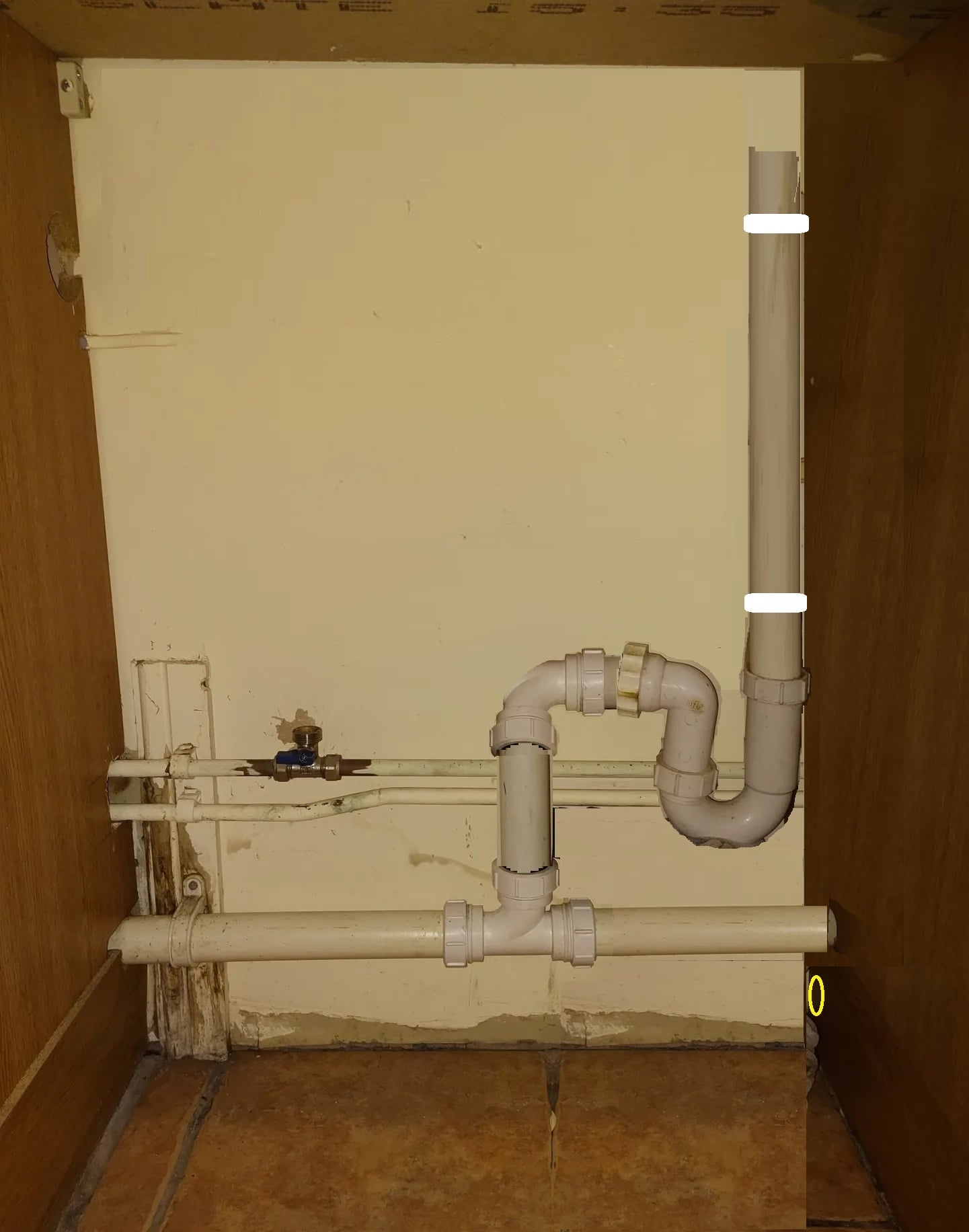
1 -
My DW hose was run along under the cupboards and then up to the kitchen waste and I kept having issues on hot washes with the leak detection kicking in as the water in the hose was backing up. Drilling a hole in the side of the unit so the hose goes up and over as it leaves the DW has solved this problem, so worth at least making sure it goes up and over before running it along the bottom.2









 https://youtu.be/EC2WytI9XBE?si=kxSsRxnqb_SeEIES

Confirm your email address to Create Threads and Reply

Categories
- All Categories
- 354.6K Banking & Borrowing
- 254.4K Reduce Debt & Boost Income
- 455.5K Spending & Discounts
- 247.4K Work, Benefits & Business
- 604.3K Mortgages, Homes & Bills
- 178.5K Life & Family
- 261.8K Travel & Transport
- 1.5M Hobbies & Leisure
- 16.1K Discuss & Feedback
- 37.7K Read-Only Boards