We’d like to remind Forumites to please avoid political debate on the Forum.
This is to keep it a safe and useful space for MoneySaving discussions. Threads that are – or become – political in nature may be removed in line with the Forum’s rules. Thank you for your understanding.
📨 Have you signed up to the Forum's new Email Digest yet? Get a selection of trending threads sent straight to your inbox daily, weekly or monthly!
Midea Heat Pump expensive to run

Painter23
Posts: 29


 Forumite
Hi all
I've just bought a house with a Midea heat pump fitted by the previous owner. She left me a very vague handover on how it works but admitted herself that she never really felt like she understood it.
I'll add at this point that I am patiently waiting for the engineer from the company who installed it to visit and show me how to use it but I'm struggling with their response rate at the moment!
I'm still renovating the property and living elsewhere so I'm not using any electricity other than the heat pump which is typically on for a couple of bursts each day to ward off any damp or frozen pipes.
The previous owner controlled it via Hive which I've been led to believe only switches the pump 'on' or 'off' and won't actually thermostatically control it (despite what the Hive thermostat says)? A phone call with the installer also suggested the system runs best when on low and constant rather than coming on and off.
Here's my issue: based on my first 4 weeks of ownership and having the system come 'on and off' typically for about 6 hours per day (although I did have it on almost constantly for a week while plaster was drying) I've spent over £350 in electricity. As I say I'm not living at the property so apart from the odd light going on and off when I'm there I'm not using any other forms of electricity.
If we assume that 'low and slow' is the best method and if we believe that Hive can only act as an 'on/off' switch rather than temp control, how do I adjust the Midea thermostat so it's not so hot? During the week that I had the heating on constantly to dry the plaster the decorators had to ask me to turn it off regularly as it was too warm for them.
My Midea controller usually reads a temperature of 40 - 55 degrees depending on outside temperature (see attached). I understand that this is the flow temperature rather than the actual temperature the house will feel, and if I try to adjust it warns me that I'm overriding weather controls. However it's far too warm to have it at this temp all the time so I'm at a loss until the engineer comes to show me how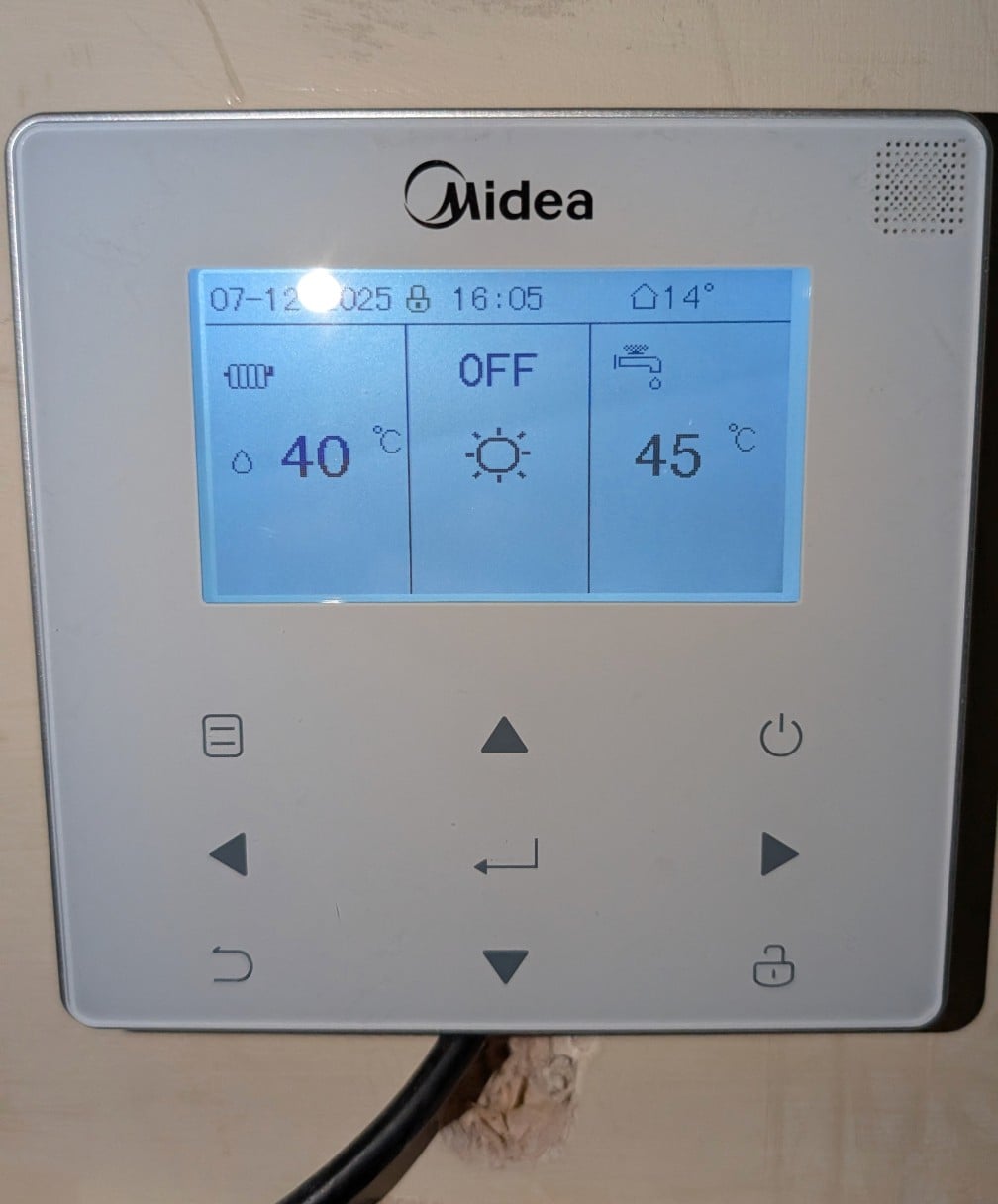 it works. My Hive thermostat is set to 17 degrees which still warms up the house considerably.
In case it matters there are solar panels fitted to the roof from which I will be getting FIT payments once the account is transferred to me but I'm not clear on whether I'm using any solar energy at all as I'm only reading my electricity meter.
I've just bought a house with a Midea heat pump fitted by the previous owner. She left me a very vague handover on how it works but admitted herself that she never really felt like she understood it.
I'll add at this point that I am patiently waiting for the engineer from the company who installed it to visit and show me how to use it but I'm struggling with their response rate at the moment!
I'm still renovating the property and living elsewhere so I'm not using any electricity other than the heat pump which is typically on for a couple of bursts each day to ward off any damp or frozen pipes.
The previous owner controlled it via Hive which I've been led to believe only switches the pump 'on' or 'off' and won't actually thermostatically control it (despite what the Hive thermostat says)? A phone call with the installer also suggested the system runs best when on low and constant rather than coming on and off.
Here's my issue: based on my first 4 weeks of ownership and having the system come 'on and off' typically for about 6 hours per day (although I did have it on almost constantly for a week while plaster was drying) I've spent over £350 in electricity. As I say I'm not living at the property so apart from the odd light going on and off when I'm there I'm not using any other forms of electricity.
If we assume that 'low and slow' is the best method and if we believe that Hive can only act as an 'on/off' switch rather than temp control, how do I adjust the Midea thermostat so it's not so hot? During the week that I had the heating on constantly to dry the plaster the decorators had to ask me to turn it off regularly as it was too warm for them.
My Midea controller usually reads a temperature of 40 - 55 degrees depending on outside temperature (see attached). I understand that this is the flow temperature rather than the actual temperature the house will feel, and if I try to adjust it warns me that I'm overriding weather controls. However it's far too warm to have it at this temp all the time so I'm at a loss until the engineer comes to show me how
it works. My Hive thermostat is set to 17 degrees which still warms up the house considerably.In case it matters there are solar panels fitted to the roof from which I will be getting FIT payments once the account is transferred to me but I'm not clear on whether I'm using any solar energy at all as I'm only reading my electricity meter.
0
Comments
-
They are correct, this is a very common misconception and doesn't just apply to your heat pump.Painter23 said:The previous owner controlled it via Hive which I've been led to believe (by AirSourceUK) only switches the pump 'on' or 'off' and won't actually thermostatically control it (despite what the Hive thermostat says)?
Virtually all thermostats simply work by calling for heat (e.g. turn on the pump/boiler) until the setpoint is reached.
If the ambient temperature is lower than the setpoint, it will call for heat. If the ambient temperature is higher than the setpoint, it will not call for heat.
People have a misunderstanding that if they whack their thermostat to 30 degrees, it will make the thermostat call for 'more/higher heat' - it won't. If it's 16 in your house, the temperature coming from your radiators will be the same whether you set your thermostat to 18 or 28.
The thermostat is not controlling the heat of the radiators (TRV's do that), a thermostat is just a simple device that switches the pump/boiler off or on based on whether the ambient temperature is lower than the setpoint or not.
The value in a smart one, would be that you can control it remotely or scheduling (e.g. making it set itself to 20 just before you wake up for work and setting itself back to 17 when you leave).
Regarding the controller, 40 degrees isn't a crazy flow temperature, the water is actually on the low end (and hopefully it's running a weekly cycle at a higher temp). I would leave it alone personally.
It would appear to be a basic problem with using the thermostat - even if the flow temperature was 100 degrees, if you don't have the thermostats calling for heat, or only for 5 minutes at a time, it wouldn't be very hot. I'd imagine you need to get better using it, for less time - it's likely the thermostat is set very high and calling for heat endlessly.
Do you have water underfloor heating? Ours takes around 2-3 hours before we feel any heat.
The problem is if a room is 17 and we set the thermostat to 20, by the time the heat penetrates the floor and gets it to 20 (which will then stop the thermostat calling for heat), you will continue to have heat coming through the floor taking it 21-23 degrees.
If you have an underfloor heating system (particularly water), you need to be very clever with scheduling, considering the delay, and switching it off early (or setting the setpoint lower) in appreciation of the fact that the heating is delayed.
That said, there are special heat pump thermostats that can do more than act as on/off switches (Hive is not one).Know what you don't1 -
I'm definitely not an expert (there are several of them who read this forum) but it sounds as though your heat pump is working under "weather compensation" control. This allows the heat pump controller to vary the flow temperature, increasing it when it's cold and decreasing it when it's warm.When you try to change the flow temperature on the controller (the Midea box you've photographed, which isn't a thermostat) you get it complaining that you're trying to override this weather compensation.You should be able to adjust the weather compensation curve to reduce the flow temperature, which will in turn reduce the steady-state temperature of the house. But you'll need someone who's more familiar with Midea heat pump controllers to tell you exactly how to do this (you might be able to find an online guide or tutorial).Once you have nudged the weather compensation curve down, you should be able to leave the heat pump running 24/7 and it will maintain a constant temperature automatically.Re. the £350 electricity bill, have you checked your bill to make sure you've been charged based on actual meter readings rather than estimates? Which supplier do you have, what's your tariff and what rates are you being charged?N. Hampshire, he/him. Octopus Intelligent Go elec / Fuse gas / Vodafone BB / iD mobile. Kirk Hill Co-op member.Economy 7 cap explainer. Gas vs E7 vs peak elec heating costs, Ecoflow Stream, Best kettle :-)
2.72kWp PV facing SSW installed Jan 2012. 11 x 247w panels, 3.6kw inverter. 37 MWh generated, long-term average 2.6 Os.0 -
That display likely has a setting that tells you electricity consumption and heat energy out. Energy out divided by electricity in gives the coefficient of performance (COP). With the cold weather over the last month a standard ASHP has probably struggled to get any better than a COP of 2.5. That means that if the house needs 100 kWh/day of heat on cold days you'd use 40 kWh per day which is about £10. Add in other electricity use and standing charge and it's not looking outside the realms of possibility.
Once you're settled in and have the headspace, you'll need to amend the settings to get the best efficiency. This typically means running at the lowest flow temp that still manages to heat your house, and in your case, timing the heating to make best use of solar generation.
0 -
For the last 4 weeks £350 could be absolutely fantastic, really bad, or somewhere in between. What size and type of house are we talking about and what average indoor temperature? Do you know the heating requirement from your EPC? And what tariff are you on?
0 -
Also a new build is going to take a lot of "filling up" of the thermal mass, even without wet plaster to dry. Once the walls reach their thermal capacity then energy use will go down.1
-
Thank you all. Apologies for the delay, the forum insists on making me change my password every time I come back(!).
In answer to your questions:
4 bed detached house, built 1990.
New double glazing and appears to be well insulated.
Large radiators in every room.
I'm with Octopus (as was the previous owner) on a 12 month fixed tariff 24.65p kwh / 41.59p standing charge.
EPC went down from a C to an E when the gas central heating was replaced by the heat pump by the previous owner (I'm told this was because electric heating will always hit the EPC rating even if it's technically more efficient).
I'm not yet living in the house as I'm doing it up, so it's been empty and carpet-less since I bought it. Heat pump has been on schedule for approximately 7 hours a day (3 hours in the morning and 4 in the evening) just to keep it 'ticking over' during the cold weather, despite me not living there. I did also have it running a lot more for a few of the colder days to avoid pipes freezing and while decorations were drying.
I've been setting the Hive thermostat to 17 degrees which after an hour or so heats the house up very nicely - however I'm conscious this is unlikely to be actually heating to meet this set point!
The biggest issue I have is the contradiction between the former owner's understanding of how it works versus what the installers are telling me.
She believes the engineers installed Hive to allow her to control the temperature thermostatically. However, she also was using the seperate hot water immersion timer every day which I believe wasn't needed as the heat pump heats the tap water too(!!). AirSourceUK say that Hive will only operate as an 'on/off' switch and that the wireless thermostat with the Midea system should control the temp. However, there is no other thermostat at the property - so I'm at a total loss! I'm desperately waiting for the installer to come to show me how they installed it but I'm struggling with being fobbed off a bit by them.
0 -
Have you had a chance to check your electricity bill?£350 for a month would (if the bill is accurate) be approx. 1300 kWh, which is 45 kWh a day. If your heat pump is running for 7 hours a day, that's ~7kW of steady load.I wouldn't expect a 1990s 4-bed to need more than a 12kW heat pump, so you're getting a COP of less than 2 which is terrible.It's more likely that there's something odd with the bill. I hope it's a dodgy bill!N. Hampshire, he/him. Octopus Intelligent Go elec / Fuse gas / Vodafone BB / iD mobile. Kirk Hill Co-op member.Economy 7 cap explainer. Gas vs E7 vs peak elec heating costs, Ecoflow Stream, Best kettle :-)
2.72kWp PV facing SSW installed Jan 2012. 11 x 247w panels, 3.6kw inverter. 37 MWh generated, long-term average 2.6 Os.0 -
Switching the heat pump on and off won't help consumption. Better to set the temperature around 15 degrees and leave it on all the time.
Alternatively, if you switch to the Cosy tariff you'll get several off peak slots each day. You could then set for a higher temperature during the cheap slots and it should largely cruise through the pricier slots with little activity. You'll need a smart meter for this option but it would be madness not to have one with electric heating of any sort. and you'll need it for when you transition to an EV.
0 -
We have a midea ASHP and can advise on how to set up. It’s a good unit, with the downside being a non user friendly control panel (as you are now discovering) and a terrible app (midea smarthome). I control ours using home assistant and well and truly gone down a rabbit hole of advanced monitoring and control for the unit. This is from a starting point a year or so ago of understanding very little.
Theres a few options here ranging from simple to advanced, but I’d be looking to decommission the hive or turn it up past the desired indoor air temp so it doesn’t control the ashp, turning it on and off all the time. Quite a few of us use pure weather compensation. That is to say set a ‘curve’ which is in fact a straight line…but in essence you tell the ashp what outlet flow temp you want running through the radiators when cold outside, and then what flow temp you want at a milder temp. There’s also an option with the midea to automatically turn off heating at a certain outdoor temp- for example we have this set at 17c. This will then set a line between the two points and alter the outlet temp based on how cold it is outside.
When you get these parameters right, your house will stay at a remarkably steady indoor temp without any room influence ie your thermostat, and provide good efficiency. What you are hoping for of course is that the radiators have been sized well so you don’t need an outlet temp of more than 50c when -2 outside (hopefully a bit less), and that you have adequate flow through your pipework. And that your radiators have been balanced.
Might seem overwhelming but honestly the best option is just to learn how to set the system up yourself. A lot of installers are clueless anyway and within a few weeks of getting your head around the controls, you’ll probably know more than them. In your situation I’d be looking at setting up an ‘eco’ curve to give a steady setback indoor air temp of say 15 to 17 ish.The other option is looking at something like homely. This is a third party control which uses AI and algorithms to do all of the above for you. This is compatible with midea. We had it initially and didn’t like it for various reasons but I’m probably not the average user profile to be fair so might be a decent option for you.2 -
Thanks so much, that's all really helpful.
I'm loathe to fiddle with Hive too much or turn it up beyond the desired temperature as I don't actually know what or where the Midea thermostat is (if I even have one). As the previous owner told me her Hive was installed to replace a former thermostat I'm not sure how the system knows what the rad/inside temperature is.
If Hive is literally just an 'on/off' switch how does Midea ever know what the temperature inside is? The installation manager says I should have a wireless thermostat (that's not Hive) but I don't appear to have one. There was an old Owl Intuition unit on the wall when I got the keys but the previous owner told me that was obsolete and replaced by Hive so I had it taken off (but I still have it - see below).
https://www.google.com/search?client=ms-android-vf-uk-rvc3&hs=stVU&sca_esv=4ba3af865432350d&sxsrf=ANbL-n6mfND9tFpxAF_lNFoF_jsJDY2ATg:1768639979458&udm=2&fbs=ADc_l-byipRaccqV0jmfPhi1DgzPtklXGmVkws8Z_lBff884vwWzYGOXmwhR8m6ZBpcqcPID-t3oX6qV5nXfMS1wRipUUm2dtTmK8up8IXqatdtNGD4IblfqU6foWz_HEeO16ws4dO3gUQWsk6t9yOlnuvvOUngX8qK06pWjhy6QPYpmY7EtQsO6U2bYsEVcDGG3cQ5UxQ9SG68mLCEB1wfhIt7rK6LqYGwzsxENw0m0RaWtne8ooM0&q=owl+intuition+rbt-3c&sa=X&ved=2ahUKEwiX8detmZKSAxXVQkEAHVvbCFgQtKgLegQIIxAB&biw=448&bih=851&dpr=2.25&aic=0#sv=CAMS_AQa3AQKjwIKuAEStQEKd0FNbjMteVMwNGdldlNqU2tkYWRKNWNfYTA2c2pjcXdYbmk1dlJ4ZUppM1JGSjZLMGhaU1hjWXlyMnV2enpxVnZ6TkFwWkZmckFFQVJIckU4MGVVZzlaaWczZDBYQzhUSVA3OEZ6cUxldW9qeE4zc2NXRklMY1IwEhY3VTFyYVlwUmpieUZzZy1TN3IycENBGiJBSktMRm1MVFlnMGFxOWtsNmRRVmpUbjFKT1JpZjVmcWVBEgM4NDkaATMiGQoBcRIUb3dsIGludHVpdGlvbiByYnQtM2MiBwoDdGJzEgAiJgoEZXFsZBIeQ2dJSUFCQUFPZ1FJQUJBQVZVZ2VPejl0MXUtNVBnErUCCs4BEssBCowBQU1uMy15UUIzVWdFQzgxeTd4dVk4YWFOQ0RhbTJ6NmdCX2tuem1NSWJFejZuM0xlczdlaDU1b1pJY2tTTS1EdVUzOENicXlWUUpDdTJtakhWT1FjWlRlWERKQWJfWE11czVjSkl6X1pCb1Utai03Z1JNTmpOZkhqUl9rWTNJbld2U2V5clpPbHlHQS0SFjdVMXJhWXBSamJ5RnNnLVM3cjJwQ0EaIkFKS0xGbUwxaVdxalRtWVE2eENDZThGMjFOSldBczgzZVESBDQ2OTgaATMiGAoGaW1nZGlpEg5HQldieUFqZnpHVkdaTSIXCgVkb2NpZBIOU240aGMweFJOZFFUaU0iJgoEZXFsZBIeQ2dJSUFCQUFPZ1FJQUJBQVZVZ2VPejl0MXUtNVBnKhBlLUdCV2J5QWpmekdWR1pNIAQqFwoBcxIQZS1HQldieUFqZnpHVkdaTRgBMAEYByCvoMagDDABSgoIAhACGAIgAigC
Using Hive as an 'on/off' device results in it being too warm if the heating just stays on constantly (not to mention extortionstely expensive) and I seemingly have no way to control a thermostat. Hence just using it for shorter bursts twice a day to ward off freezing temps until I move in in the next couple of week when I will need more reliable heating.
I'm also reluctant to fiddle with the Midea controller for fear of buggering up a system I already know nothing about during a particularly cold winter - and in case I invalidate the warranties. But I am intrigued by your self-taught method of programming yours and once I've had confirmation from the installers about where/when/if I have the right thermostatic controllers I'd definitely like to learn more about how it works and maximise its efficiency.0












Confirm your email address to Create Threads and Reply

Categories
- All Categories
- 355.8K Banking & Borrowing
- 254.9K Reduce Debt & Boost Income
- 456.2K Spending & Discounts
- 248.3K Work, Benefits & Business
- 605.9K Mortgages, Homes & Bills
- 179K Life & Family
- 263.8K Travel & Transport
- 1.5M Hobbies & Leisure
- 16.2K Discuss & Feedback
- 37.7K Read-Only Boards