We’d like to remind Forumites to please avoid political debate on the Forum.
This is to keep it a safe and useful space for MoneySaving discussions. Threads that are – or become – political in nature may be removed in line with the Forum’s rules. Thank you for your understanding.
📨 Have you signed up to the Forum's new Email Digest yet? Get a selection of trending threads sent straight to your inbox daily, weekly or monthly!
The Forum now has a brand new text editor, adding a bunch of handy features to use when creating posts. Read more in our how-to guide
Annual review should run down cash/bonds and move to 100% Equities?
Comments
-
It's worse in that I get more failures, and earlier failures, than if I go all in on equities. However see my other reply where I have changed how my "cash like" assets are classified in the software since 0% nominal growth is too pessimistic.MK62 said:
Massively worse in what way though?Pat38493 said:phlebas192 said:I'm an advocate for holding a higher % of equities than most people here seem comfortable with (since I see inflation as the single biggest risk to a comfortable retirement), but 100% with no cash buffer would be "extremely courageous" as Sir Humphrey might say! Backtesting can only tell you what might have happened with the specific assumptions you have chosen to model - and most backtesting I've seen is based on US data which has the huge assumption of "this country benefitted more than any other from the geopolitical upheavals of the 20th century but I'm going to assume that will be replicated in the 21st". Ever wondered how your backtesting would work with Russia, China or Germany as the principle data source to name just the most obvious examples?For anyone to say more than that you really need to give a lot more information. eg your age, do you have any dependants, what guaranteed income do you have / expect to get (DB pensions, annuities, state pension), how much of your expenditure these cover, rough size of investment pot etc.I would suggest at the least trying to assign a cash value to whatever other income you might have. eg at the very least you can work out an approximate cash value for your state pension via a tool such as https://comparison.moneyhelper.org.uk/en/tools/annuities. As an example, when my wife joined myself in retirement we were almost 100% in equities if we just looked at investments and saving accounts; but I was already receiving a DB pension and we had the SP to come. Including equivalent cash values for those we were more like 70% equities which is much less risky!FWIW, if you have a 60% equities ratio in your investments with a 99% chance of success then you have basically won the game. Why take a massive amount of additional risk for just a small improvement in - possibly spurious - outcomes?
Common wisdom is that any money you need in the next 10 years should not be in equities, but if I really did that, the backtesting is massively worse.
Is your planning aimed at maximising returns or minimising plan failures? Once in drawdown they can become competing aims, in that maximising the chances of highest returns means accepting a higher risk of plan failure, and conversely, minimising the chances of plan failure means accepting a lower chance of getting the highest returns.
In the end though, it's just a plan, so is basically playing with probabilities based on historic data - the reality may (and most likely will) end up being different, perhaps very different.
If front loading drawdowns, as many early retirees will be doing, prior to SP and DB pensions kicking in, then you are more exposed to sequence risk......and being 100% in equities generally means higher sequence risk......it could work out fine, but you have accept that you would be taking on more risk.
I have seen the debate before where the rationale is - if my plan works, why would I suddently take more risk?
The flip side to this is, if the plan still works even with higher risk, why not do that and take advantage of the probably additional spend ability (or give it away later)?
As another poster said above, it's actually inflation that seems to be the biggest killer on retirement plans - when I do this kind of modelling it's almost always the historical periods that had massive inflation in the early years that fail first, rather than the ones with big stock market crash.0 -
Just to clarify my understanding here, when you say the payout is 10.5%, you do not mean that I will get a 10.5% return on my investment? Looking at the tool, it seems to mean that over 10 years, I could take out 10.5% of my investment per year, but at the end I have nothing, so it's not a 10.5% return - the return rate compared to equities is more like 3.7% if I am reading the tool correctly?OldScientist said:
What duration bonds are you modelling in timeline and voyant? Historically, long duration bonds (both US and UK - not sure off-hand about other countries) have had periods of awful real returns (e.g., from 1940 to 1980) caused by increasing yields and the impact of inflation in the 60s and 70s. So-called 'safe' withdrawal rates can vary considerably (~50 bp depending on the overall asset allocation) with the duration of the fixed income used. Some quick historical modelling (asset returns from macrohistory, equities 50/50 UK/US with fixed income consisting of UK cash) suggests that for a 10 year period, the SWR was 7.0-7.3% between 20-80% equities and 6.5% for 100% equities). Using long bonds instead of cash lowered the SWR by about 40-100 bp (higher reductions with lower equity allocation).Pat38493 said:
I am in the lucky situation aleady since we have both got DB pension sources and full SP. I am just about to turn 57 wife 59. By the time we both reach 67, over 90% of our spending requirements will be covered by those sources and I am pretty sure our situation would still be fairly comfortable even if I ran out of money by then.phlebas192 said:I'm an advocate for holding a higher % of equities than most people here seem comfortable with (since I see inflation as the single biggest risk to a comfortable retirement), but 100% with no cash buffer would be "extremely courageous" as Sir Humphrey might say! Backtesting can only tell you what might have happened with the specific assumptions you have chosen to model - and most backtesting I've seen is based on US data which has the huge assumption of "this country benefitted more than any other from the geopolitical upheavals of the 20th century but I'm going to assume that will be replicated in the 21st". Ever wondered how your backtesting would work with Russia, China or Germany as the principle data source to name just the most obvious examples?For anyone to say more than that you really need to give a lot more information. eg your age, do you have any dependants, what guaranteed income do you have / expect to get (DB pensions, annuities, state pension), how much of your expenditure these cover, rough size of investment pot etc.I would suggest at the least trying to assign a cash value to whatever other income you might have. eg at the very least you can work out an approximate cash value for your state pension via a tool such as https://comparison.moneyhelper.org.uk/en/tools/annuities. As an example, when my wife joined myself in retirement we were almost 100% in equities if we just looked at investments and saving accounts; but I was already receiving a DB pension and we had the SP to come. Including equivalent cash values for those we were more like 70% equities which is much less risky!FWIW, if you have a 60% equities ratio in your investments with a 99% chance of success then you have basically won the game. Why take a massive amount of additional risk for just a small improvement in - possibly spurious - outcomes?
Meanwhile, the most important purpose of my DC funds is to make sure we make it till we are both 67, since the drawdowns will be much higher in the next 10 years. My wife's DB pension is an NHS one that already pays out at full rate. My DB pension is already in payment but is much smaller.
My spending plan includes some big ticket items and costs that roll off in the first few years, so I am due to spend about 25% of the current nominal value of my assets fund in the next 3 years - at the moment I have this all in cash, and I am going to draw out of my DC up to the top of the 20% tax threshold with the rest covered by ISA/GIA that come from a house downsize and TFC/PCLS already taken. Obviously my drawdowns after the first 3 years need to be, and will be, much lower, and after year 10 they will be very small.
On the one hand, if anyone is in a postion to risk 100% equities it's probably me. On the other hand I was a bit surprised that backtesting is showing I am better off in 100% equities, even though my spend is significantly front loaded to the first 3 years. I have spent hours studying all the reports and data from these tools and it seems correct to me, obviously within the parameters of the data that it is using.
Also the tool I am using tends to assume regular rebalancing to the mix you have programmed. It's not very easy with that tool to simulate a glidepath where you basically increase your equity % during the first few years and eventually to 100%.
Common wisdom is that any money you need in the next 10 years should not be in equities, but if I really did that, the backtesting is massively worse.
In the end I guess it comes down to what a couple of replies above already said - how confident am I that I will not sell if there is a huge downturn in year 2, or cut my spending so much that I don't enjoy life as much for a couple of years. In all prior historical scenarios the portfolio recovered enough for my plan to work after year 3.
Also to an earlier reply - these are not monte carlo simulations these are historical backtests using global financial data including UK, and using UK inflation data.
If you constructed a 10 year inflation linked gilt ladder (e.g., see https://lategenxer.streamlit.app/Gilt_Ladder which suggests a current payout rate of about 10.5%) to provide the required floor of inflation linked income in the run up to the state pension, would that leave you some surplus for a risk portfolio (with 100% equities if required)?
The difference is that this return is (almost) guaranteed?
However how would you actually implement this in real life? If I implemented this inside my SIPP wrapper, by for example purchasing bonds like T27A in my interactive investor account, I still have to pay 20% marginal tax on withdrawal, which does not seem to be taken into account in the results of this tool (although that's the same regardless how I invest the money in the SIPP)?
Back of a napkin - it looks like doing this would leave me with excess £147K to invest in equities until age 67 in my SIPP. Looking at the Timeline balances chart, this is below the 10th percentile of historical outcomes at age 67, but above the worst case.
By doing this I can probably lock in my retirement plan and get rid of inlation risk for a significant part of it, but I will be throwing away a high chance of much better outcomes, and also some of my flexibility.
I could also try to implement this outside of my tax wrappers - I'd have to think that through a bit more but it would be for a lower amount as most of my portfolio is currently in pensions.0 -
I think you are putting way too much emphasis on the difference between a 99% historical success rate compared to a 100% historical success rate.
A 100% historical rate does not translate to a 100% future success rate same for any rate.
1 -
Interesting thread Pat, I think we are in similar positions with regards to age and DB / SP covering post 67, however, we are not yet retired, unsure as to when this will be but for me could be anywhere between 4 and 40 months, dearest wife could be another 5 years as she is a tad younger and enjoys her work
I'm possibly a bit more cautious with funds at present 60% equities / 40% cash like investments, some in pensions, some in isa's. If she keep working to 60 the 40% in cash like investments will see us to SP / DB payment
Reason I'm cautious is that as we are not retired we would not want a crash derailing my ability to go in April if I wanted. There is also the potential for DW not to work until 60 which could change things a bit but this is an unknown. Still contributing to DC pensions with all contributions in equities so increasing the % of equities a bit each month
One thing you mention is that you would have 90% of income covered by SP / DB if you ran out of DC funds. Without being morbid, have you considered first death and what that would look like with a heavy dependence on DB/ SP for you both?0 -
Yes we have considered that - we have life insurance in place that is sufficient for the moment, and generally if I die before OH she will be fine. If she dies before me I will downsize house again after a year or 3.Notfarfromtheborder said:Interesting thread Pat, I think we are in similar positions with regards to age and DB / SP covering post 67, however, we are not yet retired, unsure as to when this will be but for me could be anywhere between 4 and 40 months, dearest wife could be another 5 years as she is a tad younger and enjoys her work
I'm possibly a bit more cautious with funds at present 60% equities / 40% cash like investments, some in pensions, some in isa's. If she keep working to 60 the 40% in cash like investments will see us to SP / DB payment
Reason I'm cautious is that as we are not retired we would not want a crash derailing my ability to go in April if I wanted. There is also the potential for DW not to work until 60 which could change things a bit but this is an unknown. Still contributing to DC pensions with all contributions in equities so increasing the % of equities a bit each month
One thing you mention is that you would have 90% of income covered by SP / DB if you ran out of DC funds. Without being morbid, have you considered first death and what that would look like with a heavy dependence on DB/ SP for you both?0 -
Looks like they have labelled these as 'all stocks' versions of the various bond funds (i.e., for the UK, all nominal gilts are held in proportion to their issue weight). If modelled correctly, the duration will vary with time (e.g., in the UK, perpetual bonds with long durations, e.g., consols, dominated the gilt market before the 1930s or so, while by the 1970s/80s, long bonds were no tissued because the yields were so high and the duration shortened). In the run up to the recent increase in yields, the 'all stocks' gilt index had a relatively high duration (both because of low yields and because gilts with long maturities had been issued) and consequently had poor returns when the yields increased.Pat38493 said:
This is the list of available assets - you can program a specific fund, but it seems to just split the fund into its best approximation of the below categories.OldScientist said:
What duration bonds are you modelling in timeline and voyant? Historically, long duration bonds (both US and UK - not sure off-hand about other countries) have had periods of awful real returns (e.g., from 1940 to 1980) caused by increasing yields and the impact of inflation in the 60s and 70s. So-called 'safe' withdrawal rates can vary considerably (~50 bp depending on the overall asset allocation) with the duration of the fixed income used. Some quick historical modelling (asset returns from macrohistory, equities 50/50 UK/US with fixed income consisting of UK cash) suggests that for a 10 year period, the SWR was 7.0-7.3% between 20-80% equities and 6.5% for 100% equities). Using long bonds instead of cash lowered the SWR by about 40-100 bp (higher reductions with lower equity allocation).Pat38493 said:
I am in the lucky situation aleady since we have both got DB pension sources and full SP. I am just about to turn 57 wife 59. By the time we both reach 67, over 90% of our spending requirements will be covered by those sources and I am pretty sure our situation would still be fairly comfortable even if I ran out of money by then.phlebas192 said:I'm an advocate for holding a higher % of equities than most people here seem comfortable with (since I see inflation as the single biggest risk to a comfortable retirement), but 100% with no cash buffer would be "extremely courageous" as Sir Humphrey might say! Backtesting can only tell you what might have happened with the specific assumptions you have chosen to model - and most backtesting I've seen is based on US data which has the huge assumption of "this country benefitted more than any other from the geopolitical upheavals of the 20th century but I'm going to assume that will be replicated in the 21st". Ever wondered how your backtesting would work with Russia, China or Germany as the principle data source to name just the most obvious examples?For anyone to say more than that you really need to give a lot more information. eg your age, do you have any dependants, what guaranteed income do you have / expect to get (DB pensions, annuities, state pension), how much of your expenditure these cover, rough size of investment pot etc.I would suggest at the least trying to assign a cash value to whatever other income you might have. eg at the very least you can work out an approximate cash value for your state pension via a tool such as https://comparison.moneyhelper.org.uk/en/tools/annuities. As an example, when my wife joined myself in retirement we were almost 100% in equities if we just looked at investments and saving accounts; but I was already receiving a DB pension and we had the SP to come. Including equivalent cash values for those we were more like 70% equities which is much less risky!FWIW, if you have a 60% equities ratio in your investments with a 99% chance of success then you have basically won the game. Why take a massive amount of additional risk for just a small improvement in - possibly spurious - outcomes?
Meanwhile, the most important purpose of my DC funds is to make sure we make it till we are both 67, since the drawdowns will be much higher in the next 10 years. My wife's DB pension is an NHS one that already pays out at full rate. My DB pension is already in payment but is much smaller.
My spending plan includes some big ticket items and costs that roll off in the first few years, so I am due to spend about 25% of the current nominal value of my assets fund in the next 3 years - at the moment I have this all in cash, and I am going to draw out of my DC up to the top of the 20% tax threshold with the rest covered by ISA/GIA that come from a house downsize and TFC/PCLS already taken. Obviously my drawdowns after the first 3 years need to be, and will be, much lower, and after year 10 they will be very small.
On the one hand, if anyone is in a postion to risk 100% equities it's probably me. On the other hand I was a bit surprised that backtesting is showing I am better off in 100% equities, even though my spend is significantly front loaded to the first 3 years. I have spent hours studying all the reports and data from these tools and it seems correct to me, obviously within the parameters of the data that it is using.
Also the tool I am using tends to assume regular rebalancing to the mix you have programmed. It's not very easy with that tool to simulate a glidepath where you basically increase your equity % during the first few years and eventually to 100%.
Common wisdom is that any money you need in the next 10 years should not be in equities, but if I really did that, the backtesting is massively worse.
In the end I guess it comes down to what a couple of replies above already said - how confident am I that I will not sell if there is a huge downturn in year 2, or cut my spending so much that I don't enjoy life as much for a couple of years. In all prior historical scenarios the portfolio recovered enough for my plan to work after year 3.
Also to an earlier reply - these are not monte carlo simulations these are historical backtests using global financial data including UK, and using UK inflation data.
If you constructed a 10 year inflation linked gilt ladder (e.g., see https://lategenxer.streamlit.app/Gilt_Ladder which suggests a current payout rate of about 10.5%) to provide the required floor of inflation linked income in the run up to the state pension, would that leave you some surplus for a risk portfolio (with 100% equities if required)?
In the meantime I figured out the main reason for the differences. In reality, I have about 24% of my overall assets in money market funds which I originally classified as "cash". However in Timeline cash is modelled as zero nominal growth. In the below example I moved this "cash" into the category "UK T Bills" which seems to be the closest available to money market funds. After doing that, I now have zero failure rate also in the current mix. (although the end of life balances are still worse across the main summary views which are "worst case", "Pessimistic", "Median" and "Optimistic".
Other than that, I only have about 8% in bonds at at the moment which is mostly in VAGS, which I assumed to be "Global Aggregate Bonds Hedged". I don't know what length is modelled in the software returns. My equities are modelled as "Global Equities" which seems to be equivalent to HMWS type funds or Vanguard FTSE all cap.
I have seen that gilt tool before and looked at it - I'll look into it again as bond funds like VAGS seem to be an unreliable asset in recent times - this has been my worst performing fund for the last 2 years, even including MMF.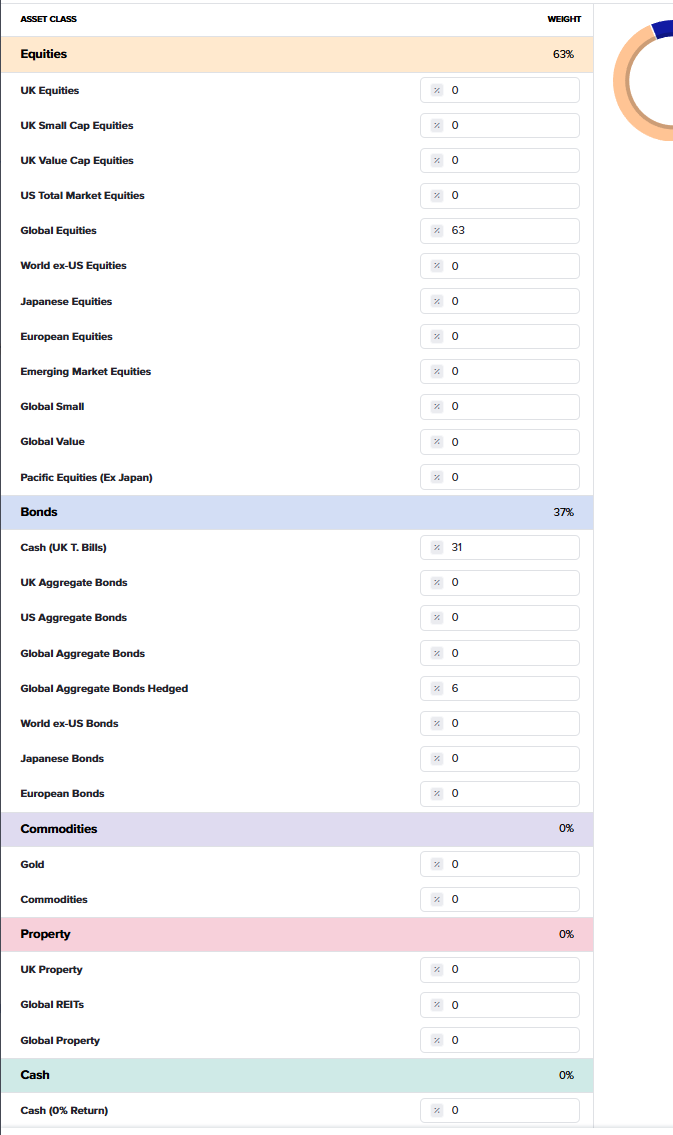
Interesting distinction between 'cash' (i.e., zero interest) and 3 month bills (interest rates will be close to the base rate). Glad you found the reason for the odd behaviour.
0 -
What I called the payout rate is same as the withdrawal rate and not the return. The real return is around 0.8% with a nominal return of 3.8% if inflation is 3% over the next 10 years. Of course, the real return of equities, bonds, and cash is unknown over the next 10 years.Pat38493 said:
Just to clarify my understanding here, when you say the payout is 10.5%, you do not mean that I will get a 10.5% return on my investment? Looking at the tool, it seems to mean that over 10 years, I could take out 10.5% of my investment per year, but at the end I have nothing, so it's not a 10.5% return - the return rate compared to equities is more like 3.7% if I am reading the tool correctly?OldScientist said:
What duration bonds are you modelling in timeline and voyant? Historically, long duration bonds (both US and UK - not sure off-hand about other countries) have had periods of awful real returns (e.g., from 1940 to 1980) caused by increasing yields and the impact of inflation in the 60s and 70s. So-called 'safe' withdrawal rates can vary considerably (~50 bp depending on the overall asset allocation) with the duration of the fixed income used. Some quick historical modelling (asset returns from macrohistory, equities 50/50 UK/US with fixed income consisting of UK cash) suggests that for a 10 year period, the SWR was 7.0-7.3% between 20-80% equities and 6.5% for 100% equities). Using long bonds instead of cash lowered the SWR by about 40-100 bp (higher reductions with lower equity allocation).Pat38493 said:
I am in the lucky situation aleady since we have both got DB pension sources and full SP. I am just about to turn 57 wife 59. By the time we both reach 67, over 90% of our spending requirements will be covered by those sources and I am pretty sure our situation would still be fairly comfortable even if I ran out of money by then.phlebas192 said:I'm an advocate for holding a higher % of equities than most people here seem comfortable with (since I see inflation as the single biggest risk to a comfortable retirement), but 100% with no cash buffer would be "extremely courageous" as Sir Humphrey might say! Backtesting can only tell you what might have happened with the specific assumptions you have chosen to model - and most backtesting I've seen is based on US data which has the huge assumption of "this country benefitted more than any other from the geopolitical upheavals of the 20th century but I'm going to assume that will be replicated in the 21st". Ever wondered how your backtesting would work with Russia, China or Germany as the principle data source to name just the most obvious examples?For anyone to say more than that you really need to give a lot more information. eg your age, do you have any dependants, what guaranteed income do you have / expect to get (DB pensions, annuities, state pension), how much of your expenditure these cover, rough size of investment pot etc.I would suggest at the least trying to assign a cash value to whatever other income you might have. eg at the very least you can work out an approximate cash value for your state pension via a tool such as https://comparison.moneyhelper.org.uk/en/tools/annuities. As an example, when my wife joined myself in retirement we were almost 100% in equities if we just looked at investments and saving accounts; but I was already receiving a DB pension and we had the SP to come. Including equivalent cash values for those we were more like 70% equities which is much less risky!FWIW, if you have a 60% equities ratio in your investments with a 99% chance of success then you have basically won the game. Why take a massive amount of additional risk for just a small improvement in - possibly spurious - outcomes?
Meanwhile, the most important purpose of my DC funds is to make sure we make it till we are both 67, since the drawdowns will be much higher in the next 10 years. My wife's DB pension is an NHS one that already pays out at full rate. My DB pension is already in payment but is much smaller.
My spending plan includes some big ticket items and costs that roll off in the first few years, so I am due to spend about 25% of the current nominal value of my assets fund in the next 3 years - at the moment I have this all in cash, and I am going to draw out of my DC up to the top of the 20% tax threshold with the rest covered by ISA/GIA that come from a house downsize and TFC/PCLS already taken. Obviously my drawdowns after the first 3 years need to be, and will be, much lower, and after year 10 they will be very small.
On the one hand, if anyone is in a postion to risk 100% equities it's probably me. On the other hand I was a bit surprised that backtesting is showing I am better off in 100% equities, even though my spend is significantly front loaded to the first 3 years. I have spent hours studying all the reports and data from these tools and it seems correct to me, obviously within the parameters of the data that it is using.
Also the tool I am using tends to assume regular rebalancing to the mix you have programmed. It's not very easy with that tool to simulate a glidepath where you basically increase your equity % during the first few years and eventually to 100%.
Common wisdom is that any money you need in the next 10 years should not be in equities, but if I really did that, the backtesting is massively worse.
In the end I guess it comes down to what a couple of replies above already said - how confident am I that I will not sell if there is a huge downturn in year 2, or cut my spending so much that I don't enjoy life as much for a couple of years. In all prior historical scenarios the portfolio recovered enough for my plan to work after year 3.
Also to an earlier reply - these are not monte carlo simulations these are historical backtests using global financial data including UK, and using UK inflation data.
If you constructed a 10 year inflation linked gilt ladder (e.g., see https://lategenxer.streamlit.app/Gilt_Ladder which suggests a current payout rate of about 10.5%) to provide the required floor of inflation linked income in the run up to the state pension, would that leave you some surplus for a risk portfolio (with 100% equities if required)?
The difference is that this return is (almost) guaranteed?
However how would you actually implement this in real life? If I implemented this inside my SIPP wrapper, by for example purchasing bonds like T27A in my interactive investor account, I still have to pay 20% marginal tax on withdrawal, which does not seem to be taken into account in the results of this tool (although that's the same regardless how I invest the money in the SIPP)?
Back of a napkin - it looks like doing this would leave me with excess £147K to invest in equities until age 67 in my SIPP. Looking at the Timeline balances chart, this is below the 10th percentile of historical outcomes at age 67, but above the worst case.
By doing this I can probably lock in my retirement plan and get rid of inlation risk for a significant part of it, but I will be throwing away a high chance of much better outcomes, and also some of my flexibility.
I could also try to implement this outside of my tax wrappers - I'd have to think that through a bit more but it would be for a lower amount as most of my portfolio is currently in pensions.
In the absence of a UK debt default, this income is guaranteed. You're entirely right in that it covers the downside and provides certainty at the expense of reduced upside. Unfortunately, that is one of those decisions where there isn't a magic formula since it at least depends on the ability to adapt to downside equity risk and legacy requirements as well as any innate aversion to risk.
I agree that the big tax advantage of gilt ladders (i.e., no capital gains) is lost within a pension. Our own (relatively short ladder) is in an ISA but that was because we could construct it from already existing funds rather than a result of planning!
0 -
What do you mean by using already existing funds? I was taking a look at this yesterday and with my current SIPP provider, Interactive Investor, you cannot buy individual index linked gilts online - it says that you have to call them to do it (which presumably means much higher transaction charges). It looks like you can purchase non index linked gilts online though.OldScientist said:
What I called the payout rate is same as the withdrawal rate and not the return. The real return is around 0.8% with a nominal return of 3.8% if inflation is 3% over the next 10 years. Of course, the real return of equities, bonds, and cash is unknown over the next 10 years.Pat38493 said:
Just to clarify my understanding here, when you say the payout is 10.5%, you do not mean that I will get a 10.5% return on my investment? Looking at the tool, it seems to mean that over 10 years, I could take out 10.5% of my investment per year, but at the end I have nothing, so it's not a 10.5% return - the return rate compared to equities is more like 3.7% if I am reading the tool correctly?OldScientist said:
What duration bonds are you modelling in timeline and voyant? Historically, long duration bonds (both US and UK - not sure off-hand about other countries) have had periods of awful real returns (e.g., from 1940 to 1980) caused by increasing yields and the impact of inflation in the 60s and 70s. So-called 'safe' withdrawal rates can vary considerably (~50 bp depending on the overall asset allocation) with the duration of the fixed income used. Some quick historical modelling (asset returns from macrohistory, equities 50/50 UK/US with fixed income consisting of UK cash) suggests that for a 10 year period, the SWR was 7.0-7.3% between 20-80% equities and 6.5% for 100% equities). Using long bonds instead of cash lowered the SWR by about 40-100 bp (higher reductions with lower equity allocation).Pat38493 said:
I am in the lucky situation aleady since we have both got DB pension sources and full SP. I am just about to turn 57 wife 59. By the time we both reach 67, over 90% of our spending requirements will be covered by those sources and I am pretty sure our situation would still be fairly comfortable even if I ran out of money by then.phlebas192 said:I'm an advocate for holding a higher % of equities than most people here seem comfortable with (since I see inflation as the single biggest risk to a comfortable retirement), but 100% with no cash buffer would be "extremely courageous" as Sir Humphrey might say! Backtesting can only tell you what might have happened with the specific assumptions you have chosen to model - and most backtesting I've seen is based on US data which has the huge assumption of "this country benefitted more than any other from the geopolitical upheavals of the 20th century but I'm going to assume that will be replicated in the 21st". Ever wondered how your backtesting would work with Russia, China or Germany as the principle data source to name just the most obvious examples?For anyone to say more than that you really need to give a lot more information. eg your age, do you have any dependants, what guaranteed income do you have / expect to get (DB pensions, annuities, state pension), how much of your expenditure these cover, rough size of investment pot etc.I would suggest at the least trying to assign a cash value to whatever other income you might have. eg at the very least you can work out an approximate cash value for your state pension via a tool such as https://comparison.moneyhelper.org.uk/en/tools/annuities. As an example, when my wife joined myself in retirement we were almost 100% in equities if we just looked at investments and saving accounts; but I was already receiving a DB pension and we had the SP to come. Including equivalent cash values for those we were more like 70% equities which is much less risky!FWIW, if you have a 60% equities ratio in your investments with a 99% chance of success then you have basically won the game. Why take a massive amount of additional risk for just a small improvement in - possibly spurious - outcomes?
Meanwhile, the most important purpose of my DC funds is to make sure we make it till we are both 67, since the drawdowns will be much higher in the next 10 years. My wife's DB pension is an NHS one that already pays out at full rate. My DB pension is already in payment but is much smaller.
My spending plan includes some big ticket items and costs that roll off in the first few years, so I am due to spend about 25% of the current nominal value of my assets fund in the next 3 years - at the moment I have this all in cash, and I am going to draw out of my DC up to the top of the 20% tax threshold with the rest covered by ISA/GIA that come from a house downsize and TFC/PCLS already taken. Obviously my drawdowns after the first 3 years need to be, and will be, much lower, and after year 10 they will be very small.
On the one hand, if anyone is in a postion to risk 100% equities it's probably me. On the other hand I was a bit surprised that backtesting is showing I am better off in 100% equities, even though my spend is significantly front loaded to the first 3 years. I have spent hours studying all the reports and data from these tools and it seems correct to me, obviously within the parameters of the data that it is using.
Also the tool I am using tends to assume regular rebalancing to the mix you have programmed. It's not very easy with that tool to simulate a glidepath where you basically increase your equity % during the first few years and eventually to 100%.
Common wisdom is that any money you need in the next 10 years should not be in equities, but if I really did that, the backtesting is massively worse.
In the end I guess it comes down to what a couple of replies above already said - how confident am I that I will not sell if there is a huge downturn in year 2, or cut my spending so much that I don't enjoy life as much for a couple of years. In all prior historical scenarios the portfolio recovered enough for my plan to work after year 3.
Also to an earlier reply - these are not monte carlo simulations these are historical backtests using global financial data including UK, and using UK inflation data.
If you constructed a 10 year inflation linked gilt ladder (e.g., see https://lategenxer.streamlit.app/Gilt_Ladder which suggests a current payout rate of about 10.5%) to provide the required floor of inflation linked income in the run up to the state pension, would that leave you some surplus for a risk portfolio (with 100% equities if required)?
The difference is that this return is (almost) guaranteed?
However how would you actually implement this in real life? If I implemented this inside my SIPP wrapper, by for example purchasing bonds like T27A in my interactive investor account, I still have to pay 20% marginal tax on withdrawal, which does not seem to be taken into account in the results of this tool (although that's the same regardless how I invest the money in the SIPP)?
Back of a napkin - it looks like doing this would leave me with excess £147K to invest in equities until age 67 in my SIPP. Looking at the Timeline balances chart, this is below the 10th percentile of historical outcomes at age 67, but above the worst case.
By doing this I can probably lock in my retirement plan and get rid of inlation risk for a significant part of it, but I will be throwing away a high chance of much better outcomes, and also some of my flexibility.
I could also try to implement this outside of my tax wrappers - I'd have to think that through a bit more but it would be for a lower amount as most of my portfolio is currently in pensions.
In the absence of a UK debt default, this income is guaranteed. You're entirely right in that it covers the downside and provides certainty at the expense of reduced upside. Unfortunately, that is one of those decisions where there isn't a magic formula since it at least depends on the ability to adapt to downside equity risk and legacy requirements as well as any innate aversion to risk.
I agree that the big tax advantage of gilt ladders (i.e., no capital gains) is lost within a pension. Our own (relatively short ladder) is in an ISA but that was because we could construct it from already existing funds rather than a result of planning!
I am wondering if a non index linked gilt ladder might work well in a SIPP if you are planning to withdraw up to a particular frozen tax band every year.
Meantime is anyone aware of providers where you can buy index linked gilts like the ones mentioned in the tool quoted above online without doing phone transactions and higher charges?
A bit ironic to be researching this when my original post was about going to 100% equities I know, but I’m also curious about all approaches.0 -
II users have reported that you only get charged the online trading fee despite having to do it by phone.I’m a Senior Forum Ambassador and I support the Forum Team on the Pensions, Annuities & Retirement Planning, Loans
& Credit Cards boards. If you need any help on these boards, do let me know. Please note that Ambassadors are not moderators. Any posts you spot in breach of the Forum Rules should be reported via the report button, or by emailing forumteam@moneysavingexpert.com.
All views are my own and not the official line of MoneySavingExpert.1 -
A conventional gilt ladder can work fine within a SIPP, particularly if the main aim is the drawdown of the same fixed amount each year until 2031, say £12570 or £50270........very simple to construct too.Pat38493 said:
What do you mean by using already existing funds? I was taking a look at this yesterday and with my current SIPP provider, Interactive Investor, you cannot buy individual index linked gilts online - it says that you have to call them to do it (which presumably means much higher transaction charges). It looks like you can purchase non index linked gilts online though.OldScientist said:
What I called the payout rate is same as the withdrawal rate and not the return. The real return is around 0.8% with a nominal return of 3.8% if inflation is 3% over the next 10 years. Of course, the real return of equities, bonds, and cash is unknown over the next 10 years.Pat38493 said:
Just to clarify my understanding here, when you say the payout is 10.5%, you do not mean that I will get a 10.5% return on my investment? Looking at the tool, it seems to mean that over 10 years, I could take out 10.5% of my investment per year, but at the end I have nothing, so it's not a 10.5% return - the return rate compared to equities is more like 3.7% if I am reading the tool correctly?OldScientist said:
What duration bonds are you modelling in timeline and voyant? Historically, long duration bonds (both US and UK - not sure off-hand about other countries) have had periods of awful real returns (e.g., from 1940 to 1980) caused by increasing yields and the impact of inflation in the 60s and 70s. So-called 'safe' withdrawal rates can vary considerably (~50 bp depending on the overall asset allocation) with the duration of the fixed income used. Some quick historical modelling (asset returns from macrohistory, equities 50/50 UK/US with fixed income consisting of UK cash) suggests that for a 10 year period, the SWR was 7.0-7.3% between 20-80% equities and 6.5% for 100% equities). Using long bonds instead of cash lowered the SWR by about 40-100 bp (higher reductions with lower equity allocation).Pat38493 said:
I am in the lucky situation aleady since we have both got DB pension sources and full SP. I am just about to turn 57 wife 59. By the time we both reach 67, over 90% of our spending requirements will be covered by those sources and I am pretty sure our situation would still be fairly comfortable even if I ran out of money by then.phlebas192 said:I'm an advocate for holding a higher % of equities than most people here seem comfortable with (since I see inflation as the single biggest risk to a comfortable retirement), but 100% with no cash buffer would be "extremely courageous" as Sir Humphrey might say! Backtesting can only tell you what might have happened with the specific assumptions you have chosen to model - and most backtesting I've seen is based on US data which has the huge assumption of "this country benefitted more than any other from the geopolitical upheavals of the 20th century but I'm going to assume that will be replicated in the 21st". Ever wondered how your backtesting would work with Russia, China or Germany as the principle data source to name just the most obvious examples?For anyone to say more than that you really need to give a lot more information. eg your age, do you have any dependants, what guaranteed income do you have / expect to get (DB pensions, annuities, state pension), how much of your expenditure these cover, rough size of investment pot etc.I would suggest at the least trying to assign a cash value to whatever other income you might have. eg at the very least you can work out an approximate cash value for your state pension via a tool such as https://comparison.moneyhelper.org.uk/en/tools/annuities. As an example, when my wife joined myself in retirement we were almost 100% in equities if we just looked at investments and saving accounts; but I was already receiving a DB pension and we had the SP to come. Including equivalent cash values for those we were more like 70% equities which is much less risky!FWIW, if you have a 60% equities ratio in your investments with a 99% chance of success then you have basically won the game. Why take a massive amount of additional risk for just a small improvement in - possibly spurious - outcomes?
Meanwhile, the most important purpose of my DC funds is to make sure we make it till we are both 67, since the drawdowns will be much higher in the next 10 years. My wife's DB pension is an NHS one that already pays out at full rate. My DB pension is already in payment but is much smaller.
My spending plan includes some big ticket items and costs that roll off in the first few years, so I am due to spend about 25% of the current nominal value of my assets fund in the next 3 years - at the moment I have this all in cash, and I am going to draw out of my DC up to the top of the 20% tax threshold with the rest covered by ISA/GIA that come from a house downsize and TFC/PCLS already taken. Obviously my drawdowns after the first 3 years need to be, and will be, much lower, and after year 10 they will be very small.
On the one hand, if anyone is in a postion to risk 100% equities it's probably me. On the other hand I was a bit surprised that backtesting is showing I am better off in 100% equities, even though my spend is significantly front loaded to the first 3 years. I have spent hours studying all the reports and data from these tools and it seems correct to me, obviously within the parameters of the data that it is using.
Also the tool I am using tends to assume regular rebalancing to the mix you have programmed. It's not very easy with that tool to simulate a glidepath where you basically increase your equity % during the first few years and eventually to 100%.
Common wisdom is that any money you need in the next 10 years should not be in equities, but if I really did that, the backtesting is massively worse.
In the end I guess it comes down to what a couple of replies above already said - how confident am I that I will not sell if there is a huge downturn in year 2, or cut my spending so much that I don't enjoy life as much for a couple of years. In all prior historical scenarios the portfolio recovered enough for my plan to work after year 3.
Also to an earlier reply - these are not monte carlo simulations these are historical backtests using global financial data including UK, and using UK inflation data.
If you constructed a 10 year inflation linked gilt ladder (e.g., see https://lategenxer.streamlit.app/Gilt_Ladder which suggests a current payout rate of about 10.5%) to provide the required floor of inflation linked income in the run up to the state pension, would that leave you some surplus for a risk portfolio (with 100% equities if required)?
The difference is that this return is (almost) guaranteed?
However how would you actually implement this in real life? If I implemented this inside my SIPP wrapper, by for example purchasing bonds like T27A in my interactive investor account, I still have to pay 20% marginal tax on withdrawal, which does not seem to be taken into account in the results of this tool (although that's the same regardless how I invest the money in the SIPP)?
Back of a napkin - it looks like doing this would leave me with excess £147K to invest in equities until age 67 in my SIPP. Looking at the Timeline balances chart, this is below the 10th percentile of historical outcomes at age 67, but above the worst case.
By doing this I can probably lock in my retirement plan and get rid of inlation risk for a significant part of it, but I will be throwing away a high chance of much better outcomes, and also some of my flexibility.
I could also try to implement this outside of my tax wrappers - I'd have to think that through a bit more but it would be for a lower amount as most of my portfolio is currently in pensions.
In the absence of a UK debt default, this income is guaranteed. You're entirely right in that it covers the downside and provides certainty at the expense of reduced upside. Unfortunately, that is one of those decisions where there isn't a magic formula since it at least depends on the ability to adapt to downside equity risk and legacy requirements as well as any innate aversion to risk.
I agree that the big tax advantage of gilt ladders (i.e., no capital gains) is lost within a pension. Our own (relatively short ladder) is in an ISA but that was because we could construct it from already existing funds rather than a result of planning!
I am wondering if a non index linked gilt ladder might work well in a SIPP if you are planning to withdraw up to a particular frozen tax band every year..
0








Confirm your email address to Create Threads and Reply

Categories
- All Categories
- 354.6K Banking & Borrowing
- 254.5K Reduce Debt & Boost Income
- 455.5K Spending & Discounts
- 247.5K Work, Benefits & Business
- 604.4K Mortgages, Homes & Bills
- 178.6K Life & Family
- 261.9K Travel & Transport
- 1.5M Hobbies & Leisure
- 16.1K Discuss & Feedback
- 37.7K Read-Only Boards