We’d like to remind Forumites to please avoid political debate on the Forum.
This is to keep it a safe and useful space for MoneySaving discussions. Threads that are – or become – political in nature may be removed in line with the Forum’s rules. Thank you for your understanding.
📨 Have you signed up to the Forum's new Email Digest yet? Get a selection of trending threads sent straight to your inbox daily, weekly or monthly!
The Forum now has a brand new text editor, adding a bunch of handy features to use when creating posts. Read more in our how-to guide
Annual review should run down cash/bonds and move to 100% Equities?

Pat38493
Posts: 3,540 Forumite




I have been looking at my financial plan after updating the numbers in Voyant Go and Timeline for the new year.
Things are looking pretty good in that even with the current overall investment mix which is about 60% equities, I had a 99% chance of success and even in the worst case would not run out of money until 80+ years of age.
On the other hand, according to this software if throw away all my cash flow ladders and allocations and so on, and just put all my money in a global equity tracker, I will eliminate all failures, and my end of life balance in all scenarios will be higher (I also tried 75/25 and the results are better than 60/40 but still a few failures).
This would make life a lot simpler to manage for reviews etc as well, and I am wondering if I should just run down my 3 year cash buffer and my bonds and let it drive up to 100% equity.
The only catch here is that you need a strong nerve because in the worst case scenarios, my balance hits a lower level than any other mix after about 3 years, but I can probably mitigate this by gliding up to 100% over 3 years as I already have a 3 years cash buffer anyway.
This is all based on historic scenario testing against financial data since1915.
Things are looking pretty good in that even with the current overall investment mix which is about 60% equities, I had a 99% chance of success and even in the worst case would not run out of money until 80+ years of age.
On the other hand, according to this software if throw away all my cash flow ladders and allocations and so on, and just put all my money in a global equity tracker, I will eliminate all failures, and my end of life balance in all scenarios will be higher (I also tried 75/25 and the results are better than 60/40 but still a few failures).
This would make life a lot simpler to manage for reviews etc as well, and I am wondering if I should just run down my 3 year cash buffer and my bonds and let it drive up to 100% equity.
The only catch here is that you need a strong nerve because in the worst case scenarios, my balance hits a lower level than any other mix after about 3 years, but I can probably mitigate this by gliding up to 100% over 3 years as I already have a 3 years cash buffer anyway.
This is all based on historic scenario testing against financial data since1915.
0
Comments
-
You've barely provided any information for people to be able to answer.
But Monte Carlo simulations are not crystal balls.
"Real knowledge is to know the extent of one's ignorance" - Confucius1 -
Yes I've heard other posters suggest similar, but I think you'd either need Incredible nerves of steel during market downturns or have a lot of defined income coming in so that you could just shrug off the falls. If you're in either camp then yes it is a possibility, but for me only the latter would tempt me to significantly up my equity percentage from my cash savings.Pat38493 said:...
On the other hand, according to this software if throw away all my cash flow ladders and allocations and so on, and just put all my money in a global equity tracker, I will eliminate all failures, and my end of life balance in all scenarios will be higher (I also tried 75/25 and the results are better than 60/40 but still a few failures).
...
Maybe think back to the early Covid days when markets crashed and we got many posters on here who were dumping their portfolio - during such times would you still be sleeping well if you were 100% equities? I'd been retired for a few years by then, and my multi-year cash savings ensured easy sleeps as I knew the world would eventually open back up again and I had the cash to ride it out.1 -
I'm an advocate for holding a higher % of equities than most people here seem comfortable with (since I see inflation as the single biggest risk to a comfortable retirement), but 100% with no cash buffer would be "extremely courageous" as Sir Humphrey might say! Backtesting can only tell you what might have happened with the specific assumptions you have chosen to model - and most backtesting I've seen is based on US data which has the huge assumption of "this country benefitted more than any other from the geopolitical upheavals of the 20th century but I'm going to assume that will be replicated in the 21st". Ever wondered how your backtesting would work with Russia, China or Germany as the principle data source to name just the most obvious examples?For anyone to say more than that you really need to give a lot more information. eg your age, do you have any dependants, what guaranteed income do you have / expect to get (DB pensions, annuities, state pension), how much of your expenditure these cover, rough size of investment pot etc.I would suggest at the least trying to assign a cash value to whatever other income you might have. eg at the very least you can work out an approximate cash value for your state pension via a tool such as https://comparison.moneyhelper.org.uk/en/tools/annuities. As an example, when my wife joined myself in retirement we were almost 100% in equities if we just looked at investments and saving accounts; but I was already receiving a DB pension and we had the SP to come. Including equivalent cash values for those we were more like 70% equities which is much less risky!FWIW, if you have a 60% equities ratio in your investments with a 99% chance of success then you have basically won the game. Why take a massive amount of additional risk for just a small improvement in - possibly spurious - outcomes?
1 -
I am in the lucky situation aleady since we have both got DB pension sources and full SP. I am just about to turn 57 wife 59. By the time we both reach 67, over 90% of our spending requirements will be covered by those sources and I am pretty sure our situation would still be fairly comfortable even if I ran out of money by then.phlebas192 said:I'm an advocate for holding a higher % of equities than most people here seem comfortable with (since I see inflation as the single biggest risk to a comfortable retirement), but 100% with no cash buffer would be "extremely courageous" as Sir Humphrey might say! Backtesting can only tell you what might have happened with the specific assumptions you have chosen to model - and most backtesting I've seen is based on US data which has the huge assumption of "this country benefitted more than any other from the geopolitical upheavals of the 20th century but I'm going to assume that will be replicated in the 21st". Ever wondered how your backtesting would work with Russia, China or Germany as the principle data source to name just the most obvious examples?For anyone to say more than that you really need to give a lot more information. eg your age, do you have any dependants, what guaranteed income do you have / expect to get (DB pensions, annuities, state pension), how much of your expenditure these cover, rough size of investment pot etc.I would suggest at the least trying to assign a cash value to whatever other income you might have. eg at the very least you can work out an approximate cash value for your state pension via a tool such as https://comparison.moneyhelper.org.uk/en/tools/annuities. As an example, when my wife joined myself in retirement we were almost 100% in equities if we just looked at investments and saving accounts; but I was already receiving a DB pension and we had the SP to come. Including equivalent cash values for those we were more like 70% equities which is much less risky!FWIW, if you have a 60% equities ratio in your investments with a 99% chance of success then you have basically won the game. Why take a massive amount of additional risk for just a small improvement in - possibly spurious - outcomes?
Meanwhile, the most important purpose of my DC funds is to make sure we make it till we are both 67, since the drawdowns will be much higher in the next 10 years. My wife's DB pension is an NHS one that already pays out at full rate. My DB pension is already in payment but is much smaller.
My spending plan includes some big ticket items and costs that roll off in the first few years, so I am due to spend about 25% of the current nominal value of my assets fund in the next 3 years - at the moment I have this all in cash, and I am going to draw out of my DC up to the top of the 20% tax threshold with the rest covered by ISA/GIA that come from a house downsize and TFC/PCLS already taken. Obviously my drawdowns after the first 3 years need to be, and will be, much lower, and after year 10 they will be very small.
On the one hand, if anyone is in a postion to risk 100% equities it's probably me. On the other hand I was a bit surprised that backtesting is showing I am better off in 100% equities, even though my spend is significantly front loaded to the first 3 years. I have spent hours studying all the reports and data from these tools and it seems correct to me, obviously within the parameters of the data that it is using.
Also the tool I am using tends to assume regular rebalancing to the mix you have programmed. It's not very easy with that tool to simulate a glidepath where you basically increase your equity % during the first few years and eventually to 100%.
Common wisdom is that any money you need in the next 10 years should not be in equities, but if I really did that, the backtesting is massively worse.
In the end I guess it comes down to what a couple of replies above already said - how confident am I that I will not sell if there is a huge downturn in year 2, or cut my spending so much that I don't enjoy life as much for a couple of years. In all prior historical scenarios the portfolio recovered enough for my plan to work after year 3.
Also to an earlier reply - these are not monte carlo simulations these are historical backtests using global financial data including UK, and using UK inflation data.1 -
Monte Carlo simulations use historical data and they cannot predict the future so any algorithm that gives you 100% success comes with caveats. I'm retired with 80% in equities and I feel very sanguine about that, but only because I have income from sources other then investments.
And so we beat on, boats against the current, borne back ceaselessly into the past.1 -
Massively worse in what way though?Pat38493 said:phlebas192 said:I'm an advocate for holding a higher % of equities than most people here seem comfortable with (since I see inflation as the single biggest risk to a comfortable retirement), but 100% with no cash buffer would be "extremely courageous" as Sir Humphrey might say! Backtesting can only tell you what might have happened with the specific assumptions you have chosen to model - and most backtesting I've seen is based on US data which has the huge assumption of "this country benefitted more than any other from the geopolitical upheavals of the 20th century but I'm going to assume that will be replicated in the 21st". Ever wondered how your backtesting would work with Russia, China or Germany as the principle data source to name just the most obvious examples?For anyone to say more than that you really need to give a lot more information. eg your age, do you have any dependants, what guaranteed income do you have / expect to get (DB pensions, annuities, state pension), how much of your expenditure these cover, rough size of investment pot etc.I would suggest at the least trying to assign a cash value to whatever other income you might have. eg at the very least you can work out an approximate cash value for your state pension via a tool such as https://comparison.moneyhelper.org.uk/en/tools/annuities. As an example, when my wife joined myself in retirement we were almost 100% in equities if we just looked at investments and saving accounts; but I was already receiving a DB pension and we had the SP to come. Including equivalent cash values for those we were more like 70% equities which is much less risky!FWIW, if you have a 60% equities ratio in your investments with a 99% chance of success then you have basically won the game. Why take a massive amount of additional risk for just a small improvement in - possibly spurious - outcomes?
Common wisdom is that any money you need in the next 10 years should not be in equities, but if I really did that, the backtesting is massively worse.
Is your planning aimed at maximising returns or minimising plan failures? Once in drawdown they can become competing aims, in that maximising the chances of highest returns means accepting a higher risk of plan failure, and conversely, minimising the chances of plan failure means accepting a lower chance of getting the highest returns.
In the end though, it's just a plan, so is basically playing with probabilities based on historic data - the reality may (and most likely will) end up being different, perhaps very different.
If front loading drawdowns, as many early retirees will be doing, prior to SP and DB pensions kicking in, then you are more exposed to sequence risk......and being 100% in equities generally means higher sequence risk......it could work out fine, but you have accept that you would be taking on more risk.
2 -
What duration bonds are you modelling in timeline and voyant? Historically, long duration bonds (both US and UK - not sure off-hand about other countries) have had periods of awful real returns (e.g., from 1940 to 1980) caused by increasing yields and the impact of inflation in the 60s and 70s. So-called 'safe' withdrawal rates can vary considerably (~50 bp depending on the overall asset allocation) with the duration of the fixed income used. Some quick historical modelling (asset returns from macrohistory, equities 50/50 UK/US with fixed income consisting of UK cash) suggests that for a 10 year period, the SWR was 7.0-7.3% between 20-80% equities and 6.5% for 100% equities). Using long bonds instead of cash lowered the SWR by about 40-100 bp (higher reductions with lower equity allocation).Pat38493 said:
I am in the lucky situation aleady since we have both got DB pension sources and full SP. I am just about to turn 57 wife 59. By the time we both reach 67, over 90% of our spending requirements will be covered by those sources and I am pretty sure our situation would still be fairly comfortable even if I ran out of money by then.phlebas192 said:I'm an advocate for holding a higher % of equities than most people here seem comfortable with (since I see inflation as the single biggest risk to a comfortable retirement), but 100% with no cash buffer would be "extremely courageous" as Sir Humphrey might say! Backtesting can only tell you what might have happened with the specific assumptions you have chosen to model - and most backtesting I've seen is based on US data which has the huge assumption of "this country benefitted more than any other from the geopolitical upheavals of the 20th century but I'm going to assume that will be replicated in the 21st". Ever wondered how your backtesting would work with Russia, China or Germany as the principle data source to name just the most obvious examples?For anyone to say more than that you really need to give a lot more information. eg your age, do you have any dependants, what guaranteed income do you have / expect to get (DB pensions, annuities, state pension), how much of your expenditure these cover, rough size of investment pot etc.I would suggest at the least trying to assign a cash value to whatever other income you might have. eg at the very least you can work out an approximate cash value for your state pension via a tool such as https://comparison.moneyhelper.org.uk/en/tools/annuities. As an example, when my wife joined myself in retirement we were almost 100% in equities if we just looked at investments and saving accounts; but I was already receiving a DB pension and we had the SP to come. Including equivalent cash values for those we were more like 70% equities which is much less risky!FWIW, if you have a 60% equities ratio in your investments with a 99% chance of success then you have basically won the game. Why take a massive amount of additional risk for just a small improvement in - possibly spurious - outcomes?
Meanwhile, the most important purpose of my DC funds is to make sure we make it till we are both 67, since the drawdowns will be much higher in the next 10 years. My wife's DB pension is an NHS one that already pays out at full rate. My DB pension is already in payment but is much smaller.
My spending plan includes some big ticket items and costs that roll off in the first few years, so I am due to spend about 25% of the current nominal value of my assets fund in the next 3 years - at the moment I have this all in cash, and I am going to draw out of my DC up to the top of the 20% tax threshold with the rest covered by ISA/GIA that come from a house downsize and TFC/PCLS already taken. Obviously my drawdowns after the first 3 years need to be, and will be, much lower, and after year 10 they will be very small.
On the one hand, if anyone is in a postion to risk 100% equities it's probably me. On the other hand I was a bit surprised that backtesting is showing I am better off in 100% equities, even though my spend is significantly front loaded to the first 3 years. I have spent hours studying all the reports and data from these tools and it seems correct to me, obviously within the parameters of the data that it is using.
Also the tool I am using tends to assume regular rebalancing to the mix you have programmed. It's not very easy with that tool to simulate a glidepath where you basically increase your equity % during the first few years and eventually to 100%.
Common wisdom is that any money you need in the next 10 years should not be in equities, but if I really did that, the backtesting is massively worse.
In the end I guess it comes down to what a couple of replies above already said - how confident am I that I will not sell if there is a huge downturn in year 2, or cut my spending so much that I don't enjoy life as much for a couple of years. In all prior historical scenarios the portfolio recovered enough for my plan to work after year 3.
Also to an earlier reply - these are not monte carlo simulations these are historical backtests using global financial data including UK, and using UK inflation data.
If you constructed a 10 year inflation linked gilt ladder (e.g., see https://lategenxer.streamlit.app/Gilt_Ladder which suggests a current payout rate of about 10.5%) to provide the required floor of inflation linked income in the run up to the state pension, would that leave you some surplus for a risk portfolio (with 100% equities if required)?
1 -
Instead of annual rebalancing try adjusting the withdrawal order to consume cash and bonds first creating a rising equity glide-path by leaving the equities untouched for a number of years, in Timeline you may need to split single accounts into separate parts for the cash/bonds from the equities to be able to set the correct withdrawal order if you have cash/bonds and equities held in same account. If you adjust your portfolio to have enough cash/bonds to get you to state pension then you create an effective bridge through the early retirement years risk of poor returns.
Have a play with that, it should reduce SORR and improve success rate in worst case scenarios at the expense of a small amount of end of life wealth.
https://finalytiq.co.uk/cash-reserve-buffers-withdrawal-rates-old-wives-fables-retirement-portfolio/
This is the retirement plan I am following, it's a bit of a pain to manage, especially when trying to be strategic with use of pension TFLS at the same time to avoid paying income tax for as long as possible, so I have part crystallised pension accounts in play, but is do-able.
In Timeline I set Guyton's inflation adjustment and guardrails set at 5% up/down for first 10 years, but already we are looking at spending less in year 2 than year 1 on basic living expenses even with inflation on the bills, through some savings I have made on various bills (switching phones, less water usage as daughter has moved out etc). So, probably won't be following guardrails to the letter.
In Timeline I show the outcomes below from a total pot of £576K, which is split 76% equity index funds / 33% cash, as we start year 2 of retirement with around 30% of living expenses covered by DB pension and full state pensions coming online in 8 years. I have set the withdrawal order to consume the cash first.
I don't expect to follow the Timeline plan to the letter but it's a good guide, I also use FiCalc and my own spreadsheet with an assumption of 2.5% annual inflation and 2.5% interest return on cash. All 3 align with successful outcomes.
Obviously, cash flow modelling can't foresee life's curveballs as funnily enough, real life doesn't seem to adhere to a spreadsheet.
99% success rate that you currently show is enough, you're clearly not happy with working (as I wasn't) and itching to retire, so take the leap, it will be fine.
The months leading up to retirement date and 6 months after are peak financial anxiety time but it passes.
I'm really looking forward to year 2 of retirement and beyond, especially as I watch people scurrying back to work on Monday 5th January, while we start the week floating around a mostly empty Sainsbury's doing our weekly shop without a care in the world. I don't miss working on the treadmill of subservience, not one bit.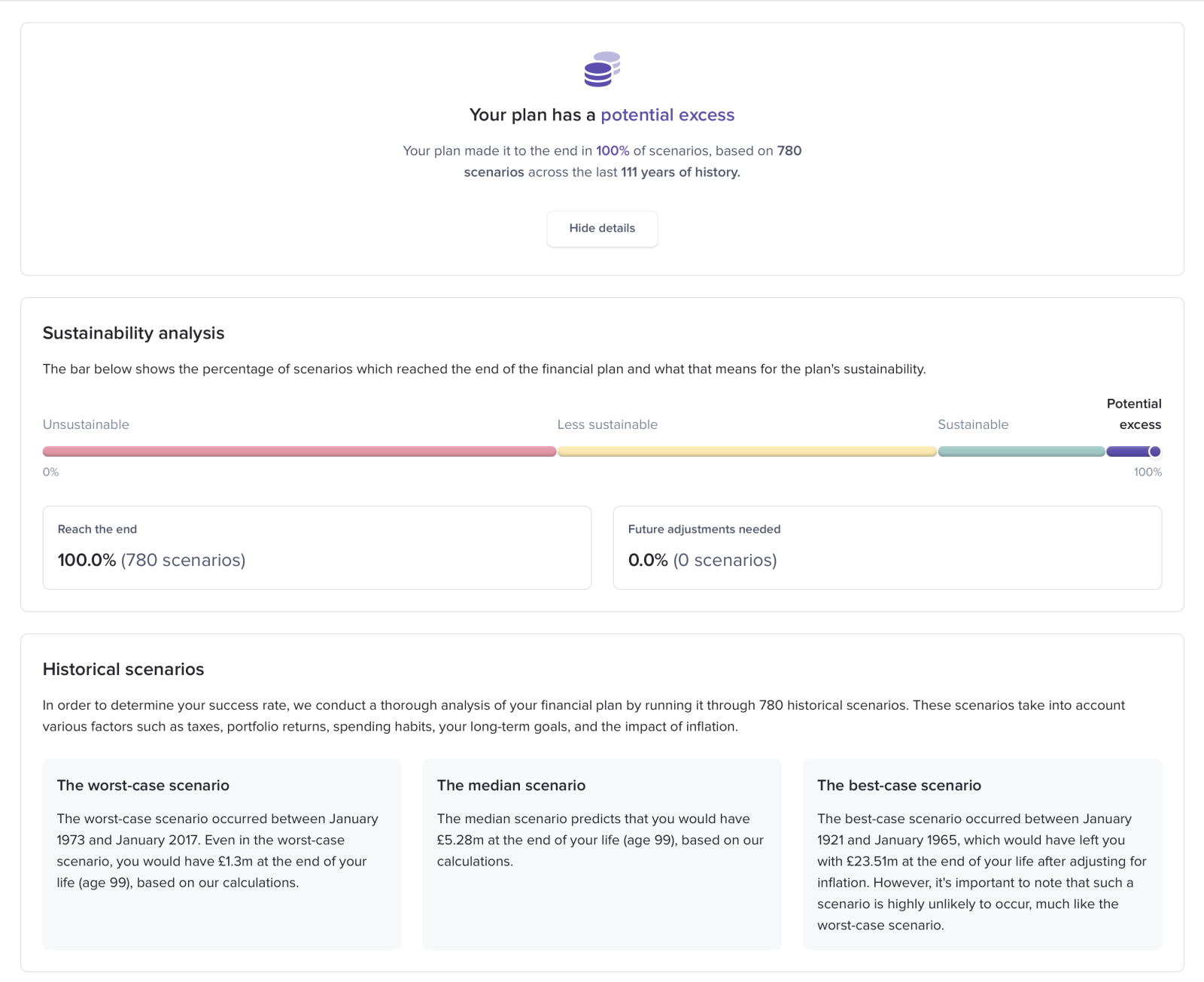
1 -
I'll take a look - I did think of splitting the accounts into portions but this could get quite complicated because like you I am trying to leverage full 20% tax band so I have programmed withdrawals each year more than what the default would be (new feature recently introduced).GazzaBloom said:Instead of annual rebalancing try adjusting the withdrawal order to consume cash and bonds first creating a rising equity glide-path by leaving the equities untouched for a number of years, in Timeline you may need to split single accounts into separate parts for the cash/bonds from the equities to be able to set the correct withdrawal order if you have cash/bonds and equities held in same account. If you adjust your portfolio to have enough cash/bonds to get you to state pension then you create an effective bridge through the early retirement years risk of poor returns.
https://finalytiq.co.uk/cash-reserve-buffers-withdrawal-rates-old-wives-fables-retirement-portfolio/0 -
This is the list of available assets - you can program a specific fund, but it seems to just split the fund into its best approximation of the below categories.OldScientist said:
What duration bonds are you modelling in timeline and voyant? Historically, long duration bonds (both US and UK - not sure off-hand about other countries) have had periods of awful real returns (e.g., from 1940 to 1980) caused by increasing yields and the impact of inflation in the 60s and 70s. So-called 'safe' withdrawal rates can vary considerably (~50 bp depending on the overall asset allocation) with the duration of the fixed income used. Some quick historical modelling (asset returns from macrohistory, equities 50/50 UK/US with fixed income consisting of UK cash) suggests that for a 10 year period, the SWR was 7.0-7.3% between 20-80% equities and 6.5% for 100% equities). Using long bonds instead of cash lowered the SWR by about 40-100 bp (higher reductions with lower equity allocation).Pat38493 said:
I am in the lucky situation aleady since we have both got DB pension sources and full SP. I am just about to turn 57 wife 59. By the time we both reach 67, over 90% of our spending requirements will be covered by those sources and I am pretty sure our situation would still be fairly comfortable even if I ran out of money by then.phlebas192 said:I'm an advocate for holding a higher % of equities than most people here seem comfortable with (since I see inflation as the single biggest risk to a comfortable retirement), but 100% with no cash buffer would be "extremely courageous" as Sir Humphrey might say! Backtesting can only tell you what might have happened with the specific assumptions you have chosen to model - and most backtesting I've seen is based on US data which has the huge assumption of "this country benefitted more than any other from the geopolitical upheavals of the 20th century but I'm going to assume that will be replicated in the 21st". Ever wondered how your backtesting would work with Russia, China or Germany as the principle data source to name just the most obvious examples?For anyone to say more than that you really need to give a lot more information. eg your age, do you have any dependants, what guaranteed income do you have / expect to get (DB pensions, annuities, state pension), how much of your expenditure these cover, rough size of investment pot etc.I would suggest at the least trying to assign a cash value to whatever other income you might have. eg at the very least you can work out an approximate cash value for your state pension via a tool such as https://comparison.moneyhelper.org.uk/en/tools/annuities. As an example, when my wife joined myself in retirement we were almost 100% in equities if we just looked at investments and saving accounts; but I was already receiving a DB pension and we had the SP to come. Including equivalent cash values for those we were more like 70% equities which is much less risky!FWIW, if you have a 60% equities ratio in your investments with a 99% chance of success then you have basically won the game. Why take a massive amount of additional risk for just a small improvement in - possibly spurious - outcomes?
Meanwhile, the most important purpose of my DC funds is to make sure we make it till we are both 67, since the drawdowns will be much higher in the next 10 years. My wife's DB pension is an NHS one that already pays out at full rate. My DB pension is already in payment but is much smaller.
My spending plan includes some big ticket items and costs that roll off in the first few years, so I am due to spend about 25% of the current nominal value of my assets fund in the next 3 years - at the moment I have this all in cash, and I am going to draw out of my DC up to the top of the 20% tax threshold with the rest covered by ISA/GIA that come from a house downsize and TFC/PCLS already taken. Obviously my drawdowns after the first 3 years need to be, and will be, much lower, and after year 10 they will be very small.
On the one hand, if anyone is in a postion to risk 100% equities it's probably me. On the other hand I was a bit surprised that backtesting is showing I am better off in 100% equities, even though my spend is significantly front loaded to the first 3 years. I have spent hours studying all the reports and data from these tools and it seems correct to me, obviously within the parameters of the data that it is using.
Also the tool I am using tends to assume regular rebalancing to the mix you have programmed. It's not very easy with that tool to simulate a glidepath where you basically increase your equity % during the first few years and eventually to 100%.
Common wisdom is that any money you need in the next 10 years should not be in equities, but if I really did that, the backtesting is massively worse.
In the end I guess it comes down to what a couple of replies above already said - how confident am I that I will not sell if there is a huge downturn in year 2, or cut my spending so much that I don't enjoy life as much for a couple of years. In all prior historical scenarios the portfolio recovered enough for my plan to work after year 3.
Also to an earlier reply - these are not monte carlo simulations these are historical backtests using global financial data including UK, and using UK inflation data.
If you constructed a 10 year inflation linked gilt ladder (e.g., see https://lategenxer.streamlit.app/Gilt_Ladder which suggests a current payout rate of about 10.5%) to provide the required floor of inflation linked income in the run up to the state pension, would that leave you some surplus for a risk portfolio (with 100% equities if required)?
In the meantime I figured out the main reason for the differences. In reality, I have about 24% of my overall assets in money market funds which I originally classified as "cash". However in Timeline cash is modelled as zero nominal growth. In the below example I moved this "cash" into the category "UK T Bills" which seems to be the closest available to money market funds. After doing that, I now have zero failure rate also in the current mix. (although the end of life balances are still worse across the main summary views which are "worst case", "Pessimistic", "Median" and "Optimistic".
Other than that, I only have about 8% in bonds at at the moment which is mostly in VAGS, which I assumed to be "Global Aggregate Bonds Hedged". I don't know what length is modelled in the software returns. My equities are modelled as "Global Equities" which seems to be equivalent to HMWS type funds or Vanguard FTSE all cap.
I have seen that gilt tool before and looked at it - I'll look into it again as bond funds like VAGS seem to be an unreliable asset in recent times - this has been my worst performing fund for the last 2 years, even including MMF.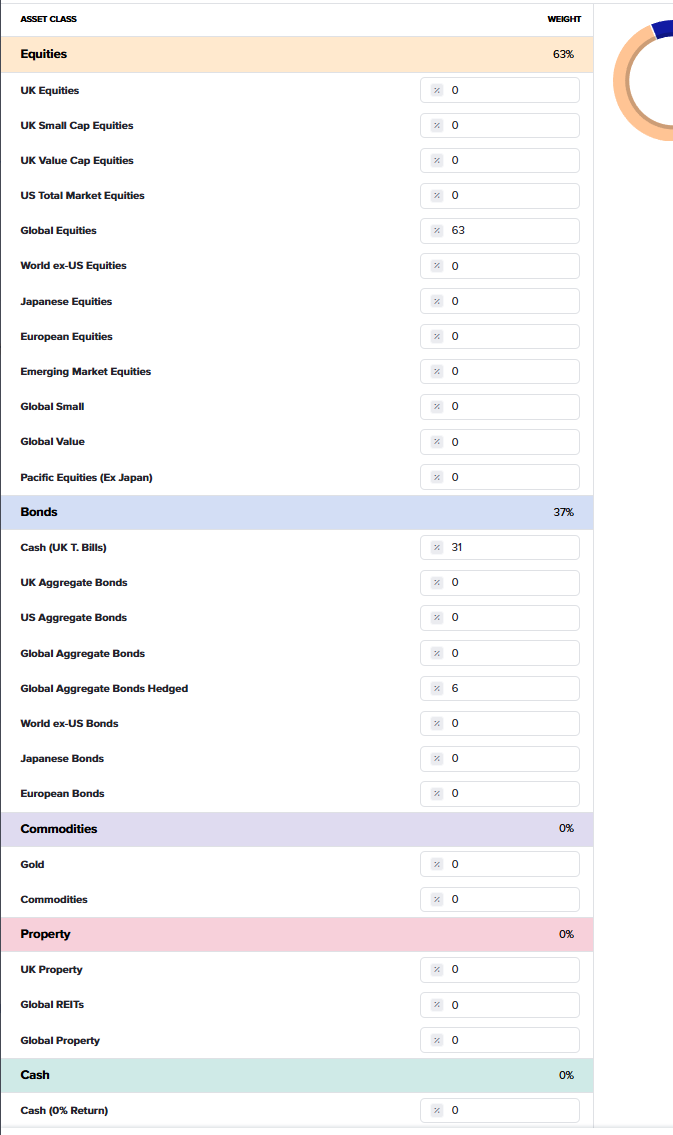 0
0







Confirm your email address to Create Threads and Reply

Categories
- All Categories
- 354.6K Banking & Borrowing
- 254.5K Reduce Debt & Boost Income
- 455.5K Spending & Discounts
- 247.5K Work, Benefits & Business
- 604.4K Mortgages, Homes & Bills
- 178.6K Life & Family
- 261.9K Travel & Transport
- 1.5M Hobbies & Leisure
- 16.1K Discuss & Feedback
- 37.7K Read-Only Boards