We’d like to remind Forumites to please avoid political debate on the Forum.
This is to keep it a safe and useful space for MoneySaving discussions. Threads that are – or become – political in nature may be removed in line with the Forum’s rules. Thank you for your understanding.
Let's discuss... corporate bonds




There is surprisingly little discussion of corporate bonds on the forum. That surprises me, both because they comprise a huge market – higher overall market cap than equities – and because I see them as a good source of diversification and income. So I thought I’d start this thread.
There is a sizeable contingent of people who see them as serving no useful purpose: “equities for risk and growth, gilts for safety”. There is also the view that spreads are too tight at the moment. I assume that is based on index returns, but a good actively managed fund can make up for the perceived ‘loss’; Trustnet shows 95 Sterling corporate bonds and, over the last three years, the index funds (HSBC, iShares, Vanguard) are in positions 70-75. This is very different from equities where the index funds sit mid-table or higher.
I own four actively managed bond funds with most holdings investment grade and/or short duration. They have returned between about 8% and 16% annually over the last three years (not that I have held them all during that period). Heading into retirement, I see corporate bonds as an excellent source of income, with more options than equities and less risk.
Comments
-
They are also riskier to hold than equities.
Why would a ''profitable'' company issue bonds paying say 8% when their bank could offer them a loan at about base rate + 1or 2%?
The reason is that they have to do obtain funds - as part of a balanced portfolio fine, but as retirement income I would not be investing .0 -
An 8% rate would only come from a company with a very poor credit rating or a high yield bond fund that focuses on such companies. If you stick to "A" rated and above corporate bonds then rates will be far lower. Duration will also factor in. Most bond index funds will mostly hold Government bonds and A rated corporate bonds with a small allocation to riskier B rated bonds.retiredbanker1 said:They are also riskier to hold than equities.
Why would a ''profitable'' company issue bonds paying say 8% when their bank could offer them a loan at about base rate + 1or 2%?
The reason is that they have to do obtain funds - as part of a balanced portfolio fine, but as retirement income I would not be investing .And so we beat on, boats against the current, borne back ceaselessly into the past.1 -
retiredbanker1 said:They are also riskier to hold than equities.Why do you say that? They are less volatile, and ahead of equities in the repayment queue if a company goes bust.
Since the bond market is larger than the equity market, Apple could not saunter down to HSBC and ask for a multi-billion dollar loan without driving prices up. The corporate bond market is a necessary part of an efficient market.retiredbanker1 said:Why would a ''profitable'' company issue bonds paying say 8% when their bank could offer them a loan at about base rate + 1or 2%?
The average yield from the four funds I hold is 7.2%. The rest of the return (the 8% - 16% I mentioned above) is capital gain. This is where fund managers earn their corn - by identifying companies where the risk is overstated in the price.Bostonerimus1 said:An 8% rate would only come from a company with a very poor credit rating or a high yield bond fund that focuses on such companies.
Aggregate bond funds hold govt and corporate bonds, but let's keep this thread to corporate bonds. Vanguard's corporate bond index is 8% AA, 44% A, 46% BBB. I do not know whether your reference to "riskier B" bond includes investment grade BBBs or is about junk Bs, but you will be hard pushed to find a corporate bond fund without a large chunk of BBBs.Bostonerimus1 said:If you stick to "A" rated and above corporate bonds then rates will be far lower. Duration will also factor in. Most bond index funds will mostly hold Government bonds and A rated corporate bonds with a small allocation to riskier B rated bonds.1 -
What strikes me as interesting, is what you see if you look at the long term data (using sector averages here because they have the history, they may underestimate equities, where most funds underperform, but may be more appropriate for bonds).
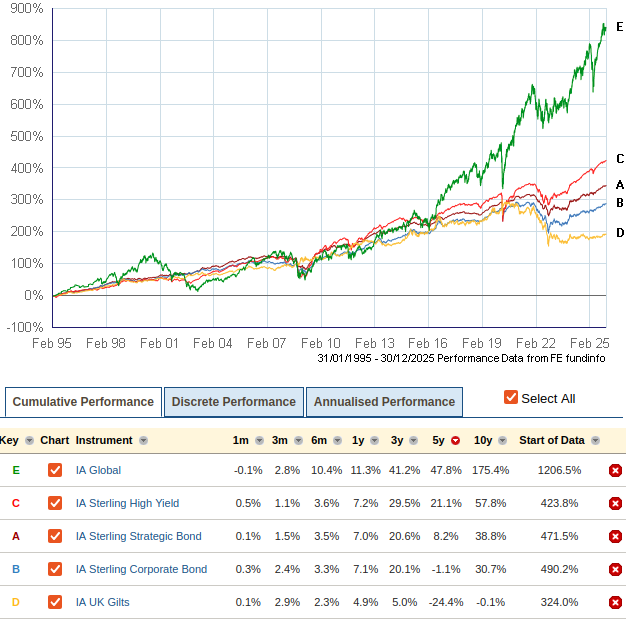 You have about 20 years from 1995 where there really isn't a huge difference between the total return from global equities and various flavours of bonds. You might say that bonds got a boost from the low interest rate era from 2008-2022, but even going into the GFC, equities had zigzagged through the dotcom crash while bonds were relatively unaffected. You can see the effect of interest rate policy on the gilts line, which if you extrapolate the 1995-2007 trend, it almost joins up with where we are today.You can see clearly from the last few years that the riskier bond sectors have really taken off. I doubt the post-2022 trend or 6-9%pa is sustainable, but with the benefit of hindsight junk has been kind to investors of late, despite tightish spreads. I see certain strategic funds are starting to load up on gilts again, so make of that what you will.2
 -
If you run a line through pre-GFC and post-GFC up to 2022 when interest rates normalised, you get a pretty straight line (aside from high yield doing a bit better post-GFC). You say, masonic, “… bonds got a boost from the low interest rate era from 2008-2022” but why is that? The GFC fall in interest rates would push up prices, but after that effect ran its course why didn’t bond yields/prices move closer to the horizontal?
0 -
From what I recall, it took a long time for it to sink in that low interest rates were going to persist, so the effect was spread out over a long time (and as is typical markets then went too far and decided they'd never end).Duration will determine how pronounced the effect is, and I'd imagine the gilt sector would consist of the longest duration funds.But you shouldn't expect a straight line for compound growth - the chart isn't logarithmic so there ought to be some curvature. I would not expect the doubling time during near-zero interest rate times to be anywhere near that observed in an era of 5%+ base rate. So it surprises me that 1995-2005 and 2010-2020 delivered comparable returns.1
-
and as is typical markets then went too far and decided they'd never end
Particularly prescient with regard to E!
Approaching twenty years now that there hasn't been an extended global recession. The lockdown period where the world shut down, literally, is a mere bump in the road.
0 -
Yes Vanguard's global corporate bond index fund fund has a yield of 4% and a total return this year of 7% and that's with 46% BBB. For me that's ok in the accumulation phase, but for most people I'd advise using the whole bond market to capture government bonds, certainly if this is part of an income strategy, and keep the BBB allocation to maybe 20% and I wouldn't touch anything with "High Yield Corporate" in the name. I really got very tired of worrying about interest rates and so look a bit sideways at bonds. And that brings up the issue of average duration.aroominyork said:retiredbanker1 said:They are also riskier to hold than equities.Why do you say that? They are less volatile, and ahead of equities in the repayment queue if a company goes bust.
Since the bond market is larger than the equity market, Apple could not saunter down to HSBC and ask for a multi-billion dollar loan without driving prices up. The corporate bond market is a necessary part of an efficient market.retiredbanker1 said:Why would a ''profitable'' company issue bonds paying say 8% when their bank could offer them a loan at about base rate + 1or 2%?
The average yield from the four funds I hold is 7.2%. The rest of the return (the 8% - 16% I mentioned above) is capital gain. This is where fund managers earn their corn - by identifying companies where the risk is overstated in the price.Bostonerimus1 said:An 8% rate would only come from a company with a very poor credit rating or a high yield bond fund that focuses on such companies.
Aggregate bond funds hold govt and corporate bonds, but let's keep this thread to corporate bonds. Vanguard's corporate bond index is 8% AA, 44% A, 46% BBB. I do not know whether your reference to "riskier B" bond includes investment grade BBBs or is about junk Bs, but you will be hard pushed to find a corporate bond fund without a large chunk of BBBs.Bostonerimus1 said:If you stick to "A" rated and above corporate bonds then rates will be far lower. Duration will also factor in. Most bond index funds will mostly hold Government bonds and A rated corporate bonds with a small allocation to riskier B rated bonds.And so we beat on, boats against the current, borne back ceaselessly into the past.0 -
I thought about it and decided it was a "no" from me. Two reasons really:aroominyork said:There is surprisingly little discussion of corporate bonds on the forum. That surprises me, both because they comprise a huge market – higher overall market cap than equities – and because I see them as a good source of diversification and income. So I thought I’d start this thread.
There is a sizeable contingent of people who see them as serving no useful purpose: “equities for risk and growth, gilts for safety”. There is also the view that spreads are too tight at the moment. I assume that is based on index returns, but a good actively managed fund can make up for the perceived ‘loss’; Trustnet shows 95 Sterling corporate bonds and, over the last three years, the index funds (HSBC, iShares, Vanguard) are in positions 70-75. This is very different from equities where the index funds sit mid-table or higher.
I own four actively managed bond funds with most holdings investment grade and/or short duration. They have returned between about 8% and 16% annually over the last three years (not that I have held them all during that period). Heading into retirement, I see corporate bonds as an excellent source of income, with more options than equities and less risk.
1. Corporate bonds can be thought of as a mixture of (i) interest rate risk, and (ii) credit risk. You can replicate that by buying (i) government bonds, plus (ii) equities (because there is some a correlation between a company's ability to pay its debts and its share price). So I am not sure that corporate bonds really help much with diversification.
2. Corporate bonds are a lot less liquid than government bonds or equities. Most equities are traded daily. Many corporate bonds are not traded for months on end. Where corporate bonds are "off-the-run" (think older, staler ones), the spread between the bid and offer price gets much bigger. That might sound esoteric but once people have got the disinfectant out to clean air conditioning unit's blades, it may be harder / take longer to convert the corporate bonds into cash for the amount you thought they were worth (compared with gilts).0 -
Dead_keen said:
1. Corporate bonds can be thought of as a mixture of (i) interest rate risk, and (ii) credit risk. You can replicate that by buying (i) government bonds, plus (ii) equities (because there is some a correlation between a company's ability to pay its debts and its share price). So I am not sure that corporate bonds really help much with diversification.I guess the question here is, if you compare a blend of government bonds and equities to corporate bonds, when equities have got ahead of themselves (like many think they have now), do corporates provide better risk adjusted return? There's a clear sacrifice of potential upside, but the downside is also limited. Bondholders may experience some haircuts in tough times, but defaults tend to be low even at the racier end of the credit spectrum. Around the time of the dotcom crash, corporate bond investors looked pretty smart, having pretty much avoided the downturn, whereas in 2008, credit came under fire and performance was much in line with a blend of equities and government bonds. Something similar was seen in the brief 2020 crash. So it seems there is benefit under certain adverse market conditions but not others. Perhaps we're in a situation now that is rather like 2000 (it's rather tempting to draw parallels from the chart above), but who knows.4







Confirm your email address to Create Threads and Reply

Categories
- All Categories
- 354.1K Banking & Borrowing
- 254.3K Reduce Debt & Boost Income
- 455.3K Spending & Discounts
- 247.1K Work, Benefits & Business
- 603.8K Mortgages, Homes & Bills
- 178.4K Life & Family
- 261.3K Travel & Transport
- 1.5M Hobbies & Leisure
- 16.1K Discuss & Feedback
- 37.7K Read-Only Boards