We’d like to remind Forumites to please avoid political debate on the Forum.
This is to keep it a safe and useful space for MoneySaving discussions. Threads that are – or become – political in nature may be removed in line with the Forum’s rules. Thank you for your understanding.
Testing and reconnecting Kinetico 2020C Water Softener After 3+ Years Unused -DIY??
Comments
-
Yes, I have reasonably good access, although not as convenient as installing the softener under the sink. As I explained above, the only practical option is to install it in the loft. The dishwasher can continue using salt pellets for its own internal softening, and I can use the unsoftened sink supply for drinking water, etc.Belenus said:If you do plan to install the softener in your loft, bear in mind that you will need to top up the salt regularly.
Can you access the loft easily while carrying salt blocks or tablet salt?
0 -
Ok, good info there, SS.
You said the drawing room was at one time a kitchen, so presumably had a waste pipe then. Any idea where? Is that cupboard on an outside wall? I presume so. And, what size 'overflow' does the machine require? 22mm? Larger? (I'm guessing it doesn't actually need a 'drain', but is more like a toilet overflow?)
The fact your softener doesn't require a power supply is a significant bonus, not only in it simplifying installation, but also in noise reduction - the machine presumably doesn't go into 'flushing' mode at times?
You clearly understand the requirement for unsoftened water being available for drinking, and also that you can counter the 'hard' in your DW using local tablets.
So I suggest it comes down to pros and cons for each location?
Drawing: Convenient for refills. Access to plumbing pipes. A catastrophic leak will 'only' wet the floor and not bring down ceilings. Cons: needs a waste outlet, so likely a hole through the wall (unless the new kitchen waste can be accessed - is it in the next room?)
Loft: Out of sight. Even easier plumbing. Cons: Access for resalting. Need to install a drain. Risk to ceilings from leak.
Anything else to add?
1 -
Absolutely do the flushing for a very extended period of time.Section62 said:A good idea to test it before installation, but after standing unused for a long time you'll also want to flush it through with lots of clean water. So not just a functional test, but flushing for say an hour, leave to stand for 24 hours, then flush for a further hour. You'll want to do the flushing shortly before putting the unit back into use... don't flush it and then leave it 6 months before you get round to doing the install.The ion exchanger has a vast surface area for bacteria and other nasties to potentially grow on, so you'll want to make sure they have all gone.Also, under no circumstances whatsover, put anything other than clean mains water into the unit to clean/flush it. E.g. no bleach, disinfectant or washing up liquid should be going anywhere near the inside of the machine.
In normal use, the frequent introduction of saturated brine solution into the resin bed is sufficient to ensure there is no bacterial growth. You may find it useful, after the flushing, to do a couple of repeat regenerations as well.
How has the unit been stored? The resin itself can break down if not in suitable conditions and there can be wear to seals etc on the unit. If you can, do the flushing so that the waste water is via a filter / strainer of some kind. This will mean that, if the resin is escaping from the unit, you will be able to catch it and be aware. Also, have consideration for leaks from and within the unit from places where there should not be leaks.
It is common that overflow pipes from the water tank in the loft do not actually go anywhere that is contained but simply spill to the floor. That would not be suitable for the drain from the softener.sujsuj said:For the overflow connection, I can follow a similar approach to the existing tank overflow pipe, which is already in place and connected.
1 -
It looks as tho' it has both a 'drain' and an 'overflow' outlet, but both appear to connected via 'washing machine'-type hoses, so presumably will be very easy to route to suitable points. Also, they presumably don't require a 'fall'?1
-
sujsuj said:
This softener has one cold mains inlet, one softened-water outlet, and one drain connection. It doesn’t require a power supply, as it operates using the kinetic energy of the water flow.
A drain in the loft should be fine, as there is already an overflow pipe from the water tank, and the connection looks straightforward. Access and lighting in the loft are also good.
It has both a drain and an overflow. Neither should be connected to the overflow of the water tank. Firstly, the size of the overflow pipe (unless you've a very unusual setup) is too small for the drain, and the drain water needs to go to your drainage system, not allowed to overflow from the warning pipe. Secondly, in case the outlet of the overflow pipe gets blocked up you don't want backflow from the water softener getting into your cold water storage tank.The drain needs to go into a waste pipe connected to the drainage system, the overflow needs to go into a separate pipe which discharges outside somewhere that you will see it if the unit is overflowing.Weight-wise, it isn't the salt you need to be worried about, it is the weight of the water in the unit when it is full. Add that to the weight of the water in the cold water storage tank and you may exceed the load capacity of your ceiling.2 -
WIAWSNB said:
The fact your softener doesn't require a power supply is a significant bonus, not only in it simplifying installation, but also in noise reduction - the machine presumably doesn't go into 'flushing' mode at times?All ion exchange softeners have to regenerate.The only difference between this one and models with a power supply is the valve(s) that control the flow of water to carry out the regeneration are operated by water pressure rather than electronically controlled.The valve mechanisms on all the softeners I've come across are more or less silent - any noise comes from the flow of water through the unit, similar to the noise of a toilet cistern refilling.It doesn't make much difference, but the advantage of electronic models is you can usually set the regeneration time to one which causes you least disturbance. Some of them will give you additional information like the volume of water used since 'x', and starting a manual regeneration usually just involves a button press (the 2020C needs a screwdriver to turn the mechanism)2 -
WIAWSNB said:It looks as tho' it has both a 'drain' and an 'overflow' outlet, but both appear to connected via 'washing machine'-type hoses, so presumably will be very easy to route to suitable points. Also, they presumably don't require a 'fall'?The drain pipe can go up to the discharge point, but there are limits to the height and length.The overflow pipe has to have a fall - the brine tank isn't pressurised. The overflow is by gravity only.2
-
WIAWSNB said:Ok, good info there, SS.
You said the drawing room was at one time a kitchen, so presumably had a waste pipe then. Any idea where? Is that cupboard on an outside wall? I presume so. And, what size 'overflow' does the machine require? 22mm? Larger? (I'm guessing it doesn't actually need a 'drain', but is more like a toilet overflow?)
The fact your softener doesn't require a power supply is a significant bonus, not only in it simplifying installation, but also in noise reduction - the machine presumably doesn't go into 'flushing' mode at times?
You clearly understand the requirement for unsoftened water being available for drinking, and also that you can counter the 'hard' in your DW using local tablets.
So I suggest it comes down to pros and cons for each location?
Drawing: Convenient for refills. Access to plumbing pipes. A catastrophic leak will 'only' wet the floor and not bring down ceilings. Cons: needs a waste outlet, so likely a hole through the wall (unless the new kitchen waste can be accessed - is it in the next room?)
Loft: Out of sight. Even easier plumbing. Cons: Access for resalting. Need to install a drain. Risk to ceilings from leak.
Anything else to add?As shown in the photo, the only remaining part of the old kitchen is the main water connection valve. The pipe appears to run under the floor. I believe the main water supply bifurcates, with one branch going to the current kitchen and the other going to the loft.
The cupboard is located on an internal wall, not an external wall. On the other side of that wall is a cupboard in the hallway to the current kitchen.
The overflow pipe has a diameter of about 1.5 cm, not 2 cm or more. The waste pipe to the drain is also the same type, around 1.5 cm in diameter.
If the unit is fitted in the roof, I am thinking that I could connect the waste and drain pipes to the existing tank overflow pipe, as long as water does not flow back into the tank. But not sure if height will be a problem as Tank overflow pipe is too high so not sure that can work?
It does not require electricity, as it is a kinetic type system.
Given the complexity of the pipe connections, the only feasible option for me now is to soften only the water that goes to the tank, not the supply to the sink or the dishwasher. Interestingly, the washing machine, which is connected just a couple of metres away from the dishwasher, receives its water from the tank. I am not familiar with the water connection logic, and this does not make much sense to me. When I tested it, I found that when I closed the mains supply, the dishwasher stopped with an error, whereas the washing machine continued to work with supply from tank!.
I think I have to completely rule out connecting anything in the drawing room. After bifurcation from the main stop valve both pipes goes in the same direction, so it is almost impossible to determine which pipe goes to the kitchen and which one goes to the tank. Also since its is in inside wall,
See photos of inside cupboard and connections diagram from manual.
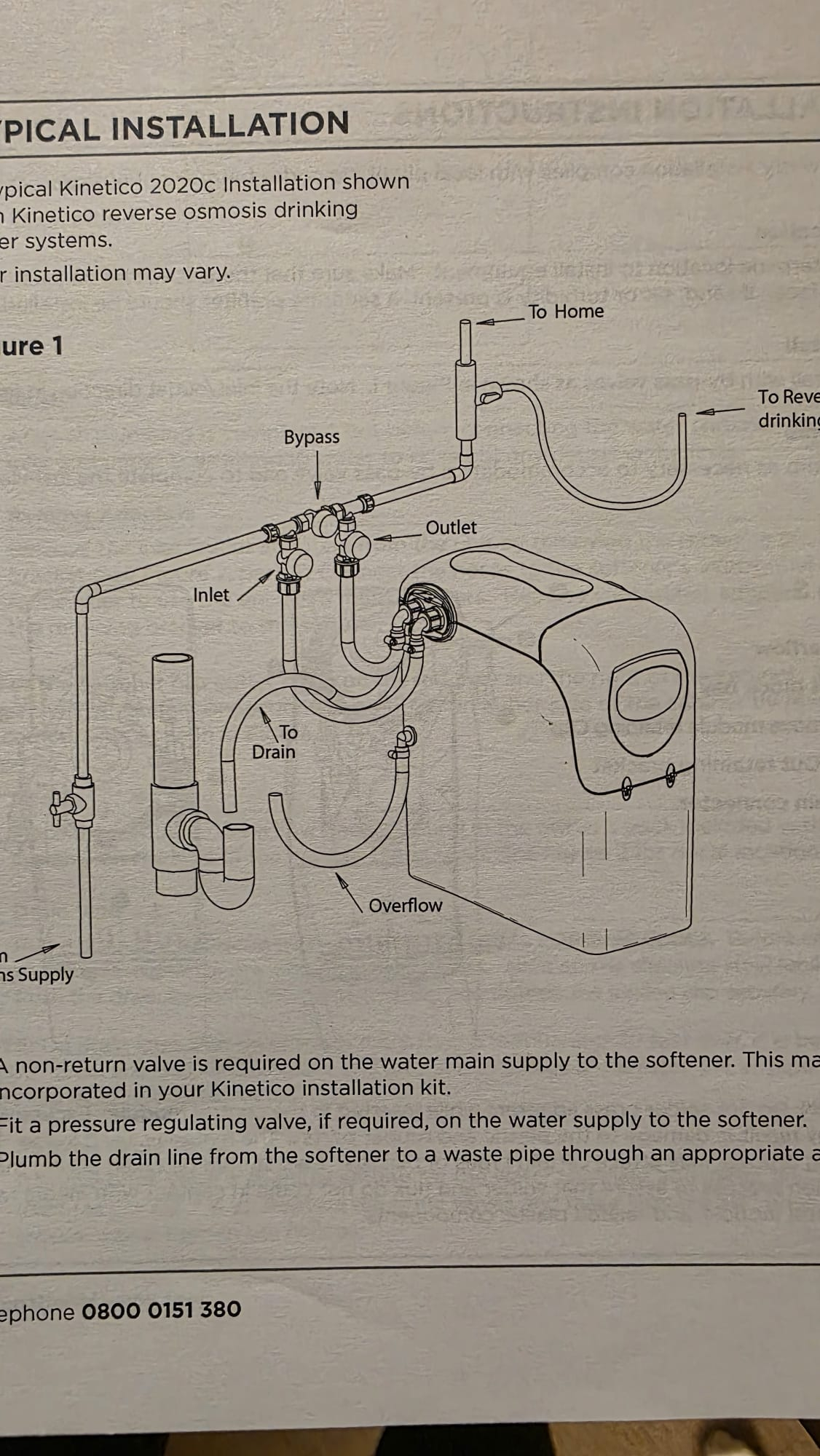
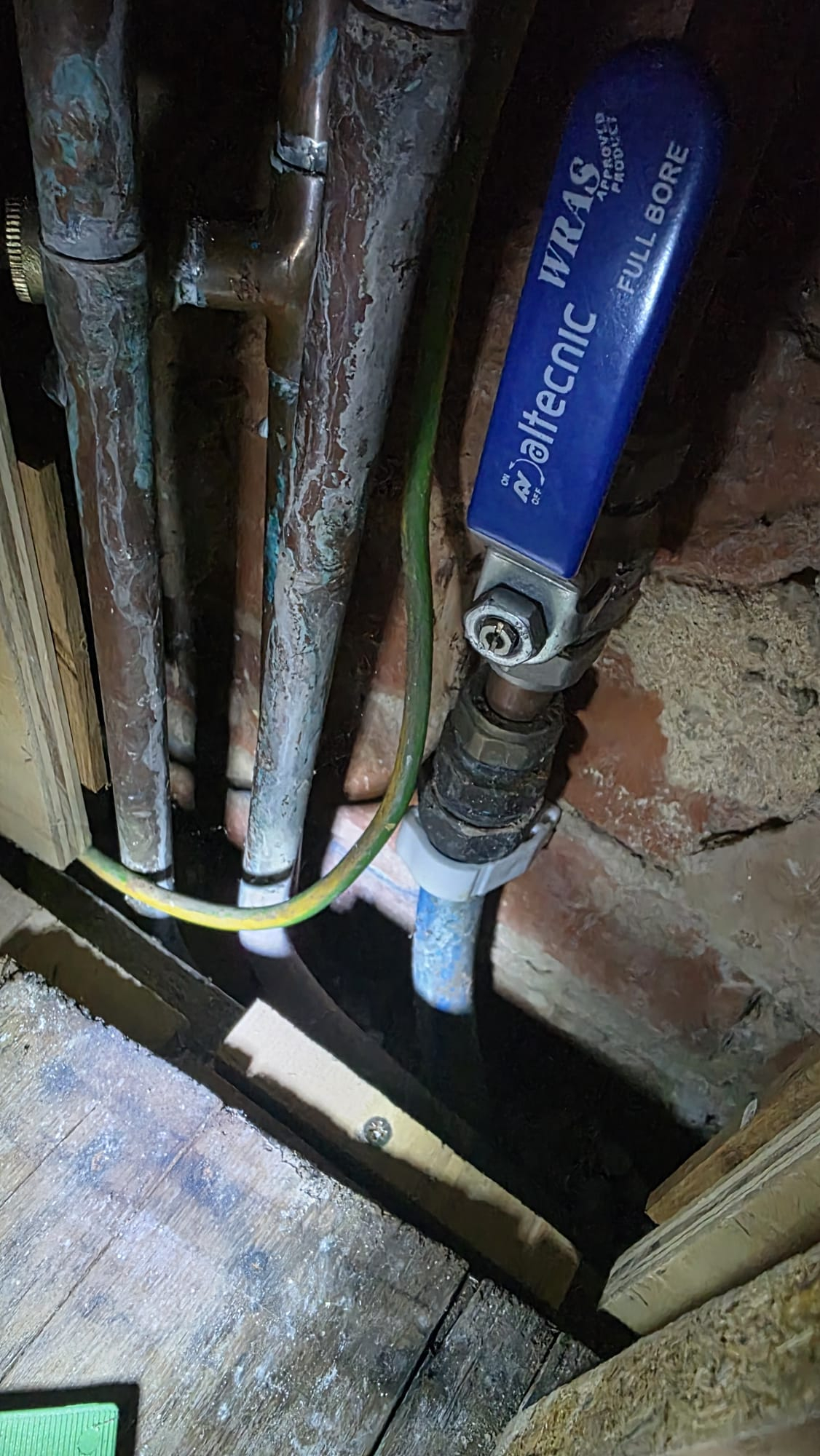 0
0 -
Grumpy_chap said:
Absolutely do the flushing for a very extended period of time.Section62 said:A good idea to test it before installation, but after standing unused for a long time you'll also want to flush it through with lots of clean water. So not just a functional test, but flushing for say an hour, leave to stand for 24 hours, then flush for a further hour. You'll want to do the flushing shortly before putting the unit back into use... don't flush it and then leave it 6 months before you get round to doing the install.The ion exchanger has a vast surface area for bacteria and other nasties to potentially grow on, so you'll want to make sure they have all gone.Also, under no circumstances whatsover, put anything other than clean mains water into the unit to clean/flush it. E.g. no bleach, disinfectant or washing up liquid should be going anywhere near the inside of the machine.
In normal use, the frequent introduction of saturated brine solution into the resin bed is sufficient to ensure there is no bacterial growth. You may find it useful, after the flushing, to do a couple of repeat regenerations as well.
How has the unit been stored? The resin itself can break down if not in suitable conditions and there can be wear to seals etc on the unit. If you can, do the flushing so that the waste water is via a filter / strainer of some kind. This will mean that, if the resin is escaping from the unit, you will be able to catch it and be aware. Also, have consideration for leaks from and within the unit from places where there should not be leaks.
It is common that overflow pipes from the water tank in the loft do not actually go anywhere that is contained but simply spill to the floor. That would not be suitable for the drain from the softener.sujsuj said:For the overflow connection, I can follow a similar approach to the existing tank overflow pipe, which is already in place and connected.
How has the unit been stored?
It has been kept indoors, but not in a heated room. The storage area is enclosed, and it does not get extremely cold either.My biggest problem right now is figuring out how to connect it for testing. The unit has connectors designed to attach to under-sink plumbing, so I may need to remove connected pipe and somehow connect it to a hose pipe directly to unit instead.
I am planning to let it run for at least a couple of hours and then check the level of water softening.
0 -
Yes it got drain and over flow Washing Machine type connectors are there for inlet, outlet and drain pipe now.WIAWSNB said:It looks as tho' it has both a 'drain' and an 'overflow' outlet, but both appear to connected via 'washing machine'-type hoses, so presumably will be very easy to route to suitable points. Also, they presumably don't require a 'fall'?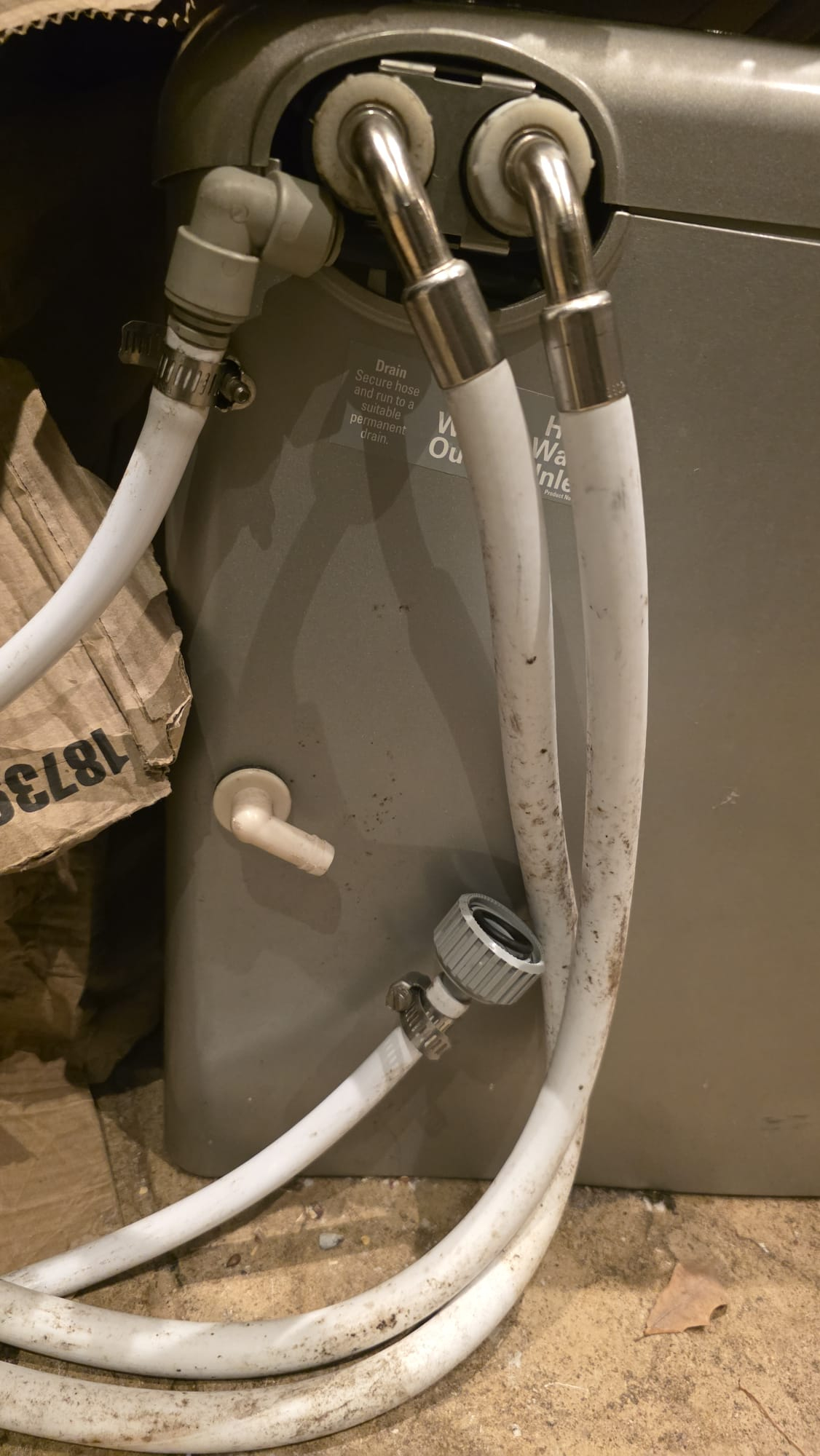
0









Confirm your email address to Create Threads and Reply

Categories
- All Categories
- 354.6K Banking & Borrowing
- 254.5K Reduce Debt & Boost Income
- 455.5K Spending & Discounts
- 247.5K Work, Benefits & Business
- 604.4K Mortgages, Homes & Bills
- 178.6K Life & Family
- 261.9K Travel & Transport
- 1.5M Hobbies & Leisure
- 16.1K Discuss & Feedback
- 37.7K Read-Only Boards