We’d like to remind Forumites to please avoid political debate on the Forum.
This is to keep it a safe and useful space for MoneySaving discussions. Threads that are – or become – political in nature may be removed in line with the Forum’s rules. Thank you for your understanding.
📨 Have you signed up to the Forum's new Email Digest yet? Get a selection of trending threads sent straight to your inbox daily, weekly or monthly!
HMRC increasing tax on salary due to savings

Gromit78
Posts: 8 Forumite



I have recently changed jobs and had a pay increase which puts me in the 40% tax bracket and I hadn't fully understood all the implications this will have.
HMRC took an additional £300 in income tax in my November pay and when I called them to find out more this is when it became apparent that it's due to interest on savings. I have now asked HR to increase my salary sacrifice pension contribution an additional 2% which should take me back to being a standard rate tax payer (and end up with similar or more money paid to me after tax from now on).
I've now bought up to the maximum value of premium bonds. What else can I do besides ensuring I have maxed out my ISA allowance for this year and then be ready to max out next year's allowance when the new tax year starts?
Short of taking the money out of the bank and hiding it under the bed (which I'm not going to do), what else can I do to maximise my tax free savings?
Also I should say HMRC read out the last 4 digits of the accounts they are referencing when applying the increase in my tax paid. However, I only have about half of them on my savings/banking spreadsheet which I maintain, so I'm unsure how to identify the rest of them and determine whether have since been closed and can advise HMRC of this fact.
HMRC took an additional £300 in income tax in my November pay and when I called them to find out more this is when it became apparent that it's due to interest on savings. I have now asked HR to increase my salary sacrifice pension contribution an additional 2% which should take me back to being a standard rate tax payer (and end up with similar or more money paid to me after tax from now on).
I've now bought up to the maximum value of premium bonds. What else can I do besides ensuring I have maxed out my ISA allowance for this year and then be ready to max out next year's allowance when the new tax year starts?
Short of taking the money out of the bank and hiding it under the bed (which I'm not going to do), what else can I do to maximise my tax free savings?
Also I should say HMRC read out the last 4 digits of the accounts they are referencing when applying the increase in my tax paid. However, I only have about half of them on my savings/banking spreadsheet which I maintain, so I'm unsure how to identify the rest of them and determine whether have since been closed and can advise HMRC of this fact.
0
Comments
-
Capital gains on gilts and other "qualifying" corporate bonds are tax free*. Buying low coupon conventional gilts below par (£100/100p) and holding them to maturity is one way to earn a guaranteed tax free return. Their coupons are taxed as interest but they're very small. You buy them via a stockbroker e.g., AJ Bell, Hargreaves Lansdown, Freetrade, iWeb/Halifax Sharedealing.Gromit78 said:I have recently changed jobs and had a pay increase which puts me in the 40% tax bracket and I hadn't fully understood all the implications this will have.
HMRC took an additional £300 in income tax in my November pay and when I called them to find out more this is when it became apparent that it's due to interest on savings. I have now asked HR to increase my salary sacrifice pension contribution an additional 2% which should take me back to being a standard rate tax payer (and end up with similar or more money paid to me after tax from now on).
I've now bought up to the maximum value of premium bonds. What else can I do besides ensuring I have maxed out my ISA allowance for this year and then be ready to max out next year's allowance when the new tax year starts?
Short of taking the money out of the bank and hiding it under the bed (which I'm not going to do), what else can I do to maximise my tax free savings?
Also I should say HMRC read out the last 4 digits of the accounts they are referencing when applying the increase in my tax paid. However, I only have about half of them on my savings/banking spreadsheet which I maintain, so I'm unsure how to identify the rest of them and determine whether have since been closed and can advise HMRC of this fact.
In the table below look for e.g., TG26A, TN28, TG29 and TR29. If you search the investments board you'll find some threads on gilts.
*The flip side is that capital losses aren't allowable against taxable capital gains.
https://giltsyield.com/bond/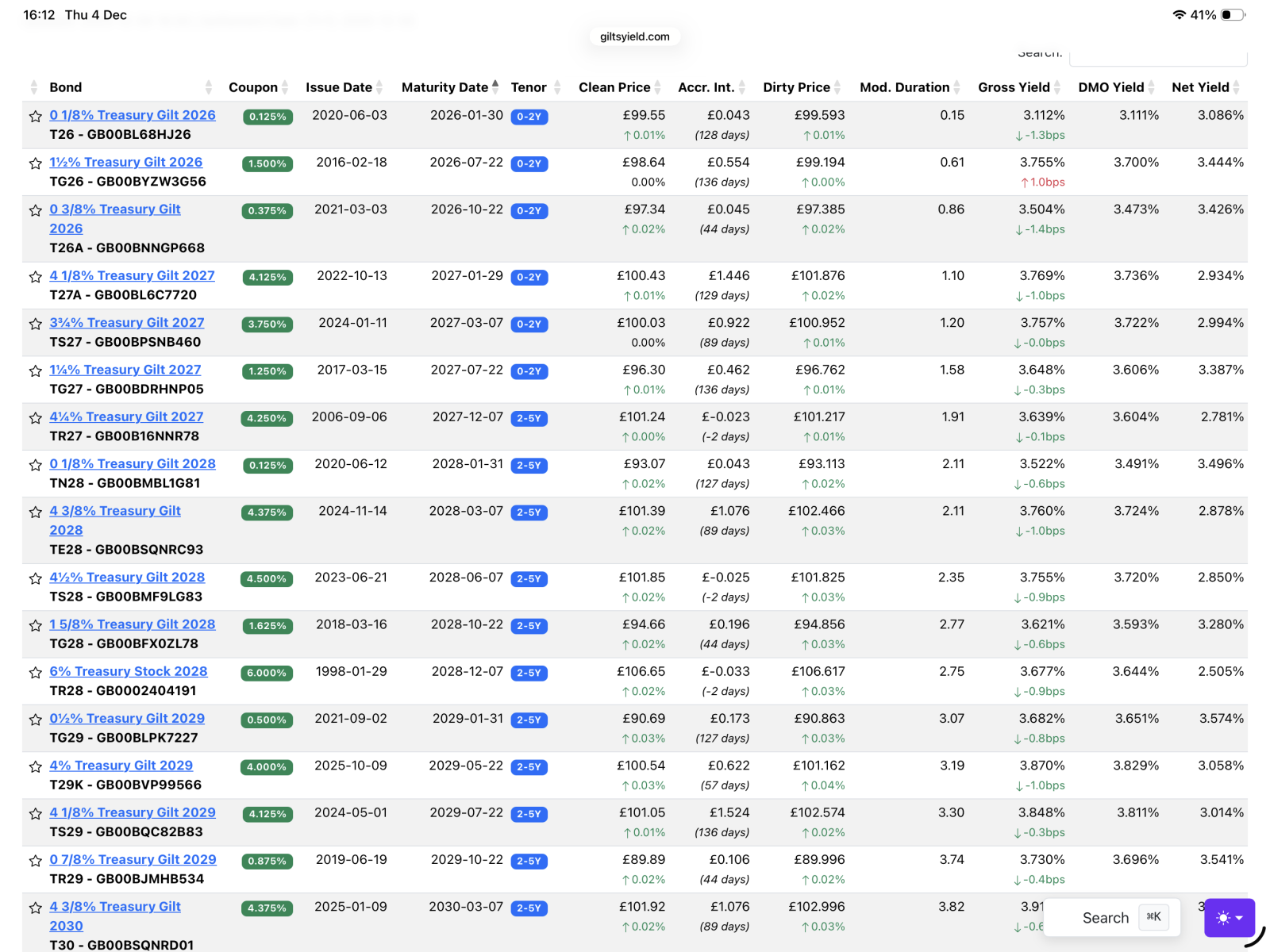
0 -
Since you'll be back down to basic rate the case for premium bonds is a little sketchy - you could make more with a good savings account even after tax. How is your pension looking? Contributing to a SIPP would a) give you even further margin so that any gains in other investments don't take you into a higher tax bracket and b) while not strictly tax free, currently benefit from a 25% tax free element (capped).0




Confirm your email address to Create Threads and Reply

Categories
- All Categories
- 355.6K Banking & Borrowing
- 254.8K Reduce Debt & Boost Income
- 456.1K Spending & Discounts
- 248.2K Work, Benefits & Business
- 605.7K Mortgages, Homes & Bills
- 179K Life & Family
- 263.5K Travel & Transport
- 1.5M Hobbies & Leisure
- 16.1K Discuss & Feedback
- 37.7K Read-Only Boards