We’d like to remind Forumites to please avoid political debate on the Forum.
This is to keep it a safe and useful space for MoneySaving discussions. Threads that are – or become – political in nature may be removed in line with the Forum’s rules. Thank you for your understanding.
📨 Have you signed up to the Forum's new Email Digest yet? Get a selection of trending threads sent straight to your inbox daily, weekly or monthly!
Fund Selection
Comments
-
I doubt I’m one of the forum regulars you are calling out. But after all this work how different is you portfolio from say VWRL both in makeup and performance?I just put everything in VHVG, I’m not willing to pay the premium on the whole holding for having any EM exposure.
I suffered analysis paralysis probably for 20 years. I finally discovered time in the market and index investing and ultra low fees.0 -
Sorry if I was unclear. I would never recommend investors create their own funds, that is far beyond my knowledge and capabalities. I refer only to ready made, off the shelf funds, that already have a benchmnark.leosayer said:
I agree that it's easy to compare individual funds.
I'm thinking more of comparing your own portfolio performance against that of a benchmark, particularly if you want to track different slices such as fixed income and equity portions.
To do so requires keeping records of all holdings, transactions and values over time.0 -
I'm not trying to compare the make up or performance of two different types of funds, both types, managed and trackers, have their place and indeed I hold both. What I'm setting out is the steps I go through to establish the funds within my porfolio, with emphasis on understanding the make up and copmpoasition of what you buy versus just buying a one size fits all tracker on the basis that's what many other do and without really understand what's inside the box or why.MX5huggy said:I doubt I’m one of the forum regulars you are calling out. But after all this work how different is you portfolio from say VWRL both in makeup and performance?I just put everything in VHVG, I’m not willing to pay the premium on the whole holding for having any EM exposure.
I suffered analysis paralysis probably for 20 years. I finally discovered time in the market and index investing and ultra low fees.
If you want certainty that you will match the index every year for ever, index trackers are the way to go. But in doing that, you should realise that you will have no choice but to take the ride down when the markets crash and you will have to wait for the markets to recover before your tracker returns to profit. Know also, that approach guarantees that you will never beat the index, not ever. Some of my earlier posts in this thread mention the success I've had this year with managed Artemis funds that have out performed and I've beaten the index for periods of around six months before swapping out into other funds. That requires effort, time and analysis, which not everyone is capable of nor wishes to do. There's a middle ground which involves a greater understanding of the funds you hold and their contenmts et al, which once understood, let;s you sleep better at night.1 -
I think I'm being unclear!chiang_mai said:
Sorry if I was unclear. I would never recommend investors create their own funds, that is far beyond my knowledge and capabalities. I refer only to ready made, off the shelf funds, that already have a benchmnark.leosayer said:
I agree that it's easy to compare individual funds.
I'm thinking more of comparing your own portfolio performance against that of a benchmark, particularly if you want to track different slices such as fixed income and equity portions.
To do so requires keeping records of all holdings, transactions and values over time.
I mean comparing the performance of my portfolio of (retail) funds to a certain benchmark.
With each fund performing differently, the relative weights of each fund will change on a daily basis so measuring the overall performance of all combined becomes challenging.
I do it myself on a spreadsheet.0 -
If you are interested in the overall performance of your portfolio then you don't really need to track the internals at all, just the account inflows and outflows. Known as unitisation, it essentially gives your portfolio a unit price and when you put money in you add units at the current price and vice versa when you draw down. Much the same as an open-ended fund would. A complementary approach is to calculate the internal rate of return, where you take the same inflows and outflows and model them as a series of cash flows. The latter gives you a time-weighted return based on your pattern of contributions, whereas the former gives to a return equivalent to buying and holding the underlying portfolio. Both measure the impact of your portfolio management decisions, but neither require knowledge of them.leosayer said:
I think I'm being unclear!chiang_mai said:
Sorry if I was unclear. I would never recommend investors create their own funds, that is far beyond my knowledge and capabalities. I refer only to ready made, off the shelf funds, that already have a benchmnark.leosayer said:
I agree that it's easy to compare individual funds.
I'm thinking more of comparing your own portfolio performance against that of a benchmark, particularly if you want to track different slices such as fixed income and equity portions.
To do so requires keeping records of all holdings, transactions and values over time.
I mean comparing the performance of my portfolio of (retail) funds to a certain benchmark.
With each fund performing differently, the relative weights of each fund will change on a daily basis so measuring the overall performance of all combined becomes challenging.
I do it myself on a spreadsheet.1 -
I used to do it that way but it meant that I wasn't able to record the relative performance of different funds and asset types eg. equity funds vs bond funds.masonic said:
If you are interested in the overall performance of your portfolio then you don't really need to track the internals at all, just the account inflows and outflows. Known as unitisation, it essentially gives your portfolio a unit price and when you put money in you add units at the current price and vice versa when you draw down. Much the same as an open-ended fund would.leosayer said:
I think I'm being unclear!chiang_mai said:
Sorry if I was unclear. I would never recommend investors create their own funds, that is far beyond my knowledge and capabalities. I refer only to ready made, off the shelf funds, that already have a benchmnark.leosayer said:
I agree that it's easy to compare individual funds.
I'm thinking more of comparing your own portfolio performance against that of a benchmark, particularly if you want to track different slices such as fixed income and equity portions.
To do so requires keeping records of all holdings, transactions and values over time.
I mean comparing the performance of my portfolio of (retail) funds to a certain benchmark.
With each fund performing differently, the relative weights of each fund will change on a daily basis so measuring the overall performance of all combined becomes challenging.
I do it myself on a spreadsheet.
So now I record weekly value and flow data points for all holdings which gives me this: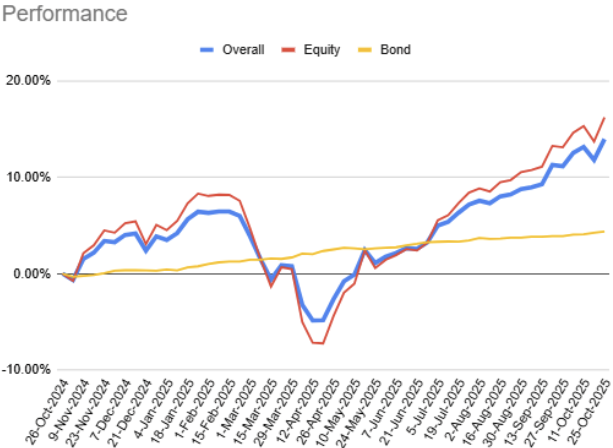
0 -
Oh, I see what you mean. I don't think I'd want to stop there though. I'd want to know how different sectors or styles performed against each other, etc. If you don't go overboard and don't chop and change a lot then you can get a lot of that using online portfolio tools.leosayer said:
I used to do it that way but it meant that I wasn't able to record the relative performance of different funds and asset types eg. equity funds vs bond funds.masonic said:
If you are interested in the overall performance of your portfolio then you don't really need to track the internals at all, just the account inflows and outflows. Known as unitisation, it essentially gives your portfolio a unit price and when you put money in you add units at the current price and vice versa when you draw down. Much the same as an open-ended fund would.leosayer said:
I think I'm being unclear!chiang_mai said:
Sorry if I was unclear. I would never recommend investors create their own funds, that is far beyond my knowledge and capabalities. I refer only to ready made, off the shelf funds, that already have a benchmnark.leosayer said:
I agree that it's easy to compare individual funds.
I'm thinking more of comparing your own portfolio performance against that of a benchmark, particularly if you want to track different slices such as fixed income and equity portions.
To do so requires keeping records of all holdings, transactions and values over time.
I mean comparing the performance of my portfolio of (retail) funds to a certain benchmark.
With each fund performing differently, the relative weights of each fund will change on a daily basis so measuring the overall performance of all combined becomes challenging.
I do it myself on a spreadsheet.0 -
It's time to wrap this up, I think. What I've got out of this thread is that most people appear unaware of the underlying internal details of funds and are happy to buy packages off the shelf, presumably on the basis of their reputation or as the result of product comparisons. This has come as a surprise. If they are aware, they don't appear to pay much attention to the metrics data. This would go some way towards explaining why platforms regularly publish the top 10 most purchased/most profitable funds etc. It also explains the limited availability of accurate fund data on some UK platform sites. Americans may regard things differently, perhaps, Morningstar publishes lots of fund data so there must be a reason and a demand.
It's unfortunate that some see it as a competition between trackers and managed funds, despite having said repeatedly that it isn't that at all and that they are complementary, there is still something of a purist view that prevails in some quarters.
If I've learmed anything about investing this year, the April slump has reinforced the need for investers to manage the degree to which they invest in different markets. This would suggest that a single global fund that spans all markets based on market sizes, is better off being replaced by individual regional funds that can be tilted according to risk tolerance. This year, for the first time, my US holdings are at 25%, UK is at 19%, Europe is at 18%, Dev Asia is at 8% and EM is around 18% (with half of that allocated to China). By using separate funds per region I can easily see which ones are generating good returns and which are laggards, it also means I can derisk slightly by tilting in and out of regions as I see fit....EM has produced my best returns this year and has often moved inversly to other markets.
Thank you for your comments and the discussion.1 -
This is indeed an age old discussion. There's not much new eg. the virtues of "slicing and dicing" have been debated for a long time and it's often sold by Wealth Managers. I can tell you that most Americans have the same level of financial interest and knowledge as the British.chiang_mai said:It's time to wrap this up, I think. What I've got out of this thread is that most people appear unaware of the underlying internal details of funds and are happy to buy packages off the shelf, presumably on the basis of their reputation or as the result of product comparisons. This has come as a surprise. If they are aware, they don't appear to pay much attention to the metrics data. This would go some way towards explaining why platforms regularly publish the top 10 most purchased/most profitable funds etc. It also explains the limited availability of accurate fund data on some UK platform sites. Americans may regard things differently, perhaps, Morningstar publishes lots of fund data so there must be a reason and a demand.
It's unfortunate that some see it as a competition between trackers and managed funds, despite having said repeatedly that it isn't that at all and that they are complementary, there is still something of a purist view that prevails in some quarters.
If I've learmed anything about investing this year, the April slump has reinforced the need for investers to manage the degree to which they invest in different markets. This would suggest that a single global fund that spans all markets based on market sizes, is better off being replaced by individual regional funds that can be tilted according to risk tolerance. This year, for the first time, my US holdings are at 25%, UK is at 19%, Europe is at 18%, Dev Asia is at 8% and EM is around 18% (with half of that allocated to China). By using separate funds per region I can easily see which ones are generating good returns and which are laggards, it also means I can derisk slightly by tilting in and out of regions as I see fit....EM has produced my best returns this year and has often moved inversly to other markets.
Thank you for your comments and the discussion.And so we beat on, boats against the current, borne back ceaselessly into the past.0 -
I think I would mostly fall into the 'aware but don't pay much attention' camp. The issue is many of these measures are easily discredited. Back in the 2000s when I was just starting out, I paid more attention to things like alpha, Sharpe/information ratio, etc, but have learned over the years that they have little value. The one I do still use is CAPE. This is backed by a fair bit of research as weakly correlated with forward 10 year returns, but has only served to lose me money so far as most of the last two decades has been dominated by indiscriminate growth. But despite our different views on the value of metrics, we've reached similar viewpoints on allocating our capital.chiang_mai said:It's time to wrap this up, I think. What I've got out of this thread is that most people appear unaware of the underlying internal details of funds and are happy to buy packages off the shelf, presumably on the basis of their reputation or as the result of product comparisons. This has come as a surprise. If they are aware, they don't appear to pay much attention to the metrics data. This would go some way towards explaining why platforms regularly publish the top 10 most purchased/most profitable funds etc. It also explains the limited availability of accurate fund data on some UK platform sites. Americans may regard things differently, perhaps, Morningstar publishes lots of fund data so there must be a reason and a demand.
It's unfortunate that some see it as a competition between trackers and managed funds, despite having said repeatedly that it isn't that at all and that they are complementary, there is still something of a purist view that prevails in some quarters.
If I've learmed anything about investing this year, the April slump has reinforced the need for investers to manage the degree to which they invest in different markets. This would suggest that a single global fund that spans all markets based on market sizes, is better off being replaced by individual regional funds that can be tilted according to risk tolerance. This year, for the first time, my US holdings are at 25%, UK is at 19%, Europe is at 18%, Dev Asia is at 8% and EM is around 18% (with half of that allocated to China). By using separate funds per region I can easily see which ones are generating good returns and which are laggards, it also means I can derisk slightly by tilting in and out of regions as I see fit....EM has produced my best returns this year and has often moved inversly to other markets.2










This discussion has been closed.
Confirm your email address to Create Threads and Reply

Categories
- All Categories
- 355.8K Banking & Borrowing
- 254.9K Reduce Debt & Boost Income
- 456.2K Spending & Discounts
- 248.3K Work, Benefits & Business
- 606K Mortgages, Homes & Bills
- 179K Life & Family
- 263.8K Travel & Transport
- 1.5M Hobbies & Leisure
- 16.2K Discuss & Feedback
- 37.7K Read-Only Boards