We’d like to remind Forumites to please avoid political debate on the Forum.
This is to keep it a safe and useful space for MoneySaving discussions. Threads that are – or become – political in nature may be removed in line with the Forum’s rules. Thank you for your understanding.
Letter from HM Courts and Tribunals Service, what to do next?
Comments
-
@Coupon-mad
I would be grateful if you could have a look at my defence draft.1. The Particulars of Claim are defective. They fail to specify the alleged contractual breach, omit the property’s address and relevant parking times, and merely refer to “Stack Shack”. This lack of clarity renders the claim embarrassing and non-compliant with CPR 16.4 and Practice Direction 16, which require a statement of all facts necessary to formulate a complete cause of action. The added costs/damages are an attempt at double recovery of capped legal fees (already listed in the claim) and are not monies genuinely owed to, or incurred by, this Claimant. The claim also exceeds the Code of Practice (CoP) £100 parking charge (“PC”) maximum. Exaggerated and incoherent claims for impermissible sums are good reason for the court to intervene. Whilst the Defendant reserves the right to amend the defence if details of the contract are provided, the Court is invited to strike out the claim using its powers under CPR 3.4.2. Separately from the defects in the Particulars of Claim, the allegation(s) and heads of cost are vague and liability is denied for the sum claimed, or at all. At the very least, interest should be disallowed; the delay in bringing proceedings lies with the Claimant. This also makes retrieving material documents/evidence difficult, which is highly prejudicial. The Defendant seeks fixed costs (CPR 27.14) and a finding of unreasonable conduct and further costs (CPR 46.5). The Defendant has little recollection of events, save as set out below and to admit that they were the registered keeper, so questions whether the Notice to Keeper was even POFA compliant.3. In further support of the Defendant’s position that the Particulars of Claim are defective, two recent persuasive appeal judgments in Civil Enforcement Limited v Chan (Ref. E7GM9W44) and Car Park Management Service Ltd v Akande (Ref. K0DP5J30) would indicate the POC fails to comply with Civil Procedure Rule 16.4(1)(e) and Practice Direction Part 16.7.5. On the 15th August 2023, in the Chan case, HHJ Murch held: 'the particulars of the claim as filed and served did not set out the conduct which amounted to the breach in reliance upon which the claimant would be able to bring a claim for breach of contract'. The same is true in this case and the Defendant trusts that the Court should strike out the extant claim, using its powers pursuant to CPR 3.4. The second recent persuasive appeal judgment also held that typical private parking case POC (like this) fail to comply with Part 16. On the 10 May 2024, in CPMS v Akande, HHJ Evans held: 'Particulars of Claim have to set out the basic facts upon which a party relies in order to prove his or her claim'.3.1 In addition to the defective Particulars of Claim, there was a procedural failure in service. The Defendant had moved from their residence near Birmingham in late September 2024, yet the Claimant served the notice to the former address (CPR 6.9(3)). The HM Courts and Tribunals notice, issued 15th August 2025, was only received via the previous landlord. This error prejudices the Defendant and undermines the claim’s reliability.3.2 Further, on the facts, the Defendant made a genuine mistake as to the identity of the premises. On the date in question, the Defendant unknowingly attended what they believed to be Phat Bun, a former occupant of the same premises, returning to a site they had visited in 2021(3 times). Having returned to the area in late 2023, the Defendant did not know the restaurant had closed and been replaced by Stack Shack. The premises—car park and ambience—were substantially identical. Once aware of the actual identity of the business, the Defendant left immediately without availing oneself of the Claimant’s services.3.3 Evidence exists to support this genuine mistake: bank statements showing prior visits to Phat Bun; proof of residence relocation away from Birmingham and return near to Birmingham ; documentation that Stack Shack now occupies the identical address.4. It is neither admitted nor denied that a term was breached but to form a contract, there must be an offer, acceptance, and valuable consideration (absent in this case). The Consumer Rights Act 2015 (s71) mandates a 'test of fairness' duty on Courts and sets a high bar for prominence of terms and 'consumer notices'. Paying regard to Sch2 (examples 6, 10, 14 & 18), also s62 and the duties of fair, open dealing/good faith, the Defendant notes that this Claimant reportedly uses unclear (unfair) terms/notices. On the limited information given, this case looks no different. The Claimant is put to strict proof with contemporaneous photographs.5. DVLA keeper data is only supplied on the basis of prior written landowner authority. The Claimant (an agent) is put to strict proof of their standing to sue and the terms, scope and dates of the landowner agreement, including the contract, updates, schedules and a map of the site boundary set by the landowner (not an unverified Google Maps aerial view).6. To impose a PC, as well as a breach, there must be: (i) a strong 'legitimate interest' extending beyond compensation for loss, and (ii) 'adequate notice' (prominence) of the PC and any relevant obligation(s). None of which have been demonstrated. This PC is a penalty arising as a result of a 'concealed pitfall or trap', poor signs and covert surveillance, thus it is fully distinguished from ParkingEye v Beavis [2015] UKSC67.7. Attention is drawn to (i) paras 98, 100, 193, 198 of Beavis (an £85 PC comfortably covered all letter chain costs and generated a profit shared with the landowner) and also to (ii) the binding judgment in ParkingEye v Somerfield Stores ChD [2011] EWHC 4023(QB) which remains unaffected by Beavis and stands as the only parking case law that deals with costs abuse. HHJ Hegarty held in paras 419-428 (High Court, later ratified by the CoA) that 'admin costs' inflating a £75 PC (already increased from £37.50) to £135 were disproportionate to the minor cost of an automated letter-chain and 'would appear to be penal'.8. The Parking (Code of Practice) Act will curb rogue conduct by operators and their debt recovery agents (DRAs). The Government recently launched a Public Consultation considered likely to bring in a ban on DRA fees, which a 2022 Minister called ‘extorting money from motorists’. They have identified in July 2025: 'profit being made by DRAs is significantly higher than ... by parking operators' and 'the high profits may be indicative of these firms having too much control over the market, thereby indicating that there is a market failure'.9. Pursuant to Sch4 of the Protection of Freedoms Act 2012 ('POFA') the claim exceeds the maximum sum and is unrecoverable: see Explanatory Note 221: 'The creditor may not make a claim against the keeper ... for more than the amount of the unpaid parking related charges as they stood when the notice to the driver was issued (para 4(5))'. Late fees (unknown to drivers, not specified on signs) are not 'unpaid parking related charges'. They are the invention of 'no win no fee' DRAs. Even in the (unlikely) event that the Claimant complied with the POFA and CoP, there is no keeper liability law for DRA fees.0 -
1. The Particulars of Claim are defective. They fail to specify the alleged contractual breach, omit the property’s address and relevant parking times, and merely refer to “Stack Shack”. This lack of clarity renders the claim embarrassing and non-compliant with CPR 16.4 and Practice Direction 16, which require a statement of all facts necessary to formulate a complete cause of action. The added costs/damages are an attempt at double recovery of capped legal fees (already listed in the claim) and are not monies genuinely owed to, or incurred by, this Claimant. The claim also exceeds the Code of Practice (CoP) £100 parking charge (“PC”) maximum. Exaggerated and incoherent claims for impermissible sums are good reason for the court to intervene. Whilst the Defendant reserves the right to amend the defence if details of the contract are provided, the Court is invited to strike out the claim using its powers under CPR 3.4.
2. Separately from the defects in the Particulars of Claim, the allegation(s) and heads of cost are vague and liability is denied for the sum claimed, or at all. At the very least, interest should be disallowed; the delay in bringing proceedings lies with the Claimant. This also makes retrieving material documents/evidence difficult, which is highly prejudicial. The Defendant seeks fixed costs (CPR 27.14) and a finding of unreasonable conduct and further costs (CPR 46.5). The Defendant has little recollection of events, save as set out below and to admit that they were the registered keeper, so questions whether the Notice to Keeper was even POFA compliant.
3. In further support of the Defendant’s position that the Particulars of Claim are defective, two recent persuasive appeal judgments in Civil Enforcement Limited v Chan (Ref. E7GM9W44) and Car Park Management Service Ltd v Akande (Ref. K0DP5J30) would indicate the POC fails to comply with Civil Procedure Rule 16.4(1)(e) and Practice Direction Part 16.7.5. On the 15th August 2023, in the Chan case, HHJ Murch held: 'the particulars of the claim as filed and served did not set out the conduct which amounted to the breach in reliance upon which the claimant would be able to bring a claim for breach of contract'. The same is true in this case and the Defendant trusts that the Court should strike out the extant claim, using its powers pursuant to CPR 3.4. The second recent persuasive appeal judgment also held that typical private parking case POC (like this) fail to comply with Part 16. On the 10 May 2024, in CPMS v Akande, HHJ Evans held: 'Particulars of Claim have to set out the basic facts upon which a party relies in order to prove his or her claim'.
3.1 In addition to the defective Particulars of Claim, there was a procedural failure in service. The Defendant had moved from their residence near Birmingham in late September 2024, yet the Claimant served the notice to the former address (CPR 6.9(3)). The HM Courts and Tribunals notice, issued 15th August 2025, was only received via the previous landlord. This error prejudices the Defendant and undermines the claim’s reliability.
3.2 Further, on the facts, the Defendant made a genuine mistake as to the identity of the premises. On the date in question, the Defendant unknowingly attended what they believed to be Phat Bun, a former occupant of the same premises, returning to a site they had visited in 2021(3 times). Having returned to the area in late 2023, the Defendant did not know the restaurant had closed and been replaced by Stack Shack. The premises—car park and ambience—were substantially identical. Once aware of the actual identity of the business, the Defendant left immediately without availing oneself of the Claimant’s services.
3.3 Evidence exists to support this genuine mistake: bank statements showing prior visits to Phat Bun; proof of residence relocation away from Birmingham and return near to Birmingham ; documentation that Stack Shack now occupies the identical address.
4. It is neither admitted nor denied that a term was breached but to form a contract, there must be an offer, acceptance, and valuable consideration (absent in this case). The Consumer Rights Act 2015 (s71) mandates a 'test of fairness' duty on Courts and sets a high bar for prominence of terms and 'consumer notices'. Paying regard to Sch2 (examples 6, 10, 14 & 18), also s62 and the duties of fair, open dealing/good faith, the Defendant notes that this Claimant reportedly uses unclear (unfair) terms/notices. On the limited information given, this case looks no different. The Claimant is put to strict proof with contemporaneous photographs.
5. DVLA keeper data is only supplied on the basis of prior written landowner authority. The Claimant (an agent) is put to strict proof of their standing to sue and the terms, scope and dates of the landowner agreement, including the contract, updates, schedules and a map of the site boundary set by the landowner (not an unverified Google Maps aerial view).
6. To impose a PC, as well as a breach, there must be: (i) a strong 'legitimate interest' extending beyond compensation for loss, and (ii) 'adequate notice' (prominence) of the PC and any relevant obligation(s). None of which have been demonstrated. This PC is a penalty arising as a result of a 'concealed pitfall or trap', poor signs and covert surveillance, thus it is fully distinguished from ParkingEye v Beavis [2015] UKSC67.
7. Attention is drawn to (i) paras 98, 100, 193, 198 of Beavis (an £85 PC comfortably covered all letter chain costs and generated a profit shared with the landowner) and also to (ii) the binding judgment in ParkingEye v Somerfield Stores ChD [2011] EWHC 4023(QB) which remains unaffected by Beavis and stands as the only parking case law that deals with costs abuse. HHJ Hegarty held in paras 419-428 (High Court, later ratified by the CoA) that 'admin costs' inflating a £75 PC (already increased from £37.50) to £135 were disproportionate to the minor cost of an automated letter-chain and 'would appear to be penal'.
8. The Parking (Code of Practice) Act will curb rogue conduct by operators and their debt recovery agents (DRAs). The Government recently launched a Public Consultation considered likely to bring in a ban on DRA fees, which a 2022 Minister called ‘extorting money from motorists’. They have identified in July 2025: 'profit being made by DRAs is significantly higher than ... by parking operators' and 'the high profits may be indicative of these firms having too much control over the market, thereby indicating that there is a market failure'.
9. Pursuant to Sch4 of the Protection of Freedoms Act 2012 ('POFA') the claim exceeds the maximum sum and is unrecoverable: see Explanatory Note 221: 'The creditor may not make a claim against the keeper ... for more than the amount of the unpaid parking related charges as they stood when the notice to the driver was issued (para 4(5))'. Late fees (unknown to drivers, not specified on signs) are not 'unpaid parking related charges'. They are the invention of 'no win no fee' DRAs. Even in the (unlikely) event that the Claimant complied with the POFA and CoP, there is no keeper liability law for DRA fees.
0 -
@Coupon-mad I would be grateful if you could check this for me.FanaUK712 said:1. The Particulars of Claim are defective. They fail to specify the alleged contractual breach, omit the property’s address and relevant parking times, and merely refer to “Stack Shack”. This lack of clarity renders the claim embarrassing and non-compliant with CPR 16.4 and Practice Direction 16, which require a statement of all facts necessary to formulate a complete cause of action. The added costs/damages are an attempt at double recovery of capped legal fees (already listed in the claim) and are not monies genuinely owed to, or incurred by, this Claimant. The claim also exceeds the Code of Practice (CoP) £100 parking charge (“PC”) maximum. Exaggerated and incoherent claims for impermissible sums are good reason for the court to intervene. Whilst the Defendant reserves the right to amend the defence if details of the contract are provided, the Court is invited to strike out the claim using its powers under CPR 3.4.
2. Separately from the defects in the Particulars of Claim, the allegation(s) and heads of cost are vague and liability is denied for the sum claimed, or at all. At the very least, interest should be disallowed; the delay in bringing proceedings lies with the Claimant. This also makes retrieving material documents/evidence difficult, which is highly prejudicial. The Defendant seeks fixed costs (CPR 27.14) and a finding of unreasonable conduct and further costs (CPR 46.5). The Defendant has little recollection of events, save as set out below and to admit that they were the registered keeper, so questions whether the Notice to Keeper was even POFA compliant.
3. In further support of the Defendant’s position that the Particulars of Claim are defective, two recent persuasive appeal judgments in Civil Enforcement Limited v Chan (Ref. E7GM9W44) and Car Park Management Service Ltd v Akande (Ref. K0DP5J30) would indicate the POC fails to comply with Civil Procedure Rule 16.4(1)(e) and Practice Direction Part 16.7.5. On the 15th August 2023, in the Chan case, HHJ Murch held: 'the particulars of the claim as filed and served did not set out the conduct which amounted to the breach in reliance upon which the claimant would be able to bring a claim for breach of contract'. The same is true in this case and the Defendant trusts that the Court should strike out the extant claim, using its powers pursuant to CPR 3.4. The second recent persuasive appeal judgment also held that typical private parking case POC (like this) fail to comply with Part 16. On the 10 May 2024, in CPMS v Akande, HHJ Evans held: 'Particulars of Claim have to set out the basic facts upon which a party relies in order to prove his or her claim'.
3.1 In addition to the defective Particulars of Claim, there was a procedural failure in service. The Defendant had moved from their residence near Birmingham in late September 2024, yet the Claimant served the notice to the former address (CPR 6.9(3)). The HM Courts and Tribunals notice, issued 15th August 2025, was only received via the previous landlord. This error prejudices the Defendant and undermines the claim’s reliability.
3.2 Further, on the facts, the Defendant made a genuine mistake as to the identity of the premises. On the date in question, the Defendant unknowingly attended what they believed to be Phat Bun, a former occupant of the same premises, returning to a site they had visited in 2021(3 times). Having returned to the area in late 2023, the Defendant did not know the restaurant had closed and been replaced by Stack Shack. The premises—car park and ambience—were substantially identical. Once aware of the actual identity of the business, the Defendant left immediately without availing oneself of the Claimant’s services.
3.3 Evidence exists to support this genuine mistake: bank statements showing prior visits to Phat Bun; proof of residence relocation away from Birmingham and return near to Birmingham ; documentation that Stack Shack now occupies the identical address.
4. It is neither admitted nor denied that a term was breached but to form a contract, there must be an offer, acceptance, and valuable consideration (absent in this case). The Consumer Rights Act 2015 (s71) mandates a 'test of fairness' duty on Courts and sets a high bar for prominence of terms and 'consumer notices'. Paying regard to Sch2 (examples 6, 10, 14 & 18), also s62 and the duties of fair, open dealing/good faith, the Defendant notes that this Claimant reportedly uses unclear (unfair) terms/notices. On the limited information given, this case looks no different. The Claimant is put to strict proof with contemporaneous photographs.
5. DVLA keeper data is only supplied on the basis of prior written landowner authority. The Claimant (an agent) is put to strict proof of their standing to sue and the terms, scope and dates of the landowner agreement, including the contract, updates, schedules and a map of the site boundary set by the landowner (not an unverified Google Maps aerial view).
6. To impose a PC, as well as a breach, there must be: (i) a strong 'legitimate interest' extending beyond compensation for loss, and (ii) 'adequate notice' (prominence) of the PC and any relevant obligation(s). None of which have been demonstrated. This PC is a penalty arising as a result of a 'concealed pitfall or trap', poor signs and covert surveillance, thus it is fully distinguished from ParkingEye v Beavis [2015] UKSC67.
7. Attention is drawn to (i) paras 98, 100, 193, 198 of Beavis (an £85 PC comfortably covered all letter chain costs and generated a profit shared with the landowner) and also to (ii) the binding judgment in ParkingEye v Somerfield Stores ChD [2011] EWHC 4023(QB) which remains unaffected by Beavis and stands as the only parking case law that deals with costs abuse. HHJ Hegarty held in paras 419-428 (High Court, later ratified by the CoA) that 'admin costs' inflating a £75 PC (already increased from £37.50) to £135 were disproportionate to the minor cost of an automated letter-chain and 'would appear to be penal'.
8. The Parking (Code of Practice) Act will curb rogue conduct by operators and their debt recovery agents (DRAs). The Government recently launched a Public Consultation considered likely to bring in a ban on DRA fees, which a 2022 Minister called ‘extorting money from motorists’. They have identified in July 2025: 'profit being made by DRAs is significantly higher than ... by parking operators' and 'the high profits may be indicative of these firms having too much control over the market, thereby indicating that there is a market failure'.
9. Pursuant to Sch4 of the Protection of Freedoms Act 2012 ('POFA') the claim exceeds the maximum sum and is unrecoverable: see Explanatory Note 221: 'The creditor may not make a claim against the keeper ... for more than the amount of the unpaid parking related charges as they stood when the notice to the driver was issued (para 4(5))'. Late fees (unknown to drivers, not specified on signs) are not 'unpaid parking related charges'. They are the invention of 'no win no fee' DRAs. Even in the (unlikely) event that the Claimant complied with the POFA and CoP, there is no keeper liability law for DRA fees.
0 -
point 2 "...so questions whether the Notice to Keeper was even POFA compliant...." This line has been removed, because we don't know about what they have mentioned in earlier notice. We just have this HMCTS letter and POC did not mention land address, what specifically terms breech, only date and no timings/duration and sent on former address.0
-
Coupon-mad said:
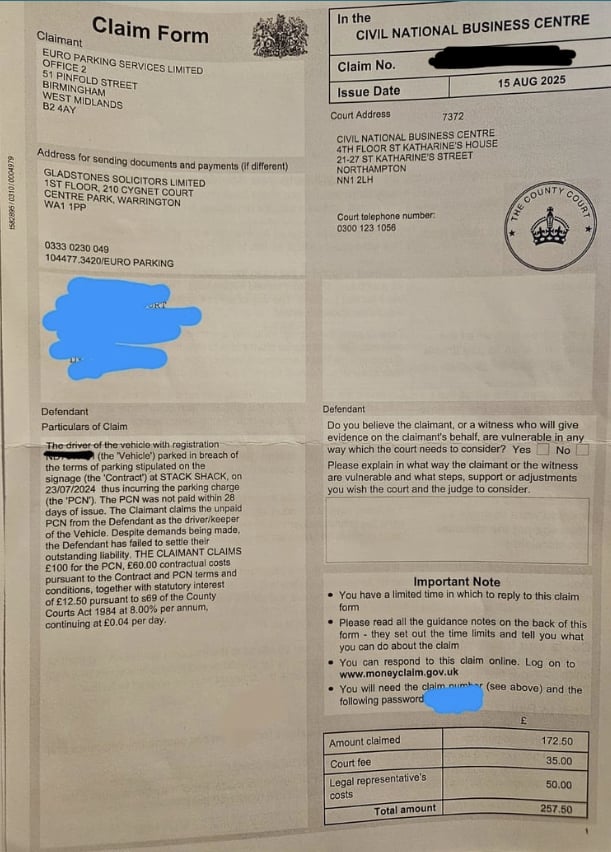 Redacted claim form above.
'Stack Shack' is not a private land location in the UK. No town or postcode has been pleaded, let alone the alleged breach!
Use the Template Defence for Gladstones claims. You know, the one linked twice in the Template Defence thread specially for cases with no breach pleaded.Remove 3.2 and 3.3.
Do not remove the line you said. EPS are never POFA compliant.
How are you going to communicate your new address to the CNBC and Gladstones now?PRIVATE 'PCN'? DON'T PAY BUT DON'T IGNORE IT (except N.Ireland).
CLICK at the top or bottom of any page where it says:
Home»Motoring»Parking Tickets Fines & Parking - read the NEWBIES THREAD1 -
Should I remove whole 3.2 and 3.3?Coupon-mad said:Coupon-mad said:Redacted claim form above.
'Stack Shack' is not a private land location in the UK. No town or postcode has been pleaded, let alone the alleged breach!
Use the Template Defence for Gladstones claims. You know, the one linked twice in the Template Defence thread specially for cases with no breach pleaded.Remove 3.2 and 3.3.
Do not remove the line you said. EPS are never POFA compliant.
How are you going to communicate your new address to the CNBC and Gladstones now?For new address I will show tenenacy agreement.0 -
Yes remove all of 3.2 and 3.3 and put back the line you removed.
You aren't sending anyone your tenancy details. I merely meant that you must email Gladstones and the CNBC to tell them to erase the old address that was on the Claim and to instead use your NEW ADDRESSPRIVATE 'PCN'? DON'T PAY BUT DON'T IGNORE IT (except N.Ireland).
CLICK at the top or bottom of any page where it says:
Home»Motoring»Parking Tickets Fines & Parking - read the NEWBIES THREAD2 -
So wrong address can not used as a flaw in their claim form?Coupon-mad said:Yes remove all of 3.2 and 3.3 and put back the line you removed.
You aren't sending anyone your tenancy details. I merely meant that you must email Gladstones and the CNBC to tell them to erase the old address that was on the Claim and to instead use your NEW ADDRESS
I will remove now 3.2 and 3.3 and add that line you suggested.Rest do you think enough to be submitted?0 -
Yes.
The wrong address MUST BE CORRECTED by you, by email as I said, or you will risk missing later court directions and get a CCJ.PRIVATE 'PCN'? DON'T PAY BUT DON'T IGNORE IT (except N.Ireland).
CLICK at the top or bottom of any page where it says:
Home»Motoring»Parking Tickets Fines & Parking - read the NEWBIES THREAD3 -
@Coupon-mad
Sorry to bother you again. We have emailed to CNBC and Gladstones about updating the address.
Could you just checked it once if this is ok so that I will submit it. I have omitted point 3.3 and 3.4 as you said and put the line back which was previously removed.1. The Particulars of Claim are defective. They fail to specify the alleged contractual breach, omit the property’s address and relevant parking times, and merely refer to “Stack Shack”. This lack of clarity renders the claim embarrassing and non-compliant with CPR 16.4 and Practice Direction 16, which require a statement of all facts necessary to formulate a complete cause of action. The added costs/damages are an attempt at double recovery of capped legal fees (already listed in the claim) and are not monies genuinely owed to, or incurred by, this Claimant. The claim also exceeds the Code of Practice (CoP) £100 parking charge (“PC”) maximum. Exaggerated and incoherent claims for impermissible sums are good reason for the court to intervene. Whilst the Defendant reserves the right to amend the defence if details of the contract are provided, the Court is invited to strike out the claim using its powers under CPR 3.4.
2. Separately from the defects in the Particulars of Claim, the allegation(s) and heads of cost are vague and liability is denied for the sum claimed, or at all. At the very least, interest should be disallowed; the delay in bringing proceedings lies with the Claimant. This also makes retrieving material documents/evidence difficult, which is highly prejudicial. The Defendant seeks fixed costs (CPR 27.14) and a finding of unreasonable conduct and further costs (CPR 46.5). The Defendant has little recollection of events, save as set out below and to admit that they were the registered keeper, so questions whether the Notice to Keeper was even POFA compliant.
3. In further support of the Defendant’s position that the Particulars of Claim are defective, two recent persuasive appeal judgments in Civil Enforcement Limited v Chan (Ref. E7GM9W44) and Car Park Management Service Ltd v Akande (Ref. K0DP5J30) would indicate the POC fails to comply with Civil Procedure Rule 16.4(1)(e) and Practice Direction Part 16.7.5. On the 15th August 2023, in the Chan case, HHJ Murch held: 'the particulars of the claim as filed and served did not set out the conduct which amounted to the breach in reliance upon which the claimant would be able to bring a claim for breach of contract'. The same is true in this case and the Defendant trusts that the Court should strike out the extant claim, using its powers pursuant to CPR 3.4. The second recent persuasive appeal judgment also held that typical private parking case POC (like this) fail to comply with Part 16. On the 10 May 2024, in CPMS v Akande, HHJ Evans held: 'Particulars of Claim have to set out the basic facts upon which a party relies in order to prove his or her claim'.
3.1 In addition to the defective Particulars of Claim, there was a procedural failure in service. The Defendant had moved from their residence near Birmingham in late September 2024, yet the Claimant served the notice to the former address (CPR 6.9(3)). The HM Courts and Tribunals notice, issued 15th August 2025, was only received via the previous landlord. This error prejudices the Defendant and undermines the claim’s reliability.
4. It is neither admitted nor denied that a term was breached but to form a contract, there must be an offer, acceptance, and valuable consideration (absent in this case). The Consumer Rights Act 2015 (s71) mandates a 'test of fairness' duty on Courts and sets a high bar for prominence of terms and 'consumer notices'. Paying regard to Sch2 (examples 6, 10, 14 & 18), also s62 and the duties of fair, open dealing/good faith, the Defendant notes that this Claimant reportedly uses unclear (unfair) terms/notices. On the limited information given, this case looks no different. The Claimant is put to strict proof with contemporaneous photographs.
5. DVLA keeper data is only supplied on the basis of prior written landowner authority. The Claimant (an agent) is put to strict proof of their standing to sue and the terms, scope and dates of the landowner agreement, including the contract, updates, schedules and a map of the site boundary set by the landowner (not an unverified Google Maps aerial view).
6. To impose a PC, as well as a breach, there must be: (i) a strong 'legitimate interest' extending beyond compensation for loss, and (ii) 'adequate notice' (prominence) of the PC and any relevant obligation(s). None of which have been demonstrated. This PC is a penalty arising as a result of a 'concealed pitfall or trap', poor signs and covert surveillance, thus it is fully distinguished from ParkingEye v Beavis [2015] UKSC67.
7. Attention is drawn to (i) paras 98, 100, 193, 198 of Beavis (an £85 PC comfortably covered all letter chain costs and generated a profit shared with the landowner) and also to (ii) the binding judgment in ParkingEye v Somerfield Stores ChD [2011] EWHC 4023(QB) which remains unaffected by Beavis and stands as the only parking case law that deals with costs abuse. HHJ Hegarty held in paras 419-428 (High Court, later ratified by the CoA) that 'admin costs' inflating a £75 PC (already increased from £37.50) to £135 were disproportionate to the minor cost of an automated letter-chain and 'would appear to be penal'.
8. The Parking (Code of Practice) Act will curb rogue conduct by operators and their debt recovery agents (DRAs). The Government recently launched a Public Consultation considered likely to bring in a ban on DRA fees, which a 2022 Minister called ‘extorting money from motorists’. They have identified in July 2025: 'profit being made by DRAs is significantly higher than ... by parking operators' and 'the high profits may be indicative of these firms having too much control over the market, thereby indicating that there is a market failure'.
9. Pursuant to Sch4 of the Protection of Freedoms Act 2012 ('POFA') the claim exceeds the maximum sum and is unrecoverable: see Explanatory Note 221: 'The creditor may not make a claim against the keeper ... for more than the amount of the unpaid parking related charges as they stood when the notice to the driver was issued (para 4(5))'. Late fees (unknown to drivers, not specified on signs) are not 'unpaid parking related charges'. They are the invention of 'no win no fee' DRAs. Even in the (unlikely) event that the Claimant complied with the POFA and CoP, there is no keeper liability law for DRA fees.
0





Confirm your email address to Create Threads and Reply

Categories
- All Categories
- 354.6K Banking & Borrowing
- 254.5K Reduce Debt & Boost Income
- 455.5K Spending & Discounts
- 247.5K Work, Benefits & Business
- 604.3K Mortgages, Homes & Bills
- 178.5K Life & Family
- 261.8K Travel & Transport
- 1.5M Hobbies & Leisure
- 16.1K Discuss & Feedback
- 37.7K Read-Only Boards