We’d like to remind Forumites to please avoid political debate on the Forum.
This is to keep it a safe and useful space for MoneySaving discussions. Threads that are – or become – political in nature may be removed in line with the Forum’s rules. Thank you for your understanding.
Claim for DBL (UKPC) for parking in unmarked bays
Comments
-
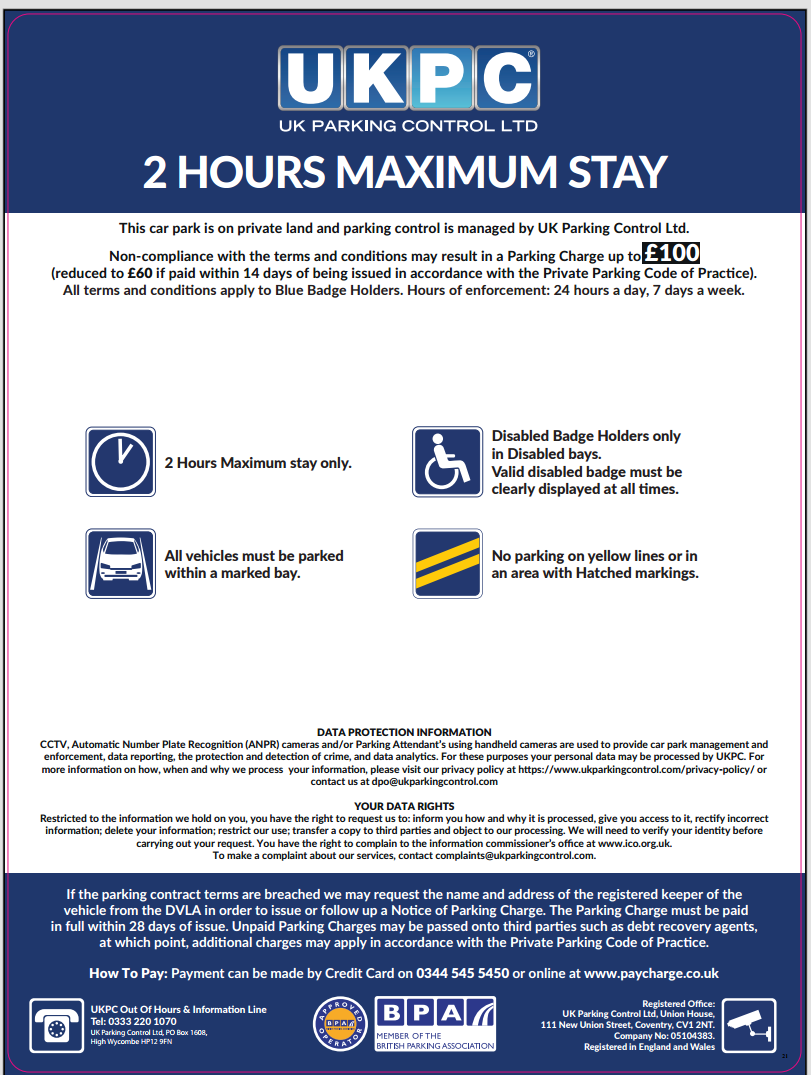
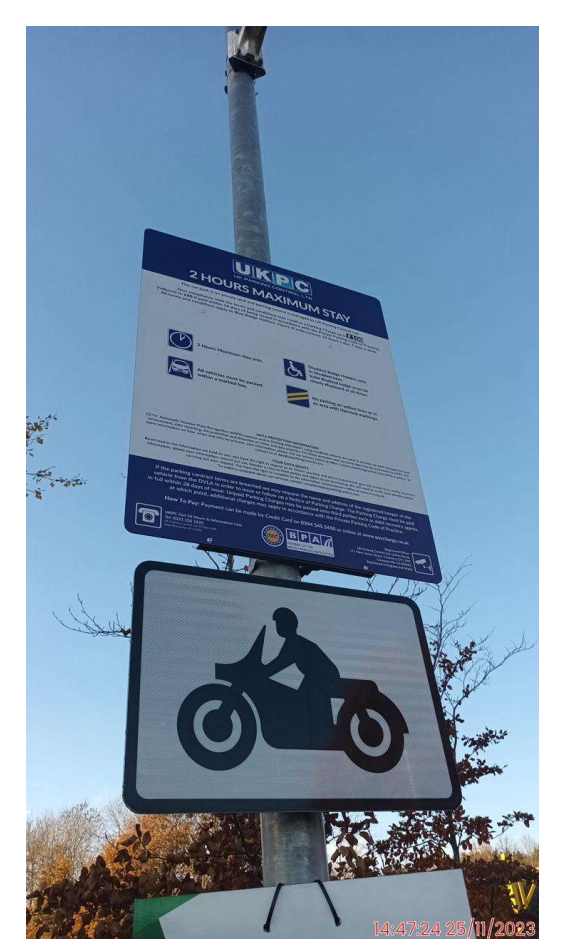
so these are the signs that they attached to their WS, the first one, I'm guessing is not an actual photo of a sign judging by how big it is. the other one is what the signs look like across the car park.
 0
0 -
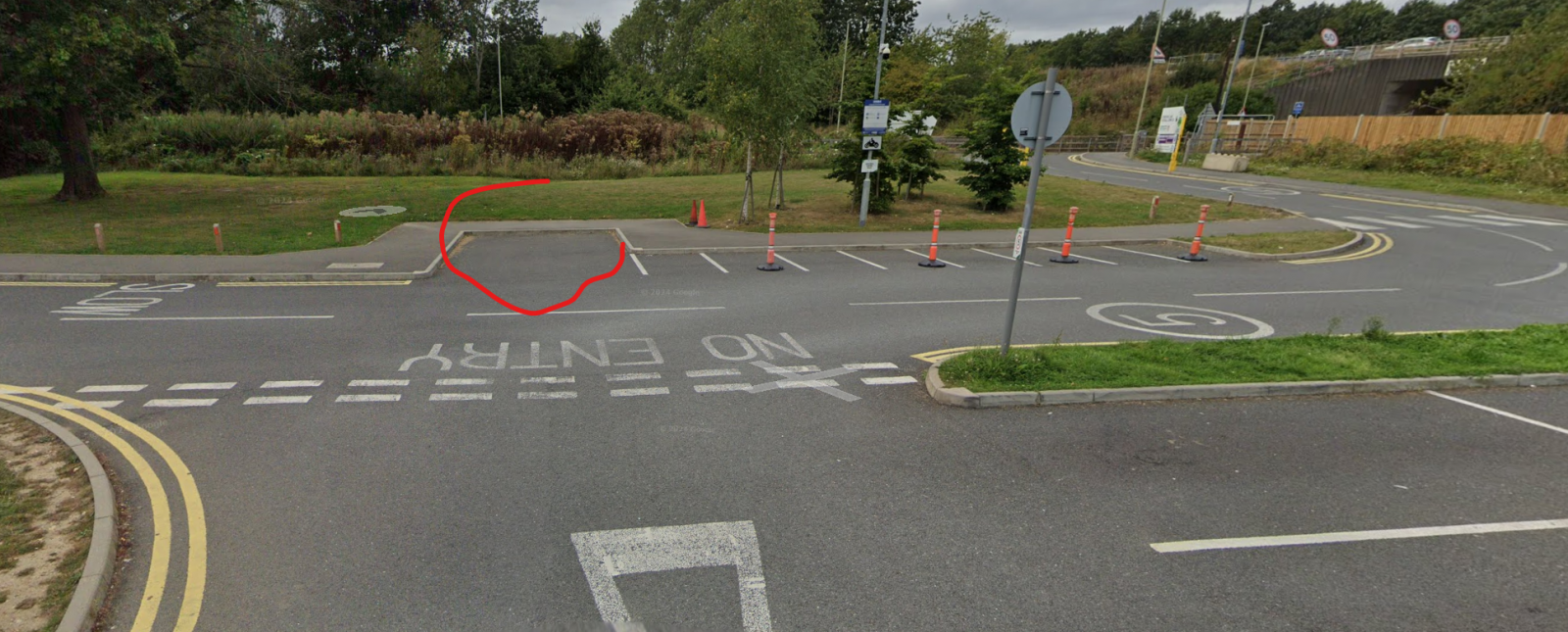
two of the three PCN are related to 'parked in an unmarked bay' having just had a look at google street view this is what the place that my partner was parked at those two occasions. could this be argued that it isn't clear that this is an unmarked bay? there were some rubbish bins there at the time when he was parked
 0
0 -
they are also stating that the defendant did not attend the mediation which is untrue as my partner did attend the court mediation phone call. shall we make a point of this being untrue in our WS? Or are they just referring to the phonecalls/emails that they sent trying to bribe into paying a decreased fee?
"xxiii. In addition, my Company agreed to mediation in an attempt to settle this matter. However, due tothe Defendant’s unwillingness to mediate, the mediation appointment could not be conducted. It istherefore unreasonable for the Defendant to assert that my Company has failed to offer ADR whenthey had the opportunity to participate in mediation but declined to mediate."0 -
Yes include ALL of the above.
The sign is unreadable due to the height, as their picture shows.
And if they wanted to signal what looks like a perfectly acceptable 'double bay' in fact isn't a parking space, it was open to a professional parking operator to get some yellow paint and add a clear message with hashed lines and/or 'no parking' as surface markings.
And/or a sign within it with a crossed out P. There's no sign in that bay at all.PRIVATE 'PCN'? DON'T PAY BUT DON'T IGNORE IT (except N.Ireland).
CLICK at the top or bottom of any page where it says:
Home»Motoring»Parking Tickets Fines & Parking - read the NEWBIES THREAD2 -
I have now completed the WS - adapted from previously posted ones. If someone could please have a look if it makes sense, that would be most appreciated.
IN THE COUNTY COURT AT XXXXX
Claim No. XXXXXX
Date of Hearing: XXXXXXX
Between
UK PARKING CONTROL LIMITED
(Claimant)
– and –
Mr. X
(Defendant)
WITNESS STATEMENT OF DEFENDANT
TABLE OF CONTENTS
WITNESS STATEMENT OF DEFENDANT ..............................................................................2
Exhibit 01: Civil Enforcement Ltd. v Ming Tak Chan Judgment...............................................9
Exhibit 02: Car Park Management Service Ltd. v Charles Akande Judgment.........................13
Exhibit 03: Multiple area court “strike outs”........................................................................17
Exhibit 04: Excerpt from Jopson v Homeguard Judgment (paras 19-21) ...............................34
Exhibit 05: Bay in Question ...............................................................................................36
Exhibit 06: Entrance Signage.............................................................................................37
Exhibit 07: Signage with Terms and Conditions...................................................................38
Exhibit 08: Signage seen in ParkingEye v Beavis..................................................................39
Exhibit 09: Excel v Wilkinson Judgment ..............................................................................40
Exhibit 10: Excerpt from ParkingEye Ltd. v Beavis (paras 98, 193, 198) .................................49
WITNESS STATEMENT OF DEFENDANT
1. I, [NAME], of [Adress], am the Defendant against whom this Claim is made. The facts
below are true to the best of my belief and my account has been prepared based on my
own knowledge.
2. In my Statement I shall refer to Exhibits 01-10 within the evidence supplied with this
Statement, referring to page and reference numbers where appropriate. My Defence is
repeated, and I will say as follows:
Preliminary matter: The Claim should be struck out
3. I draw to the attention of the Judge that there are two very recent and persuasive
Appeal judgements to support dismissing or striking out the Claim. I believe that
dismissing this meritless Claim is the correct course, with the Overriding Objective in
mind. Bulk litigators should know better than to make little or no attempt to comply
with the Practice Direction. By continuing to plead cases with generic, auto-fill,
unspecific wording, private parking firms should not be surprised when courts strike
out their claims using powers pursuant to CPR 3.4., based on the following persuasive
authorities (I append transcripts of both – plus multiple area court ‘strike outs’ of
parking claims that reflect those authorities – in Exhibits 01-03).
4. The first recent persuasive appeal judgment in Civil Enforcement Limited v Chan
(Ref. E7GM9W44) would indicate the Particulars of Claim fails to comply with Civil
Procedure Rule 16.4(1)(e) and Practice Direction Part 16.7.5. On the 15th of August
2023, in the cited case, HHJ Murch held that “the particulars of the claim as filed and
served did not set out the conduct which amounted to the breach in reliance upon
which the Claimant would be able to bring a claim for breach of contract”. (See
Exhibit 01.)
5. The second recent persuasive appeal judgment in Car Park Management Service Ltd.
v Akande (Ref. K0DP5J30) would also indicate the POC fails to comply with Part 16.
On the 10th of May 2024, in the cited case, HHJ Evans held that “Particulars of Claim
have to set out the basic facts upon which a party relies in order to prove his or her
claim”. (See Exhibit 02.)
6. I believe the Claim should be struck out and should not have been accepted by the
CNBC due to a represented parking firm Claimant knowingly breaching basic CPRs.
The specifics of this case lack clarity, as no explicit statement has been provided to
indicate which specific term of the alleged contract was purportedly breached.
Facts and sequence of events
7. Date and time of the Incidents: It is admitted that on 25/11/23, 09/12/23 and 16/12/23 I was the registered keeper of the vehicle XXXXX, and I was driving on these occasions.
8. Parking Notice: The Claimant pursues a claim for vehicle not parked correctly within the markings of the bay or space on two occasions and vehicle parked on yellow lines on one occasion. I do recognise the location of the alleged parking violations as a car park of Stoneham Lane Football Complex. On both occasions when I stopped the vehicle in the alleged unmarked bay, I did so in good faith, believing that the space was legitimate parking area. The bay in question did not have clear or distinguishable markings indicating that it was not a designated parking spot. The absence of clear lines or signs led me to reasonably assume the space was available for parking. The bay in question did not have sufficient markings or visual indicators to indicate that it was unmarked or not compliant (See Exhibit 05), the markings must be easily recognisable and visible to any reasonable person. I submit that the lack of clarity in the markings could have led to confusion, which is why I stopped my vehicle there without any intention to violate parking rules.
9. On the occasion when I stopped my vehicle on the yellow lines, I did so in order to set down and safely escort my child and carry his football kit to the safe place with other adults at the football field. I draw to the attention of the Judge a persuasive Appeal judgment which called into question the definition of “parking”. In Jopson v Homeguard [2016] (Ref. B9GF0A9E), paras 19-21, HHJ Harris points out that “The concept of parking, as opposed to stopping, is that of leaving a car for some duration of time beyond that needed for getting in or out of it, loading or unloading it [...]. Merely to stop a vehicle cannot be to park it; otherwise traffic jams would consist of lines of parked cars”.
10. Parliament agrees. The Claimant has ignored the Parking (Code of Practice) Act 2019 first published in February 2022, due to be finalised after a Judicial Review delay engineered by the parking industry, who did not object to the following clause which remains unchanged:
11. The definition of a “parking period” specifically excludes dropping off/picking up passengers. Clause 2.24 defines a parking period as: "the length of time that a vehicle has been parked, i.e. left stationary otherwise than in the course of driving, after any relevant consideration period has expired (excluding instances where the driver has stopped to enable passengers to leave or enter the vehicle). This is not the period between a vehicle being recorded as entering and departing controlled land."
12. Inadequate signage: I have observed poor signage regarding parking regulations. The signage present at the car park was positioned too high and the text is too small and cannot be easily read from inside a moving vehicle (see Exhibit 06-07) . Signs that set out parking restrictions must be placed in a location that is clearly visible to motorists at a reasonable height and angle. In this instance, the height of the signage made it difficult – if not impossible – to read without exiting the vehicle. This creates an unfair situation where a motorist is expected to comply with rules that they may not have had a reasonable opportunity to read. Similar cases have previously been dismissed where inadequate signage was a key issue, as clear, well-positioned signage is essential for enforceability. This is highly visible, clear and legible signs seen in ParkingEye v Beavis [2015] UKSC67 (“the Beavis case”). (See Exhibit 08)
Exaggerated Claim and “market failure” currently examined by UK
Government
13. The alleged “core debt” from any parking charge cannot have exceeded £100 (the industry cap set out in the IAS Code of Practice). I have seen no evidence that the added damages/fees are genuine.
14. I say that fees were not paid out or incurred by this Claimant, who is put to strict proof of:
i) The alleged breach, and
ii) A breakdown of how they arrived at the enhanced amount claimed.
15. This Claimant routinely pursues a disproportionate additional fixed sum (inexplicably
added per PCN) despite knowing that the will of Parliament is to ban or substantially
reduce the disproportionate “debt fees”. The case is a classic example where the
unjust enrichment of exaggerated feeds encourages the “numbers game” of
inappropriate and out of control bulk litigation of weak or archive parking cases. No
pre-action checks and balances are likely to have been made to ensure facts, merit,
position of signs/the vehicle, or a proper cause of action.
16. The Department for Levelling Up, Housing and Communities (the DLUHC) first
published its statutory Parking Code of Practice on the 7th of February 2022, here:
https://www.gov.uk/government/publications/private-parking-code-of-practice.
“Private firms issue roughly 22,000 parking tickets every day, often adopting a
labyrinthine system of misleading and confusing signage, opaque appeals services,
aggressive debt collection and unreasonable fees designed to extort money from
motorists.”
17. Despite legal challenges delay the Code’s implementation (marking it as temporarily
“withdrawn” as shown in the link above) a draft Impact Assessment (IA) to finalise
the DLUHC Code was recently published on the 30th of July 2023, which has exposed
some industry-gleaned facts about supposed “debt fees”. This is revealed in the
Government’s analysis, found here:
18. Paragraphs 4.31 and 5.19 reveal that the parking industry has informed the DLUHC
that the true minor cost of what the parking industry likes to call debt recovery or
“enforcement” (pre-action) stage totals a mere £8.42 per recovery case.
19. With that sum in mind, the extant claim has been enhanced by an excessive amount,
disingenuously added as an extra “fee”. This is believed to be routinely retained by
the litigating legal team and has been claimed in addition to the intended “legal
representatives fees” cap set within the small claims track rules. This conduct has
been examined and found – including in a notably detailed judgment by Her Honour
Judge Jackson, now a specialist Civil High Court Judge on the Leeds/Bradford circuit
– to constitute “double recovery” and I take that position.
20. The new draft IA now demonstrates that the unnecessarily intimidating stage of pre-
action letter-chains costs “eight times less” (says the DLUHC analysis) than the price-
fixed £70 per PCN routinely added. This has caused consumer harm in the form of
hundreds of thousands of inflated CCJs each year that District Judges have been
powerless to prevent. This abusively enhanced “industry standard” Debt Fee was
enabled only by virtue of the self-serving Codes of Practice of the rival parking Trade
Bodies, influenced by a Board of parking operators and their debt firms who stood to
gain from it.
21. In support of my contention that the sum sought is unconscionably exaggerated and
thus unrecoverable, attention is drawn to paras 98, 100, 193, 198 of Beavis. Also,
ParkingEye Ltd. v Somerfield Stores Ltd. ChD [2011] EWHC4023(QB) where the
parking charge was £75, discounted to £37.50 for prompt payment. Whilst £75 was
reasonable, HHJ Hegarty (decision later ratified by the CoA) held in paras 419-428
that unspecified “admin costs” inflating a parking charge to £135 was not a true
reflection of the cost of a template letter and “would appear to be penal”.
0 -
22. This Claimant has not incurred any additional costs because the full parking charge
(after expiry of discount) is already high and more than covers what the Supreme
Court called an “automated-letter-chain” business model that generates a healthy
profit. In Beavis, there were 4 or 5 letters in total, including pre-action phase
reminders. The £85 parking charge was held to cover the “costs of the operation” and
the DLUHC’s IA suggests it should still be the case that the parking charge itself more
than covers the minor costs of pre-action stage, even if and when the Government
reduces the level of parking charges.
23. Whilst the new Code is not retrospective, the majority of the clauses went
unchallenged by the parking industry, and it stands to become a creature of statute due
to the failure of the self-serving BPA & IPC Codes. The DLUHC’s Secretary of State
mentions they are addressing “market failure” more than once in the draft IA, a phrase
which should be a clear steer for Courts in 2024 to scrutinise every aspect of claims
like this one.
24. In addition, pursuant to Schedule 4 Paragraph 4(5) of the Protection of Freedoms Act
2012 (“the POFA”), the sum claimed exceeds the maximum potentially recoverable. It
is also disproportionate and in breach of the Consumer Rights Act 2015 (the CRA).
CRA breaches25. Claiming costs on an indemnity basis is unfair, per the Unfair Contract TermsGuidance (CMA37, para 5.14.3), the Government guidance on the CRA whichintroduced new requirements for “prominence” of both contract terms and “consumernotices”. In a parking context, this includes a test of fairness and clarity of signage,and all notices, letters and other communications intended to be read by the consumer.26. Section 71 creates a duty upon courts to consider the test of fairness, including (butnot limited to) whether all terms/notices were unambiguously and conspicuouslybrought to the attention of a consumer. Signage must be prominent, plentiful, well-placed (and lit in hours of dusk/darkness) and all terms must be unambiguous and contractual obligations clear.27. The CRA has been breached due to unfair/unclear terms and notices, pursuant to s62and paying due regard to examples 6, 10, 14 & 18 of Schedule 2 and the requirementsfor fair/open dealing and good faith (NB: this does not necessarily mean that there hasto be a finding of bad faith).28. Now for the first time, the DLUHC’s draft IA exposes that the template “debt chaser”stage costs less than £9. This shows that HHJ Jackson was right all along in Excel vWilkinson. (See Exhibit 09)The Beavis case is against this Claim29. The Supreme Court clarified that “the penalty rule is plainly engaged” in parkingcases, which must be determined on their own facts. That “unique” case met acommercial justification test, given the location and clear signs with the charges in thelargest/boldest text. Rather than causing other parking charges to be automaticallyjustified, that case, particularly the brief, conspicuous yellow and black warning signs– (See Exhibit 08) – set a high bar that this Claimant has failed to reach.30. Paraphrasing from the Supreme Court, deterrence is likely to be penal if there is a lackof a “legitimate interest” in performance extending beyond the prospect ofcompensation flowing directly from the alleged breach. The intention cannot be topunish a driver, nor to present them with hidden terms, unexpected/cumbersomeobligations not “concealed pitfalls or traps”. (See Exhibit 10 for paragraphs from theBeavis case.)31. In the present case, the Claimant has fallen foul of these tests. There is one main issuethat renders this parking charge to be purely penal (i.e. no legitimate interest saves it)and thus, it is unenforceable:i) Hidden Terms: The £100 penalty clause is positively buried in small print, asseen on the signs in evidence. The purported added (false) “costs” are evenmore hidden and are also unspecified as a sum. Their (unlawful, due to theCRA Schedule 2 grey list of unfair terms) suggestion is that they can hide avague sentence within a wordy sign, in the smallest possible print, then addwhatever their Trade Body lets them, until the Government bans it. The driverthus has no idea about any risk, nor even how much may be added on top.Court of Appeal authorities which are on all fours with a case involving a lackof “adequate notice” of a charge include:ii) Spurling v Bradshaw [1956] 1 WLR 461 (“red hand rule”) andiii) Thornton v Shoe Lane Parking Ltd. [1970] EWCA Civ2, both leadingauthorities confirming that a clause cannot be incorporated after a contract hasbeen concluded; andiv) Vine v London Borough of Waltham Forest: CA 5 Apr 2000, where Ms Vinewon because it was held that she had not seen the terms by which she wouldlater be bound, due to “the absence of any notice on the wall opposite theparking space”.Alternative Dispute Resolution (“ADR”)32. The Claimant asserts that I was unwilling to mediate and, therefore, it is unreasonable for me to suggest that they failed to offer Alternative Dispute resolution (“ADR”). I refute this claim and provide the following response:i) Contrary to Claimant’s assertion, I attended the mediation session as arranged by the court. I fully engaged in the process in good faith and was willing to explore a fair resolution.ii) During the mediation, the Claimant put forward an offer that I considered unreasonable based on the circumstances of the case, including:a. The lack of adequate signage within the parking area.b. The unclear nature of the allegedly unmarked bay, making it unreasonable to expect a motorist to recognize it as a non-parking space.c. The presence of yellow lines on private land without proper reinforcement through signage, creating ambiguity about enforceability.iii) Mediation is a process that aims to reach fair and reasonable compromise. However, I am under no obligation to accept an offer that is excessive or unjustified, particularly when the parking charges themselves are disputed on legitimate grounds
Conclusion33. In conclusion, the Claimant has failed to provide clear evidence that a contract wasformed, nor has it shown that the parking charge notices were validly issued. The lackof adequate signage and the unlawful nature of the additional charges furtherinvalidate the Claim. The Claimant’s attempt to impose liability for these inflatedcharges is unsupported by both statutory law and leading case precedents. I ask thecourt to dismiss the Claim and award appropriate costs for the time and effortexpended in defending against these unjust claims.34. I ask the Judge to read the persuasive Judgement from His Honour Judge Murch(August 2023) in the Civil Enforcement Ltd. v Chan case, and deliver the sameoutcome given this Claimant has submitted a similarly vague POC. It is worth notingthat in that case the POC, while still ambiguous, did contain a subtle indication of thealleged contravention, specifically regarding the duration of the parking on thepremises. In contrast, the POC in this case lacks even a minimal effort to hint at thenature of the alleged violation. In the Civil Enforcement Ltd. v Chan case, full costswere awarded to the motorist and the claim was struck out.35. There is now ample evidence to support the view – long held by many District Judges– that these are knowingly inflated claims. The July 2023 DLUHC IA analysis surelymakes that clear, because it is now a matter of record that the industry has told theGovernment that “debt recovery” costs eight times less than they have been claimingin almost every case. For HMCTS to only disallow those costs in the tiny percentageof cases that reach hearings whilst other claims continue to flood the courts unabated,is to fail hundreds of thousands of consumers who suffer CCJs or pay inflatedamounts, in fear of the intimidating pre-action demands. I strongly believe that it is inthe public interest that claims like this should be struck out, because knowinglyenhanced parking claims like this one cause consumer harm on a grand scale.36. Attention is drawn specifically to the (often seen from this industry) possibility of anunreasonably late Notice of Discontinuance. Whilst CPR r.38.6 states that theClaimant is liable for the Defendant’s costs after discontinuance (r.38.6(1)) this doesnot normally apply to claims allocated to the small claims track (r.38.6(3)). However,the White Book states (annotation 38.6.1) “Note that the normal rule as to costs doesnot apply if a claimant in a case allocated to the small claims track serves a Notice ofDiscontinuance although it might be contended that costs should be awarded if aparty has behaved unreasonably (r.27.14(2)(dg)).”Costs AssessmentGiven the significant time and effort required to defend against this unjust claim, Irespectfully request that the court consider awarding costs under CPR 27.14(2)(g). I havespent considerable time researching, preparing this Statement, and attending the hearing. Myestimated costs for this are as follows:- Research and preparation of Defence and Witness Statement (8 hours): £80- Travel expenses (return journey to hearing, 32 miles @ 45p/mile): £14.4- Time away from work (7.5 hours @ £23.5/hour): £176.25Totalling £270.65I request that the court considers these costs in its Judgment, given the Claimant’sunreasonable behaviour in pursuing this meritless Claim.Statement of TruthI believe that the facts stated in this Witness Statement are true. I understand that proceedingsfor contempt of court may be brought against anyone who makes, or causes to be made, afalse statement in a document verified by a statement of truth without an honest belief in itstruth.Defendant’s Signature:Date:0 -
"Exhibit 01: Civil Enforcement Ltd. v Ming Tak Chan Judgment...............................................9
Exhibit 02: Car Park Management Service Ltd. v Charles Akande Judgment.........................13
Exhibit 03: Multiple area court “strike outs”........................................................................17"
Don't think you can use the above cases - PoC indicated a reason for the breach (as you confirm in para 8) - were they in the Defence?
I believe the experts will confirm that the latter half of the WS is not necessary - check that any paras that are the same in the Defence can be removed from the WS accordingly.
1 -
That sign is abysmal. You need a telescope to see it.
The text has been strangely reduced so that it doesn't fill the space and it has the effect of making the entirety of the sign small print.
It's a slog to read even on a screen.1 -
A bay is either marked as such or it isn't a bay. You can't have an "unmarked bay"; it's an oxymoron.LunaraEcho86 said:two of the three PCN are related to 'parked in an unmarked bay' having just had a look at google street view this is what the place that my partner was parked at those two occasions. could this be argued that it isn't clear that this is an unmarked bay? there were some rubbish bins there at the time when he was parkedThe onus is on the claimant to make restrictions clear. They have marked "no parking" areas with double yellow lines. There are no double lines in that area - and it is even adjacent to lines. To say you can't park on double yellows and you also can't park in areas without double yellows is ludicrous.
If they didn't put hatchings or lines in that area, there are no restrictions and they can't be surprised when people park in it.
They surely can't take this flimsiest of flimsy claims all the way to a hearing surely?!1 -
Many thanks for looking into this. So based on that I should exclude the exhibits 1-3 and the paragraphs 3-6.1505grandad said:"Exhibit 01: Civil Enforcement Ltd. v Ming Tak Chan Judgment...............................................9Exhibit 02: Car Park Management Service Ltd. v Charles Akande Judgment.........................13
Exhibit 03: Multiple area court “strike outs”........................................................................17"
Don't think you can use the above cases - PoC indicated a reason for the breach (as you confirm in para 8) - were they in the Defence?
I believe the experts will confirm that the latter half of the WS is not necessary - check that any paras that are the same in the Defence can be removed from the WS accordingly.
Sorry but when you say "the latter half of the WS is not necessary" - do you have any specific paragraphs in mind that should be excluded? many thanks in advance0








Confirm your email address to Create Threads and Reply

Categories
- All Categories
- 354.5K Banking & Borrowing
- 254.4K Reduce Debt & Boost Income
- 455.4K Spending & Discounts
- 247.4K Work, Benefits & Business
- 604.2K Mortgages, Homes & Bills
- 178.5K Life & Family
- 261.6K Travel & Transport
- 1.5M Hobbies & Leisure
- 16K Discuss & Feedback
- 37.7K Read-Only Boards