We’d like to remind Forumites to please avoid political debate on the Forum.
This is to keep it a safe and useful space for MoneySaving discussions. Threads that are – or become – political in nature may be removed in line with the Forum’s rules. Thank you for your understanding.
📨 Have you signed up to the Forum's new Email Digest yet? Get a selection of trending threads sent straight to your inbox daily, weekly or monthly!
Switching to a Smart Meter with Economy 7
Comments
-
Depending on supplier, I don't believe the historical regional times are very much adhered to any longer. I had a detailed and lengthy conversation with an E.On emergency field engineer who informed me that all of E.On's E7 five terminal smart meters are now pre-programmed for 00:30 - 07:30 regardless of region. I believe this is also the case with EDF, as per my own EDF smart meter.indebt80 said:Thank you that is helpful. But if Seeboard hours are meant to be the hours for my area - the times that I quote above. How does 7 hour block of economy hours work? Are there other people in my area who have economy 7 meters not on the same times as me? (If you understand what I mean).0 -
They must have done their sums and come to the conclusion that what they might lose on the swings and roundabouts of settlement is outweighed by the cost of supporting a myriad of different tariffs.0
-
For what it's worth: I had a new economy 7 (five wire) smart meter just before I switched to a new supplier in January. Being a very untrusting old sparks I took some readings for a couple of days. I found there were 5 units every day on the max tariff that I could not account for. After a week isolating circuits, checking times and readings it was all due to a miss match in Off peak Load Switching time and Tariff Change time. Load switches at 00.06, tariff switches at 00.30.
Quick maths: 10kW load for half an hour = 5 kWh.
The next three months are painful, total denial of responsibility, denial of possibility of change; once I was even advised to change to another supplier who could match my "odd" time switch. HOWEVER, once the ombudsman was involved all was rectified within 24 hours. Lesson! Check the switching times before you switch supplier, complain (with civility) by telephone ONCE, after that do it all by e-mail, you have a record of what you actually said (not what they understood) and what they told you. It makes better evidence.
Good luck everybody.2 -
EOn Next most recent T&C s say they now only support something they term sonething like non complex metering - which they define as anything other than 1 solid 7 hr block for e7 multirate - their only standard new offering.Swipe said:
Depending on supplier, I don't believe the historical regional times are very much adhered to any longer. I had a detailed and lengthy conversation with an E.On emergency field engineer who informed me that all of E.On's E7 five terminal smart meters are now pre-programmed for 00:30 - 07:30 regardless of region. I believe this is also the case with EDF, as per my own EDF smart meter.indebt80 said:Thank you that is helpful. But if Seeboard hours are meant to be the hours for my area - the times that I quote above. How does 7 hour block of economy hours work? Are there other people in my area who have economy 7 meters not on the same times as me? (If you understand what I mean).1 -
I suspect that E.On engineer didn't know what he was talking about - or phrased what he meant so badly you misunderstood. E.On Next may now only do E7 as a block of 7hrs off-peak as mentioned by @Scot_39 but all supplies will NOT switch at exactly 0030/0730 GMT it will vary dependant of region and also within your own substation group by a few minutes + or -. otherwise DNOs would be moaning like !!!! about the surge as lots of storage heaters came on-line at the same instant. My EDF switch times are 0039/0739 GMT.Swipe said:
Depending on supplier, I don't believe the historical regional times are very much adhered to any longer. I had a detailed and lengthy conversation with an E.On emergency field engineer who informed me that all of E.On's E7 five terminal smart meters are now pre-programmed for 00:30 - 07:30 regardless of region. I believe this is also the case with EDF, as per my own EDF smart meter.indebt80 said:Thank you that is helpful. But if Seeboard hours are meant to be the hours for my area - the times that I quote above. How does 7 hour block of economy hours work? Are there other people in my area who have economy 7 meters not on the same times as me? (If you understand what I mean).
The ALCS times are controlled by a separate register from the R1/R2 switching but the two should be at exactly the same time - obviously not the case initially with @retilec who had 3 months of pain until the ombudsman intervened @retilec who was that supplier who tried to deny responsibility?0 -
My smart meter switches at 0037/0737 GMT. The switch time is determined and made by the smart meter, not the DNO or substation. The engineer didn't mean they are pre-programmed to switch at exactly 0030/0730 on the dot. The ALCS +/- variance is offset at firmware configuration to prevent surges as you say. Smart meter switching block times could well be pre-configured based on DNO region but as I said, I don't believe this is the case any longer. This was an E.On out of hours emergency engineer and not some outsourced smart meter installer. He said that the pre-configured switch times would apply immediately at the point of installation, even before it was commissioned or even registered with E.On Next (something he explained that couldn't be done out of hours and that someone would have to come back again to do this during the daytime).Phones4Chris said:
I suspect that E.On engineer didn't know what he was talking about - or phrased what he meant so badly you misunderstood. E.On Next may now only do E7 as a block of 7hrs off-peak as mentioned by @Scot_39 but all supplies will NOT switch at exactly 0030/0730 GMT it will vary dependant of region and also within your own substation group by a few minutes + or -. otherwise DNOs would be moaning like !!!! about the surge as lots of storage heaters came on-line at the same instant. My EDF switch times are 0039/0739 GMT.Swipe said:
Depending on supplier, I don't believe the historical regional times are very much adhered to any longer. I had a detailed and lengthy conversation with an E.On emergency field engineer who informed me that all of E.On's E7 five terminal smart meters are now pre-programmed for 00:30 - 07:30 regardless of region. I believe this is also the case with EDF, as per my own EDF smart meter.indebt80 said:Thank you that is helpful. But if Seeboard hours are meant to be the hours for my area - the times that I quote above. How does 7 hour block of economy hours work? Are there other people in my area who have economy 7 meters not on the same times as me? (If you understand what I mean).
The ALCS times are controlled by a separate register from the R1/R2 switching but the two should be at exactly the same time - obviously not the case initially with @retilec who had 3 months of pain until the ombudsman intervened @retilec who was that supplier who tried to deny responsibility?
The background was, I had an issue when I switched to E.On next where my tariff and supply profile was erroneously changed to single rate and my meter was only writing to the Rate 1 register 24/7 but the ALCS was still working and switching my storage heater circuits on and off at the normal times. EO.n Next thought a meter swap would fix this even though I explained that it wouldn't but still insisted on an out of hours visit. Once I explained the issue to the engineer when he called to say he was setting off to visit me, he agreed that it was not my meter at fault, but rather the supply profile class was registered as Class 1 incorrectly. After 9 days of not being able to use my storage heaters on off peak rate, I eventually managed to get EO.n Next to update my supply profile back to a Class 2 (E7) and correct my tariff to dual rate.0 -
@Swipe I clearly said - quote "The ALCS times are controlled by a separate register from the R1/R2 switching but the two should be at exactly the same time" I did not say that they weren't determined by the Smart meter - (to be precise "Settings"). However those regional times are determined by the various DNOs who will advise the supplier. I suggest you go and do your research.
Here's just two example lists of the 14 regional differences -
https://selectra.co.uk/energy/guides/tariffs/economy7#economy-7-times and https://switchd.co.uk/energy/guides/economy7/
Even this from E.ON Next Community !
https://community.eonnext.com/threads/4195-What-are-my-Economy-7-Times
There are other sites that say similar things.
Your original post to which I responded, left the impression that all (new) E7 now switched at 0030/0730 GMT irrespective of region. That is most certainly NOT the case.0 -
The topic of switching times comes up every so often, with a variety of results, only some of which are accurate.
There are several factors which ought to settle this once and for all in any individual case. The Wikipedia article on MPANs is a good start. Here's my view of the labyrinth- The MPAN Profile Class (PC). Domestic supplies on two-rate tariffs should be PC 02.
- The MPAN Meter Timeswitch Code (MTC). This will depend on the DNO, the supplier and the tariff applied.
- The Standard Settlement Configuration (SSC). This gives the arrangement for paying ('settlement') between the supplier and the DNO.
It consists of two or three Time Pattern Regime (TPR) codes which specify the actual peak/offpeak timings. Suppliers push the SSC to smart meters to configure the internal Time of Use registers. The MTC dictates which SSCs are available.
- The Auxiliary Load Control Switch (ALCS) is the switch in five-port meters that actually turns offpeak circuits on and off. It has its own calendar, pushed by the supplier. It will normally match the TPRs, but it may not.
- The Randomized Offset is a period of up to 30 minutes that SMETS2 mandates to delay the switching times of the ToU registers and the auxiliary load. It is unique to each meter, set in part by the meter manufacturer and in part by the installing engineer.
- Using my own E7 system as an example:
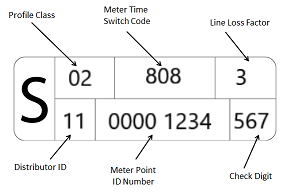
PC 02 > Domestic multi-rate
DNO 11 > East Midlands
MTC 808 > SSC 244 - the only allowable SSC, shared by most DNOs.
SSC 244 > TPRs 40 (Weekdays and weekends 0700-2400) (Day) and 206 (All days 0000-0700) (Night)
The Elexon table relating SSCs to TPRs includes a code specifying whether the times are local or GMT. I'm not sure it's accurate; my own times are definitely GMT, so the switch happens a clock hour later during BST. I've taken the actual timing narrative from engie's handy table, which may not be up-to-date; I haven't yet bothered to download the Elexon source data.
And last pitfall: DCC used not to be able to cope with multi-register readings where the first isn't the peak rate. If the TPRs are applied the wrong way round, chaos ensued (BTDT!). This may no longer be the case.
All that said, it's not certain that every combination that DNOs agree with suppliers is accurately represented in the Elexon tables, so E&OE.
If anyone's interested, I'll come back and expand on where to find the tables I used. Otherwise, I'll just crawl back under my rock 4
4











Confirm your email address to Create Threads and Reply

Categories
- All Categories
- 355.1K Banking & Borrowing
- 254.6K Reduce Debt & Boost Income
- 455.8K Spending & Discounts
- 247.8K Work, Benefits & Business
- 604.9K Mortgages, Homes & Bills
- 178.8K Life & Family
- 262.6K Travel & Transport
- 1.5M Hobbies & Leisure
- 16.1K Discuss & Feedback
- 37.7K Read-Only Boards