We’d like to remind Forumites to please avoid political debate on the Forum.
This is to keep it a safe and useful space for MoneySaving discussions. Threads that are – or become – political in nature may be removed in line with the Forum’s rules. Thank you for your understanding.
Plug in solar
Comments
-
Yes, it does seem that some countries haven't thought it through properly.
But Germany was one of the 'slower' countries to allow plug-n-play solar, and only after a review, and restrictions *dowb to 800W), as mentioned in the article you link:
Germany has rules, the Netherlands lags behind
In Germany, the rules for “Balkonkraftwerke” are already strict. A maximum of 800 watts may be returned and special sockets are required. In the Netherlands, there is no maximum powers, and normal plugs are used. Supersola's advice to connect three solar panels leads to a feed-in of 1,050 watts.
Similarly, the UK has being reviewing this too, and whilst taking Germany's lead, didn't jump in when they did in April 2024, but has consulted and reviewed far longer.
Mart. Cardiff. 8.72 kWp PV systems (2.12 SSW 4.6 ESE & 2.0 WNW). 28kWh battery storage. Two A2A units for cleaner heating. Two BEV's for cleaner driving.
For general PV advice please see the PV FAQ thread on the Green & Ethical Board.0 -
Could someone help me with the maths on solar panels as its something I know nothing about.
If these balcony kits (Such as the Lidl Germany ones) are sold as 800 watts, in practical terms what is the realistic output I could expect flowing back into the house on say a really sunny day mid summer with south facing panels and then on a grey overcast day in winter? I appreciate it's probably hard to be exact, but just some ballpark numbers would help.
I would be interested to work out the payback and how much of our day time load could potentially be supported by one kit.
I am planning to look at cost options for full fat roof mounted solar to add to our Powerwall 3 battery, but perhaps one of these plug in balcony kits might be an easy way to get started.
Also would it be possible to plug more than one kit in to increase capacity, being mindful of the maximum current on any ring main in the house?
Another question, how do these systems align their output phase to that of the mains? Presumably if the solar side is pushing 800 watts back into the ring main and the demand on the ring main is 2000 watts, then the mains and the solar will need to be in phase.1 -
Reminds me, years ago we had an apprentice at the works who was asked to wire in a piece of kit. We were perplexed after we saw he'd put a mains socket in the side. Then he showed us the cable with 13A plugs fitted on each end! I recall he was let go on the spot.
0 -
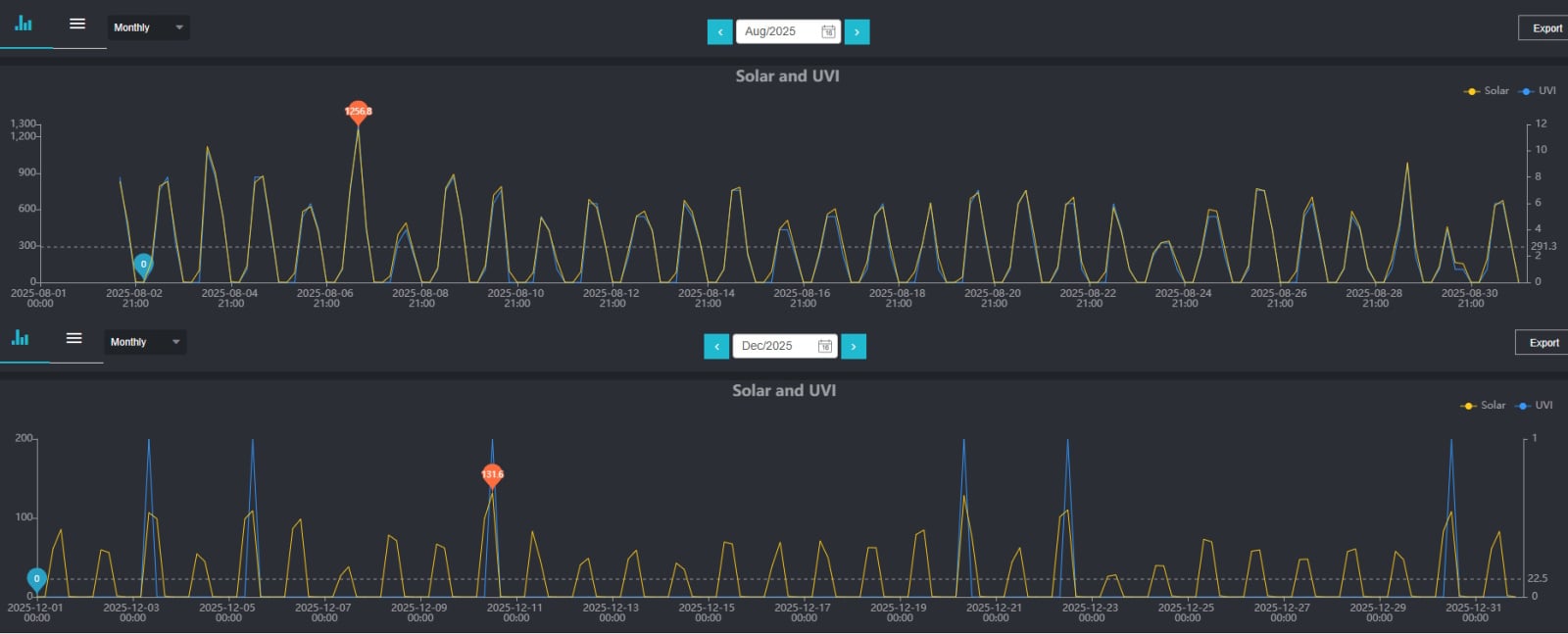
This is the solar irradiance measures I get in Watts per square m in August vs. Dec, there's close to factor of 10 difference from the peak in August compared to the peak in Dec.
Allowing for losses, an 800W plug in solar in summer would deliver a maximum usable 750W, in winter that peak would be more like 100W, so enough for a one light bulb.
 1
1 -
Thanks Vitor.
0 -
100W hopefully 10-15 led bulbs or by todays standard a small led tv.
But as its a cost savjbgs question realky nee to know how many hours a day would it give the 750 / 100 W.
Looking at grid level in past its only been maybe half the c8hrs in depth of winter ?
So do you have equiv kWh daily cf your panel ratings to scale down to 800 W.
0 -
So all these things can do is power the house, up to its max generation (800W?) at the time, and there’s no storage that can power the house when that pesky cloud passes by?
0 -
You can add a storage battery but then your install cost jumps up quite a bit.
My back of envelope calculation is that for where I live in the UK, 800W balcony solar would need to be around £250 all-up and I'd need to be at home during the middle of day to run appliances such as dishwasher etc. for the payback period to make sense at under 5 years. If you're on the south coast, then the numbers are more attractive.
2 -
Hiya. First off, the PVGIS tool is excellent at guestimating the amount of generation you will get pa, and also provides a chart for how it is spread across the year. Happy to run through with you, but rather than panic, just leave 1 (for 1kWp of PV) in the power box, and enter pitch and orientation. The orientation is azimuth (point of interest) which for us in the northern hempisphere will be the south (where the sun is), south is zero, East is -90, and West is +90. Press visualize results, and this will give you figures with a ratio to 1kWp of panels. Or enter the correct amount of PV. But note that if inverter is limited to 800W (unlike say the 2kWp of the Ecoflow batts) then there will be some clipping of generation if panel size exceeds inverter. For 1kWp and 800W inverter, that's probably perfect, as undersizing inverters by ~20% in the UK works well.
I'd suggest playing with pitch, as you'll see how it changes the generation a bit, from summer max, for flat mounted panels (looking up), and winter max* for vertical mounted panels. I have E and W facing roof PV, but a couple of years ago I installed a ground in the garden with 2kWp of south facing panels at a steep 60d, to improve their winter max, at only a very small annual penalty. This set up has a 3:1 ratio of best month (May) to worst (Dec), whereas my shallow pitch WNW facing panels have a 9:1 ratio. All figures are from PVGIS, a tool that the PV'ers on MSE have been using since ~2011.
*Obviously, they won't generate most in winter, but this will max out their winter potential.
But more importantly, you have a PW3 already?
If so, then did you know that they already have 3 connections for PV, with a max potential (I think) of 20kWp.
If you had a plug-n-play system, and it was generating more than the house is consuming, then you should be able to tell the PW3 to grab that excess and store it. But panels into the PW3 would be better due to inverter losses.
PV generates DC, and batteries store DC, so the panels can charge the PW3 battery at minimal loss. But the plug-n-play inverter will convert to AC, then as the excess is grabbed it will be convertered back to DC for the battery, before the DC to AC for use in the house. Bet you wish you'd never asked!
Regarding max plug-n-play, I don't know, but I'd strongly suspect that the 800W limit is for a house, rather than a ring main. But I don't know. We also need to consider the DNO (District Network Operator), who need to be notified of PV installs. I don't know (yet) if they need notification of a plug-n-play system, but if a property had multiple, then you'd be like a 'normal' PV system.
Mart. Cardiff. 8.72 kWp PV systems (2.12 SSW 4.6 ESE & 2.0 WNW). 28kWh battery storage. Two A2A units for cleaner heating. Two BEV's for cleaner driving.
For general PV advice please see the PV FAQ thread on the Green & Ethical Board.0 -
Now difficult to get 450W solar panels for fifty quid, not sure why, but lower battery prices are finally filtering through to the likes of aliexpress (shipping from the UK rather than China so no unknown taxes), whilst inverter prices are up a bit - so a mixed bag for DIY'ers that may feed through to the prices of plug-in solar. Annoying that only the MCS wallahs can get the VAT removed for solar panels etc and will be interesting to see if the government will take the VAT off for balcony solar or whether export will get some dosh (which would mitigate the need for a battery to make full use of the solar pv production - although if it is over-panelled there will still be a lot of potential waste). A decent 500W panel that does well in low light now costs minimum of £80 inc VAT and delivery, throw in some leads and it ain't far off two hundred quid just for the panels.
0











Confirm your email address to Create Threads and Reply

Categories
- All Categories
- 355.7K Banking & Borrowing
- 254.9K Reduce Debt & Boost Income
- 456.1K Spending & Discounts
- 248.3K Work, Benefits & Business
- 605.9K Mortgages, Homes & Bills
- 179K Life & Family
- 263.6K Travel & Transport
- 1.5M Hobbies & Leisure
- 16.2K Discuss & Feedback
- 37.7K Read-Only Boards