We’d like to remind Forumites to please avoid political debate on the Forum.
This is to keep it a safe and useful space for MoneySaving discussions. Threads that are – or become – political in nature may be removed in line with the Forum’s rules. Thank you for your understanding.
Plug in solar
Comments
-
I would imagine there'll be quite a bit of competition and 'special deal' bundles if this gets approved.
0 -
@Scot_39 wrote:
thr ecoflow brand linked above basic kit - 2 standard panels and invertor - was on offer at £350 from £500 in recent past - abd that says taxes included iirc.
Currently £324 after a virtual coupon, from Ecoflow's own eBay store. Including VAT.
The listing says they've already sold 345 of them, although over what period isn't immediately clear.
Or £824 for a system that includes ~2kWh of storage:
N. Hampshire, he/him. Octopus Intelligent Go elec / Fuse gas / Vodafone BB / iD mobile. Kirk Hill Co-op member.Economy 7 cap explainer. Gas vs E7 vs peak elec heating costs, Ecoflow Stream, Best kettle :-)
2.72kWp PV facing SSW installed Jan 2012. 11 x 247w panels, 3.6kw inverter. 37 MWh generated, long-term average 2.6 Os.1 -
We get around 240V most of the time when just drawing base load. When exporting flat out at 6kW It does sometimes nudge just over 250V. I seem to remember reading that it (Solaredge) cuts out at 263V which more or less correspondcorresponds.
The point is that in comparison 800W isn't going to push the voltage up nearly that high.
0 -
Just comig back to this post from a couple of days ago.
The problem you'll have there is that you've got two separate systems.Yes the EcoFlow will generate electricity and feed it onto your outbuilding's mains system,and yes you can charge the DJI power bank from the mains, but you'll have a bit of trouble coordinating them both. You could easily end up charging the DJI fro grid electricity and exporting most of your EcoFlow surplus.
The guy from eFixx in the video from earlier in this thread seems to have most of his kit from DJI, which makes interoperability simpler. Maybe take a look at his videos and see if there are hints on making it all play nicely together?
N. Hampshire, he/him. Octopus Intelligent Go elec / Fuse gas / Vodafone BB / iD mobile. Kirk Hill Co-op member.Economy 7 cap explainer. Gas vs E7 vs peak elec heating costs, Ecoflow Stream, Best kettle :-)
2.72kWp PV facing SSW installed Jan 2012. 11 x 247w panels, 3.6kw inverter. 37 MWh generated, long-term average 2.6 Os.0 -
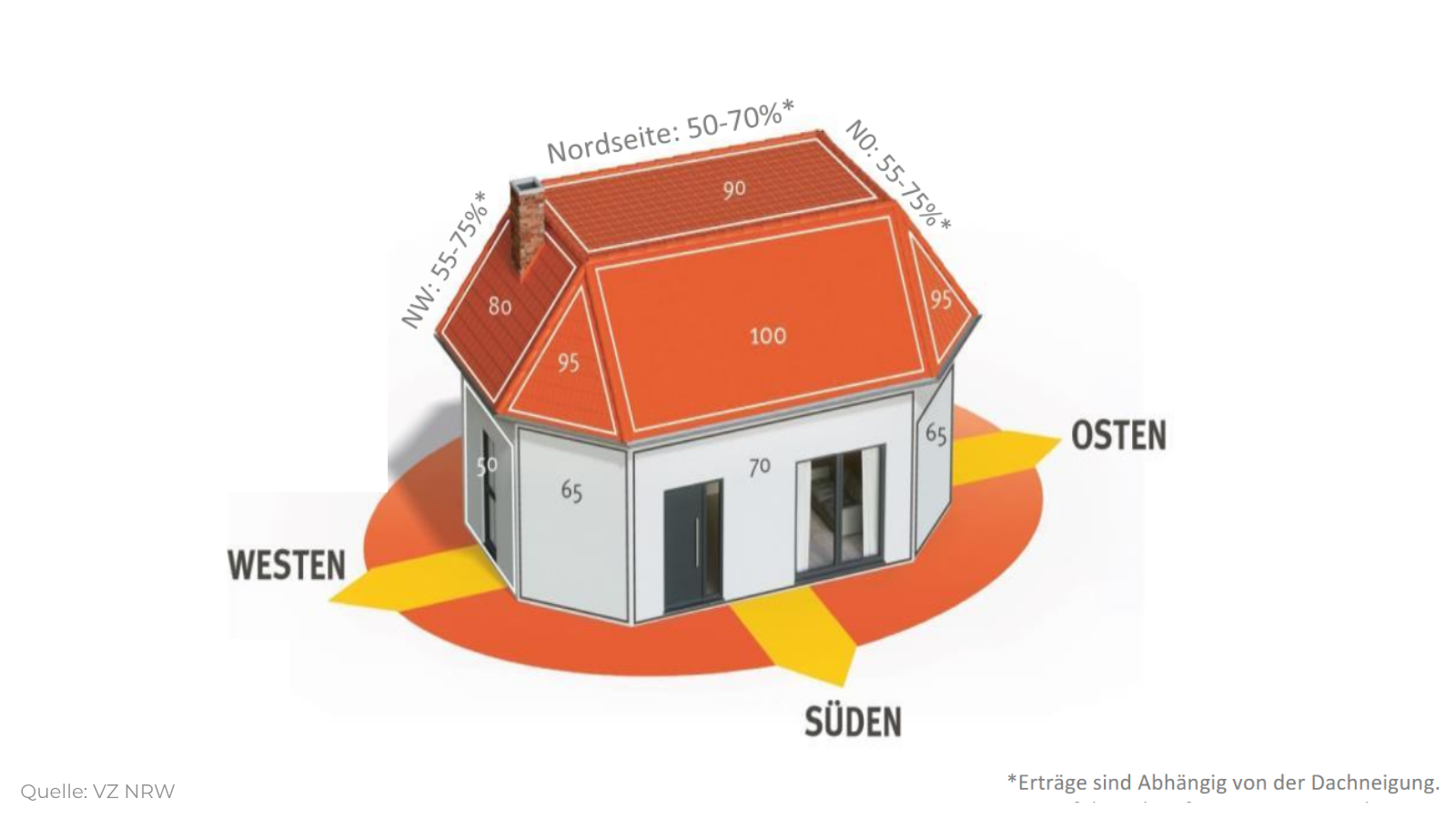
Here's an interesting graphic that popped up on my social media feed today, shared by a German plug-in solar advocate.
It illusrates the relative PV output from different solar panel aspects. While intended for Germany it'll also apply in the UK, as we're on similar latottides.
 N. Hampshire, he/him. Octopus Intelligent Go elec / Fuse gas / Vodafone BB / iD mobile. Kirk Hill Co-op member.Economy 7 cap explainer. Gas vs E7 vs peak elec heating costs, Ecoflow Stream, Best kettle :-)
2.72kWp PV facing SSW installed Jan 2012. 11 x 247w panels, 3.6kw inverter. 37 MWh generated, long-term average 2.6 Os.3 -
50 to 70% on a north facing roof compared to south facing? That seems surprisingly high.
Reed0 -
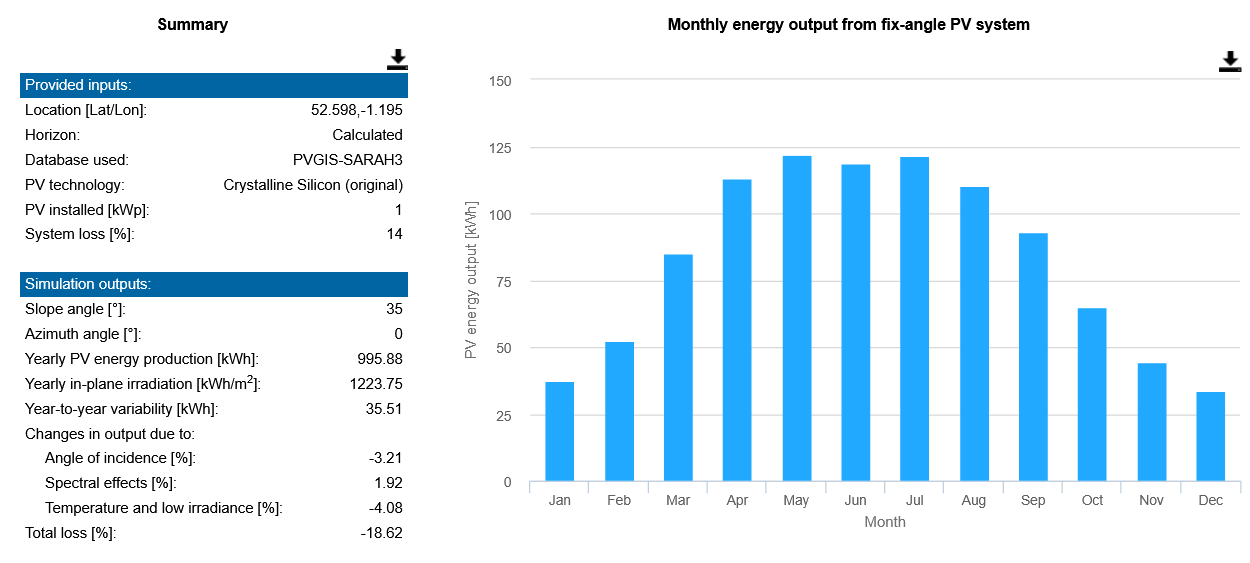
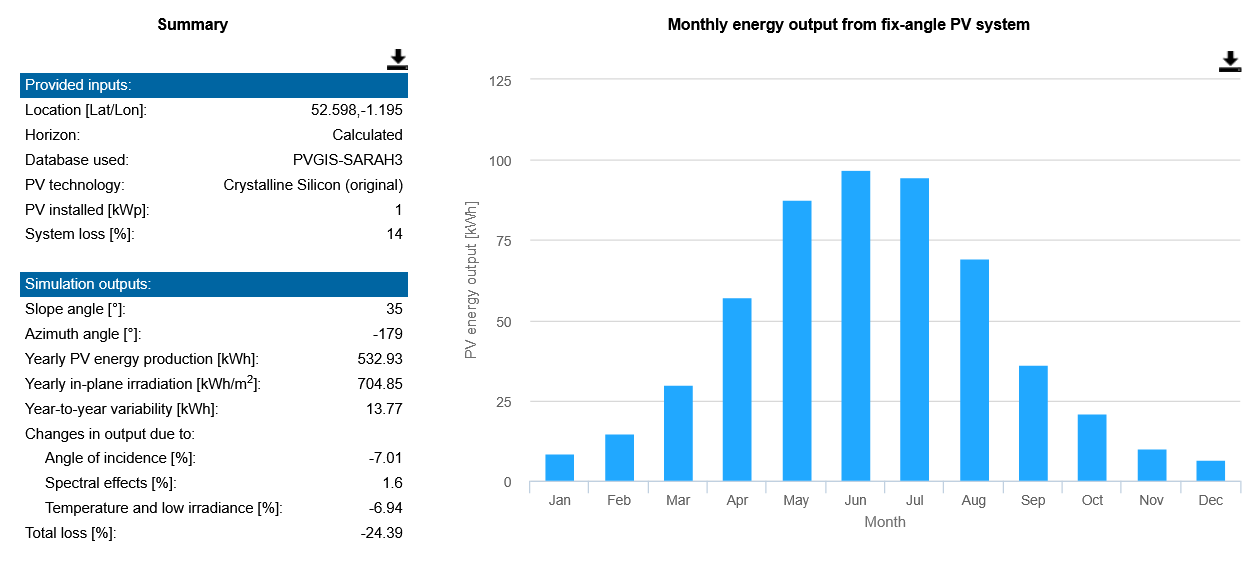
Here's a couple of PVGIS projections for 1kWp installed at the junction of the M1 and M69 near Leicester (I've chosen the Midlands to avoid accusations of favouring the south). The only change is azimuth, 0 (south) to 180 (north).
South-facing, 996 kWh/yr:
North-facing, 533 kWh/r:
 N. Hampshire, he/him. Octopus Intelligent Go elec / Fuse gas / Vodafone BB / iD mobile. Kirk Hill Co-op member.Economy 7 cap explainer. Gas vs E7 vs peak elec heating costs, Ecoflow Stream, Best kettle :-)
2.72kWp PV facing SSW installed Jan 2012. 11 x 247w panels, 3.6kw inverter. 37 MWh generated, long-term average 2.6 Os.1 -
I think the problem with only concentrating on total output is that it ignores proportion of self consumption. Vertical S facing panels in the diagram give 70% of max output but if that means less exported in summer and more consumed in winter the value of the output might be just as great. Similarly E or W facing panels if the output more closely aligns with household demand.
I think....2 -
That demonstrates well just how dire solar output is with a north facing roof in December. When the sun is shining the difference is even more marked in winter. It is only the overcast days that give any hope for a N facing system. I have generation on 3 elevations and on an overcast day, output is broadly proportional to kwp irrespective of elevation. In fact on a cloudy day in middle of winter you can get more generation from a N facing system than on a sunny day because the sunlight is diffused.
As an aside I have never got anywhere near PVGIS predictions in December and don’t trust the winter figures it produces. I’ll dig out the figures later and add them.Northern Lincolnshire. 7.8 kWp system, (4.2 kWwest facing panels , 3.6 kWeast facing), Solis inverters installed 2018, 5kW SSE facing system (shaded in afternoon) added in 2025 with Tesla PW3 battery, Mitsubishi SRK35ZS-S and SRK20ZS-S Wall Mounted A2A Heat Pumps, ex Nissan Leaf owner.1 -
Having read through this thread I must say I'm concerned. Not for those of you who have some electrical nous or are aware of and choose to ignore the risks, but for those consumers who may not know the risks.
Firstly before people jump on this post and try to tear me a new one - I will open with making it clear I am in support of Solar & Battery in all of its forms - including plug in or balcony solar - when installed following the UK regulations
I'm seeing a lot of discussion on this group and the wider social media regarding the use of plug-in or balcony solar and it concerns me that there are those in the UK who've just decided to buy this and plug it in via 3 pin plug, who are not aware of the risks.
I don't mean electrocution as I know the system is designed to cut out if there's no grid power. I mean things like
- Circuit breakers in your consumer unit not designed for current flowing backwards or for DC leakage
- Household insurance being voided as the connection does not comply with British standards
- Potential voltage surges or over voltage issues if many people in a block of flats decide to install
- DNO notification is still required but most plug-in solar users don't do it
- bigger risks of plugging in multiple systems
If you've assessed these and other risks that's good, but I would ask that before you suggest buying kit and plugging in that you consider that others may not be aware of the risk and they may following your lead or recommendation
Anyone wanting to understand more about the current UK position and some background on how it works have a read of this
3














Confirm your email address to Create Threads and Reply

Categories
- All Categories
- 355.7K Banking & Borrowing
- 254.9K Reduce Debt & Boost Income
- 456.1K Spending & Discounts
- 248.3K Work, Benefits & Business
- 605.9K Mortgages, Homes & Bills
- 179K Life & Family
- 263.7K Travel & Transport
- 1.5M Hobbies & Leisure
- 16.2K Discuss & Feedback
- 37.7K Read-Only Boards