We’d like to remind Forumites to please avoid political debate on the Forum.
This is to keep it a safe and useful space for MoneySaving discussions. Threads that are – or become – political in nature may be removed in line with the Forum’s rules. Thank you for your understanding.
Is solar battery storage worth it?
Comments
-
Yes I do have the cash to purchase the system. Sorry to sound obtuse but are you saying that the £1600 a year from solar is better than the £560 from an ISA ?
I’ll question the installer about the payback period tomorrow.
0 -
Sorry to sound obtuse but are you saying that the £1600 a year from solar is better than the £560 from an ISA ?
It's not quite as simple as that but yes, if the solar PV lasts for longer than 13 years you'll be better off than leaving the cash in an ISA.
Based on all the experience on this forum, the panels are almost certain to last for 20+ years. The inverter might not last that long but inverters are cheap (I replaced mine a couple of years ago for £600). The biggest risk is the battery, which might not last a decade, but the battery is only £2k of the system so it's a relatively minor component.
N. Hampshire, he/him. Octopus Intelligent Go elec / Fuse gas / Vodafone BB / iD mobile. Kirk Hill Co-op member.Economy 7 cap explainer. Gas vs E7 vs peak elec heating costs, Ecoflow Stream, Best kettle :-)
2.72kWp PV facing SSW installed Jan 2012. 11 x 247w panels, 3.6kw inverter. 37 MWh generated, long-term average 2.6 Os.1 -
I see, so I guess it’s worth doing then from what I gather. I hear a lot of neigh sayers when it comes to solar systems that are mainly based on the cost of replacing batteries. I’m not sure of the cost of the Fox EP12 but the PW3 is over £6k and I was going to go for one of those initially but have since decided that maybe the Fox will be enough and it’s modular so can add to it easily if need be.
0 -
Good Info from QrizB ( as we would all expect! ). All I would add is that
1. There are other battery makers than Fox who make good batteries such as Fogstar in the UK ( but still chinese cells in them) and they have a very good rep. Modular or not options but 16kWh ( non modular, with heater if in unheated area which is essential then) also about £2k and modular ones too.
2. The comparison to keeping your money in an ISA has always been done. In fact Which? many years ago suggested that is the best option, mainly because with solar you end up with an asset ( and a cost of repair risk) but with an ISA you still have your cash ( which you might need for other things) but inflation risk. Used for investment ISA changes things again as over a long period hrowth and income is possible. Things have changed a bit owing to higher fuel cost but the principle still applies.
Many of us have opted for solar/batteries over cash/investment...or even both. Being 'green' is attractive too as also then is Time of Use tariffs/SEG export which is a game changer with batteries. If you can get on a TOU tariff and export a bigger battery can be great.
1 -
thanks for all the input. I got another quote from another company today who quoted for a 9.8 kW system based on our usage and aspect of the which is spun me a little bit because this other company thinks that the north facing aspect is not really suitable for panels and suggested using 14 panels of 485 W along with hanchu inverter and 10KW battery for £9995 with a 7-8 year break even.
- Panels: 14 X Aiko 485W panels, inc. bird protection - we are always happy to add more panels if the roof measurements post survey allow for them
- Inverter: Hanchu 7kW Hybrid Inverter
- Battery Storage: Hanchu 9.4kWh Battery Storage Heated (95% usable capacity)
- Cost inc. Scaffolding: £9,450.55
- Est. Payback Period: 7 to 8 years
Now I’m debating whether to go with the 31 panel or 14 panel.
Both have the same or similar payback time but the 31 panel will supply 138% of our needs allowing for export income
What does one do ?
0 -
Your original installer projected 7600kWh/yr for the 31-panel 14.88kWp system. That's a pretty low specific output, only 510 kWh/kWp per year. A south-facing array in Liverpool should make closer to 950 kWh/kWp per year.
I suspect the north-facing panels aren't making a huge contribution to the output.
What is the projected annual output for the second quote? Also, you say it's a 9.8kW system but 14 x 485 watt panels is only 6.8kWp, was that a typo?
N. Hampshire, he/him. Octopus Intelligent Go elec / Fuse gas / Vodafone BB / iD mobile. Kirk Hill Co-op member.Economy 7 cap explainer. Gas vs E7 vs peak elec heating costs, Ecoflow Stream, Best kettle :-)
2.72kWp PV facing SSW installed Jan 2012. 11 x 247w panels, 3.6kw inverter. 37 MWh generated, long-term average 2.6 Os.2 -
Hi and thanks for the reply, the second one is 5176kwh/yr
My mistake -
Solar PV System Size: - 6.79kWBattery Storage Size: - 9.4kWh
Total price for installation: - £9,450.55
could the lower output than expected for location be due to a 0.876 shading factor ?Actually I just read the 31 panel proposal again and the annual projection was 8253kWh/yr image attached.
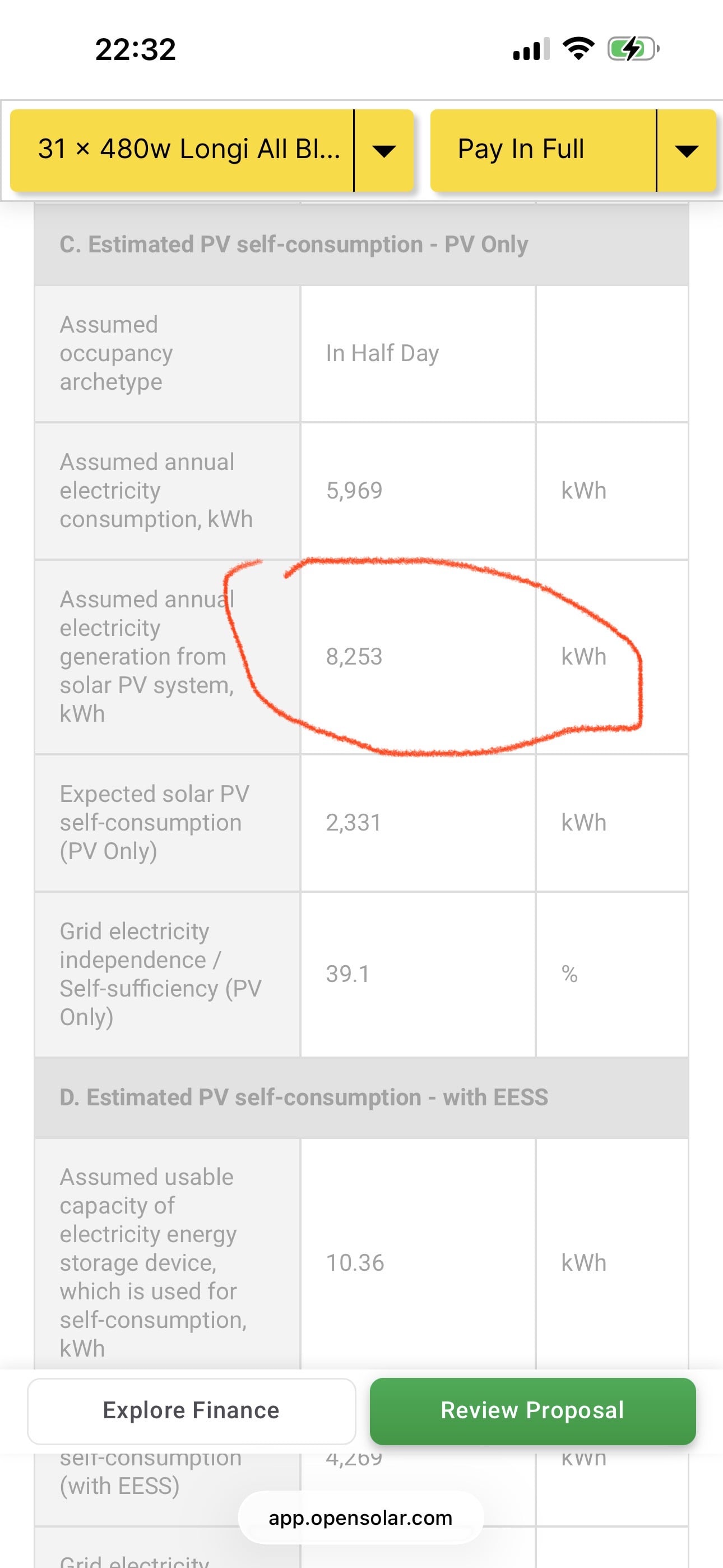
incidentally I did run through a 19 panel 9.12kW system based on longi 480 w panels and this gave 99% off grid and gave a 5925kWH/yr for the price of £13 834 including a PW3 battery1 -
Something that I have always wondered about - if you draw more current from your array of panels than it is rated at - is the switch to the grid instant or is there a blip ?
Sensitive electronic equipment doesn't appreciate a break in supply and I just wondered how smooth the supply transfer was
If I was half as smart as I think I am - I'd be twice as smart as I REALLY am.0 -
if you draw more current from your array of panels than it is rated at - is the switch to the grid instant or is there a blip ?
There is no switch and there is no blip.
Sensitive electronic equipment doesn't appreciate a break in supply and I just wondered how smooth the supply transfer was
There is no break and there is no transfer.
Your solar inverter and the incoming mains supply are both live at the same time. The inverter follows the grid waveform. The only thing that happens when you draw more current than the panels can supply is that the direction of current flow in your mains connection reverses, and you begin to draw from the mains rather than feeding it.
N. Hampshire, he/him. Octopus Intelligent Go elec / Fuse gas / Vodafone BB / iD mobile. Kirk Hill Co-op member.Economy 7 cap explainer. Gas vs E7 vs peak elec heating costs, Ecoflow Stream, Best kettle :-)
2.72kWp PV facing SSW installed Jan 2012. 11 x 247w panels, 3.6kw inverter. 37 MWh generated, long-term average 2.6 Os.3 -
@QrizB and others, just a thought - is solar and batteries still worth it if you don’t have access to an EV tariff so you can charge at 7p during the winter ? We don’t have an EV and can only access regular solar tariffs or possibly economy 7
thanks
0











Confirm your email address to Create Threads and Reply

Categories
- All Categories
- 355.7K Banking & Borrowing
- 254.9K Reduce Debt & Boost Income
- 456.1K Spending & Discounts
- 248.3K Work, Benefits & Business
- 605.9K Mortgages, Homes & Bills
- 179K Life & Family
- 263.7K Travel & Transport
- 1.5M Hobbies & Leisure
- 16.2K Discuss & Feedback
- 37.7K Read-Only Boards