We’d like to remind Forumites to please avoid political debate on the Forum.
This is to keep it a safe and useful space for MoneySaving discussions. Threads that are – or become – political in nature may be removed in line with the Forum’s rules. Thank you for your understanding.
Is solar battery storage worth it?
Comments
-
Back to the very first comment in the forum, could someone please clarify why the article STILL says solar batteries SHOULD be placed inside the home when the latest regs (from before this article was published) say they SHOULD NOT? (apologies if already covered - it's a very long forum and I haven't read every comment)0
-
Timbo46 said:Back to the very first comment in the forum, could someone please clarify why the article STILL says solar batteries SHOULD be placed inside the home when the latest regs (from before this article was published) say they SHOULD NOT?That sounds like a question for @MSE_Clare although I'd note that lots of people still have batteries fitted indoors.Are you sure you're reading regs (regulations) rather than guidance?If you're referring to PAS63100:2024, it's not a regulation and there's no requirement to follow it. Also it only recommends outdoor batteries, and includes guidance for indoor installation.See eg:
N. Hampshire, he/him. Octopus Intelligent Go elec / Fuse gas / Vodafone BB / iD mobile. Kirk Hill Co-op member.Economy 7 cap explainer. Gas vs E7 vs peak elec heating costs, Ecoflow Stream, Best kettle :-)
2.72kWp PV facing SSW installed Jan 2012. 11 x 247w panels, 3.6kw inverter. 37 MWh generated, long-term average 2.6 Os.0 -
Is it wired into your existing solar inverter, or on a separate inverter just for the battery?QrizB said:I built the Fogstar kit earlier this year. My "build diary" is a post on this forum somewhere Edit: here!0
 -
I have a standalone ac-coupled Sofar ME3000SP. A bit old school (no app to speak of, all settings done via the front panel) but works for me.Qyburn said:
Is it wired into your existing solar inverter, or on a separate inverter just for the battery?QrizB said:I built the Fogstar kit earlier this year. My "build diary" is a post on this forum somewhereEdit: here!N. Hampshire, he/him. Octopus Intelligent Go elec / Fuse gas / Vodafone BB / iD mobile. Kirk Hill Co-op member.Economy 7 cap explainer. Gas vs E7 vs peak elec heating costs, Ecoflow Stream, Best kettle :-)
2.72kWp PV facing SSW installed Jan 2012. 11 x 247w panels, 3.6kw inverter. 37 MWh generated, long-term average 2.6 Os.0 -
well time to jump on the bandwagon.
we just moved in to a large 3 storey Edwardian semi and I would like to offset the cost of heating the house using a valiant 35kw ecotec pro by installing solar and batteries.
Obviously we want the system to also take care of our electric too.
Our front roof faces SW and rear faces NE
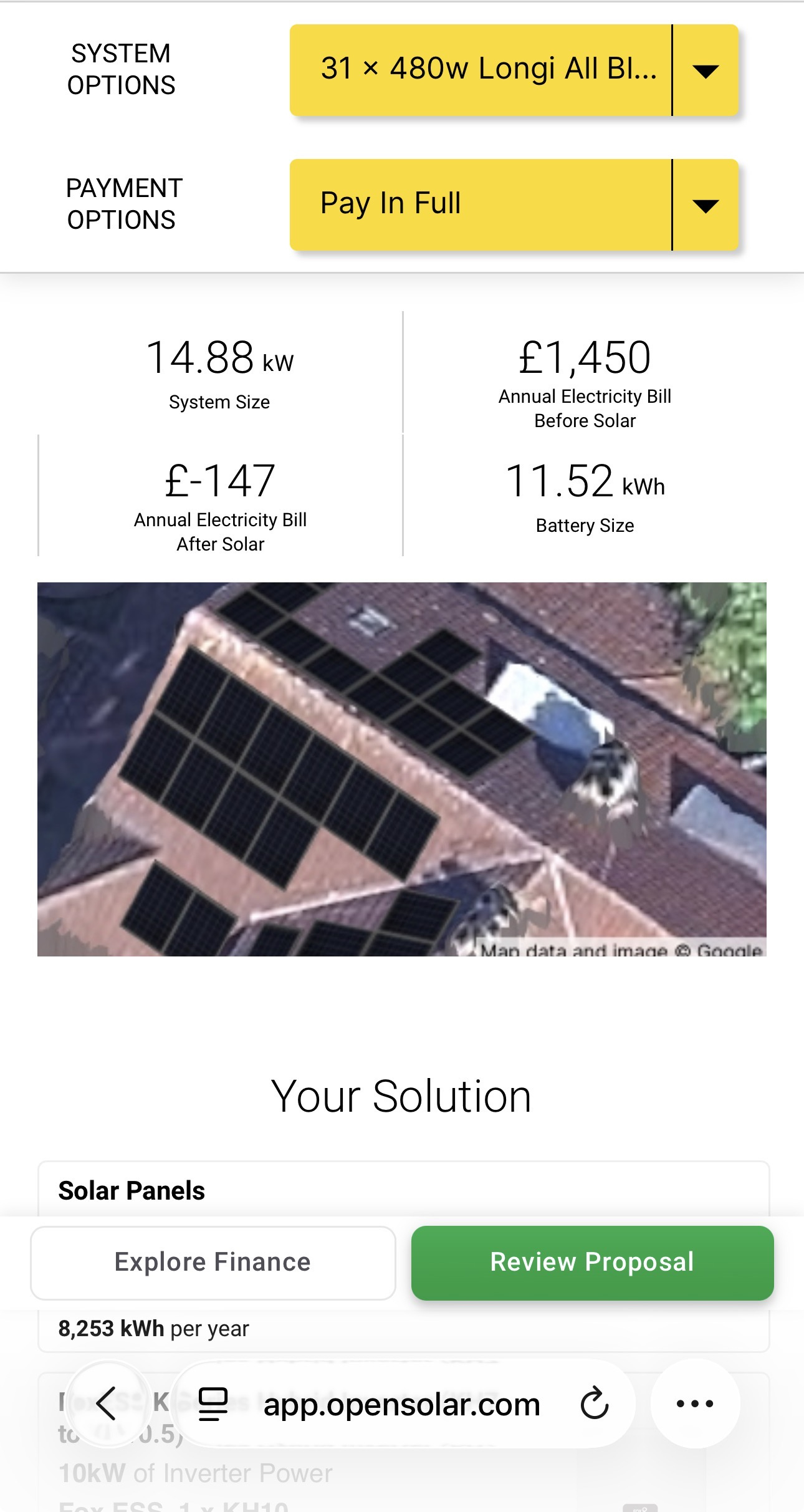
I have had a quote for 31 panels and a 10KW battery and inverter 14 panels on the rear and 17 on the front making a 14.88 kw array.
We expect to use 6000kw a year, we don’t have an EV or heat pump and don’t have plans to get either.
Panels are longi 480w
Battery is Fox EP12 with 10KW inverter (DNO dependant)
Total cost £14,400 including scaffold and all.
Before pulling the trigger I’d like to have a sanity check as to whether it will be worth the cost vs ROI?
we had saw that moving into such a big House is going to see a dramatic increase in the cost of Heating and electric. We are a family of four and just have the usual electrical installation dishwasher fridge and freezer lights of course washing machine and dryer, the usual culprits.
obviously we would consider going onto a time of use tariff we are with EON now who offer 13p export with 24p import.
The quotation suggested that our net bill would be zero and we would make a saving of around £1500 a year if it’s accurate.
Thanks in advance
0 -
Total cost £14,400 including scaffold and all.
This might might be better as a separate thread. I'll ask if it can be split off.
The price is in the right ballpark. Longi panels are from the budget end of the market and Fox is ~mid-market.
You haven't said which part of the country you're in (Brighton is better for solar than Ullapool is) but, unless your house is heavily shaded eg. by trees or neighbours, a net zero electricity bill should be possible. You could even make a profit.
I'm sure others will also have thoughts; for example, at that price point you could probably stretch to a Tesla Powerwall which (by all accounts) is somewhat more versatile than a Fox ESS system.
N. Hampshire, he/him. Octopus Intelligent Go elec / Fuse gas / Vodafone BB / iD mobile. Kirk Hill Co-op member.Economy 7 cap explainer. Gas vs E7 vs peak elec heating costs, Ecoflow Stream, Best kettle :-)
2.72kWp PV facing SSW installed Jan 2012. 11 x 247w panels, 3.6kw inverter. 37 MWh generated, long-term average 2.6 Os.2 -
thank you, I am based in Liverpool and have minimal shading.
the panels are LR7-54HVB-480and the installer said it’s 30 year guarantee on and hardware
is the battery size correct for such a system?
0 -
is the battery size correct for such a system?
It all depends why you've chosen to have a battery. Three common scenarios are:
1. If you want to be self-powered, considering your 6000kWh/yr consumption I'd expect 10kWh will see you through the night without any importing any grid electricity for perhaps 8 months of the year. The other four months (Nov to Feb) you probably won't generate enough solar power in a day to avoid importing electricity overnight.
Adding more battery won't change this appreciably; if there's not enough sunshine, there's no power to store regardless of the size of your battery.
2. If you want to buy cheap off-peak electricity from the grid at night and then sell it along with your solar PV during the daytime, a bigger battery might be worth having. However, check the economics carefully; it might not be worthwhile. A Fox EP12 is about £2k; if you can cycle 10kWh a day through one and make 5p/kWh profit on the arbitrage, that's 50p/day and it'll take 4000 days (11 years) to pay for itself.
3. If you want to be grid-independent in the event of power cuts or blackouts, make sure your solar installer realises this and has quoted for the necessary gubbins (most solar inverters will just cut out if the grid goes dark, even if they have batteries attached, unless there's extra hardware and some wiring mods). You'll need to calculate how much of your 6000kWh/yr (16kWh/day) is really necessary and how many days of independence you want. Then assume the power cut is during a December dunkelflaute when you're not going to generate more than a handful of kWh a day from your 14kWp of panels, and size your battery to suit.
N. Hampshire, he/him. Octopus Intelligent Go elec / Fuse gas / Vodafone BB / iD mobile. Kirk Hill Co-op member.Economy 7 cap explainer. Gas vs E7 vs peak elec heating costs, Ecoflow Stream, Best kettle :-)
2.72kWp PV facing SSW installed Jan 2012. 11 x 247w panels, 3.6kw inverter. 37 MWh generated, long-term average 2.6 Os.2 -
Thank you very much for explaining.
I primarily want to reduce my electricity bill to as close to zero as possible and use what I would have been paying toward gas heating of the massive house during the colder months.
The way the installer explains it I’d be exporting at 13p (eon SEG) and that during the summer months I’d be building credit so to speak that will bring winter bills inline with zero overall.
If I have enough surplus to export and profit then great but primary objective is to reduce the bill to zero or as close to it as possible.
According to the quote the payback time is 7 yrs 7 months.
I just want to know if it’s worth doing or not tbh. £14k is a chunk of money but if it’s going to do what it says on the tin and reduce the bill to near zero then it seems worthwhile.1 -
If it’s going to do what it says on the tin and reduce the bill to near zero then it seems worthwhile.
I've not seen your installer's calculation but yes, I'd expect it to reduce your bill to zero.
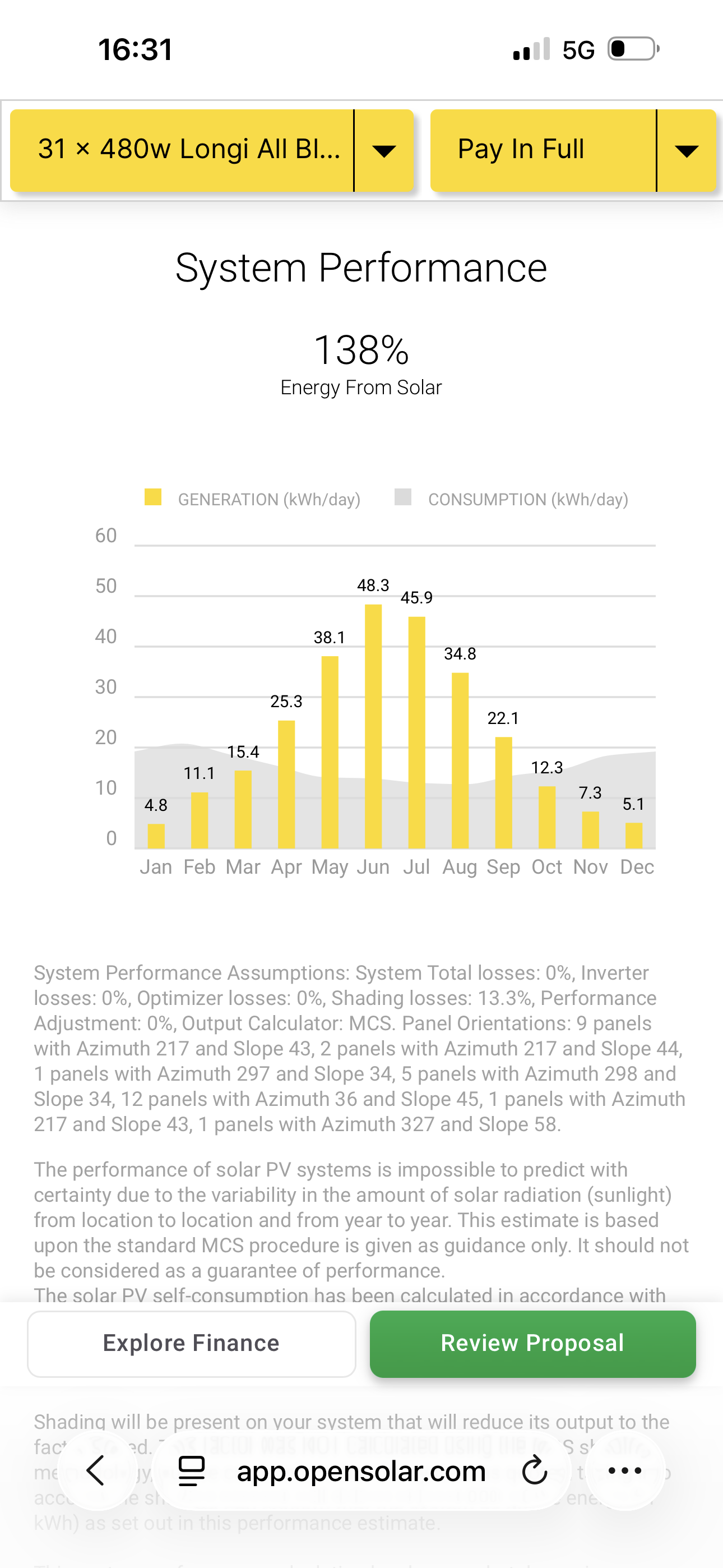
On your installer's numbers, you'll be generating 7560kWh/yr. That's pretty low for a 14kWp system but I think that's due to your complicated roof layout (only 13 of your 31 panels face south-ish, the others all face north-ish). Your neighbour to the east would get a better output from an equivalent system.
If we assume that 5000 of those can substitute for purchased energy at 24p/kWh, and that the other 2560 are sold for 13p/kWh, that's £1533 a year in Benefits from the system. That's pretty close to your installer's calculation.
On your installer's numbers, you're saving £1450 in electricity and making £147 profit. That's ~£1600 a year, which with a £14k system is almost nine years to pay back.
If your installer is saying 7 years 7 months there's something else going on in the background. Maybe they're assuming energy inflation, or something? I don't like doing that as no-one knows what future energy prices will be; they might go up or they might fall.
That's usually the biggest risk in any payback forecast; future energy costs are unknown (anyone who could predict them would be living on a private island by now, sipping cocktails by their pool).
Do you have the £14k in cash now? What would you be doing with it if you didn't buy solar? Would it be sitting in an ISA earning 4% (so you'd be giving up £560 a year, which pushes your payback time out to 13 years)?
N. Hampshire, he/him. Octopus Intelligent Go elec / Fuse gas / Vodafone BB / iD mobile. Kirk Hill Co-op member.Economy 7 cap explainer. Gas vs E7 vs peak elec heating costs, Ecoflow Stream, Best kettle :-)
2.72kWp PV facing SSW installed Jan 2012. 11 x 247w panels, 3.6kw inverter. 37 MWh generated, long-term average 2.6 Os.3










Confirm your email address to Create Threads and Reply

Categories
- All Categories
- 355.7K Banking & Borrowing
- 254.9K Reduce Debt & Boost Income
- 456.1K Spending & Discounts
- 248.3K Work, Benefits & Business
- 605.9K Mortgages, Homes & Bills
- 179K Life & Family
- 263.7K Travel & Transport
- 1.5M Hobbies & Leisure
- 16.2K Discuss & Feedback
- 37.7K Read-Only Boards