We’d like to remind Forumites to please avoid political debate on the Forum.
This is to keep it a safe and useful space for MoneySaving discussions. Threads that are – or become – political in nature may be removed in line with the Forum’s rules. Thank you for your understanding.
Tax credit overpayment help
Comments
-
@alwayslookintosave to me it suggests you’ve a previous overpayment.
The green is the amount already recovered from you. With the yellow being what’s left of the overpayment prior to 2023.
Under the yellow is the over payment from this year 2023-2024
It’s been a few years since I looked at TC however your award for 2023-24 was £2519.59, from this they deducted £875.39. So leaving payment of £1667.20 youve recieved. They have at the point of claiming UC calculated they should have paid you £879.70. Hence the overpayment for 23-24 is £1639.89 (£2519.59 - £879.70).As there’s still overpayment due from prior to 2023 this is also added to the total. Do you still have you end of year 2023 documents, was the overpayment on this?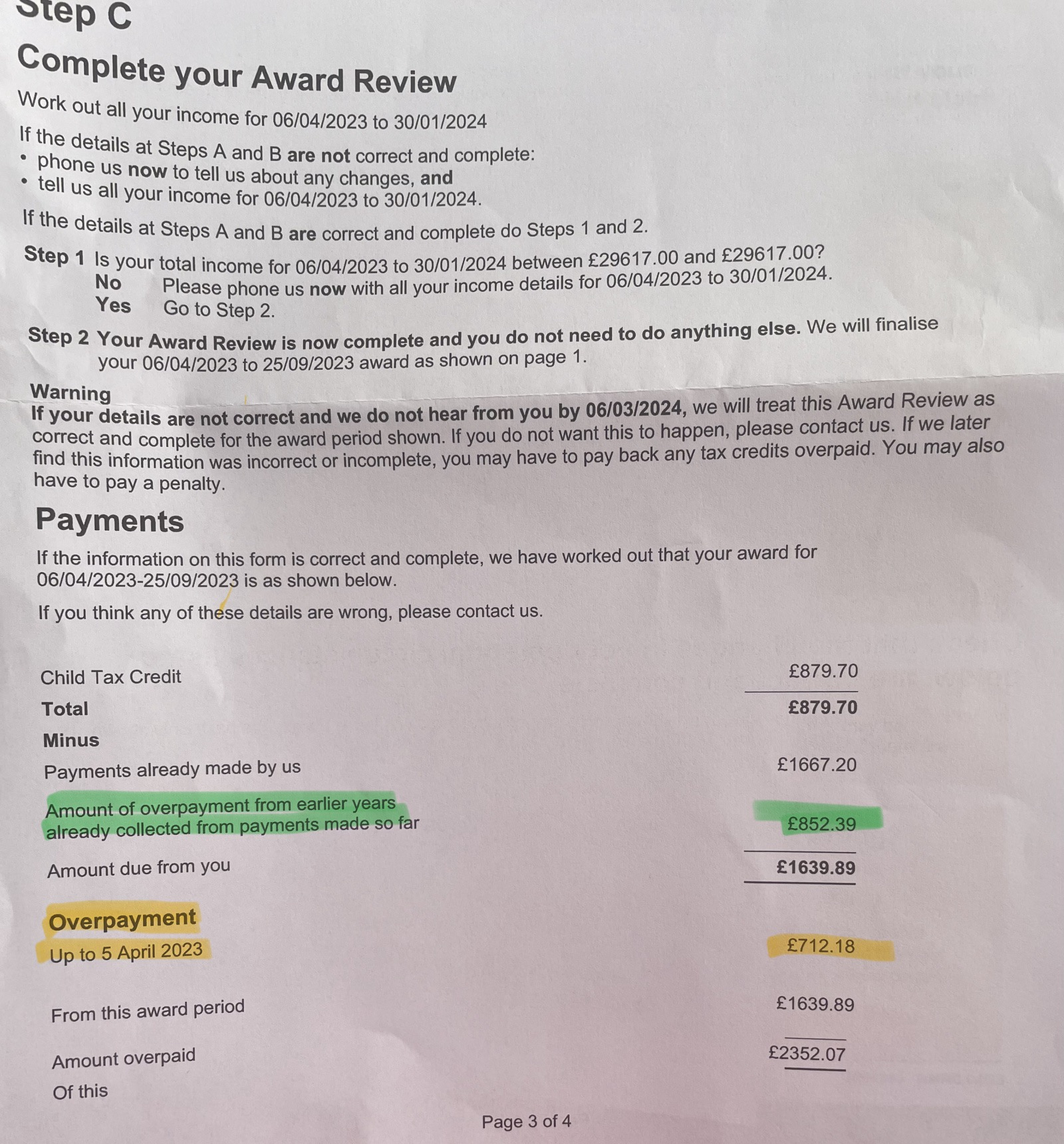 Proud to have dealt with our debtsStarting debt 2005 £65.7K.
Current debt ZERO.DEBT FREE0 -
I'm not following what you mean by the highlighted.peteuk said:
Does the highlighted not suggest that at the point of claiming UC, they calculate you TC (Hence using Apr-Feb Income) over the first sentence that states its recalculated at the end of the financial year, so had the OP not claimed UC it would have still been recalculated in April.Icequeen1 said:
This is not correct. The process for working out income and finalising a tax credit claim when moving to UC uses a different process to the usual end of year process which is what you are describing.peteuk said:Tax credits is always recalculated at the end of the financial year, you payments from April 23 - Sept 23 was the amount for the whole year divided by 13 (paid ever 4 weeks).
I assume you stopped as you moved in with someone but then became single in Feb 24 at which point you couldnt register for a new TC claim and so had to go through UC.
At this point they would have recalculated your TC and with the new amount taken away what they have paid you and so hence the overpayment. This will then be claimed back through your UC claim, although it might be worth speaking to them to see if you can get the repayment amount reduced (but paid over a longer period)I haven’t suggested how, just the why.
The OP's tax credits ended on 25/9/23. At that point, HMRC don't know she is going to make a UC claim, so she will be on the system for normal end of year finalisation.
However, the OP then did make a UC claim in Feb 24 (I assume the 1st?). As the UC claim was made in the same tax year that tax credits ended, it triggered HMRC to start in-year finalisation. Under in-year finalisation, HMRC need to find out what the part year income is from 6/04/23 to 25/09/23. That is what they should have asked OP for or used in their estimate. It looks like they have used the period between 6 April and the day before the UC claim. That is incorrect.
The legislation is here: https://www.legislation.gov.uk/uksi/2014/1230/schedule Point 12 says: “part tax year” means a period of less than a year beginning with 6th April and ending with the date on which the award of a tax credit terminated;”.
It is a separate question as to whether this error actually caused the whole overpayment - which is what Yamor is trying to explore.0 -
I’ve been on the phone to them today, on hold for nearly an hour then after talking to them for 25 mins the phone went dead 🤦♀️. The £712.18 was a previous overpayment that I had paid back. The £852.39 she couldn’t explain. It should be £1667.20 minus the £879.70 what I was entitled too and the difference should be the over payment, she said to wait until I get the letter requesting the overpayment which seems mad and said that they don’t get it wrong so I’m none the wiser, have looked at the previous year award and the £712.18 was documented but I’ve paid that. I will wait and leave it until the payment request letter is sent. Thankyou so much everyone for the help!! Very much appreciated. I hate the thought of owing money to anyone
0 -
Your point about the tax credit ending on 25 Sep is incorrect, The claim is still for the whole year, just that the payment has stopped. As I have pointed out despite stopping the TC in September due to a change in circumstance because the way TC works it would have been automatically recalculated in April.Icequeen1 said:
I'm not following what you mean by the highlighted.peteuk said:
Does the highlighted not suggest that at the point of claiming UC, they calculate you TC (Hence using Apr-Feb Income) over the first sentence that states its recalculated at the end of the financial year, so had the OP not claimed UC it would have still been recalculated in April.Icequeen1 said:
This is not correct. The process for working out income and finalising a tax credit claim when moving to UC uses a different process to the usual end of year process which is what you are describing.peteuk said:Tax credits is always recalculated at the end of the financial year, you payments from April 23 - Sept 23 was the amount for the whole year divided by 13 (paid ever 4 weeks).
I assume you stopped as you moved in with someone but then became single in Feb 24 at which point you couldnt register for a new TC claim and so had to go through UC.
At this point they would have recalculated your TC and with the new amount taken away what they have paid you and so hence the overpayment. This will then be claimed back through your UC claim, although it might be worth speaking to them to see if you can get the repayment amount reduced (but paid over a longer period)I haven’t suggested how, just the why.
The OP's tax credits ended on 25/9/23. At that point, HMRC don't know she is going to make a UC claim, so she will be on the system for normal end of year finalisation.
However, the OP then did make a UC claim in Feb 24 (I assume the 1st?). As the UC claim was made in the same tax year that tax credits ended, it triggered HMRC to start in-year finalisation. Under in-year finalisation, HMRC need to find out what the part year income is from 6/04/23 to 25/09/23. That is what they should have asked OP for or used in their estimate. It looks like they have used the period between 6 April and the day before the UC claim. That is incorrect.
The legislation is here: https://www.legislation.gov.uk/uksi/2014/1230/schedule Point 12 says: “part tax year” means a period of less than a year beginning with 6th April and ending with the date on which the award of a tax credit terminated;”.
It is a separate question as to whether this error actually caused the whole overpayment - which is what Yamor is trying to explore.
“When a claim ends mid-year, payments will cease (subject to the four-week run-on) but the claimant will still go through the ‘renewals’ process. This will usually take place following the end of the tax year.” - revenue benefits.org.uk
So had tho OP not made a UC claim it would have been reviewed in April. Because they did make a UC claim in Feb
“ Where a tax credit claim ends and UC is claimed in the same tax year, the normal renewals/finalisation process will not apply and the claimant will instead follow an in-year finalisation process. This means that after they claim UC, DWP will notify HMRC to start the in-year finalisation process. The claimant will receive a notice asking them to confirm their income from April to the date the tax credit claim ended and that will be finalised.” revenue benefits.org.uk
However it seems they have taken the OP wage from April - Feb which no one else has said is incorrect, so the TC period is not April to Sep (when the claim stopped) had there been no claim to UC it would be April- April, however because of the UC claim the TC claim period is April - Feb.Proud to have dealt with our debtsStarting debt 2005 £65.7K.
Current debt ZERO.DEBT FREE0 -
What you have quoted is exactly what I have said. The claim did end mid-year. This is under s.16 tax credits act. The claim is terminated. The claim is not for the whole year. The award period is shortened. Income would have been collected for the whole year in April. But the award period/claim period is not the full year. The Rev Ben text says 'when a claim ends mid-year'. They would have taken the OP's annual income and pro-rated it equally for the award period.peteuk said:
Your point about the tax credit ending on 25 Sep is incorrect, The claim is still for the whole year, just that the payment has stopped. As I have pointed out despite stopping the TC in September due to a change in circumstance because the way TC works it would have been automatically recalculated in April.Icequeen1 said:
I'm not following what you mean by the highlighted.peteuk said:
Does the highlighted not suggest that at the point of claiming UC, they calculate you TC (Hence using Apr-Feb Income) over the first sentence that states its recalculated at the end of the financial year, so had the OP not claimed UC it would have still been recalculated in April.Icequeen1 said:
This is not correct. The process for working out income and finalising a tax credit claim when moving to UC uses a different process to the usual end of year process which is what you are describing.peteuk said:Tax credits is always recalculated at the end of the financial year, you payments from April 23 - Sept 23 was the amount for the whole year divided by 13 (paid ever 4 weeks).
I assume you stopped as you moved in with someone but then became single in Feb 24 at which point you couldnt register for a new TC claim and so had to go through UC.
At this point they would have recalculated your TC and with the new amount taken away what they have paid you and so hence the overpayment. This will then be claimed back through your UC claim, although it might be worth speaking to them to see if you can get the repayment amount reduced (but paid over a longer period)I haven’t suggested how, just the why.
The OP's tax credits ended on 25/9/23. At that point, HMRC don't know she is going to make a UC claim, so she will be on the system for normal end of year finalisation.
However, the OP then did make a UC claim in Feb 24 (I assume the 1st?). As the UC claim was made in the same tax year that tax credits ended, it triggered HMRC to start in-year finalisation. Under in-year finalisation, HMRC need to find out what the part year income is from 6/04/23 to 25/09/23. That is what they should have asked OP for or used in their estimate. It looks like they have used the period between 6 April and the day before the UC claim. That is incorrect.
The legislation is here: https://www.legislation.gov.uk/uksi/2014/1230/schedule Point 12 says: “part tax year” means a period of less than a year beginning with 6th April and ending with the date on which the award of a tax credit terminated;”.
It is a separate question as to whether this error actually caused the whole overpayment - which is what Yamor is trying to explore.
“When a claim ends mid-year, payments will cease (subject to the four-week run-on) but the claimant will still go through the ‘renewals’ process. This will usually take place following the end of the tax year.” - revenue benefits.org.uk
So had tho OP not made a UC claim it would have been reviewed in April. Because they did make a UC claim in Feb
“ Where a tax credit claim ends and UC is claimed in the same tax year, the normal renewals/finalisation process will not apply and the claimant will instead follow an in-year finalisation process. This means that after they claim UC, DWP will notify HMRC to start the in-year finalisation process. The claimant will receive a notice asking them to confirm their income from April to the date the tax credit claim ended and that will be finalised.” revenue benefits.org.uk
However it seems they have taken the OP wage from April - Feb which no one else has said is incorrect, so the TC period is not April to Sep (when the claim stopped) had there been no claim to UC it would be April- April, however because of the UC claim the TC claim period is April - Feb.
But that didn't happen and she did make a UC claim. The Rev Ben site is talking about someone making a UC claim that ends their TC claim. So not exactly what has happened here. But the key bit is still on Rev Ben 'The claimant will receive a notice asking them to confirm their income from April to the date the tax credit claim ended and that will be finalised'. The date the tax credit claim ended here is 25 September. Not february. I have given you a link to the legislation that defines part tax year in in-year finalisation. The claim ended on 25 September. Yamor has confirmed that the period of income is incorrect as well. @Yamor0 -
This example on the finalising page shows how the income for the period of the tax credits claim is calculated , including comparing the annualised figure with the previous year’ income and with reference to the £2500 disregard and then pro rated for the period of the claim.It is not just based on the income received for the period of the claim
Example: Part 2 – in-year finalisation process
Justine’s single tax credit claim will end from 30 November 2023. As soon as HMRC receive a notification from DWP that she has claimed universal credit (with David), HMRC will either ask Justine to provide them with her employment income figure from 6 April to 30 November 2023 or they will use income data obtained through the RTI (Real Time Information) tax system and populate the review form with that information for Justine to check.
Justine’s actual income from employment received between 6 April and 30 November 2023 was made up of £10,476 plus £5,000 bonus making a total of £15,476. This is the figure Justine will put on her review form.
HMRC will then convert this figure to an annual figure – £23,699 (£15,476/239 x 366 NB. 2024 is a leap year). This figure will be compared to her previous year income of £20,000. As this has increased by more than £2,500, her award will be finalised using an income of £21,199. This will be pro-rated for the 239 days of her award and income of £13,843.06 will be used in the calculation.
However, Justine’s award was paid between April 2023 and November 2023 based on an income of £20,000, not £21,199 and so Justine will have an overpayment of around £321.
0 -
Agreed.Icequeen1 said:
What you have quoted is exactly what I have said. The claim did end mid-year. This is under s.16 tax credits act. The claim is terminated. The claim is not for the whole year. The award period is shortened. Income would have been collected for the whole year in April. But the award period/claim period is not the full year. The Rev Ben text says 'when a claim ends mid-year'. They would have taken the OP's annual income and pro-rated it equally for the award period.peteuk said:
Your point about the tax credit ending on 25 Sep is incorrect, The claim is still for the whole year, just that the payment has stopped. As I have pointed out despite stopping the TC in September due to a change in circumstance because the way TC works it would have been automatically recalculated in April.Icequeen1 said:
I'm not following what you mean by the highlighted.peteuk said:
Does the highlighted not suggest that at the point of claiming UC, they calculate you TC (Hence using Apr-Feb Income) over the first sentence that states its recalculated at the end of the financial year, so had the OP not claimed UC it would have still been recalculated in April.Icequeen1 said:
This is not correct. The process for working out income and finalising a tax credit claim when moving to UC uses a different process to the usual end of year process which is what you are describing.peteuk said:Tax credits is always recalculated at the end of the financial year, you payments from April 23 - Sept 23 was the amount for the whole year divided by 13 (paid ever 4 weeks).
I assume you stopped as you moved in with someone but then became single in Feb 24 at which point you couldnt register for a new TC claim and so had to go through UC.
At this point they would have recalculated your TC and with the new amount taken away what they have paid you and so hence the overpayment. This will then be claimed back through your UC claim, although it might be worth speaking to them to see if you can get the repayment amount reduced (but paid over a longer period)I haven’t suggested how, just the why.
The OP's tax credits ended on 25/9/23. At that point, HMRC don't know she is going to make a UC claim, so she will be on the system for normal end of year finalisation.
However, the OP then did make a UC claim in Feb 24 (I assume the 1st?). As the UC claim was made in the same tax year that tax credits ended, it triggered HMRC to start in-year finalisation. Under in-year finalisation, HMRC need to find out what the part year income is from 6/04/23 to 25/09/23. That is what they should have asked OP for or used in their estimate. It looks like they have used the period between 6 April and the day before the UC claim. That is incorrect.
The legislation is here: https://www.legislation.gov.uk/uksi/2014/1230/schedule Point 12 says: “part tax year” means a period of less than a year beginning with 6th April and ending with the date on which the award of a tax credit terminated;”.
It is a separate question as to whether this error actually caused the whole overpayment - which is what Yamor is trying to explore.
“When a claim ends mid-year, payments will cease (subject to the four-week run-on) but the claimant will still go through the ‘renewals’ process. This will usually take place following the end of the tax year.” - revenue benefits.org.uk
So had tho OP not made a UC claim it would have been reviewed in April. Because they did make a UC claim in Feb
“ Where a tax credit claim ends and UC is claimed in the same tax year, the normal renewals/finalisation process will not apply and the claimant will instead follow an in-year finalisation process. This means that after they claim UC, DWP will notify HMRC to start the in-year finalisation process. The claimant will receive a notice asking them to confirm their income from April to the date the tax credit claim ended and that will be finalised.” revenue benefits.org.uk
However it seems they have taken the OP wage from April - Feb which no one else has said is incorrect, so the TC period is not April to Sep (when the claim stopped) had there been no claim to UC it would be April- April, however because of the UC claim the TC claim period is April - Feb.
But that didn't happen and she did make a UC claim. The Rev Ben site is talking about someone making a UC claim that ends their TC claim. So not exactly what has happened here. But the key bit is still on Rev Ben 'The claimant will receive a notice asking them to confirm their income from April to the date the tax credit claim ended and that will be finalised'. The date the tax credit claim ended here is 25 September. Not february. I have given you a link to the legislation that defines part tax year in in-year finalisation. The claim ended on 25 September. Yamor has confirmed that the period of income is incorrect as well. @Yamor
The law is clear that it is irrelevant when the UC claim is made, as long as it is made in the same tax year as the one in which the tax credits award terminates. Once the in-year finalisation process applies, the income is calculated based only on the period of the tax credits award - 25/09/23 in this case.
I have seen a number of in-year finalisations where the UC claim was made after the tax credits had already terminated, but this is the first one I have seen where HMRC have seemingly taken the wrong period.
As @Icequeen1 says, it is still not clear that this caused any overpayment. It will depend on how income was earned over the year.
Just to give an example each way:
Assuming the following:
1. salary was a consistent £2,961.70/month
2. 10 sets of wages were received by 30/01/24
3. 6 sets of wages were received by 25/09/23
Then, the two calculations for the annualised income are as follows:
HMRC’s wrong method: £2,961.70*10/300*366=£36,132.74
Correct method: £2,961.70*6/173*366=£37,594.75
In this scenario, HMRC’s wrong method is MORE beneficial for the claimant.
However, under the same assumptions, except that only 5 sets of wages were received by 25/09/23, then the correct method of calculating the annualised income is like this:
£2,961.70*5/173*366=£31,328.96
In this scenario, the correct method is more beneficial for the claimant.
Coming back to the OP’s overpayment:
It is clear from the paperwork provided that during the period of the 23/24 award the claimant received £2,519.59 (including actual payments and the amount held back for the prior year overpayment).
It is also clear that HMRC are now saying that they should have only received £879.70.
This means they were overpaid by £1,639.89.
Whether that amount should be higher or lower depends on how and when the income was earned over the year, as above.1 -
I'm not really sure what else to say on this point - i've pointed to the legislation above. This example shows it IS based on the income received for the period of the claim. That is the figure HMRC need. In this example they take the figure from 6 April to 30 November as the starting point. So HMRC need from the OP her figure from 6 April to 25 September. Then you convert that into an annual figure. But you need the actual income for the period of the award first.sheramber said:This example on the finalising page shows how the income for the period of the tax credits claim is calculated , including comparing the annualised figure with the previous year’ income and with reference to the £2500 disregard and then pro rated for the period of the claim.It is not just based on the income received for the period of the claimExample: Part 2 – in-year finalisation process
Justine’s single tax credit claim will end from 30 November 2023. As soon as HMRC receive a notification from DWP that she has claimed universal credit (with David), HMRC will either ask Justine to provide them with her employment income figure from 6 April to 30 November 2023 or they will use income data obtained through the RTI (Real Time Information) tax system and populate the review form with that information for Justine to check.
Justine’s actual income from employment received between 6 April and 30 November 2023 was made up of £10,476 plus £5,000 bonus making a total of £15,476. This is the figure Justine will put on her review form.
HMRC will then convert this figure to an annual figure – £23,699 (£15,476/239 x 366 NB. 2024 is a leap year). This figure will be compared to her previous year income of £20,000. As this has increased by more than £2,500, her award will be finalised using an income of £21,199. This will be pro-rated for the 239 days of her award and income of £13,843.06 will be used in the calculation.
However, Justine’s award was paid between April 2023 and November 2023 based on an income of £20,000, not £21,199 and so Justine will have an overpayment of around £321.
2 -
Tax credits would get the figure to September 23 from RTI.
The OP has not stated what that figure is.
To check anything the income to September is needed - X
X is then annualised - Y
Y is then compared to the income for the previous year, which is normal procedure.- Z
If Y is £2500 more than Z then the annualised figure for 23/24 is Y - 2500. = A
A is then pro-rated for the period April to September.
income to September 23 is needed ( tax credits will have this figure from RTI)
The income figure for the previous year is also needed to consider any increase /reduction in income with regard to the disregard.
0 -
I think you are agreeing with each other!
I think the line in your original post:
"It is not just based on the income received for the period of the claim"
was understood to mean that the income post-September matters, when you really meant that the income from the previous year matters.0










Confirm your email address to Create Threads and Reply

Categories
- All Categories
- 354.2K Banking & Borrowing
- 254.3K Reduce Debt & Boost Income
- 455.3K Spending & Discounts
- 247.2K Work, Benefits & Business
- 603.8K Mortgages, Homes & Bills
- 178.4K Life & Family
- 261.3K Travel & Transport
- 1.5M Hobbies & Leisure
- 16.1K Discuss & Feedback
- 37.7K Read-Only Boards