We’d like to remind Forumites to please avoid political debate on the Forum.
This is to keep it a safe and useful space for MoneySaving discussions. Threads that are – or become – political in nature may be removed in line with the Forum’s rules. Thank you for your understanding.
📨 Have you signed up to the Forum's new Email Digest yet? Get a selection of trending threads sent straight to your inbox daily, weekly or monthly!
The Forum now has a brand new text editor, adding a bunch of handy features to use when creating posts. Read more in our how-to guide
Running power to shed

the_lunatic_is_in_my_head
Posts: 9,856 Forumite




I'm assuming something like this:
https://www.amazon.co.uk/E7ECPRO4YU-Christmas-Extension-Indicator-Enclosure/dp/B0BK5D5V2R/
isn't safe for a permanent set up?
If it isn't, can I simply run a length of armoured cable from a spare slot in the fuse board into a plug socket such as this:
https://www.screwfix.com/p/british-general-ip66-13a-2-gang-sp-weatherproof-outdoor-switched-passive-rcd-socket/91095
If so can the cable be pinned to the house for part of the run to save digging up the entire run to bury the cable?
House and shed are situated similar to the below.
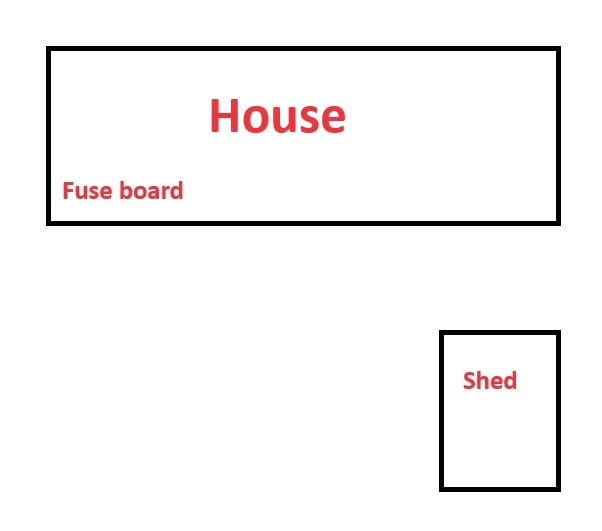
If it can be pinned to the house, once going in the ground how far down should it be buried and which cable would be needed please?
I'd get an electrician in to wire it up but don't fancy paying them to dig up the path and garden to bury the cable.
Thanks in advance for any pointers.
https://www.amazon.co.uk/E7ECPRO4YU-Christmas-Extension-Indicator-Enclosure/dp/B0BK5D5V2R/
isn't safe for a permanent set up?
If it isn't, can I simply run a length of armoured cable from a spare slot in the fuse board into a plug socket such as this:
https://www.screwfix.com/p/british-general-ip66-13a-2-gang-sp-weatherproof-outdoor-switched-passive-rcd-socket/91095
If so can the cable be pinned to the house for part of the run to save digging up the entire run to bury the cable?
House and shed are situated similar to the below.
If it can be pinned to the house, once going in the ground how far down should it be buried and which cable would be needed please?
I'd get an electrician in to wire it up but don't fancy paying them to dig up the path and garden to bury the cable.
Thanks in advance for any pointers.
In the game of chess you can never let your adversary see your pieces
0
Comments
-
A perminant connection is notifiable work so would need a qualified electrician, but nothing to stop you doing all the digging work.2
-
A minimum of 450mm is generally regarded as "best practice", and it needs to be SWA cable. I'd suggest putting it in conduit so that it can be replaced/upgraded should the need every arise.
Any language construct that forces such insanity in this case should be abandoned without regrets. –
Erik Aronesty, 2014
Treasure the moments that you have. Savour them for as long as you can for they will never come back again.3 -
Just curious why do you need power in the shed?1
-
Keep_pedalling said:A perminant connection is notifiable work so would need a qualified electrician, but nothing to stop you doing all the digging work.I'd second this advice - if you do want a "proper" permanent installation then get an electrician to do it (this will also remove the risk of any issues arising if/when you ever sell the house), but by all means do the donkey-work yourself to minimise costs.But do you need a permanent installation? I guess if you're going to set it up as a workshop that you'll be using a lot, then it makes sense - or if you want mains-powered lighting. But if you're just wanting to use a power tool on the very odd occasion then it'd be far cheaper to just use an ordinary extension lead.
1 -
Could the cable be run through conduit at higher level along the wall and across to the shed?
1 -
If you are only wanting occasional power in the shed would a small generator suit your needs. It would be handy in case of power cuts, or for camping.Play with the expectation of winning not the fear of failure. S.Clarke1
-
Don't disagree with the alternatives offered, so how about this, doesn't need digging: an overhead cable on a support wire. Still needs correct installation by an electrician, but looks like less effort.1
-
Thanks for the all replies
I did wonder about this but I think I'd feel better if it was in the ground, can't blow away in the ground!mexican_dave said:doesn't need digging: an overhead cable on a support wire.
I don't really fancy going down the road of generators, it would only take a day to get the donkey work for the cable sorted and the electrician is needed for a few other small jobs anyway.Eldi_Dos said:small generator suit your needs.
That's what I'm doing at the moment but it's a bind to keep reeling in and out, especially when it's raining which seems to be most of the time.CliveOfIndia said:But if you're just wanting to use a power tool on the very odd occasion then it'd be far cheaper to just use an ordinary extension lead.
Gotten to the point the house is nice enough to not want dust and mess everywhere, shed probably under sells it a bit, it's a fair sized out building with a decent work bench.moneysaver1978 said:Just curious why do you need power in the shed?
Thanks @FreeBearFreeBear said:A minimum of 450mm is generally regarded as "best practice", and it needs to be SWA cable. I'd suggest putting it in conduit so that it can be replaced/upgraded should the need every arise.
When you say conduit I assume you mean for the part in the ground so the cable can just be pulled out and threaded back through without digging again if ever needed, something like this?
https://www.screwfix.com/p/deta-corrugated-conduit-20mm-x-10m-black/234PV
In terms of cable Screwfix has this:
https://www.screwfix.com/p/prysmian-6943x-black-3-core-2-5mm-armoured-cable-25m-coil/38769
Tools have been working fine of normal plugs running of the usual 2.5mm twin and earth so I assume the 2.5mm SWA is sufficient, 6mm seems overkill for a few standard power tools? I assume the 3 core is suitable for connecting at both ends?
I don't really fancy any conduit or boxing running on the outside of the house, is it safe to simply pin to the wall just under the soffit?
Many thanks again In the game of chess you can never let your adversary see your pieces2
 -
I've used some corrugated conduit in the past for data cables - It is a pig to pull cable through as stuff gets snagged on the ridges.. 20mm would be too small for SWA. I'd go for something like this - https://www.screwfix.com/p/floplast-solvent-weld-waste-pipe-black-40mm-x-3m/23406 - Use solvent weld connectors where needed, and just use the pipe for the below ground run. If you think 6mm² is too much, drop down to 4mm² and you'll still be able to use the bigger toys tools. I have a chop saw that will trip a 16A MCB (which is the limit for 2.5mm²)...the_lunatic_is_in_my_head said:
Thanks @FreeBearFreeBear said:A minimum of 450mm is generally regarded as "best practice", and it needs to be SWA cable. I'd suggest putting it in conduit so that it can be replaced/upgraded should the need every arise.
When you say conduit I assume you mean for the part in the ground so the cable can just be pulled out and threaded back through without digging again if ever needed, something like this?
https://www.screwfix.com/p/deta-corrugated-conduit-20mm-x-10m-black/234PV
Any language construct that forces such insanity in this case should be abandoned without regrets. –
Erik Aronesty, 2014
Treasure the moments that you have. Savour them for as long as you can for they will never come back again.2 -
If turning the outbuilding into a workshop look into ABB industrial range of sockets and plugs. These are robust and easy to handle if your hands are a bit mucky and will last better if outbuilding is unheated.Play with the expectation of winning not the fear of failure. S.Clarke1











Confirm your email address to Create Threads and Reply

Categories
- All Categories
- 353.7K Banking & Borrowing
- 254.2K Reduce Debt & Boost Income
- 455.1K Spending & Discounts
- 246.8K Work, Benefits & Business
- 603.2K Mortgages, Homes & Bills
- 178.2K Life & Family
- 260.8K Travel & Transport
- 1.5M Hobbies & Leisure
- 16K Discuss & Feedback
- 37.7K Read-Only Boards