We’d like to remind Forumites to please avoid political debate on the Forum.
This is to keep it a safe and useful space for MoneySaving discussions. Threads that are – or become – political in nature may be removed in line with the Forum’s rules. Thank you for your understanding.
📨 Have you signed up to the Forum's new Email Digest yet? Get a selection of trending threads sent straight to your inbox daily, weekly or monthly!
The Forum now has a brand new text editor, adding a bunch of handy features to use when creating posts. Read more in our how-to guide
Plumber Charging Missed Call Out Fee Even Though I Was In The House?
Comments
-
There’s an exemption from the right to cancel for urgent repair or maintenance but the required info still has to be given.
Regarding information, for off premises repairs or maintenance (no mention of urgent IIRC) under £170 info is still required on paper, just not as much info.
If you have an urgent issue it’s most likely to be a distance contract any way, you wouldn’t be likely to call someone and say “I need a quote” so you can decide whilst they are there if you are going to pick them to fix the problem, you’d more like just say “come and it fix it” which would be a distance contract.Right to cancel and information requirements are under 2 different parts in the regs, where the right to cancel doesn’t exist there is still information requirements to meet as the required info covers a lot more than just cancelling.
The general limits of application:
https://www.legislation.gov.uk/uksi/2013/3134/regulation/6
are where the regs themselves don’t apply at all (gambling, banking, etc).In the game of chess you can never let your adversary see your pieces1 -
Thanks for clarifying.. i found it odd for there to be an exception to the requirement for info to be provided. Too many retailers would use it as a get out out clause IMO. I know some l here think you rely on the legislation too much, I don't agree. It's really not hard for a company to send an email with the appropriate info to cover themselves.There’s an exemption from the right to cancel for urgent repair or maintenance but the required info still has to be given.
Regarding information, for off premises repairs or maintenance (no mention of urgent IIRC) under £170 info is still required on paper, just not as much info.
If you have an urgent issue it’s most likely to be a distance contract any way, you wouldn’t be likely to call someone and say “I need a quote” so you can decide whilst they are there if you are going to pick them to fix the problem, you’d more like just say “come and it fix it” which would be a distance contract.Right to cancel and information requirements are under 2 different parts in the regs, where the right to cancel doesn’t exist there is still information requirements to meet as the required info covers a lot more than just cancelling.
The general limits of application:
https://www.legislation.gov.uk/uksi/2013/3134/regulation/6
are where the regs themselves don’t apply at all (gambling, banking, etc).1 -
Interestingly, given the value of the callout fee and that the contract at that stage is simply to attend/quote...
Regarding information, for off premises repairs or maintenance (no mention of urgent IIRC) under £170 info is still required on paper, just not as much info.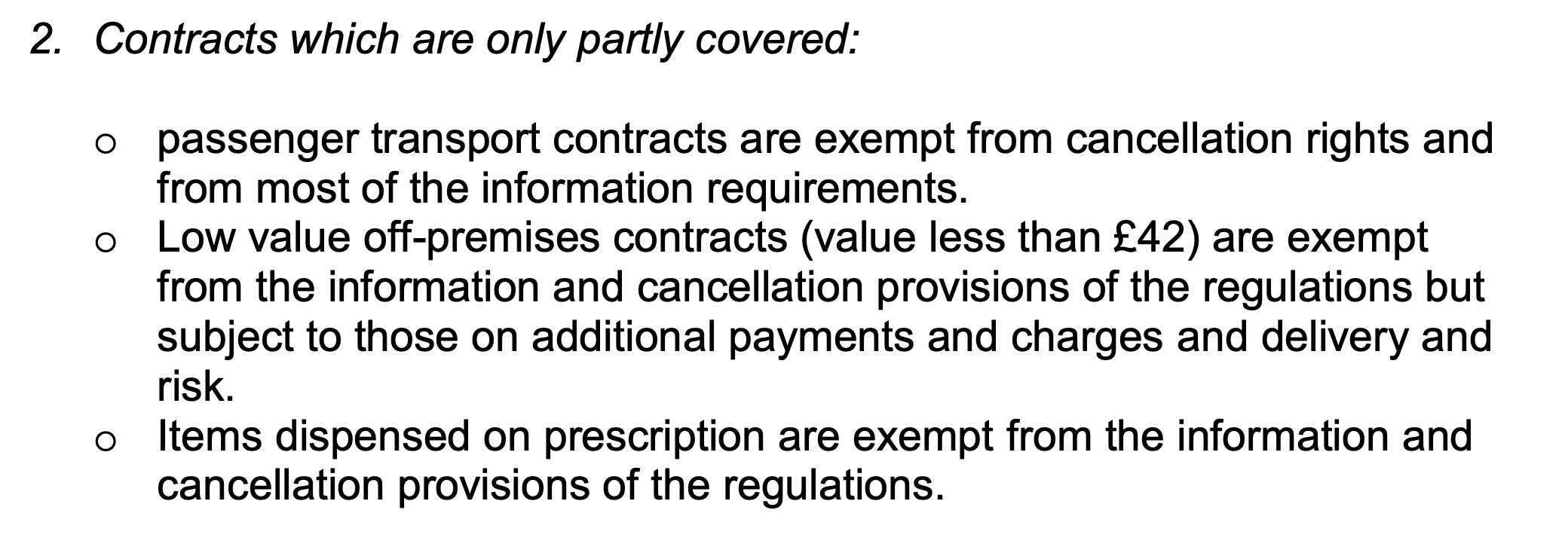
And I'm unclear why you're saying the information has to be on paper - given text is a durable medium and the regs say other durable mediums are acceptable if the customer agrees...
https://assets.publishing.service.gov.uk/media/5a817b92ed915d74e33fe73a/bis-13-1368-consumer-contracts-information-cancellation-and-additional-payments-regulations-guidance.pdf
I'm not an early bird or a night owl; I’m some form of permanently exhausted pigeon.2 -
I’m really unsure where the paper talk is coming from either. It’s normally best practice to put the contract in writing but a verbal contract is just as binding as the written form - but the former is hard to prove if there’s a dispute/allows for misinterpretation from either side - ‘I’ll take a look at your car’ vs ‘I’ll diagnose the fault in the car’ - technically the former is met by a visual inspection of the car but the latter says that the fault will be diagnosed.ArbitraryRandom said:
Interestingly, given the value of the callout fee and that the contract at that stage is simply to attend/quote...
Regarding information, for off premises repairs or maintenance (no mention of urgent IIRC) under £170 info is still required on paper, just not as much info.
And I'm unclear why you're saying the information has to be on paper - given text is a durable medium and the regs say other durable mediums are acceptable if the customer agrees...
https://assets.publishing.service.gov.uk/media/5a817b92ed915d74e33fe73a/bis-13-1368-consumer-contracts-information-cancellation-and-additional-payments-regulations-guidance.pdfFor simple contracts, the written form is still best practice but not needed as much, whilst more complex contracts (like those with a multi part payment schedule) I believe are required to be in writing, but happy to stand corrected.In any sense, a contract can’t be nullified just because it’s a verbal contract and verbal components can form part of the contract even if it’s not written down. To say consumers can get out of contracts just because they’re verbal means that businesses can get out of contracts just because they’re verbal too. Means the return of massively slimy salespeople who will tell half truths, and then claim ‘nuh uh - I didn’t put in writing so can’t hold me to it’0 -
In this case, the regs specially say the required information must be provided in advance of work starting in a durable medium, which can be other than paper if the customer agrees, or the customer is not bound by the contract (paraphrasing) - meaning the trader can't enforce the terms of any contract in the absence of being able to prove they provided the required info in advance.RefluentBeans said:I’m really unsure where the paper talk is coming from either. It’s normally best practice to put the contract in writing but a verbal contract is just as binding as the written form - but the former is hard to prove if there’s a dispute/allows for misinterpretation from either side - ‘I’ll take a look at your car’ vs ‘I’ll diagnose the fault in the car’ - technically the former is met by a visual inspection of the car but the latter says that the fault will be diagnosed.For simple contracts, the written form is still best practice but not needed as much, whilst more complex contracts (like those with a multi part payment schedule) I believe are required to be in writing, but happy to stand corrected.
Again, nothing saying the trader can't do the job anyway, but they can't take the customer to court for payment if they don't so they're taking on a risk.I'm not an early bird or a night owl; I’m some form of permanently exhausted pigeon.1 -
When you have water leak and post online to ask for recommendations for a decent plumber and get four people say Mr Smith is good, here’s his number, guy comes, fixes the leak, 2 weeks later your ceiling collapses because the job wasn’t done correctly and all you’ve got is a mobile number which the plumber has blocked you calling…diinozzo said:
So if for instance I have a river of water pouring down my stairs due to a water leak...an emergency situation...do I REALLY NEED at the insistence of the plumber to see a hard copy of all their T&C's before they will attend? Not going to happen.ArbitraryRandom said:Appliance_engineer said:You can all go on about the technical and legal aspects of this but in essence, a tradesman has gone to quote on a job, he's made every effort to contact the householder and his phone call was ignored.
He has had the expense and time taken to visit. That needs to be reimbursed. £30 is a very small amount of money and may be less than the costs of attending.
No-one likes paperwork, but it's not like it's hard to give the customer some generic boilerplate when agreeing to come out, and if you don't do it then you lose the right to have your expenses reimbursed.
That said, as someone who tends to get trades in via word of mouth/referral, I'd apologise and pay.
Required information protects you as a consumer, as above it’s mainly generic and not difficult to do.
Regardless of what we all think, the people who wrote the legislation clearly think it’s important otherwise the consequences for not providing it wouldn’t be so severe.The bit about being on paper (unless the consumer agrees another medium) is clearly written in the regs, one mention was linked to earlier in the thread, but applies to off premises only. Distance requires confirmation of the contract via any durable means.In the game of chess you can never let your adversary see your pieces2 -
For a one man band or small companies. It can be, as doing that is costing them time/money to do, They may answer call while on a job & agree to pop over as it's near & they have a spare bit of time. But do not have the facility to send emails.Bradden said:
Thanks for clarifying.. i found it odd for there to be an exception to the requirement for info to be provided. Too many retailers would use it as a get out out clause IMO. I know some l here think you rely on the legislation too much, I don't agree. It's really not hard for a company to send an email with the appropriate info to cover themselves.There’s an exemption from the right to cancel for urgent repair or maintenance but the required info still has to be given.
Regarding information, for off premises repairs or maintenance (no mention of urgent IIRC) under £170 info is still required on paper, just not as much info.
If you have an urgent issue it’s most likely to be a distance contract any way, you wouldn’t be likely to call someone and say “I need a quote” so you can decide whilst they are there if you are going to pick them to fix the problem, you’d more like just say “come and it fix it” which would be a distance contract.Right to cancel and information requirements are under 2 different parts in the regs, where the right to cancel doesn’t exist there is still information requirements to meet as the required info covers a lot more than just cancelling.
The general limits of application:
https://www.legislation.gov.uk/uksi/2013/3134/regulation/6
are where the regs themselves don’t apply at all (gambling, banking, etc).Life in the slow lane0 -
But then should they really be charging £30 for a missed appointment, especially if not agreed before. The whole argument before of wasted time/missed jobs etc falls apart if it’s just round the corner.born_again said:
For a one man band or small companies. It can be, as doing that is costing them time/money to do, They may answer call while on a job & agree to pop over as it's near & they have a spare bit of time. But do not have the facility to send emails.Bradden said:
Thanks for clarifying.. i found it odd for there to be an exception to the requirement for info to be provided. Too many retailers would use it as a get out out clause IMO. I know some l here think you rely on the legislation too much, I don't agree. It's really not hard for a company to send an email with the appropriate info to cover themselves.There’s an exemption from the right to cancel for urgent repair or maintenance but the required info still has to be given.
Regarding information, for off premises repairs or maintenance (no mention of urgent IIRC) under £170 info is still required on paper, just not as much info.
If you have an urgent issue it’s most likely to be a distance contract any way, you wouldn’t be likely to call someone and say “I need a quote” so you can decide whilst they are there if you are going to pick them to fix the problem, you’d more like just say “come and it fix it” which would be a distance contract.Right to cancel and information requirements are under 2 different parts in the regs, where the right to cancel doesn’t exist there is still information requirements to meet as the required info covers a lot more than just cancelling.
The general limits of application:
https://www.legislation.gov.uk/uksi/2013/3134/regulation/6
are where the regs themselves don’t apply at all (gambling, banking, etc).If contractors want to charge for missed appointments then they should tell consumers that and say how much it is. Or it’s unfair to charge customers a fee that they didn’t agree to (and that gets awfully close to penalties and fines).But I agree, morally the right thing to do would be to pay for the wasted time; but if it comes common place to charge for missed appointments, there’s a lot of consumer abuse companies can do.1 -
No wonder many workmen now ask for payment up front.2
-
Last time I had someone round was an electrician to change two very old lights in the garden. I supplied the lights and paid £100 for the service.No paperwork, no T&C's - He came quoted, I said yes and he got the tools from the van.In theory I could have said 'You did not supply me with the required information in a durable format, so I shall not be paying you'.Crazy.3











Confirm your email address to Create Threads and Reply

Categories
- All Categories
- 354.6K Banking & Borrowing
- 254.5K Reduce Debt & Boost Income
- 455.5K Spending & Discounts
- 247.5K Work, Benefits & Business
- 604.4K Mortgages, Homes & Bills
- 178.6K Life & Family
- 261.9K Travel & Transport
- 1.5M Hobbies & Leisure
- 16.1K Discuss & Feedback
- 37.7K Read-Only Boards