We’d like to remind Forumites to please avoid political debate on the Forum.
This is to keep it a safe and useful space for MoneySaving discussions. Threads that are – or become – political in nature may be removed in line with the Forum’s rules. Thank you for your understanding.
Court Claim- Defence review
Comments
-
The pics won’t have come through but they are taken from the WS you guys reference in the newbie thread.
I’ll post in a few comments as is a big doc
————————————————————
Table of ContentsWitness Statement of DefendantExhibit 01 - Civil Enforcement v Ming Tak Chan JudgmentExhibit 02 - Parallel Parking v AnonExhibit 03 - Another Badly Pleaded Parking Claim 1Exhibit 04 - Another Badly Pleaded Parking Claim 2Exhibit 05 – Signage on ApproachExhibit 06 – Confirmation of CustomExhibit 07 – ‘BPA AOS Code of Practice’Exhibit 08 – Excel v Wilkinson Case TranscriptExhibit 09 - The Beavis case sign for comparisonExhibit 10 - ParkingEye Limited v BeavisXxxxxx (Claimant)
V
Xxxxxxx (Defendant)
Witness Statement of Defendant
1. I am xxxxxxx, (Address: xxxxxxxx) and I am the defendant against whom this claim is made. The facts below are true to the best of my belief and my account has been prepared based upon my own knowledge.
2. In my statement I shall refer to (Exhibits 1-10) within the evidence supplied with this statement, referring to page and reference numbers where appropriate. My defence is repeated and I will say as follows:
Preliminary matter: The claim should be struck out
3. The Defendant draws to the attention of the court that there is now a persuasive Appeal judgment to support striking out the claim (in these exact circumstances of typically poorly pleaded private parking claims, and the extant PoC seen here are far worse than the one seen on Appeal). The Defendant believes that dismissing this meritless claim is the correct course, with the Overriding Objective in mind. Bulk litigators (legal firms) should know better than to make little or no attempt to comply with the Practice Direction. By continuing to plead cases with generic auto-fill unspecific wording, private parking firms should not be surprised when courts strike out their claims based in the following persuasive authority.
4. A recent persuasive appeal judgment in Civil Enforcement Limited v Chan (Ref. E7GM9W44) would indicate the POC fails to comply with Civil Procedure Rule 16.4 and Practice Direction Part 16. On the 15th August 2023, in the cited case, HHJ Murch held that 'the particulars of the claim as filed and served did not set out the conduct which amounted to the breach in reliance upon which the claimant would be able to bring a claim for breach of contract'. The same is true in this case and in view of the Chan judgment, the Court should strike out the claim, using its powers pursuant to CPR 3.4 (Exhibit-01).
5. Similarly, at the Wakefield County Court on 8th September 2023, District Judge Robinson considered mirror image POC in claim K3GF9183 (Parallel Parking v anon) and struck the Claim out without a hearing. (See Exhibit-02)
6. Likewise, in January 2023 (also without a hearing) District Judge Sprague, sitting at the County Court at Luton, struck out a similarly badly-pleaded parking claim with a full explanation of his reasoning. (See Exhibit-03)
7. Furthermore, at Manchester District Judge McMurtrie and District Judge Ranson also struck out a claim (again without a hearing) on the grounds of POC’s lacking clarity, detail, and precision. As stated in the final image below, the Claimant’s solicitors confirmed they would not file an amended POC, demonstrating again the reliance of a number of firms on robo-letters and illegitimate practices. (See Exhibit-04)
8. The Defendant believes the Claim should be struck out and should not have been accepted by the CNBC due to a represented parking firm Claimant knowingly breaching basic CPRs. The specifics of this case lack clarity, as no explicit statement has been provided to indicate which specific term of the alleged contract was purportedly breached. It remains uncertain whether the claim pertains to my alleged parking outside of a designated bay, failure to remain on the premises, incorrect bay parking, overstaying the allotted time, or perhaps a technicality associated with the entry process at the kiosk. This lack of specificity places me, the defendant, at a distinct disadvantage, as I find myself in the position of having to mount a defence without a clear understanding of the precise nature of the alleged violation.
0 -
Facts and Sequence of events
9. Date and Time of the Incident: On xxxxxx at xx we went as a family to McDonald’s to celebrate my son’s 8th Birthday. We were meeting my sisters and their families as well.
10. Restrictions Affecting Country: The UK was facing another potential lockdown over the Christmas period having already had most of the year restricted. This was one of the first times that we were able to meet up as a family to try and celebrate together before the Country went back into a restricted Christmas period.
11. Car Park Approach: Prior to Co-vid the McDonald’s car park did not have any restrictions for parking. Upon approach to the car park there was nothing to suggest that this had changed. It was a very wet and stormy night which hindered visibility even more than usual. Upon entering the car park there is a small lane that is parallel to the drive thru which you have to navigate before there is a wider car park to find a spot to park in. As you made your way round, there are no signs visible to drivers to highlight that that parking conditions had changed or that there were any parking conditions to meet. (Exhibit-05)
12. Genuine Customers: As submitted to McDonald’s after the PCN was first received and subsequently to POPLA, the time that was spent on site can be accounted for via purchases made throughout the time within the franchise. Whilst the claimant has expressed on PCN that the 90 minutes were breeched it should be noted that purchases were made at several points during the visit. This is made further important because it was one of the first times we were able to meet up following COVID-19 restrictions and it being my Son’s birthday celebration. Had there been clear signage to point customers that parking restrictions were now in force we would have been responsive to the change in situation. (Exhibit-06)
13. Insufficient Signage: The country had not long come out of an enforced period of lockdown due to COVID-19 and opportunities for connecting with family members were few and far between. Prior to this time, the location mentioned above had no such restrictions on length of stay on its premises. I was unaware of there being new parking restrictions as the Claimants signage were not located in a visible location and the car park was inadequately lit for patrons to be able to see them let alone be aware that they had entered into a contract for parking. It states within the ‘BPA AOS Code of Practice’, in paragraph 19.10 that signage should reflect the change in the terms and conditions. (Exhibit-07)
Exaggerated Claim and 'market failure' currently examined by the Government
14. The alleged 'core debt' from any parking charge cannot have exceeded £100 (the industry cap set out in the applicable Code of Practice at the time). I have seen no evidence that the added damages/fees are genuine.
15. I say that fees were not paid out or incurred by this Claimant, who is to put strict proof of:
(i) the alleged breach, and
(ii) a breakdown of how they arrived at the enhanced quantum claimed, including how interest has been calculated, which appears to have been applied improperly on the entire inflated sum, as if that figure was immediately overdue on the day of an alleged parking event.
16. This Claimant routinely pursues a disproportionate additional fixed sum (inexplicably added per PCN) despite knowing that the will of Parliament is to ban or substantially reduce the disproportionate 'Debt Fees'. This case is a classic example where the unjust enrichment of exaggerated fees encourages the 'numbers game' of inappropriate and out of control bulk litigation of weak/archive parking cases. No pre-action checks and balances are likely to have been made to ensure facts, merit, position of signs/the vehicle, or a proper cause of action.
17. The Department for Levelling Up, Housing and Communities (the DLUHC) first published its statutory Parking Code of Practice on 7th February 2022, here:
https://www.gov.uk/government/publications/private-parking-code-of-practice
"Private firms issue roughly 22,000 parking tickets every day, often adopting a labyrinthine system of misleading and confusing signage, opaque appeals services, aggressive debt collection and unreasonable fees designed to extort money from motorists."
18. Despite legal challenges delaying the Code's implementation (marking it as temporarily 'withdrawn' as shown in the link above) a draft Impact Assessment (IA) to finalise the DLUHC Code was recently published on 30th July 2023, which has exposed some industry-gleaned facts about supposed 'Debt Fees'. This is revealed in the Government's analysis, found here: https://assets.publishing.service.gov.uk/government/uploads/system/uploads/attachment_data/file/1171438/Draft_IA_-_Private_Parking_Code_of_Practice_.pdf
19. Paragraphs 4.31 and 5.19 reveal that the parking industry has informed the DLUHC that the true minor cost of what the parking industry likes to call debt recovery or 'enforcement' (pre-action) stage totals a mere £8.42 per recovery case.
20. With that sum in mind, it is clear that the extant claim has been enhanced by an excessive amount, disingenuously added as an extra 'fee'. This is believed to be routinely retained by the litigating legal team and has been claimed in addition to the intended 'legal representatives fees' cap set within the small claims track rules. This conduct has been examined and found - including in a notably detailed judgment by Her Honour Judge Jackson, now a specialist Civil High Court Judge on the Leeds/Bradford circuit - to constitute 'double recovery' and the Defendant takes that position.
21. The new draft IA now demonstrates that the unnecessarily intimidating stage of pre-action letter-chains actually costs 'eight times less' (says the DLUHC analysis) than the price-fixed £70 per PCN routinely added. This has caused consumer harm in the form of hundreds of thousands of inflated CCJs each year that District Judges have been powerless to prevent. This abusively enhanced 'industry standard' Debt Fee was enabled only by virtue of the self- serving Codes of Practice of the rival parking Trade Bodies, influenced by a Board of parking operators and debt firms who stood to gain from it.
22. In support of my contention that the sum sought is unconscionably exaggerated and thus unrecoverable, attention is drawn to paras 98, 100, 193, 198 of ParkingEye Ltd v Beavis [2015] UKSC67 ('the Beavis case'). Also ParkingEye Ltd v Somerfield Stores Ltd ChD [2011] EWHC 4023(QB) where the parking charge was £75, discounted to £37.50 for prompt payment. Whilst £75 was reasonable, HHJ Hegarty (decision later ratified by the CoA) held in paras 419-428 that unspecified 'admin costs' inflating a parking charge to £135 was not a true reflection of the cost of a template letter and 'would appear to be penal.
23. This Claimant has not incurred any additional costs because the full parking charge (after expiry of discount) is already high and more than covers what the Supreme Court called an 'automated letter-chain' business model that generates a healthy profit. In Beavis, there were 4 or 5 letters in total, including pre-action phase reminders. The £85 parking charge was held to cover the 'costs of the operation' and the DLUHC's IA suggests it should still be the case that the parking charge itself more than covers the minor costs of pre-action stage, even if and when the Government reduces the level of parking charges.
24. Whilst the new Code is not retrospective, the majority of the clauses went unchallenged by the parking industry and it stands to become a creature of statute due to the failure of the self-serving BPA & IPC Codes. The DLUHC's Secretary of State mentions they are addressing 'market failure' more than once in the draft IA, a phrase which should be a clear steer for Courts in 2023 to scrutinise every aspect of claims like this one.
25. In addition, pursuant to Schedule 4 paragraph 4(5) of the Protection of Freedoms Act 2012 ('the POFA') the sum claimed exceeds the maximum potentially recoverable. It is also disproportionate and in breach of the Consumer Rights Act 2015 (CRA).
0 -
CRA Breaches
26. Claiming costs on an indemnity basis is unfair, per the Unfair Contract Terms Guidance (CMA37, para 5.14.3), the Government guidance on the CRA which introduced new requirements for 'prominence' of both contract terms and 'consumer notices'. In a parking context, this includes a test of fairness and clarity of signage and all notices, letters and other communications intended to be read by the consumer.
27. Section 71 creates a duty upon courts to consider the test of fairness, including (but not limited to) whether all terms/notices were unambiguously and conspicuously brought to the attention of a consumer. Signage must be prominent, plentiful, well-placed (and lit in hours of darkness/dusk) and all terms must be unambiguous and contractual obligations clear.
28. The CRA has been breached due to unfair/unclear terms and notices, pursuant to s62 and paying due regard to examples 6, 10, 14 & 18 of Schedule 2 and the requirements for fair/open dealing and good faith (NB: this does not necessarily mean there has to be a finding of bad faith).
29. Now for the first time, the DLUHC's draft IA exposes that template 'debt chaser' stage costs less than £9. This shows that HHJ Jackson was right all along in Excel v Wilkinson. (See Exhibit-08)
The Beavis case is against this claim
30. The Supreme Court clarified that ‘the penalty rule is plainly engaged’ in parking cases, which must be determined on their own facts. That 'unique' case met a commercial justification test, given the location and clear signs with the charges in the largest/boldest text. Rather than causing other parking charges to be automatically justified, that case, in particular, the brief, conspicuous yellow & black warning signs - (See Exhibit-09) - set a high bar that this Claimant has failed to reach.
31. Paraphrasing from the Supreme Court, deterrence is likely to be penal if there is a lack of a 'legitimate interest' in performance extending beyond the prospect of compensation flowing directly from the alleged breach. The intention cannot be to punish a driver, nor to present them with hidden terms, unexpected/cumbersome obligations nor 'concealed pitfalls or traps'. (See Exhibit-10) for paragraphs from ParkingEye v Beavis).
32. In the present case, the Claimant has fallen foul of those tests. There are two main issues that render this parking charge to be purely penal (i.e. no legitimate interest saves it) and thus, it is unenforceable:
(i). Concealed pitfall or trap:
The signage in this case did not let patrons know that there had been a change to conditions of using the car park. Especially since the country had been in the grips of a world-wide pandemic that meant establishments were not frequented by the general public often enough to recognise the change to conditions. Hence hoping that patrons would be none the wiser and trap them into paying PCNs under threat.
(ii). Hidden Terms:
The £100 penalty clause is positively buried in small print. The purported added (false) 'costs' are even more hidden and are also unspecified as a sum. Their (unlawful, due to the CRA Schedule 2 grey list of unfair terms) suggestion is that they can hide a vague sentence within a wordy sign, in the smallest possible print, then add whatever their trade body lets them, until the DLUHC bans it in 2024. And the driver has no idea about any risk nor even how much they might layer on top. None of this was agreed by me, let alone known or even seen. Court of Appeal authorities which are on all fours with a case involving a lack of ‘adequate notice’ of a charge, include:
(i) Spurling v Bradshaw [1956] 1 WLR 461 (‘red hand rule’) and
(ii) Thornton v Shoe Lane Parking Ltd [1970] EWCA Civ2both leading authorities confirming that a clause cannot be incorporated after a contract has been concluded; and
(iii) Vine v London Borough of Waltham Forest: CA 5 Apr 2000, where Ms Vine won because it was held that she had not seen the terms by which she would later be bound, due to "the absence of any notice on the wall opposite the parking space".
Defence
33. I attended a family children’s birthday party at McDonalds xxxxxxxxx. Due to the time of year the conditions were dark and wintery. The country had not long come out of an enforced period of lockdown due to COVID -19 and opportunities for connecting with family members were few and far between. Prior to this time, the location mentioned above had no such restrictions on length of stay on its premises. The Defendant was unaware of there being new parking restrictions as the Claimants signage were not located in a visible location and the car park was inadequately lit for patrons to be able to see them let alone be aware that they had entered into a contract for parking.
34. During the Defendants stay there was no visible reference to the changes in parking terms within McDonalds, thus giving the Defendant no opportunity to make an informed decision on length of stay. As previously mentioned, this was a family birthday party and due to restrictions imposed by COVID-19 this was a chance to enjoy the company of family and spend time which was not allowed before said date.
35. The Defendant and other family members were patrons of McDonalds and offered evidence of purchases during the time they were on said premises. Two of my family members also received parking charges for the same visit and duration however these were successfully appealed with POPLA. This is despite all three appeals using the exact same appeal documentation, albeit car registrations and name of keeper being different.
36. Therefore, I maintain that no contractual agreement existed between myself and UK Parking Control Limited, and the Claimant will concede that no financial loss has arisen. The charge imposed, in all the circumstances is a penalty (not saved by the ParkingEye v Beavis case, which is fully distinguished). In addition to the fact that the sum claimed under purported 'contract' is disproportionately exaggerated, additionally the interest is inflated as interest appears to be miscalculated on the whole enhanced sum from day one as if £160 or £170 was 'overdue' on the day of parking;
Conclusion
37. The claim is entirely without merit and the Claimant is urged to discontinue now, to avoid incurring costs and wasting the court's time and that of the Defendant.
38. The Defendant asks the judge to read the persuasive Judgment from His Honour Judge Murch (August 2023) in the Civil Enforcement v Chan case, and deliver the same outcome given this Claimant has submitted a similarly vague POC. It is worth noting that in the Civil Enforcement v Chan case the POC, while still ambiguous, did contain a subtle indication of the alleged contravention, specifically regarding the duration of the defendant's parking on the premises. In contrast, the POC in this case lacks even a minimal effort to hint at the nature of the alleged violation. In the Civil Enforcement v Chan case, full costs were awarded to the motorist and the claim was struck out.
39. There is now ample evidence to support the view - long held by many District Judges - that these are knowingly exaggerated claims. The July 2023 DLUHC IA analysis surely makes that clear because it is now a matter of record that the industry has told the Government that 'debt recovery' costs eight times less than they have been claiming in almost every case.
40. With the DLUHC's ban on the false 'costs' there is ample evidence to support the view - long held by many District Judges - that these are knowingly exaggerated claims. For HMCTS to only disallow those costs in the tiny percentage of cases that reach hearings whilst other claims to continue to flood the courts unabated, is to fail hundreds of thousands of consumers who suffer CCJs or pay inflated amounts, in fear of the intimidating pre-action demands. The Defendant believes that it is in the public interest that claims like this should be struck out because knowingly enhanced parking claims like this one cause consumer harm on a grand scale.
41. In the matter of costs, the Defendant asks:
(a) The previously reserved costs of £315, and
(b) standard witness costs for attendance at Court, pursuant to CPR 27.14, and
(c) for a finding of unreasonable conduct by this Claimant, seeking costs pursuant to CPR 46.5.
42. Attention is drawn specifically to the (often-seen from this industry) possibility of an unreasonably late Notice of Discontinuance. Whilst CPR r.38.6 states that the Claimant is liable for the Defendant's costs after discontinuance (r.38.6(1)) this does not normally apply to claims allocated to the small claims track (r.38.6(3)). However, the White Bookstates (annotation 38.6.1): "Note that the normal rule as to costs does not apply if a claimant in a case allocated to the small claims track serves a notice of discontinuance although it might be contended that costs should be awarded if a party has behaved unreasonably (r.27.14(2)(dg))."
Statement of truth:
I believe that the facts stated in this witness statement are true. I understand that proceedings for contempt of court may be brought against anyone who makes, or causes to be made, a false statement in a document verified by a statement of truth without an honest belief in its truth.
Defendant’s signature:
Date:
Exhibit 01 - Civil Enforcement v Ming Tak Chan Judgment
Exhibit 02 - Parallel Parking v Anon
Exhibit 03 - Another Badly Pleaded Parking Claim 1
Exhibit 04 - Another Badly Pleaded Parking Claim 2
Exhibit 05 – Signage on Approach
Exhibit 06 – Confirmation of Custom
Exhibit 07 – ‘BPA AOS Code of Practice’
’19.10 Where there is a change in the terms and conditions that materially affects the motorist then you must make these terms and conditions clear on your signage. Where such changes impose liability where none previously existed then you must consider a transition to allow regular visitors to the site to adjust and familiarise themselves with the changes. Best practice would be the installation of additional/ temporary signage at the entrance and throughout the site making it clear that new terms and conditions apply. This will ensure such that regular visitors who may be familiar with the previous terms become aware of the new ones.’
Exhibit 08 – Excel v Wilkinson Case Transcript
Exhibit 09 - The Beavis case sign for comparison
Exhibit 10 - ParkingEye Limited v Beavis
Paragraphs 98, 193, and 198
98. Against this background, it can be seen that the £85 charge had two main objects. One was to manage the efficient use of parking space in the interests of the retail outlets, and of the users of those outlets who wish to find spaces in which to park their cars. This was to be achieved by deterring commuters or other long-stay motorists from occupying parking spaces for long periods or engaging in other inconsiderate parking practices, thereby reducing the space available to other members of the public, in particular the customers of the retail outlets. The other purpose was to provide an income stream to enable ParkingEye to meet the costs of operating the scheme and make a profit from its services, without which those Page 43 services would not be available. These two objectives appear to us to be perfectly reasonable in themselves. Subject to the penalty rule and the Regulations, the imposition of a charge to deter overstayers is a reasonable mode of achieving them. Indeed, once it is resolved to allow up to two hours free parking, it is difficult to see how else those objectives could be achieved.
193. The penalty doctrine is therefore potentially applicable to the present scheme. It is necessary to identify the interests which it serves. They are in my view clear. Mr Beavis obtained an (admittedly revocable) permission to park and, importantly, agreement that if and so far as he took advantage of this it would be free of charge. ParkingEye was able to fulfil its role of providing a traffic management maximisation scheme for BAPF. The scheme met, so far as appears, BAPF’s aim of providing its retail park lessees with spaces in which their customers could park. All three conditions imposed were directed to this aim, and all were on their face reasonable. (The only comment that one might make, is that, although the signs made clear that it was a “Customer only car park”, the Parking Charge of £85 did not apply to this limitation, which might be important in central Chelmsford. The explanation is, no doubt, that, unlike a barrier operated scheme where exit can be made conditional upon showing or using a ticket or bill obtained from a local shop, a camera operated scheme allows no such control.) The scheme gave BAPF through ParkingEye’s weekly payments some income to cover the costs of providing and maintaining the car park. Judging by ParkingEye’s accounts, and unless the Chelmsford car park was out of the ordinary, the scheme also covered ParkingEye’s costs of operation and gave their shareholders a healthy annual profit.
198. The £85 charge for overstaying is certainly set at a level which no ordinary customer (as opposed to someone deliberately overstaying for days) would wish to incur. It has to have, and is intended to have, a deterrent element, as Judge Moloney QC recognised in his careful judgment (para 7.14). Otherwise, a significant number of customers could all too easily decide to overstay, limiting the shopping possibilities of other customers. Turnover of customers is obviously important for a retail park. A scheme which imposed a much smaller charge for short overstaying or operated with fine gradations according to the period of overstay would be likely to be unenforceable and ineffective. It would also not be worth taking customers to Page 88 court for a few pounds. But the scheme is transparent, and the risk which the customer accepts is clear. The fact that, human nature being what it is, some customers under-estimate or over-look the time required or taken for shopping, a break or whatever else they may do, does not make the scheme excessive or unconscionable. The charge has to be and is set at a level which enables the managers to recover the costs of operating the scheme. It is here also set at a level enabling ParkingEye to make a profit. Unless BAPF was itself prepared to pay ParkingEye, which would have meant, in effect, that it was subsidising customers to park on its own site, this was inevitable. If BAPF had attempted itself to operate such a scheme, one may speculate that the charge might even have had to be set at a higher level to cover its costs without profit, since ParkingEye is evidently a specialist in the area.
0 -
Witness statements are written in the first person so "I" not "the defendant", you have a few at the beginning of this statement (at least paragraphs 3 & 8 - didn't check the rest) that need changing.1
-
Morning All,
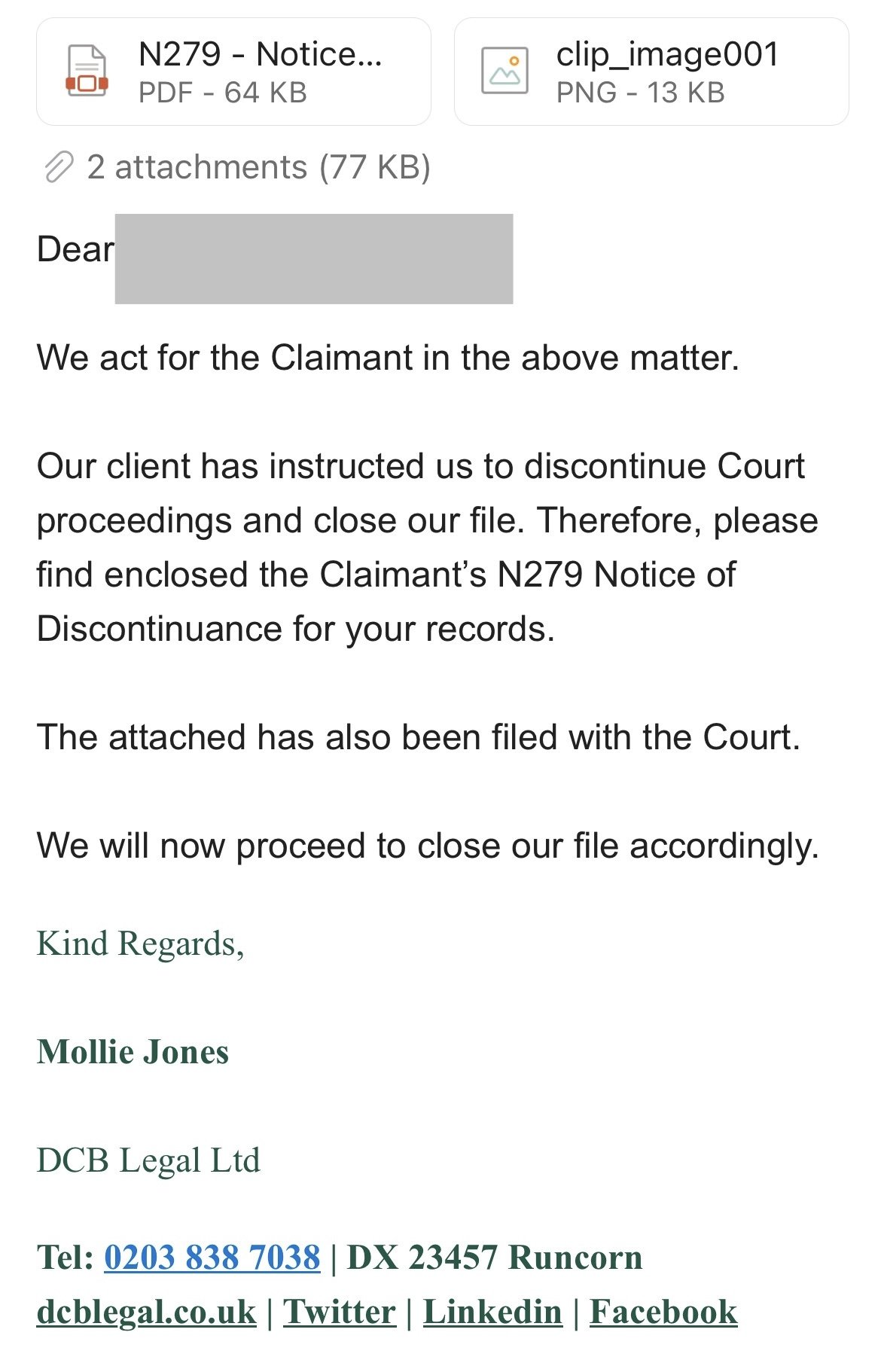
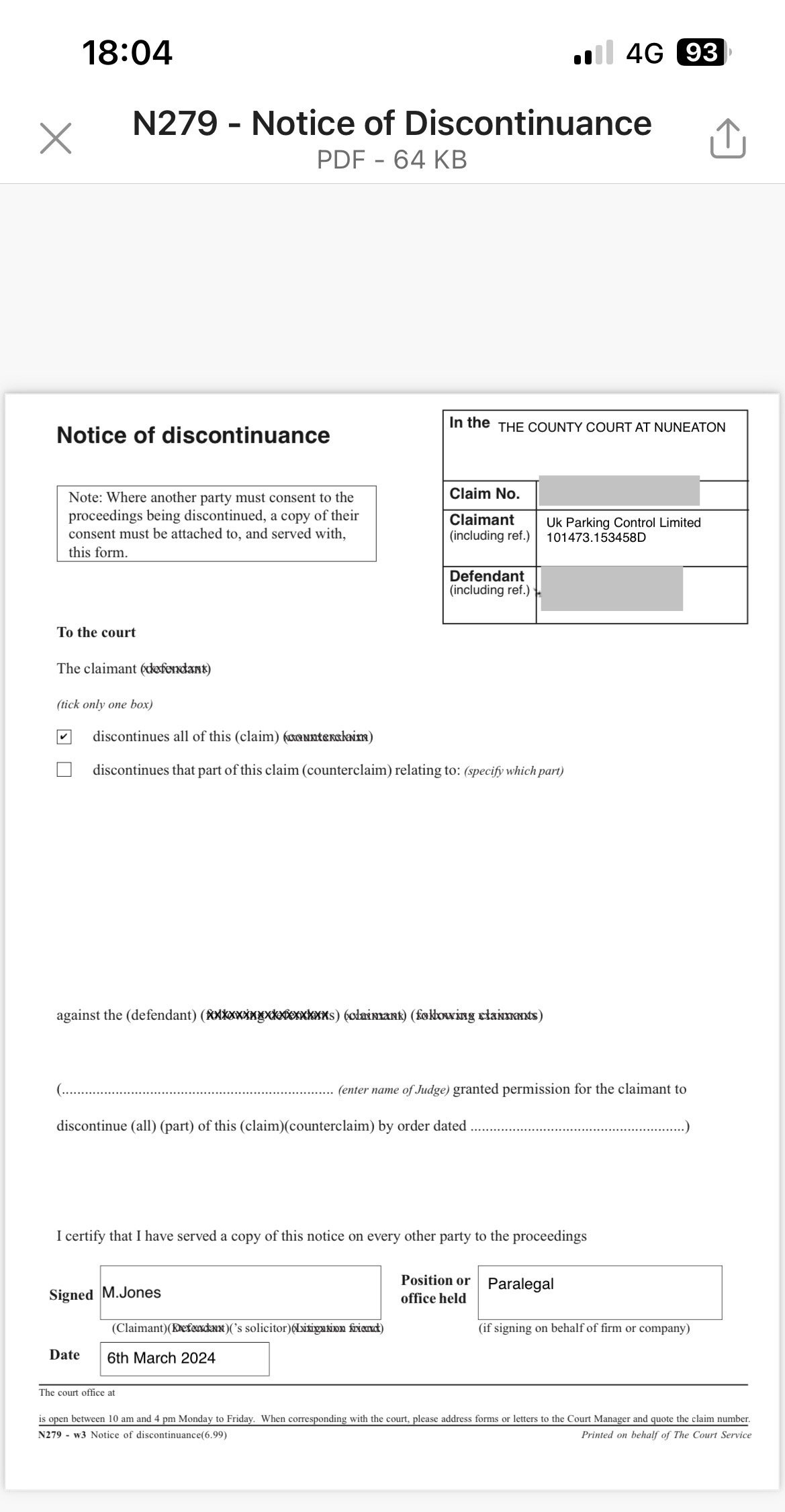
As predicted I have had an email today from DCB Legal discontinuing their claim on behalf of UKPC 👍
This forum is so valuable and I have to admit, when the debt letters & threats came I was tempted to cave. However seeing the advice and help you on this forum has meant that I have not had to pay 🌟 just over 2 years since the incident 🙌 thank you once again.3 -
Yay - yet another DCB Legal discontinuance.Crazygirl_2 said:Morning All,
As predicted I have had an email today from DCB Legal discontinuing their claim on behalf of UKPC 👍
This forum is so valuable and I have to admit, when the debt letters & threats came I was tempted to cave. However seeing the advice and help you on this forum has meant that I have not had to pay 🌟 just over 2 years since the incident 🙌 thank you once again.
WELL DONE. That's a win! Congrats!
ANOTHER ONE BITES THE DUST!
I have added you to the 'disco' thread.Can you show us a redacted copy of that discontinuance? It helps to show none of this is hearsay.PRIVATE 'PCN'? DON'T PAY BUT DON'T IGNORE IT (except N.Ireland).
CLICK at the top or bottom of any page where it says:
Home»Motoring»Parking Tickets Fines & Parking - read the NEWBIES THREAD0 -
Absolutely will. I’ll sort when I’m home. Once again thank you and I’m proud to be part of the disco thread 🙌0
-
This is the email
0 -
This is the form
4










Confirm your email address to Create Threads and Reply

Categories
- All Categories
- 354.4K Banking & Borrowing
- 254.4K Reduce Debt & Boost Income
- 455.4K Spending & Discounts
- 247.3K Work, Benefits & Business
- 604.1K Mortgages, Homes & Bills
- 178.4K Life & Family
- 261.6K Travel & Transport
- 1.5M Hobbies & Leisure
- 16K Discuss & Feedback
- 37.7K Read-Only Boards