We’d like to remind Forumites to please avoid political debate on the Forum.
This is to keep it a safe and useful space for MoneySaving discussions. Threads that are – or become – political in nature may be removed in line with the Forum’s rules. Thank you for your understanding.
📨 Have you signed up to the Forum's new Email Digest yet? Get a selection of trending threads sent straight to your inbox daily, weekly or monthly!
The Forum now has a brand new text editor, adding a bunch of handy features to use when creating posts. Read more in our how-to guide
RTS
Comments
-
As much as I regularly argue that it could (if we chose to), you know that "rapidly winding up and down wind and solar" to help the system doesn't happen at this point. If anything, it's the exact opposite. We need to pay other generators to cover when the renewables wind up and down by themselves.JSHarris said:CSI_Yorkshire said:
Which is the completely backwards way to look at it.JSHarris said:Leaving to one side the smart meter/dumb meter debate, and looking solely at the pattern of UK energy use, very simple time switched tariffs, like E7, are every bit as sensible today as they were 50 years ago.Energy demand is very predictable. We have a clear pattern, where night time demand is far less than day time demand. A look at Gridwatch demonstrates this. This is demand over the past week: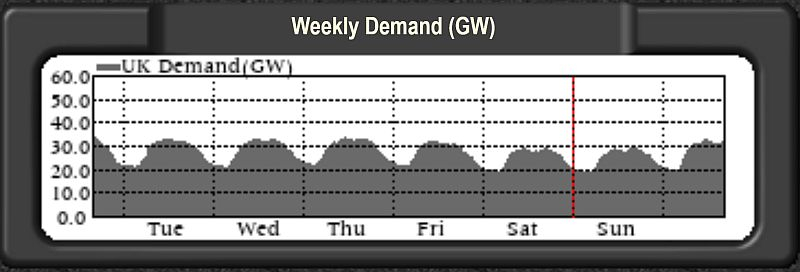 This isn't untypical. Demand has followed the same diurnal pattern for decades. Overnight demand is always around 2/3rd of day time demand. There is no need for any sort of complex control systems to try and move energy consumption to the low demand period. I time switch is every bit as good as anything else.If we had the sort of ill-defined demand curves seen in places like California, then the argument for smart control is more compelling. We don't though, and there is no sign that the easily predictable demand curve shown above isn't going to remain much the same for a few decades yet.
We used to have dispatchable generation, so could turn generators up and down to follow that curve. Making it flatter made it cheaper, so that was kind of nice.
We no longer have anywhere near the same amount of dispatchable generation (we could, but we seem to have decided that we shouldn't) and it's getting worse. Now we just get whatever generation is pushed in, so the best way to balance the system is with the demand side. A coarse and simplistic E7-type tariff doesn't allow that.
I expected a better argument than "well it worked in the 1970s".Generators are now far more flexible than they used to be. We've lost a lot of inflexible generation over the years (mostly coal and nuclear). We've replaced that with a lot of very flexible generation, generation that can be wound up and down very rapidly (wind, for example, together with solar and, more recently, battery storage.
They will. We've got a robust system. And the cost of doing so has quadrupled, regularly reaching £300 - £500 million per month. I'm interested to note that you are a fan of paying ever increasing charges to generating companies to provide this service, rather than allowing consumers to reduce their overall bills.JSHarris said:CSI_Yorkshire said:
Which is the completely backwards way to look at it.JSHarris said:Leaving to one side the smart meter/dumb meter debate, and looking solely at the pattern of UK energy use, very simple time switched tariffs, like E7, are every bit as sensible today as they were 50 years ago.Energy demand is very predictable. We have a clear pattern, where night time demand is far less than day time demand. A look at Gridwatch demonstrates this. This is demand over the past week:This isn't untypical. Demand has followed the same diurnal pattern for decades. Overnight demand is always around 2/3rd of day time demand. There is no need for any sort of complex control systems to try and move energy consumption to the low demand period. I time switch is every bit as good as anything else.If we had the sort of ill-defined demand curves seen in places like California, then the argument for smart control is more compelling. We don't though, and there is no sign that the easily predictable demand curve shown above isn't going to remain much the same for a few decades yet.
We used to have dispatchable generation, so could turn generators up and down to follow that curve. Making it flatter made it cheaper, so that was kind of nice.
We no longer have anywhere near the same amount of dispatchable generation (we could, but we seem to have decided that we shouldn't) and it's getting worse. Now we just get whatever generation is pushed in, so the best way to balance the system is with the demand side. A coarse and simplistic E7-type tariff doesn't allow that.
I expected a better argument than "well it worked in the 1970s".Generators will track it easily, and will maintain grid frequency within limits, almost certainly without needing to call upon FFR. The fact that FFR exists, and has existed for years, illustrates just how flexible generators now are.0 -
CSI_Yorkshire said:
As much as I regularly argue that it could (if we chose to), you know that "rapidly winding up and down wind and solar" to help the system doesn't happen at this point. If anything, it's the exact opposite. We need to pay other generators to cover when the renewables wind up and down by themselves.JSHarris said:CSI_Yorkshire said:
Which is the completely backwards way to look at it.JSHarris said:Leaving to one side the smart meter/dumb meter debate, and looking solely at the pattern of UK energy use, very simple time switched tariffs, like E7, are every bit as sensible today as they were 50 years ago.Energy demand is very predictable. We have a clear pattern, where night time demand is far less than day time demand. A look at Gridwatch demonstrates this. This is demand over the past week:This isn't untypical. Demand has followed the same diurnal pattern for decades. Overnight demand is always around 2/3rd of day time demand. There is no need for any sort of complex control systems to try and move energy consumption to the low demand period. I time switch is every bit as good as anything else.If we had the sort of ill-defined demand curves seen in places like California, then the argument for smart control is more compelling. We don't though, and there is no sign that the easily predictable demand curve shown above isn't going to remain much the same for a few decades yet.
We used to have dispatchable generation, so could turn generators up and down to follow that curve. Making it flatter made it cheaper, so that was kind of nice.
We no longer have anywhere near the same amount of dispatchable generation (we could, but we seem to have decided that we shouldn't) and it's getting worse. Now we just get whatever generation is pushed in, so the best way to balance the system is with the demand side. A coarse and simplistic E7-type tariff doesn't allow that.
I expected a better argument than "well it worked in the 1970s".Generators are now far more flexible than they used to be. We've lost a lot of inflexible generation over the years (mostly coal and nuclear). We've replaced that with a lot of very flexible generation, generation that can be wound up and down very rapidly (wind, for example, together with solar and, more recently, battery storage.
They will. We've got a robust system. And the cost of doing so has quadrupled, regularly reaching £300 - £500 million per month. I'm interested to note that you are a fan of paying ever increasing charges to generating companies to provide this service, rather than allowing consumers to reduce their overall bills.JSHarris said:CSI_Yorkshire said:
Which is the completely backwards way to look at it.JSHarris said:Leaving to one side the smart meter/dumb meter debate, and looking solely at the pattern of UK energy use, very simple time switched tariffs, like E7, are every bit as sensible today as they were 50 years ago.Energy demand is very predictable. We have a clear pattern, where night time demand is far less than day time demand. A look at Gridwatch demonstrates this. This is demand over the past week:This isn't untypical. Demand has followed the same diurnal pattern for decades. Overnight demand is always around 2/3rd of day time demand. There is no need for any sort of complex control systems to try and move energy consumption to the low demand period. I time switch is every bit as good as anything else.If we had the sort of ill-defined demand curves seen in places like California, then the argument for smart control is more compelling. We don't though, and there is no sign that the easily predictable demand curve shown above isn't going to remain much the same for a few decades yet.
We used to have dispatchable generation, so could turn generators up and down to follow that curve. Making it flatter made it cheaper, so that was kind of nice.
We no longer have anywhere near the same amount of dispatchable generation (we could, but we seem to have decided that we shouldn't) and it's getting worse. Now we just get whatever generation is pushed in, so the best way to balance the system is with the demand side. A coarse and simplistic E7-type tariff doesn't allow that.
I expected a better argument than "well it worked in the 1970s".Generators will track it easily, and will maintain grid frequency within limits, almost certainly without needing to call upon FFR. The fact that FFR exists, and has existed for years, illustrates just how flexible generators now are.Please point out exactly where I wrote that I was, quote: "a fan of paying ever increasing charges to generating companies to provide this service, rather than allowing consumers to reduce their overall bills."That's a fabrication intended to make out that I hold views that are the polar opposite of those I actually hold.We do have a major problem with the way the generation system is gamed for profit. I've mentioned this here in another post. The way we've implemented privatisation of something that is now as essential to life as food or water is a scandal. We've allowed governments to create a money-making scam where generators can ransom NG ESO in order to maximise their income. We've allowed generators to make absolutely outrageous profits, whilst millions struggle to pay their bills.It is this that needs fixing. This doesn't mean taking all generators back into public ownership, it does mean overhauling the processes by which we buy energy from generators. It means having robust regulation, that has sufficient power to ensure that generators can make a fair profit, but cannot game the system to make unfair levels of profit.0 -
So far you've said that E7 tariffs are fine and we don't need anything different, that there is no argument for smart control, that dumb meters should be allowed on smart tariffs (which would, of course, stop the smart tariff from actually providing any useful service as its response couldn't be predicted), and that our present flexible generators (which are mainly gas and diesel) manage the system just fine so we don't need to change it.JSHarris said:CSI_Yorkshire said:
As much as I regularly argue that it could (if we chose to), you know that "rapidly winding up and down wind and solar" to help the system doesn't happen at this point. If anything, it's the exact opposite. We need to pay other generators to cover when the renewables wind up and down by themselves.JSHarris said:CSI_Yorkshire said:
Which is the completely backwards way to look at it.JSHarris said:Leaving to one side the smart meter/dumb meter debate, and looking solely at the pattern of UK energy use, very simple time switched tariffs, like E7, are every bit as sensible today as they were 50 years ago.Energy demand is very predictable. We have a clear pattern, where night time demand is far less than day time demand. A look at Gridwatch demonstrates this. This is demand over the past week:This isn't untypical. Demand has followed the same diurnal pattern for decades. Overnight demand is always around 2/3rd of day time demand. There is no need for any sort of complex control systems to try and move energy consumption to the low demand period. I time switch is every bit as good as anything else.If we had the sort of ill-defined demand curves seen in places like California, then the argument for smart control is more compelling. We don't though, and there is no sign that the easily predictable demand curve shown above isn't going to remain much the same for a few decades yet.
We used to have dispatchable generation, so could turn generators up and down to follow that curve. Making it flatter made it cheaper, so that was kind of nice.
We no longer have anywhere near the same amount of dispatchable generation (we could, but we seem to have decided that we shouldn't) and it's getting worse. Now we just get whatever generation is pushed in, so the best way to balance the system is with the demand side. A coarse and simplistic E7-type tariff doesn't allow that.
I expected a better argument than "well it worked in the 1970s".Generators are now far more flexible than they used to be. We've lost a lot of inflexible generation over the years (mostly coal and nuclear). We've replaced that with a lot of very flexible generation, generation that can be wound up and down very rapidly (wind, for example, together with solar and, more recently, battery storage.
They will. We've got a robust system. And the cost of doing so has quadrupled, regularly reaching £300 - £500 million per month. I'm interested to note that you are a fan of paying ever increasing charges to generating companies to provide this service, rather than allowing consumers to reduce their overall bills.JSHarris said:CSI_Yorkshire said:
Which is the completely backwards way to look at it.JSHarris said:Leaving to one side the smart meter/dumb meter debate, and looking solely at the pattern of UK energy use, very simple time switched tariffs, like E7, are every bit as sensible today as they were 50 years ago.Energy demand is very predictable. We have a clear pattern, where night time demand is far less than day time demand. A look at Gridwatch demonstrates this. This is demand over the past week:This isn't untypical. Demand has followed the same diurnal pattern for decades. Overnight demand is always around 2/3rd of day time demand. There is no need for any sort of complex control systems to try and move energy consumption to the low demand period. I time switch is every bit as good as anything else.If we had the sort of ill-defined demand curves seen in places like California, then the argument for smart control is more compelling. We don't though, and there is no sign that the easily predictable demand curve shown above isn't going to remain much the same for a few decades yet.
We used to have dispatchable generation, so could turn generators up and down to follow that curve. Making it flatter made it cheaper, so that was kind of nice.
We no longer have anywhere near the same amount of dispatchable generation (we could, but we seem to have decided that we shouldn't) and it's getting worse. Now we just get whatever generation is pushed in, so the best way to balance the system is with the demand side. A coarse and simplistic E7-type tariff doesn't allow that.
I expected a better argument than "well it worked in the 1970s".Generators will track it easily, and will maintain grid frequency within limits, almost certainly without needing to call upon FFR. The fact that FFR exists, and has existed for years, illustrates just how flexible generators now are.Please point out exactly where I wrote that I was, quote: "a fan of paying ever increasing charges to generating companies to provide this service, rather than allowing consumers to reduce their overall bills."That's a fabrication intended to make out that I hold views that are the polar opposite of those I actually hold.
All of these are arguments for the status quo - which the statistics record results in ever increasing charges for system balancing paid to generators or other system operators. If it walks like a duck and quacks like a duck, I'm not going to call it a horse.
Advocating instead for smart tariffs, smart controls, and actually using flexible demand, instead balances the system with benefits paid to those providing that service (i.e. the consumers), as well as potentially reducing the payments made for balancing services (further reducing costs). You've advanced no arguments in this direction, quite the opposite.
(edit typos)
0 -
CSI_Yorkshire said:
So far you've said that E7 tariffs are fine and we don't need anything different, that there is no argument for smart control, that dumb meters should be allowed on smart tariffs (which would, of course, stop the smart tariff from actually providing any useful service as its response couldn't be predicted), and that our present flexible generators (which are mainly gas and diesel) manage the system just fine so we don't need to change it.JSHarris said:CSI_Yorkshire said:
As much as I regularly argue that it could (if we chose to), you know that "rapidly winding up and down wind and solar" to help the system doesn't happen at this point. If anything, it's the exact opposite. We need to pay other generators to cover when the renewables wind up and down by themselves.JSHarris said:CSI_Yorkshire said:
Which is the completely backwards way to look at it.JSHarris said:Leaving to one side the smart meter/dumb meter debate, and looking solely at the pattern of UK energy use, very simple time switched tariffs, like E7, are every bit as sensible today as they were 50 years ago.Energy demand is very predictable. We have a clear pattern, where night time demand is far less than day time demand. A look at Gridwatch demonstrates this. This is demand over the past week:This isn't untypical. Demand has followed the same diurnal pattern for decades. Overnight demand is always around 2/3rd of day time demand. There is no need for any sort of complex control systems to try and move energy consumption to the low demand period. I time switch is every bit as good as anything else.If we had the sort of ill-defined demand curves seen in places like California, then the argument for smart control is more compelling. We don't though, and there is no sign that the easily predictable demand curve shown above isn't going to remain much the same for a few decades yet.
We used to have dispatchable generation, so could turn generators up and down to follow that curve. Making it flatter made it cheaper, so that was kind of nice.
We no longer have anywhere near the same amount of dispatchable generation (we could, but we seem to have decided that we shouldn't) and it's getting worse. Now we just get whatever generation is pushed in, so the best way to balance the system is with the demand side. A coarse and simplistic E7-type tariff doesn't allow that.
I expected a better argument than "well it worked in the 1970s".Generators are now far more flexible than they used to be. We've lost a lot of inflexible generation over the years (mostly coal and nuclear). We've replaced that with a lot of very flexible generation, generation that can be wound up and down very rapidly (wind, for example, together with solar and, more recently, battery storage.
They will. We've got a robust system. And the cost of doing so has quadrupled, regularly reaching £300 - £500 million per month. I'm interested to note that you are a fan of paying ever increasing charges to generating companies to provide this service, rather than allowing consumers to reduce their overall bills.JSHarris said:CSI_Yorkshire said:
Which is the completely backwards way to look at it.JSHarris said:Leaving to one side the smart meter/dumb meter debate, and looking solely at the pattern of UK energy use, very simple time switched tariffs, like E7, are every bit as sensible today as they were 50 years ago.Energy demand is very predictable. We have a clear pattern, where night time demand is far less than day time demand. A look at Gridwatch demonstrates this. This is demand over the past week:This isn't untypical. Demand has followed the same diurnal pattern for decades. Overnight demand is always around 2/3rd of day time demand. There is no need for any sort of complex control systems to try and move energy consumption to the low demand period. I time switch is every bit as good as anything else.If we had the sort of ill-defined demand curves seen in places like California, then the argument for smart control is more compelling. We don't though, and there is no sign that the easily predictable demand curve shown above isn't going to remain much the same for a few decades yet.
We used to have dispatchable generation, so could turn generators up and down to follow that curve. Making it flatter made it cheaper, so that was kind of nice.
We no longer have anywhere near the same amount of dispatchable generation (we could, but we seem to have decided that we shouldn't) and it's getting worse. Now we just get whatever generation is pushed in, so the best way to balance the system is with the demand side. A coarse and simplistic E7-type tariff doesn't allow that.
I expected a better argument than "well it worked in the 1970s".Generators will track it easily, and will maintain grid frequency within limits, almost certainly without needing to call upon FFR. The fact that FFR exists, and has existed for years, illustrates just how flexible generators now are.Please point out exactly where I wrote that I was, quote: "a fan of paying ever increasing charges to generating companies to provide this service, rather than allowing consumers to reduce their overall bills."That's a fabrication intended to make out that I hold views that are the polar opposite of those I actually hold.
All of these are arguments for the status quo - which the statistics record results in ever increasing charges for system balancing paid to generators or other system operators. If it walks like a duck and quacks like a duck, I'm not going to call it a horse.
Advocating instead for smart tariffs, smart controls, and actually using flexible demand, instead balances the system with benefits paid to those providing that service (i.e. the consumers), as well as potentially reducing the payments made for balancing services (further reducing costs). You've advanced no arguments in this direction, quite the opposite.
(edit typos)No, again you have made that up, no idea why. I've not once written "E7 tariffs are fine and we don't need anything different".I'm all for debating topics, but would prefer it if false statements were not used to try and make out I hold views that I do not.What I have written is that ~10% of homes can't get a smart meter, so do not have access to smart tariffs. I don't believe it's fair to financially penalise those families just because of a technological change that is wholly outwith their control. For them a timed off-peak tariff is the best they can hope for and also matches the demand profile very closely, so doesn't have an adverse impact on the grid or generators. Because it doesn't have an adverse impact it shouldn't be unfairly cost-loaded to subsidise other tariffs.
0 -
JSHarris said:CSI_Yorkshire said:
So far you've said that E7 tariffs are fine and we don't need anything different, that there is no argument for smart control, that dumb meters should be allowed on smart tariffs (which would, of course, stop the smart tariff from actually providing any useful service as its response couldn't be predicted), and that our present flexible generators (which are mainly gas and diesel) manage the system just fine so we don't need to change it.JSHarris said:CSI_Yorkshire said:
As much as I regularly argue that it could (if we chose to), you know that "rapidly winding up and down wind and solar" to help the system doesn't happen at this point. If anything, it's the exact opposite. We need to pay other generators to cover when the renewables wind up and down by themselves.JSHarris said:CSI_Yorkshire said:
Which is the completely backwards way to look at it.JSHarris said:Leaving to one side the smart meter/dumb meter debate, and looking solely at the pattern of UK energy use, very simple time switched tariffs, like E7, are every bit as sensible today as they were 50 years ago.Energy demand is very predictable. We have a clear pattern, where night time demand is far less than day time demand. A look at Gridwatch demonstrates this. This is demand over the past week:This isn't untypical. Demand has followed the same diurnal pattern for decades. Overnight demand is always around 2/3rd of day time demand. There is no need for any sort of complex control systems to try and move energy consumption to the low demand period. I time switch is every bit as good as anything else.If we had the sort of ill-defined demand curves seen in places like California, then the argument for smart control is more compelling. We don't though, and there is no sign that the easily predictable demand curve shown above isn't going to remain much the same for a few decades yet.
We used to have dispatchable generation, so could turn generators up and down to follow that curve. Making it flatter made it cheaper, so that was kind of nice.
We no longer have anywhere near the same amount of dispatchable generation (we could, but we seem to have decided that we shouldn't) and it's getting worse. Now we just get whatever generation is pushed in, so the best way to balance the system is with the demand side. A coarse and simplistic E7-type tariff doesn't allow that.
I expected a better argument than "well it worked in the 1970s".Generators are now far more flexible than they used to be. We've lost a lot of inflexible generation over the years (mostly coal and nuclear). We've replaced that with a lot of very flexible generation, generation that can be wound up and down very rapidly (wind, for example, together with solar and, more recently, battery storage.
They will. We've got a robust system. And the cost of doing so has quadrupled, regularly reaching £300 - £500 million per month. I'm interested to note that you are a fan of paying ever increasing charges to generating companies to provide this service, rather than allowing consumers to reduce their overall bills.JSHarris said:CSI_Yorkshire said:
Which is the completely backwards way to look at it.JSHarris said:Leaving to one side the smart meter/dumb meter debate, and looking solely at the pattern of UK energy use, very simple time switched tariffs, like E7, are every bit as sensible today as they were 50 years ago.Energy demand is very predictable. We have a clear pattern, where night time demand is far less than day time demand. A look at Gridwatch demonstrates this. This is demand over the past week:This isn't untypical. Demand has followed the same diurnal pattern for decades. Overnight demand is always around 2/3rd of day time demand. There is no need for any sort of complex control systems to try and move energy consumption to the low demand period. I time switch is every bit as good as anything else.If we had the sort of ill-defined demand curves seen in places like California, then the argument for smart control is more compelling. We don't though, and there is no sign that the easily predictable demand curve shown above isn't going to remain much the same for a few decades yet.
We used to have dispatchable generation, so could turn generators up and down to follow that curve. Making it flatter made it cheaper, so that was kind of nice.
We no longer have anywhere near the same amount of dispatchable generation (we could, but we seem to have decided that we shouldn't) and it's getting worse. Now we just get whatever generation is pushed in, so the best way to balance the system is with the demand side. A coarse and simplistic E7-type tariff doesn't allow that.
I expected a better argument than "well it worked in the 1970s".Generators will track it easily, and will maintain grid frequency within limits, almost certainly without needing to call upon FFR. The fact that FFR exists, and has existed for years, illustrates just how flexible generators now are.Please point out exactly where I wrote that I was, quote: "a fan of paying ever increasing charges to generating companies to provide this service, rather than allowing consumers to reduce their overall bills."That's a fabrication intended to make out that I hold views that are the polar opposite of those I actually hold.
All of these are arguments for the status quo - which the statistics record results in ever increasing charges for system balancing paid to generators or other system operators. If it walks like a duck and quacks like a duck, I'm not going to call it a horse.
Advocating instead for smart tariffs, smart controls, and actually using flexible demand, instead balances the system with benefits paid to those providing that service (i.e. the consumers), as well as potentially reducing the payments made for balancing services (further reducing costs). You've advanced no arguments in this direction, quite the opposite.
(edit typos)No, again you have made that up, no idea why. I've not once written "E7 tariffs are fine and we don't need anything different".I'm all for debating topics, but would prefer it if false statements were not used to try and make out I hold views that I do not.What I have written is that ~10% of homes can't get a smart meter, so do not have access to smart tariffs. I don't believe it's fair to financially penalise those families just because of a technological change that is wholly outwith their control. For them a timed off-peak tariff is the best they can hope for and also matches the demand profile very closely, so doesn't have an adverse impact on the grid or generators. Because it doesn't have an adverse impact it shouldn't be unfairly cost-loaded to subsidise other tariffs.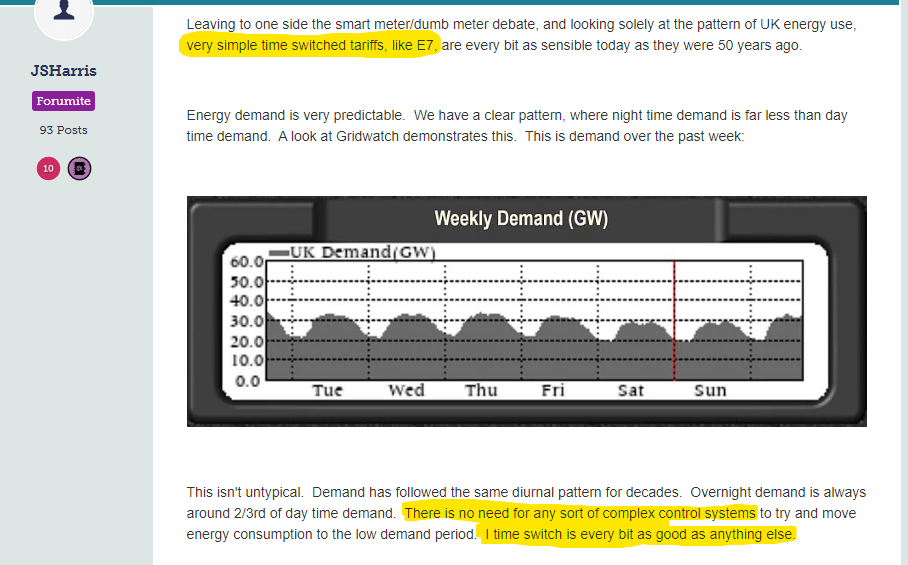
Your own post.
Just in case you have trouble reading the screenshot, it says:
"very simple time switched tariffs like E7" - so you define E7 and simple time switch as equivalent.
"There is no need for any sort of complex control systems" - self explanatory, yet you have claimed twice that you didn't say it.
"I [sic] [A? 1?] time switch is as good as anything else" - E7 is as good as anything else, according to your equivalence earlier.
These are your own words, saying that E7 is as good as anything else and there is no need for anything complex.
Stop accusing me of making up false statements. They are your words, you wrote them. If you don't agree with them, be more careful about what you write.
edit: Anyway, this has got way off the OP's topic.0 -
That has to be the most twisted justification for defending a falsehood I've seen in a long time.Taking comments out of context to support your false opinion of my own views regarding smart meters doesn't cut it. For the record (and you can check anything I've posted to prove this) I've not once said anything against the introduction of smart meter tariffs. I've even related here my own experience in having a smart meter for a few months (which couldn't be made to work despite the best endeavours of the supplier). If I was in anyway opposed to smart meters I'd never have requested one a few years ago, would I?My sole point all along has been that suppliers (and perhaps the regulator) need to safeguard tariffs for those who are unable to have a smart meter. Your view seems to be that penalising those that are unable to take advantage of smart meter tariffs is OK. My view is that it isn't.0
-
(edit: removed initial paragraphs - ad-hom comments help nobody)
I'll address your "sole point".
Your view was (directly stated earlier) that people who are unable to have a smart meter should still have access to smart meter tariffs. My view is that they should not.
Not allowing people to have a contract that they don't have the equipment to fulfil is not penalising them. Equally, I don't think that people without EVs should be on EV-only tariffs, people without heat pumps should be on heat-pump-only tariffs, or people with single rate meters should be on E7.
If there were to be social tariffs, other off-peak tariffs, the maintenance of the price cap, differential rates for prepayment (which I think legitimately could be cheaper than non-prepayment), or any other method to address the present gap in technology and costs, that's fine (and fair).0






Confirm your email address to Create Threads and Reply

Categories
- All Categories
- 354.1K Banking & Borrowing
- 254.3K Reduce Debt & Boost Income
- 455.3K Spending & Discounts
- 247.1K Work, Benefits & Business
- 603.8K Mortgages, Homes & Bills
- 178.4K Life & Family
- 261.3K Travel & Transport
- 1.5M Hobbies & Leisure
- 16.1K Discuss & Feedback
- 37.7K Read-Only Boards